eBook - ePub
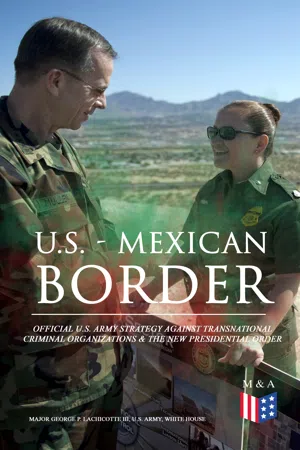
U.S. - Mexican Border: Official U.S. Army Strategy Against Transnational Criminal Organizations & The New Presidential Order
Strategies for Border Stability
- 112 pages
- English
- ePUB (mobile friendly)
- Available on iOS & Android
eBook - ePub
U.S. - Mexican Border: Official U.S. Army Strategy Against Transnational Criminal Organizations & The New Presidential Order
Strategies for Border Stability
About this book
This edition provides a starting point in understanding U.S. – Mexico relations and the border issues. The book addresses the importance of strategic guidance and the dangers of certain hasty actions, as it relates to operational planning for synchronized tactical actions and border politics. Analyzing Mexico's drug-war offers a crucial case study to help understand the current situation surrounding non-traditional forms of war, such as a drug related war, and how Mexico's internal conflict impacts their regional neighbors as well as the international community.
Content:
Understanding the Current Situation
Rise of Drug Trafficking Organizations in Mexico
Causes and Costs of Instability in Mexico
Developing an Understanding of the Strategic Approach
United States' Strategic Vision to Achieve Security and Stability in Mexico
Mexico's Strategic Vision for Security and Stability within their Borders
The International Community's Strategy for Security and Stability in the Western Hemisphere
Linking Strategies to Tactics: The Current Operational Approach
Presidential Executive Order 13535: Enforcing Federal Law with Respect to Transnational Criminal Organizations and Preventing International Trafficking
Presidential Executive Order 13768: Enhancing Public Safety in the Interior of the United States
Trusted by 375,005 students
Access to over 1.5 million titles for a fair monthly price.
Study more efficiently using our study tools.
Information
Subtopic
Immigration LawU.S. - Mexican Border: Official U.S. Army Strategy Against Transnational Criminal Organizations & The New Presidential Order
Preventing Criminal Organizations, International Trafficking & Enhancing Public Safety in the Interior of the United States
Madison & Adams Press, 2017. No claim to original U.S. Government Works
Contact [email protected]
Contact [email protected]
ISBN 978-80-268-7611-3
This is a publication of Madison & Adams Press. Our production consists of thoroughly prepared educational & informative editions: Advice & How-To Books, Encyclopedias, Law Anthologies, Declassified Documents, Legal & Criminal Files, Historical Books, Scientific & Medical Publications, Technical Handbooks and Manuals. All our publications are meticulously edited and formatted to the highest digital standard. The main goal of Madison & Adams Press is to make all informative books and records accessible to everyone in a high quality digital and print form.
Table of Contents
Introduction
Understanding the Current Situation:
Rise of Drug Trafficking Organizations in Mexico
Causes and Costs of Instability in Mexico
Developing an Understanding of the Strategic Approach:
United States’ Strategic Vision to Achieve Security and Stability in Mexico
Mexico’s Strategic Vision for Security and Stability within their Borders
The International Community’s Strategy for Security and Stability in the Western Hemisphere
Linking Strategies to Tactics: The Current Operational Approach
Conclusion
APPENDIX 1
Presidential Executive Order 13535: Enforcing Federal Law with Respect to Transnational Criminal Organizations and Preventing International Trafficking
APPENDIX 2
Presidential Executive Order 13768: Enhancing Public Safety in the Interior of the United States
Acronyms
Bibliography
Acknowledgments
Introduction
Table of Contents
This monograph provides a starting point to address the importance of strategic guidance as it relates to operational planning for synchronized tactical actions. Analyzing Mexico’s drug-war offers an interesting case study to help understand the current situation surrounding non-traditional forms of war, such as a drug related war, and how Mexico’s internal conflict impacts their regional neighbors as well as the international community. The ultimate aim is to achieve a competent level of understanding in order to establish a unified regional approach that will disrupt the Mexican drug trafficking organizations and reduce violence to an acceptable and controllable level. Accomplishing this requires the unified efforts of all elements of national power from the U.S., Mexican, and regional governments by designing an operational approach that focuses efforts and unifies goals. The current U.S. and Mexican strategies work to contain drug trafficking organizations on a limited basis, but fail to fix the problem for the long-term because of their limited approach. At the conclusion, this study reveals how the employment of unified governmental approach can enhance the United States and Mexico’s current security strategy by disrupting the actions of the Mexican drug trafficking organizations.
Social scientists and political scholars often see the U.S.-Mexican border as a critical vulnerability for the United States because it provides a point of entry opportunity into the country for virtually anyone.1 As the flow of illegal immigration continues into the U.S., a more fundamental question exists as to what motivates Mexicans to come to the United States. Opportunity and hope are among the reasons for illegally crossing the Mexican-U.S. border; however, one of the major contributing a factor is survival. More than 47,000 Mexican citizens lost their lives due to warring drug trafficking organizations (DTOs) from 2006-11 throughout Mexico.2 Furthermore, between 2006 and 2011, DTOs assassinated twenty-seven mayors, thirteen state gubernatorial candidates (in 2010 alone), and more than five hundred Mexican government officials.3 This escalation in violence has created an unstable environment. Indeed, the lack of confidence in the Mexican government’s security capability contributes greatly to the flight by the local population north to the U.S. or south to Central America in order to escape the life threatening danger. While it is easy to focus blame on the United States’ lack of involvement and the combined efforts of both the U.S. and Mexico governments’ inability to employ resources appropriately, the real problem stems from misunderstanding the current situation along the border. The events in Mexico “have raised concerns about the stability of a strategic partner and neighbor” among individual members of the 112th Congress.4 They have conducted several hearings to discuss the DTO violence and its subsequent spillover onto U.S. soil, as well as “the efforts by the government of President Felipe Calderón to address the situation, and implications of the violence for the United States,” in order to achieve a better understanding of the current situation.5 Despite these efforts, the priorities for protection of the American people, the nation, and its vital interests still reside in the Pacific as well as the Middle East. For example, prior to the terrorist events of 9/11, the tensions in the Middle East and with Islamic fundamentalist organizations were under watchful eye, but little was done to because Middle Eastern based terrorist organizations perceived as having a low threat against U.S. national interests in that region.6 Hence, the United States’ historical behavior was historically reactionary rather than prioritizing preventive action higher in order to pre-emptively countering potential violent situation before the spillover to the U.S. Once perceived as a real threat, the responsibility for clearly defining a solution or providing goals falls onto the strategic leaders of nations involved, which includes the U.S., Mexico, as well as the international community. The next step, which is one that leaders often struggle the most with, centers on how to visualize and describe what the environment should look like in five, ten, or twenty years into the future. However, challenge emerges when trying to design and implement a plan that bridges the gap between the current situation and the desired goal or aim. The United States Army’s doctrine defines this process as the operational approach, which assists commanders and their staffs with their planning process in order to successfully inform ground-level actions or tactics with the strategic aims.7 As the world remains focused on the Middle East and the Asian Pacific regions, it behooves policy makers, intergovernmental organizations, and the citizenry, at large, to re-evaluate their approach and ask themselves if the international community (IC) and, more specifically, the U.S. is correctly addressing the Mexican drug war issue and the subsequent spillover effects. Army doctrine outlines an evaluation process that can be applied at the strategic level in order to synchronize efforts that maximize limited resources against a growing threat within Mexico. This suggests that strategic leaders reevaluate current policy and consider altering tactics to facilitate efforts aimed at accomplishing the U.S. strategic goals of “stability and security in Mexico.”8
The security of the U.S.-Mexican border is a growing concern for both countries, especially since their economic relationship has grown more interdependent over recent years. The North American Free Trade Agreement (NAFTA), manufacturing plants, and labor ties between the U.S. and Mexico have strengthened their economic interdependency over the last several decades. Mexican DTOs have taken advantage of established U.S.-Mexican policy protected trade routes created by those same economic opportunities, allowing them to feed off of American illegal drug users. Competition over the illegal narcotics market has resulted in increased violence in society, intimidation of the citizenry, and extensive coercion throughout the Mexican governance and law enforcement agencies. The Mexican government’s inability to subdue drug trafficking cartels has destabilized Mexico, thus creating spillover effects into the U.S.
Mexico’s DTO issues also have international ripple effects, such as allowing terrorists organizations to piggy back off of money laundering channels and infiltration routes into the U.S. established through the same drug trafficking arteries.9 The U.S. and Mexican governments’ cooperation on this issue has been tentative at best due to political sensitivity surrounding the current U.S. immigration policy and Mexico’s apprehension toward potential U.S. intervention. Thus, while Mexico’s internal conflict increases at exponential rates it continues to pose more of a threat to the United States’ national security. As this threat expands, the risk of degrading fragile international relations between regional neighbors becomes more prevalent because Mexico’s violent situation will be the source of blame if things continue to spillover unto U.S. soil.10
When examining the United States’ approach to the DTO issue, some scholars, like Ted Galen Carpenter of the Cato Institute, and national leaders, like former Mexican President Vicente Fox Quesada, claim that the focus of both countries needs to be the reexamination of their current strategic approach.11 The United States’ focus has drifted away from the border in recent years due to the activity in the Middle East and in Sub-Saharan Africa. Even though the majority of Americans do not directly feel impact of the violence south of its border, the costs in U.S. border cities must be considered. Mexican violence may not make its way to northern Minnesota, but it has a direct and immediate spillover on U.S. soil and to the U.S. citizens in Arizona, California, New Mexico, and Texas. The expanding conflic...
Table of contents
- U.S. - Mexican Border: Official U.S. Army Strategy Against Transnational Criminal Organizations & The New Presidential Order
Frequently asked questions
Yes, you can cancel anytime from the Subscription tab in your account settings on the Perlego website. Your subscription will stay active until the end of your current billing period. Learn how to cancel your subscription
No, books cannot be downloaded as external files, such as PDFs, for use outside of Perlego. However, you can download books within the Perlego app for offline reading on mobile or tablet. Learn how to download books offline
Perlego offers two plans: Essential and Complete
- Essential is ideal for learners and professionals who enjoy exploring a wide range of subjects. Access the Essential Library with 800,000+ trusted titles and best-sellers across business, personal growth, and the humanities. Includes unlimited reading time and Standard Read Aloud voice.
- Complete: Perfect for advanced learners and researchers needing full, unrestricted access. Unlock 1.5M+ books across hundreds of subjects, including academic and specialized titles. The Complete Plan also includes advanced features like Premium Read Aloud and Research Assistant.
We are an online textbook subscription service, where you can get access to an entire online library for less than the price of a single book per month. With over 1.5 million books across 990+ topics, we’ve got you covered! Learn about our mission
Look out for the read-aloud symbol on your next book to see if you can listen to it. The read-aloud tool reads text aloud for you, highlighting the text as it is being read. You can pause it, speed it up and slow it down. Learn more about Read Aloud
Yes! You can use the Perlego app on both iOS and Android devices to read anytime, anywhere — even offline. Perfect for commutes or when you’re on the go.
Please note we cannot support devices running on iOS 13 and Android 7 or earlier. Learn more about using the app
Please note we cannot support devices running on iOS 13 and Android 7 or earlier. Learn more about using the app
Yes, you can access U.S. - Mexican Border: Official U.S. Army Strategy Against Transnational Criminal Organizations & The New Presidential Order by George P. Major Lachicotte III,U.S. Army,Major George P. Lachicotte III in PDF and/or ePUB format, as well as other popular books in Politics & International Relations & Immigration Law. We have over 1.5 million books available in our catalogue for you to explore.