What are the differences between leadership and management? How are they connected? What is the common goal? What methods do leaders and managers use? The essence of leadership is to create meaning and to formulate the appropriate goal while giving explanations for actions. The essence of management is to pave the way and to ensure the implementation of necessary steps to achieve the goal. It is possible to distinguish between the choices of having to or wishing to do something. If the chief punishes hunters who refuse to join in, the hunter runs towards the stag because he wants to run away from punishment. In fact, he is running away from, rather than towards, something. This is what we call a negative vector of motivation. Avoiding hunger is also a negative vector of motivation. In the temporal dimension, both incentives tend to be short-lived. If, on the contrary, the hunter bursts into a run because he wants to unite with the animal's soul, he is following a positive vector of motivation towards union. In all primeval societies, the shaman, not the chief, instilled this way of thinking in the hunter. The motivation of uniting spiritually in death with the totem is imbued with the idea of divine eternity and happiness. It transcends existence and imparts a higher purpose or meaning to life than pure self-preservation.
eBook - ePub
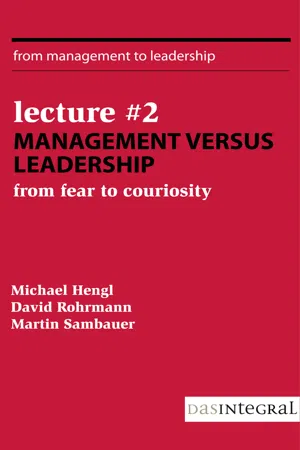
Lecture #2 - Management versus Leadership
From Fear to Curiosity
- 18 pages
- English
- ePUB (mobile friendly)
- Available on iOS & Android
eBook - ePub
Lecture #2 - Management versus Leadership
From Fear to Curiosity
About this book
Trusted by 375,005 students
Access to over 1.5 million titles for a fair monthly price.
Study more efficiently using our study tools.
Information
Subtopic
ManagementIndex
BusinessLecture #2
Management vs. Leadership
-
From fear to curiosity
Copyright 2014: Michael Hengl, David Rohrmann, Martin Sambauer.
Autoren: Michael Hengl, David Rohrmann, Martin Sambauer.
ALL RIGHTS RESERVED. This book contains material protected under International and Federal Copyright Laws and Treaties. Any unauthorized reprint or use of this material is prohibited. No part of this book may be reproduced or transmitted in any form or by any means, electronic or mechanical, including photocopying, recording, or by any information storage and retrieval system without express written permission from the author / publisher.
If you would like to use parts of or the complete lecture in an educational context, please contact the publisher.
Publisher:
1492.// School of Business
Oberlupitsch 123
8992 Altaussee
Austria
Introduction
Vectors of motivation
The archetypal principles of management and leadership
Opposing forces
Complementary forces
The chief = M
The chief‘s fundamental duty: coordination through communication
A) Define aims
B) Secure participation
C) Guarantee reward: justice
The chief‘s strengths
Representation: eagle‘s feathers and chronographs
The chief‘s weak points
Summary of management qualities
The shaman = L
The shaman‘s fundamental duty: lofty aims and endowment with meaning
The shaman‘s strengths
Representation: rituals
The shaman’s weak points
Summary of leadership qualities
The „integral leader” = ML
The integral leader‘s fundamental duty: balance and consciousness
The integral leader‘s strengths
Joke
The integral leader’s weak points
Balance and prosperity
Interorganisational balance of roles
Martin Luther King and John F. Kennedy
Intrapersonal balance
Talents
Conditioning
Followers’ preferences
Roles that depend on context
Spontaneous reactions
Rigid roles
Prosperity
Uncertainty Grid
Initial situation
Axis
X axis
Y axis
M challenges: left hand triangle
Example 1: the green room
Example 2: Netscape Mozilla
Cases where pure management fails
L challenges: right hand triangle
Example: humanitarian relief organizations operating in disaster areas
Where pure leadership fails
The integral ML square
Introduction
What are the differences between leadership and management? How are they connected? What is the common goal? What methods do leaders and managers use?
The essence of leadership is to create meaning and to formulate the appropriate goal while giving explanations for actions. The essence of management is to pave the way and to ensure the implementation of necessary steps to achieve the goal.
Vectors of motivation
There are different reasons why people do things, how long they engage and how intense that interaction is. And why do people participate at all?
It is possible to distinguish between the choices of having to or wishing to do something. If the chief punishes hunters who refuse to join in, the hunter runs towards the stag because he wants to run away from punishment. In fact, he is running away from, rather than towards, something. This is what we call a negative vector of motivation. Avoiding hunger is also a negative vector of motivation. In the temporal dimension, both incentives tend to be short-lived.
If, on the contrary, the hunter bursts into a run because he wants to unite with the animal‘s soul, he is following a positive vector of motivation towards union. In all primeval societies, the shaman, not the chief, instilled this way of thinking in the hunter. The motivation of uniting spiritually in death with the totem is imbued with the idea of divine eternity and happiness. It transcends existence and imparts a higher purpose or meaning to life than pure self-preservation.
The shaman succeeds in awakening a desire for something different, the unknown that cannot be named, whereas the chief does his utmost to preserve that which already exists. The chief guarantees safety in a physical world full of dangers when his followers subject themselves to his regime. In contrast, the shaman is capable of arousing curiosity about something different when his followers become reconciled with their own strength and fate and can thus make the transition from fear to curiosity.
The archetypal principles of management and leadership
Opposing forces
The motivation generated by the chief and the shaman therefore serves opposite ends. While one avoids danger in order to ensure the safety of his followers, the shaman conjures up danger by awakening a desire for something new and different and thus spurs the transformation of the individual and of the whole system.
But it is not sufficient to apply chieftain methods to avoid dangers for the system. The context of systems is constantly changing. New things come by themselves. Those who are reluctant to accept that, trying to just defend the existing will sooner than later not be able to bring about the necessary transformations. This is why the role of the shaman is extremely important, stimulating the curiosity for something new.
Complementary forces
All social systems, including tribal communities, operate in a changing environment. Transformation is an external constraint impinging on all social systems‘ cultural heritage with increasing speed over the course of time. All human organizations must therefore cultivate growing adaptability if they are to remain in existence. They must face up to the transformation and adjust to it if they are to survive.
It was not by chance that both roles always coexisted in primeval societies...
Table of contents
- Introduction
- The archetypal principles of management and leadership
- Balance and prosperity
- Uncertainty Grid
Frequently asked questions
Yes, you can cancel anytime from the Subscription tab in your account settings on the Perlego website. Your subscription will stay active until the end of your current billing period. Learn how to cancel your subscription
No, books cannot be downloaded as external files, such as PDFs, for use outside of Perlego. However, you can download books within the Perlego app for offline reading on mobile or tablet. Learn how to download books offline
Perlego offers two plans: Essential and Complete
- Essential is ideal for learners and professionals who enjoy exploring a wide range of subjects. Access the Essential Library with 800,000+ trusted titles and best-sellers across business, personal growth, and the humanities. Includes unlimited reading time and Standard Read Aloud voice.
- Complete: Perfect for advanced learners and researchers needing full, unrestricted access. Unlock 1.5M+ books across hundreds of subjects, including academic and specialized titles. The Complete Plan also includes advanced features like Premium Read Aloud and Research Assistant.
We are an online textbook subscription service, where you can get access to an entire online library for less than the price of a single book per month. With over 1.5 million books across 990+ topics, we’ve got you covered! Learn about our mission
Look out for the read-aloud symbol on your next book to see if you can listen to it. The read-aloud tool reads text aloud for you, highlighting the text as it is being read. You can pause it, speed it up and slow it down. Learn more about Read Aloud
Yes! You can use the Perlego app on both iOS and Android devices to read anytime, anywhere — even offline. Perfect for commutes or when you’re on the go.
Please note we cannot support devices running on iOS 13 and Android 7 or earlier. Learn more about using the app
Please note we cannot support devices running on iOS 13 and Android 7 or earlier. Learn more about using the app
Yes, you can access Lecture #2 - Management versus Leadership by David Rohrmann,Michael Hengl,Martin Sambauer in PDF and/or ePUB format, as well as other popular books in Business & Management. We have over 1.5 million books available in our catalogue for you to explore.