eBook - ePub
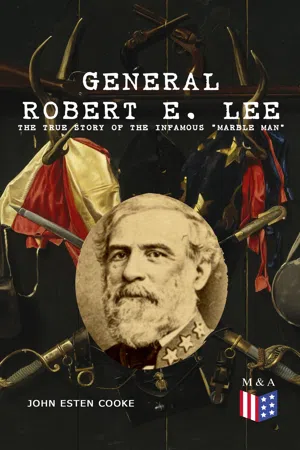
General Robert E. Lee: The True Story of the Infamous "Marble Man"
The Life & Legacy of Robert E. Lee, Including Personal Writings, Speeches and Orders
- 541 pages
- English
- ePUB (mobile friendly)
- Available on iOS & Android
eBook - ePub
General Robert E. Lee: The True Story of the Infamous "Marble Man"
The Life & Legacy of Robert E. Lee, Including Personal Writings, Speeches and Orders
About this book
This book reveals the incredible life of the legendary General, one of the most prominent figures of the Confederate Army in the American Civil War. It also contains his personal writings which paint a full picture of Lee's life. Robert Edward Lee was an American general known for commanding the Confederate Army of Northern Virginia in the American Civil War from 1862 until his surrender in 1865.
Content:
Robert E. Lee by John Esten Cooke
Lee's Early Life
The Lees of Virginia
General "Light-horse Harry" Lee
Stratford
Lee's Early Manhood and Career in the United States Army
His Reception at Richmond
Lee in 1861
The War Begins
Lee's Advance Into Western Virginia
Lee's Last Interview With Bishop Meade
In Front of Richmond.
Plan of the Federal Campaign
Johnston Is Wounded
Lee Assigned to the Command
On the Chickahominy
Lee's Plan of Assault
The Retreat
Richmond in Danger
The War Advances Northward
Lee's Manoeuvres
Lee Advances From the Rapidan
Jackson Flanks General Pope
Lee Invades Maryland.
Lee Concentrates at Fredericksburg
The Battle of Fredericksburg
Chancellorsville and Gettysburg
Advance of General Hooker
Jackson's Attack and Fall
The Battle of Chancellorsville
Lee's Plans and Objects
The Cavalry-fight at Fleetwood
Lee in Pennsylvania
The Last Charge at Gettysburg
Lee's Retreat Across the Potomac
The Cavalry of Lee's Army
Lee Flanks General Meade
Lee in the Autumn and Winter of 1863
Lee's Last Campaigns and Last Days
First Battles at Petersburg
The Siege of Richmond Begun
The Mine Explosion
The Southern Lines Broken
Lee Evacuates Petersburg
Writings of Robert E. Lee:
Robert E. Lee's Letter Announcing Surrender
Robert E. Lee's Farewell Address to the Army of Northern Virginia
Testimony of General R. E. Lee
General Lee's Final Report of the Pennsylvania Campaign and Battle of Gettysburg
Patriotic Letters of Confederate Leaders
Trusted by 375,005 students
Access to over 1.5 million titles for a fair monthly price.
Study more efficiently using our study tools.
Information
Subtopic
American Civil War HistoryIndex
HistoryGeneral Robert E. Lee: The True Story of the Infamous “Marble Man”
The Life & Legacy of Robert E. Lee, Including & Personal Writings, Speeches and Orders
Madison & Adams Press, 2017.
Contact [email protected]
Contact [email protected]
ISBN 978-80-268-7969-5
This is a publication of Madison & Adams Press. Our production consists of thoroughly prepared educational & informative editions: Advice & How-To Books, Encyclopedias, Law Anthologies, Declassified Documents, Legal & Criminal Files, Historical Books, Scientific & Medical Publications, Technical Handbooks and Manuals. All our publications are meticulously edited and formatted to the highest digital standard. The main goal of Madison & Adams Press is to make all informative books and records accessible to everyone in a high quality digital and print form.
Table of Contents
The Life & Legacy of Robert E. Lee by John Esten Cooke
Letters, Orders & Speeches of General Robert E. Lee
Robert E. Lee's Letter Announcing Surrender
Robert E. Lee's Farewell Address to the Army of Northern Virginia
Testimony of General R. E. Lee
General Lee's Final Report of the Pennsylvania Campaign and Battle of Gettysburg
Patriotic Letters of Confederate Leaders
The Life & Legacy of Robert E. Lee by John Esten Cooke
Table of Contents
PART I LEE'S EARLY LIFE
I INTRODUCTION
II THE LEES OF VIRGINIA
III GENERAL "LIGHT-HORSE HARRY" LEE
IV STRATFORD
V LEE'S EARLY MANHOOD AND CAREER IN THE UNITED STATES ARMY
VI LEE AND SCOTT
VII LEE RESIGNS
VIII HIS RECEPTION AT RICHMOND
IX LEE IN 1861
X THE WAR BEGINS
XI LEE'S ADVANCE INTO WESTERN VIRGINIA
XII LEE'S LAST INTERVIEW WITH BISHOP MEADE
PART II IN FRONT OF RICHMOND
I PLAN OF THE FEDERAL CAMPAIGN
II JOHNSTON IS WOUNDED
III LEE ASSIGNED TO THE COMMAND — HIS FAMILY AT THE WHITE HOUSE
IV LEE RESOLVES TO ATTACK
V STUART'S "RIDE AROUND McCLELLAN"
PART III ON THE CHICKAHOMINY
I THE TWO ARMIES
II LEE'S PLAN OF ASSAULT
III THE BATTLE OF THE CHICKAHOMINY
IV THE RETREAT
V RICHMOND IN DANGER — LEE'S VIEWS
VI LEE AND McCLELLAN — THEIR IDENTITY OF OPINION
PART IV THE WAR ADVANCES NORTHWARD
I LEE'S PROTEST
II LEE'S MANOEUVRES
III LEE ADVANCES FROM THE RAPIDAN
IV JACKSON FLANKS GENERAL POPE
V LEE FOLLOWS
VI THE SECOND BATTLE OF MANASSAS
PART V LEE INVADES MARYLAND
I HIS DESIGNS
II LEE IN MARYLAND
III MOVEMENTS OF THE TWO ARMIES
IV THE PRELUDE TO SHARPSBURG
V THE BATTLE OF SHARPSBURG
VI LEE AND McCLELLAN — THEIR MERITS IN THE MARYLAND CAMPAIGN
VII LEE AND HIS MEN
VIII LEE PASSES THE BLUE RIDGE
IX LEE CONCENTRATES AT FREDERICKSBURG
X THE BATTLE OF FREDERICKSBURG
XI FINAL MOVEMENTS OF 1862
XII THE YEAR OF BATTLES
XIII LEE IN DECEMBER, 1862
PART VI CHANCELLORSVILLE AND GETTYSBURG
I ADVANCE OF GENERAL HOOKER
II THE WILDERNESS
III LEE'S DETERMINATION
IV JACKSON'S ATTACK AND FALL
V THE BATTLE OF CHANCELLORSVILLE
VI FLANK MOVEMENT OF GENERAL SEDGWICK
VII LEE'S GENERALSHIP AND PERSONAL DEMEANOR DURING THE CAMPAIGN
VIII PERSONAL RELATIONS OF LEE AND JACKSON
IX CIRCUMSTANCES LEADING TO THE INVASION OF PENNSYLVANIA
X LEE'S PLANS AND OBJECTS
XI THE CAVALRY-FIGHT AT FLEETWOOD
XII THE MARCH TO GETTYSBURG
XIII LEE IN PENNSYLVANIA
XIV CONCENTRATION AT GETTYSBURG
XV THE FIRST DAY'S FIGHT AT GETTYSBURG
XVI THE TWO ARMIES IN POSITION
XVII THE SECOND DAY
XVIII THE LAST CHARGE AT GETTYSBURG
XIX LEE AFTER THE CHARGE
XX LEE'S RETREAT ACROSS THE POTOMAC
XXI ACROSS THE BLUE RIDGE AGAIN
PART VII LAST CAMPAIGNS OF THE YEAR 1863
I THE CAVALRY OF LEE'S ARMY
II LEE FLANKS GENERAL MEADE
III A RACE BETWEEN TWO ARMIES
IV THE FIGHT AT BUCKLAND
V THE ADVANCE TO MINE RUN
VI LEE IN THE AUTUMN AND WINTER OF 1863
PART VIII LEE'S LAST CAMPAIGNS AND LAST DAYS
I GENERAL GRANT CROSSES THE RAPIDAN
II THE FIRST COLLISION IN THE WILDERNESS
III THE BATTLE OF THE 6TH OF MAY
IV THE 12TH OF MAY
V FROM SPOTTSYLVANIA TO THE CHICKAHOMINY
VI FIRST BATTLES AT PETERSBURG
VII THE SIEGE OF RICHMOND BEGUN
VIII LEE THREATENS WASHINGTON
IX THE MINE EXPLOSION
X END OF THE CAMPAIGN OF 1864
XI LEE IN THE WINTER OF 1864-'65
XII THE SITUATION AT THE BEGINNING OF 1865
XIII LEE ATTACKS THE FEDERAL CENTRE
XIV THE SOUTHERN LINES BROKEN
XV LEE EVACUATES PETERSBURG
XVI THE RETREAT AND SURRENDER
XVII LEE RETURNS TO RICHMOND
XVIII GENERAL LEE AFTER THE WAR
XIX GENERAL LEE'S LAST YEARS AND DEATH
APPENDIX
I THE FUNERAL OF GENERAL LEE
II TRIBUTES TO GENERAL LEE
PART I
LEE'S EARLY LIFE
Table of Contents
I
INTRODUCTION
Table of Contents
The name of Lee is beloved and respected throughout the world. Men of all parties and opinions unite in this sentiment, not only those who thought and fought with him, but those most violently opposed to his political views and career. It is natural that his own people should love and honor him as their great leader and defender in a struggle of intense bitterness — that his old enemies should share this profound regard and admiration is due solely to the character of the individual. His military genius will always be conceded, and his figure remain a conspicuous landmark in history; but this does not account for the fact that his very enemies love the man. His private character is the origin of this sentiment. The people of the North, no less than the people of the South, feel that Lee was truly great; and the harshest critic has been able to find nothing to detract from this view of him. The soldier was great, but the man himself was greater. No one was ever simpler, truer, or more honest. Those who knew him best loved him the most. Reserved and silent, with a bearing of almost austere dignity, he impressed many persons as cold and unsympathetic, and his true character was long in revealing itself to the world. To-day all men know what his friends knew during his life — that under the grave exterior of the soldier, oppressed with care and anxiety, beat a warm and kindly heart, full of an even extraordinary gentleness and sweetness; that the man himself was not cold, or stiff, or harsh, but patient, forbearing, charitable under many trials of his equanimity, and magnanimous without effort, from the native impulse of his heart. Friend and foe thus to-day regard him with much the same sentiment, as a genuinely honest man, incapable of duplicity in thought or deed, wholly good and sincere, inspired always under all temptations by that prisca fides which purifies and ennobles, and resolutely bent, in the dark hour, as in the bright, on the full performance of his duty. "Duty is the sublimest word in our language," he wrote to his son; and, if we add that other august maxim, "Human virtue should be equal to human calamity," we shall have in a few words a summary of the principles which inspired Lee.
The crowning grace of this man, who was thus not only great but good, was the humility and trust in God, which lay at the foundation of his character. Upon this point we shall quote the words of a gentleman of commanding intellect, a bitter opponent of the South in the war:
"Lee is worthy of all praise. As a man, he was fearless among men. As a soldier, he had no superior and no equal. In the course of Nature my career on earth may soon terminate. God grant that, When the day of my death shall come, I may look up to Heaven with that confidence and faith which the life and character of Robert E. Lee gave him. He died trusting in God as a good man, with a good life, and a pure conscience."
He had lived, as he died, with this supreme trust in an overruling and merciful Providence; and this sentiment, pervading his whole being, was the origin of that august calmness with which he greeted the most crushing disasters of his military career. His faith and humble trust sustained him after the war, when the woes of the South wellnigh broke his great spirit; and he calmly expired, as a weary child falls asleep, knowing that its father is near.
Of this eminent soldier and man whose character offers so great an example, a memoir is attempted in this volume. The work will necessarily be "popular" rather than full and elaborate, as the public and private correspondence of Lee are not at this time accessible. These will throw a fuller light on the subject; but sufficient material is at the disposal of the writer to enable him to present an accurate likeness of Lee, and to narrate clearly the incidents of his career. In doing so, the aim of the author is to measure out full justice to all — not to arouse old enmities, which should be allowed to slumber, but to treat his subject with the judicial moderation of the student of history.
A few words will terminate this preface. The volume before the reader was begun in 1866. The writer first, however, informed General Lee of his design, and had the honor to receive from him in reply the assurance that the work "would not interfere with any he might have in contemplation; he had not written a line of any work as yet, and might never do so; but, should he write a history of the campaigns of the Army of Northern Virginia, the proposed work would be rather an assistance than a hinderance."
As the writer had offered promptly to discontinue the work if it were not agreeable to General Lee, this reply was regarded in the light of an assurance that he did not disapprove of it. The composition was, however, interrupted, and the work laid aside. It is now resumed and completed at a time when the death of the illustrious soldier adds a new and absorbing interest to whatever is connected with his character or career.
II
THE LEES OF VIRGINIA
Table of Contents
The Lees of Virginia spring from an ancient and respectable family of Essex, in England.
Of some members of the family, both in the Old World and the New, a brief account will be given. The origin of an individual explains much that is striking and peculiar in his own character; and it will be found that General Lee inherited many of the traits of his ancestors, especially of some eminent personages of his name in Virginia.
The family pedigree is traced back by Lee, in the life of his father, to Launcelot Lee, of London, in France, who accompanied William the Conqueror to England. After the battle of Hastings, which subjected England to the sway of the Normans, Launcelot Lee, like others, was rewarded by lands wrested from the subdued Saxons. His estate lay in Essex, and this is all that is known concerning him. Lionel Lee is the next member of the family of whom mention is made. He lived during the reign of Richard Coeur de Lion, and, when the king went on his third crusade, in the year 1192, Lionel Lee raised a company of gentlemen, and marched with him to the Holy Land. His career there was distinguished; he displayed special gallantry at the siege of Acre, and for this he received a solid proof of King Richard's approbation. On his return he was made first Earl of Litchfield; the king presented him with the estate of "Ditchley," which became the name afterward of an estate of the Lees in Virginia; and, when he died, the armor which he had worn in the Holy Land was placed in the department of "Horse Armory" in the great Tower of London.
The name of Richard Lee is next mentioned as one of the followers of the Earl of Surrey in his expedition across the Scottish border in 1542. Two of the family about this period were "Knights Companions of the Garter," and their banners, with the Lee arms above, were suspended in St. George's Chapel in Windsor Castle. The coat-of-arms was a shield "band sinister battled and embattled," the crest a closed visor surmounted by a squirrel holding a nut. The motto, which may be thought characteristic of one of General Lee's traits as a soldier, was, "Non incautus futuri"
Such are the brief notices given of the family in England. They seem to have been persons of high character, and often of distinction. When Richard Lee came to Virginia, and founded the family anew there, as Launcelot, the first Lee, had founded it in England, he brought over in his veins some of the best and most valiant blood of the great Norman race.
This Richard Lee, the princeps of the family in Virginia, was, it seems, like the rest of his kindred, strongly Cavalier in his sentiments; indeed, the Lees seem always to have been Cavalier. The reader will recall the stately old representative of the family in Scott's "Woodstock" — Sir Henry Lee of Ditchley — who is seen stalking proudly through the great apartments of the palace, in his laced doublet, slashed boots, and velvet cloak, scowling darkly at the Puritan intruders. Sir Henry was not a fanciful person, but a real individual; and the political views attributed to him were those of the Lee family, who remained faithful to the royal cause in all its hours of adversity.
It will be seen that Richard Lee, the first of the Virginia Lees, was an ardent monarchist. He came over during the reign of Charles I., but returned to England, bequeathing all his lands to his servants; he subsequently came back to Virginia, however, and lived and died there. In his will he styles himself "Richard Lee, of Strafford Langton, in the County of Essex, Esquire." It is not certainly known whether he sought refuge in Virginia after the failure of the king's cause, or was tempted to emigrate with a view to better his fortunes in the New World. Either may have been the impelling motive. Great numbers of Cavaliers "came over" after the overthrow of Charles at Naseby; but a large emigration had already taken place, and took place afterward, induced by the salubrity of the country, the ease of living, and the cheapness and fertility of the lands on the great rivers, where families impoverished or of failing fortunes in England might "make new settlements" and build on a new foundation. This would amply account for the removal of Richard Lee to Virginia, and for the ambition he seems to have been inspired with, to build and improve, without attributing to him any apprehension of probable punishment for his political course. Very many families had the first-named motives, and commenced to build great manor-houses, which were never finished, or were too costly for any one of their descendants to possess. The abolition of primogeniture, despite the opposition of Pendleton and others, overthrew all this; and the Lees, like other families, now possess few of the broad acres which their ancestors acquired.
To return, however, to Richard Lee. He had already visited Virginia in some official capacity under the royal governor, Sir William Berkeley, and had been so much pleased with the soil and climate of the country, that he, as we have said, emigrated finally, and cast his lot in the new land. He brought a number of followers and servants, and, coming over to Westmoreland County, in the Northern Neck of Virginia, "took up" extensive tracts of land there, and set about building manor-houses upon them.
Among these, it is stated, was the original "Stratford" House, afterward destroyed by fire. It was rebuilt, however, and became the birthplace of Richard Henry Lee, and afterward of General Robert E. Lee. We shall speak of it more in detail after finishing, in a few words, our notice of Richard Lee, its founder, and the founder of the Lee family in Virginia. He is described as a person of great force of character and many virtues — as "a man of good stature, comely visage, enterprising genius, sound head, vigorous spirit, and generous nature." This may be suspected to partake of the nature of epitaph; but, of his courage and energy, the proof remains in the action taken by him in connection with Charles II. Inheriting, it would seem, in full measure, the royalist and Cavalier sentiments of his family, he united with Sir William Berkeley, the royal governor, in the irregular proclamation of Charles II. in Virginia, a year or two before his reinstallment on the English throne. He had already, it is reported on the authority of well-supported tradition, made a voyage across the Atlantic to Breda, where Charles II. was then in exile, and offered to erect his standard in Virginia, and proclaim him king there. This proposition the young monarch declined, shrinking, with excellent good sense, from a renewal, under less favorable circumstances, of the struggle which terminated at Worcester. Lee was, therefore, compelled to return without having succeeded in his enterprise; but he had made, it seems, a very strong impression in favor of Virginia upon the somewhat frivolous young monarch. When he came to his throne again, Charles II. graciously wore a coronation-robe of Virginia silk, and Virginia, who had proved so faithful to him in the hour of his need, was authorized, by royal decree, to rank thenceforward, in the British empire, with England, Scotland, and Ireland, and bear upon her shield the motto, "En dat Virginia quartam."
Richard Lee returned, after his unsuccessful mission, to the Northern Neck, and addressed himself thenceforward to the management of his private fortunes and the affairs of the colony. He had now become possessed of very extensive estates between the Potomac and Rappahannock Rivers and elsewhere. Besides Stratford, he owned plantations called "Mocke Neck," "Mathotick," "Paper-Maker's Neck," "War Captain's Neck," "Bishop's Neck," and "Paradise," with four thousand acres besides, on the Potomac, ...
Table of contents
- General Robert E. Lee: The True Story of the Infamous “Marble Man”
Frequently asked questions
Yes, you can cancel anytime from the Subscription tab in your account settings on the Perlego website. Your subscription will stay active until the end of your current billing period. Learn how to cancel your subscription
No, books cannot be downloaded as external files, such as PDFs, for use outside of Perlego. However, you can download books within the Perlego app for offline reading on mobile or tablet. Learn how to download books offline
Perlego offers two plans: Essential and Complete
- Essential is ideal for learners and professionals who enjoy exploring a wide range of subjects. Access the Essential Library with 800,000+ trusted titles and best-sellers across business, personal growth, and the humanities. Includes unlimited reading time and Standard Read Aloud voice.
- Complete: Perfect for advanced learners and researchers needing full, unrestricted access. Unlock 1.5M+ books across hundreds of subjects, including academic and specialized titles. The Complete Plan also includes advanced features like Premium Read Aloud and Research Assistant.
We are an online textbook subscription service, where you can get access to an entire online library for less than the price of a single book per month. With over 1.5 million books across 990+ topics, we’ve got you covered! Learn about our mission
Look out for the read-aloud symbol on your next book to see if you can listen to it. The read-aloud tool reads text aloud for you, highlighting the text as it is being read. You can pause it, speed it up and slow it down. Learn more about Read Aloud
Yes! You can use the Perlego app on both iOS and Android devices to read anytime, anywhere — even offline. Perfect for commutes or when you’re on the go.
Please note we cannot support devices running on iOS 13 and Android 7 or earlier. Learn more about using the app
Please note we cannot support devices running on iOS 13 and Android 7 or earlier. Learn more about using the app
Yes, you can access General Robert E. Lee: The True Story of the Infamous "Marble Man" by John Esten Cooke,Robert E. Lee in PDF and/or ePUB format, as well as other popular books in History & American Civil War History. We have over 1.5 million books available in our catalogue for you to explore.