eBook - ePub
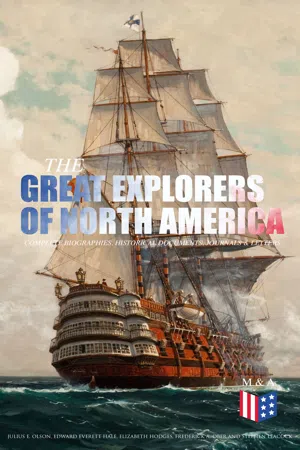
The Great Explorers of North America: Complete Biographies, Historical Documents, Journals & Letters
Adventurers Who Shaped the New World
- 741 pages
- English
- ePUB (mobile friendly)
- Available on iOS & Android
eBook - ePub
The Great Explorers of North America: Complete Biographies, Historical Documents, Journals & Letters
Adventurers Who Shaped the New World
About this book
European colonization of America occurred as a result of the bravery and discoveries of great navigators, visionaries and adventurers. This carefully edited collection presents the lives of the most influential explorers of North America: Eric the Red, Christopher Columbus, John Cabot, Amerigo Vespucci, Vasco Núñez de Balboa, Jacques Cartier, Henry Hudson and Samuel de Champlain. Sale with these remarkable seamen through the vivid biographies and writings of their contemporaries.
Table of Contents:
Eric the Red and the Northmen:
The Saga of Eric the Red
The Vinland History of the Flat Island Book
From Adam of Bremen's DescriptioInsularumAquilonis
From the Icelandic Annals
Papal Letters Concerning the Bishopric of Gardar in Greenland During the Fifteenth Century
Christopher Columbus
The life of John Cabot
Original Narratives of the Voyages of John Cabot
Letter of Lorenzo Pasqualigo to His Brothers Alvise and Francesco, Merchants in Venice
Despatch to Ferdinand and Isabella From Pedro De Ayala Junior Ambassador at the Court of England, July 25, 1498
Amerigo Vespucci
Vasco Núñez de Balboa
Jacques Cartier
Henry Hudson
Samuel de Champlain
Trusted by 375,005 students
Access to over 1.5 million titles for a fair monthly price.
Study more efficiently using our study tools.
Information
Subtopic
Historical BiographiesIndex
HistoryThe Great Explorers of North America: Complete Biographies, Historical Documents, Journals & Letters
Eric the Red, Christopher Columbus, John Cabot, Amerigo Vespucci, Vasco Núñez de Balboa, Jacques Cartier, Henry Hudson & Samuel de Champlain
Illustrator : Samuel Loxton
Madison & Adams Press, 2017.
Contact [email protected]
Contact [email protected]
ISBN 978-xx-xxx-xxxx-x
This is a publication of Madison & Adams Press. Our production consists of thoroughly prepared educational & informative editions: Advice & How-To Books, Encyclopedias, Law Anthologies, Declassified Documents, Legal & Criminal Files, Historical Books, Scientific & Medical Publications, Technical Handbooks and Manuals. All our publications are meticulously edited and formatted to the highest digital standard. The main goal of Madison & Adams Press is to make all informative books and records accessible to everyone in a high quality digital and print form.
Table of Contents
Eric the Red and the Northmen
Christopher Columbus
John Cabot
Amerigo Vespucci
Vasco Núñez de Balboa
Jacques Cartier
Henry Hudson
Samuel de Champlain
Eric the Red and the Northmen
Table of Contents
Introduction
The Saga of Eric the Red
The Vinland History of the Flat Island Book
From Adam of Bremen’s Descriptio Insularum Aquilonis
From the Icelandic Annals
Papal Letters Concerning the Bishopric of Gardar in Greenland During the Fifteenth Century
Introduction
Table of Contents
The important documents from Norse sources that may be classed as “Original Narratives of Early American History” are the Icelandic sagas (prose narratives) that tell of the voyages of Northmen to Vinland. There are two sagas that deal mainly with these voyages, while in other Icelandic sagas and annals there are a number of references to Vinland and adjacent regions. These two sagas are the “Saga of Eric the Red” and another, which, for the lack of a better name, we may call the “Vinland History of the Flat Island Book,” but which might well bear the same name as the other. This last history is composed of two disjointed accounts found in a fine vellum manuscript known as the Flat Island Book (Flateyjar-bok), so-called because it was long owned by a family that lived on Flat Island in Broad Firth, on the northwestern coast of Iceland. Bishop Brynjolf, an enthusiastic collector, got possession of this vellum, “the most extensive and most perfect of Icelandic manuscripts,” and sent it, in 1662, with other vellums, as a gift to King Frederick III. of Denmark, where it still is one of the great treasures of the Royal Library.
On account of the beauty of the Flat Island vellum, and the number of sagas that it contained (when printed it made 1700 octavo pages), it early attracted the attention of Old Norse collectors and scholars, and hence the narrative relating to Vinland that it contained came to be better known than the vellum called Hauk’s Book, containing the “Saga of Eric the Red,” and was the only account of Vinland that received any particular attention from the scholars of the seventeenth and eighteenth centuries The Flat Island Book narrative was also given first place in Rafn’s Antiquitates Americanæ (Copenhagen, 1837). This ponderous volume contained all the original sources, but it has given rise to much needless controversy on the Norse voyages, for many of the author’s conclusions were soon found to be untenable. He failed to winnow the sound historical material from that which was unsubstantiated or improbable. And so far as the original sources are concerned, it was particularly unfortunate that he followed in the footsteps of seventeenth and eighteenth century scholars and gave precedence to the Flat Island Book narrative. In various important respects this saga does not agree with the account given in the “Saga of Eric the Red,” which modern scholarship has pronounced the better and more reliable version, for reasons that we shall consider later.
The Flat Island Book consists of transcripts of various sagas made by the Icelandic priests Jon Thordsson and Magnus Thorhallsson. Very little of their lives is known, but there is evidence to show that the most important portion of the copying was completed about 1380. There is, however, no information concerning the original from which the transcripts were made. From internal evidence, however, Dr. Storm of the University of Christiania thinks that this original account was a late production, possibly of the fourteenth century.1 It is, moreover, evident that this original account was quite different from the one from which the existing “Saga of Eric the Red” was made, so that we have two distinct accounts of the same set of events, both separately derived from oral tradition, a fact which, on account of the lack of harmony in details, has been the source of much confusion, but which nevertheless gives strong testimony concerning the verity of the Vinland tradition in its general outlines.
The saga which has best stood the test of modern criticism, namely the “Saga of Eric the Red,” has beyond this fact the additional advantage of having come down to us in two different vellums. The one is found in Hauk’s Book, No. 544 of the Arne-Magnæan Collection in Copenhagen, and the other is in No. 557 of the same collection. These two narratives (in vellums 544 and 557) tell the same story. They are so closely allied that the translation which appears in this volume has been made from a collation of both texts, that of Hauk’s Book (544) having been more closely followed.2 The Hauk’s Book text is clearly legible; No. 557 is not in such good condition.
Many facts in the life of Hauk Erlendsson, who with the assistance of two secretaries made Hauk’s Book, are known. He was in 1294 made a “lawman” in Iceland, and died in Norway in 1334. There are reasons for believing that the vellum bearing his name was written a number of years before his death, probably during the period 1310-1320. Hauk was particularly interested in the “Saga of Eric the Red,” as he was descended from Thorfinn Karlsefni, the principal character of the saga, a fact that perhaps lends a certain authority to this version as against that of the Flat Island Book. Hauk brings the genealogical data of the saga down to his own time, which is not done in No. 557, one fact among others which shows that 557 is not a copy of 544.
The early history of AM. 557 is not known. The orthography and hand indicate that it was made later than Hauk’s Book, probably in the early part of the fifteenth century. Vigfusson considered it a better text than the Hauk’s Book version, though rougher and less carefully written.3 Other critics (Jonsson and Gering) consider 544 the safer text.
In regard to the date of composition of the archetype, it may be remarked that both 544 and 557 speak of Bishop Brand “the Elder,” which presupposes a knowledge of the second Bishop Brand, whose accession occurred in 1263. Before this date, therefore, the originals used in making 544 and 557 could not have been written. But this mention of Bishop Brand “the Elder” does not, we think, give an adequate basis for fixing the date of the composition of the saga, as Dr. Storm believes, who places it somewhere between 1263 and 1300, with an inclination toward the earlier date. Dr. Finnur Jonsson,4 who accepts Dr. Storm’s opinion in other respects, says on this point: “The classic form of the saga and its vivid and excellent tradition surely carry it back to about 1200.... To assume that the saga was first written down about 1270 or after, I consider to be almost an impossibility.” Nor does this conservative opinion by Dr. Jonsson preclude the possibility, or even probability, that written accounts of the Vinland voyages existed before this date. John Fiske’s5 well-considered opinion of this same saga (544 and 557) has weight: “Its general accuracy in the statement and grouping of so many remote details is proof that its statements were controlled by an exceedingly strong and steady tradition, — altogether too strong and steady, in my opinion, to have been maintained simply by word of mouth.” And Vigfusson,6 in speaking of the sagas in general, says: “We believe that when once the first saga was written down, the others were in quick succession committed to parchment, some still keeping their original form through a succession of copies, others changed. The saga time was short and transitory, as has been the case with the highest literary periods of every nation, whether we look at the age of Pericles in Athens, or of our own Elizabeth in England, and that which was not written down quickly, in due time, was lost and forgotten forever.”
The absence of contemporary record has caused some American historians to view the narratives of the Vinland voyages as ordinary hearsay. But it is important to remember that before the age of writing in Iceland there was a saga-telling age, a most remarkable period of intellectual activity, by means of which the deeds and events of the seething life of the heroic age were carried over into the age of writing.7 The general trustworthiness of this saga-telling period has been attested in numerous ways from foreign records. Thus Snorri Sturlason’s “The Sagas of the Kings of Norway,” one of the great history books of the world, written in Iceland in the thirteenth century, was based primarily on early tradition, brought over the sea to Iceland. Yet the exactness of its descriptions and the reliability of its statements have been verified in countless cases by modern Norwegian historians.8
With reference to the Vinland voyages, there is proof of an unusually strong tradition in the fact that it has come down from two sources, the only case of such a phenomenon among the Icelandic sagas proper. It does not invalidate the general truth of the tradition that these two sources clash in various matters. These disagreements are not so serious but that fair-minded American scholars have found it “easy to believe that the narratives contained in the sagas are true in their general outlines and important features.” It lies within the province of Old Norse scholarship to determine which of the two Vinland sagas has the better literary and historical antecedents. After this point has been established, the truthfulness and credibility of the selected narrative in its details must be maintained on the internal evidence in conjunction with the geographical and other data of early America. And here American scholarship may legitimately speak.
These sagas have in recent years been subjected, especially by Dr. Gustav Storm of Christiania,9 to most searching textual and historical criticism, and the result has been that the simpler narrative of Hauk’s Book and AM. 557 is pronounced the more reliable account.10 In respect to literary quality, it has the characteristics of the Icelandic sagas proper, as distinguished from the later sagas by well-known literary men like Snorri. Where it grazes facts of Northern history it is equally strong. Thus, there is serious question as to the first sighting of land by Biarni Herjulfson, who is mentioned only in the Flat Island narrative, and nowhere else in the rich genealogical literature of Iceland, although his alleged father was an important man, of whom there are reliable accounts. On the other hand, the record of the “Saga of Eric the Red,” giving the priority of discovery to Leif Ericson, can be collaterally confirmed.11 The whole account of Biarni seems suspicious, and the main facts, viewed with reference to Leif’s discovery, run counter to Northern chronology and history. There are, however, two incidental touches in the Flat Island Book narrative, which are absent from the other saga, namely, the observation concerning the length of the day in Vinland, and the reference to finding “three skin-canoes, with three men under each.” The improbabilities of the Flat Island Book saga are easily detected, if one uses as a guide the simpler narrative of the “Saga of Eric the Red,” the only doubtful part of which is the “uniped” episode, a touch of mediaeval superstition so palpable as not to be deceptive.
Aside from such things as picking grapes in the spring, sipping sweet dew from the grass, and the presence of an apparition, the Flat Island Book account, when read by itself, with no attempt to make it harmonize with the statements of the “Saga of Eric the Red” or other facts of Scandinavian history, is a sufficiently straightforward narrative. The difficulty begins when it is placed in juxtaposition to these facts and statements. It should not be and need not be discarded, but in giving an account of the Vinland voyages it must be used with circumspection. From an historical standpoint it must occupy a subordinate place. If Rafn in his Antiquitates Americanæ had given emphatic precedence to the saga as found in Hauk’s Book and AM. 557, had left to American scholars the Dighton Rock and the Newport Tower, and had not been so confident in the matter of identifying the exact localities that the explorers visited, he might have carried conviction, instead of bringing confusion, to American scholars.
The general results of the work of the Norwegian scholar Dr. Storm, together with a unique presentation of the original narratives, are accessible in The Finding of Wineland (London, 1890 and 1895), by an American scholar, the late Arthur Middleton Reeves. This work contains a lucid account of the important investigations on the subject, photographs of all the vellum pages that give the various narratives, a printed text accompanying these, page by page and line by line, and also translations into English. There is one phase of the subject that this work does not discuss: the identifications of the regions visited by the Northmen. Dr. Storm, however, has gone into this subject, and is convinced that Helluland, Markland, and Vinland of the sagas, are Labrador, Newfoundland, and Nova Scotia.12 The sailing directions in the “Saga of Eric the Red” are given with surprising detail. These, with other observations, seem to fit Nova Scotia remarkably well. Only one thing appears to speak against Storm’s view, and that is the abundance of grapes to which the Flat Island Book account testifies. But coupled with this testimony are statements (to say nothing of the unreliability of this saga in other respects) that indicate that the Icelandic narrators had come to believe that grapes were gathered in the spring, thus invalidating the testimony as to abundance.
Whether the savages that the sagas describe were Indians or Eskimos is a question of some interest. John Fiske13 believes that the explorers came in contact with American Indians; Vigfusson, on the other hand, believes that the sagas describe Eskimos. Here, however, the American has the better right to an opinion.
On this point, it is of importance to call attention to the fact that the Norse colonists in Greenland found no natives there, only vestiges of them. They were at that time farther north in Greenland; the colonists came in contact with them much later, — too late to admit of descriptions of them in any of the classical Icelandic sagas, in which the Greenland colonists play no inconspicuous part. Ari, the great authority on early Norse history, speaking of the Greenland colonists, says in his Libellus Islandorum:14 “They found there men’s habitations both east and west in the land [i.e., in both the Eastern and Western settlements] both broken cayaks and stone-smithery, whereby it may be seen that the same kind of folk had been there as they which inhabited Vinland, and whom the men of Greenland [i.e., the explorers] called Skrellings.”
A sort of negative corroboration of this is offered by a work of high rank, the famous Speculum Regale, written in Old Norse in Norway in the middle of the thirteenth century. It contains much trustworthy information on Greenland; it tells, “with bald common sense,” of such characteristic things as glaciers and northern lights, discusses the question as to whether Greenland is an island or a peninsula, tells of exports and imports, the climate, the means of subsistence, and especially the fauna, but not one word concerning any natives. Moreover Ivar Bardsen’s account of Greenland, which is entirely trustworthy, gives a distinct impression that the colonists did not come into conflict with the Eskimos until the fourteenth century.
There is consequently no valid reason for doubting that the savages described in the sagas were natives of Vinland and Markland. But whether it can ever be satisfactorily demonstrated that the Norse explorers came in contact with Algonquin, Micmac, or Beothuk Indians, and just where they landed, are not matters of essential importance. The incontrovertible facts of the various Norse expeditions are that Leif Ericson and Thorfinn Karlsefni are as surely historical characters as Christopher Columbus, that they visited, in the early part of the eleventh century, some part of North America where the grape grew, and that in that region the colonists found savages, whose hostility upset their plans of permanent settlement.
According to the usually accepted chronology, Leif’s vo...
Table of contents
- The Great Explorers of North America: Complete Biographies, Historical Documents, Journals & Letters
Frequently asked questions
Yes, you can cancel anytime from the Subscription tab in your account settings on the Perlego website. Your subscription will stay active until the end of your current billing period. Learn how to cancel your subscription
No, books cannot be downloaded as external files, such as PDFs, for use outside of Perlego. However, you can download books within the Perlego app for offline reading on mobile or tablet. Learn how to download books offline
Perlego offers two plans: Essential and Complete
- Essential is ideal for learners and professionals who enjoy exploring a wide range of subjects. Access the Essential Library with 800,000+ trusted titles and best-sellers across business, personal growth, and the humanities. Includes unlimited reading time and Standard Read Aloud voice.
- Complete: Perfect for advanced learners and researchers needing full, unrestricted access. Unlock 1.5M+ books across hundreds of subjects, including academic and specialized titles. The Complete Plan also includes advanced features like Premium Read Aloud and Research Assistant.
We are an online textbook subscription service, where you can get access to an entire online library for less than the price of a single book per month. With over 1.5 million books across 990+ topics, we’ve got you covered! Learn about our mission
Look out for the read-aloud symbol on your next book to see if you can listen to it. The read-aloud tool reads text aloud for you, highlighting the text as it is being read. You can pause it, speed it up and slow it down. Learn more about Read Aloud
Yes! You can use the Perlego app on both iOS and Android devices to read anytime, anywhere — even offline. Perfect for commutes or when you’re on the go.
Please note we cannot support devices running on iOS 13 and Android 7 or earlier. Learn more about using the app
Please note we cannot support devices running on iOS 13 and Android 7 or earlier. Learn more about using the app
Yes, you can access The Great Explorers of North America: Complete Biographies, Historical Documents, Journals & Letters by Julius E. Olson,Edward Everett Hale,Elizabeth Hodges,Frederick A. Ober,Stephen Leacock,Charles W. Colby,Thomas A. Janvier in PDF and/or ePUB format, as well as other popular books in History & Historical Biographies. We have over 1.5 million books available in our catalogue for you to explore.