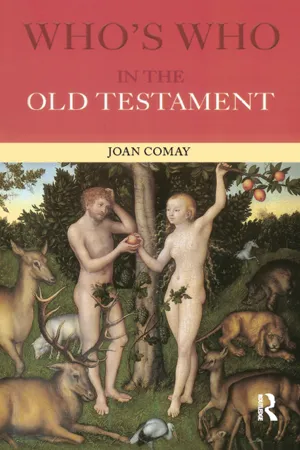
Who's Who in the Old Testament brings vividly to life the thousands of characters in the Old Testament, and provides:
* nearly 3000 extensive entries covering every character
* detailed biographical information on each character, including exactly where to find them in the Bible
* the complete historical, geographical and archaeological context of each entry
* comprehensive chronology of the times
* a section on the Apocrypha - the collection of works that bridges the gap between the Old and New Testaments.
- 424 pages
- English
- ePUB (mobile friendly)
- Available on iOS & Android
eBook - ePub
Who's Who in the Old Testament
About this book
Information
A
Aaron c. 13 century BC. Brother of Moses and first high priest.
Aaron was the son of Amram and Jochebed, of the priestly tribe of Levi. He was older than his brother Moses by three years, though younger than their sister Miriam. He married Elisheba, the daughter of Amminadab of the tribe of Judah, and had four sons: Nadab, Abihu, Eleazar and Ithamar.
When the Lord ordered Moses to go to Pharaoh and ask him to let the Israelites leave Egypt, Moses pleaded that ‘I am slow of speech and of tongue.’ (Exod. 4:10) The Lord told him that Aaron his brother would serve as his spokesman, for ‘I know that he can speak well.’ (Exod. 4:14)
Aaron went into the wilderness and met Moses. The two brothers embraced, and Moses repeated the Lord’s commandments. They then sent for the Israelite elders. Aaron informed them that the Lord was about to release them from their slavery, and convinced them by performing magic signs.
Moses and Aaron appeared before Pharaoh, and at first asked for permission for the Israelites to journey into the wilderness to hold a feast to their God. Pharaoh refused, and increased the burdens of the Hebrew slaves, who then blamed the brothers for these new hardships. Once again they appeared before Pharaoh to urge their plea. To impress Pharaoh with a miracle, Aaron threw down his rod and it turned into a serpent. Pharaoh sent for his sorcerers who performed the same feat ‘but Aaron’s rod swallowed up their rods’. (Exod. 7:12)
Aaron’s role in the infliction of some of the ten plagues that followed is recorded in Exodus (Chapters 7, 8 and 9). By stretching out his rod at the behest of Moses, he brought on the first three plagues (blood, frogs and lice). Together they were involved in producing the sixth plague (boils) and the eighth one (locusts). Only Moses is mentioned in connection with the other five. Pharaoh finally yielded to the demand to let my people go’. Aaron was then eighty-three years old and Moses eighty.
After their dramatic crossing of the Red (or Reed) Sea, the Israelites were attacked in the desert by fierce Amale-kite nomads. All day Moses sat on a hill-top while Aaron and Hur (Miriam’s son) stood on either side of him and held up his hands grasping the sacred rod, until the attackers were repulsed.
Moses went up Mount Sinai to receive the Ten Commandments leaving Aaron and Hur in charge of the encampment. When Moses did not appear at the appointed time, the people became rebellious and demanded of Aaron: ‘Up, make us gods, who shall go before us; as for this Moses … we do not know what has become of him.’ (Exod. 32:1) Aaron told them to bring him whatever gold items they had, and he fashioned a golden calf as a tangible object of worship for them. He proclaimed a feast for the following day and the people sacrificed, ate, drank and ‘rose up to play’ (Exod. 32:6).
On his return, the outraged Moses smashed the stone tablets he was carrying. He destroyed the calf and upbraided Aaron, who replied defensively: ‘Let not the anger of my lord burn hot; you know the people, that they are set on evil.’ (Exod. 32:22)
It was after this that the Ark of the Law and the tabernacle were constructed, and Aaron and his sons ordained as priests.
Two hundred and fifty of the Israelites, led by Korah, a Levite, revolted against the leadership of Moses and Aaron, claiming that all members of the congregation were holy. The earth split open and swallowed up the mutinous group. Moses placed a stave from each of the tribes overnight in the Tabernacle, with the Levites represented by that of Aaron. Next morning, it was seen that Aaron’s rod alone had sprouted blossom, ‘put forth buds … and it bore ripe almonds’ (Num. 17:8). This demonstrated the special status of the priesthood and the Levites.
Before the Children of Israel entered the Promised Land, they reached Mount Hor, near the southern end of the Dead Sea. The Lord told Moses to take Aaron up the mountain, together with his son Eleazar. Aaron’s vestments were placed upon Eleazar, who succeeded him as high priest. Aaron then died, at the age of one hundred and twenty-three. The Israelites mourned him for thirty days.
Aaron figures in the biblical account as sharing with Moses the receipt of God’s commands, the performance of miracles, and leadership over the people. Despite this close association in authority, Aaron lacked the spiritual grandeur that made Moses the central figure of the Old Testament.
Aaron and the Priesthood
Scholars are generally of the opinion that the earlier traditions about the Exodus, as reflected in the J and E Documents, give Aaron a minor role, and do not refer to his priestly function at all. A professional priesthood was developed in Jerusalem under the monarchy, and was centred on the Temple. Two priestly orders came into being, both claiming descent from Aaron – the Zadokites, through Aaron’s son Eleazar; the Aaronites, through Aaron’s son Ith-amar. After the Return, and under the influence of Ezra’s reforms, the Zadokites became the dominant priesthood, and the Aaronites or Levites were relegated to the status of Temple servants and lesser country priests.
The special role of the priesthood, and the details of Temple worship, were elaborated in the P (priestly) Document in the post-exilic period, in about the 4th century BC. It is mainly from this late source that these themes were injected into the Books of Exodus, Leviticus and Numbers. Aaron’s importance as the founder of the priesthood and the first high priest was thereby magnified in retrospect. [The main part of the story of Aaron is told in the Books of Exodus, Leviticus and Numbers.]
Abagtha c. 5 century BC. One of the seven chamberlains of Ahasuerus, king of Persia, sent to bring Queen Vashti to the king’s banquet to show off her beauty. [Esther 1:10, 11]
Abda (Heb. ‘servant’) 1. c. 10 century BC. Father of Adoniram who was the member of King Solomon’s household in charge of the levy of labour for public works. [1 Kgs. 4:6] 2. see OBADIAH 9.
Abdeel (Heb. ‘servant of God’) c. 7 century BC. Father of Shelemiah, who was ordered by King Joiakim to arrest the prophet Jeremiah and his scribe Baruch. [Jer. 36:26]
Abdi (Heb. ‘servant’) 1. c. 10 century BC. Grandfather of Ethan, one of the chief musicians of King David. [1 Chr. 6:44] 2. c. 8 century BC. The father of Kish, a Levite who sanctified himself and helped cleanse the Temple in the reign of Hezekiah. [2 Chr. 29:12]
3. 5 century BC. Descendant of Elam, who divorced his non-Jewish wife in the time of Ezra. [Ezra 10:26]
Abdiel (Heb. ‘servant’) c. 8 century BC. Father of Ahi and son of Guni, he was head of a family of Gadites living in Gilead during the period of Jeroboam II, king of Israel. [1 Chr. 5:15]
Abdon (Heb. ‘servile’) 1. c. 12 century BC. Son of Hillel, a Pirathonite from the land of Ephraim, he judged Israel for eight years and had forty sons and thirty nephews who rode on seventy asses. [Judg. 12:13–15] 2. date unknown. Son of Shashak, a Benjaminite leader who lived in Jerusalem. [1 Chr. 8:23–25]
3. c: II century BC. Son of Jeiel, a Benjaminite leader and uncle of King Saul. [1 Chr. 8:30; 9:36]
4. c. 7 century BC. The son of Micah, he was sent by King Josiah to consult the prophetess Huldah. Also called Achbor. [2 Kgs. 22:12, 14; 2 Chr. 34:20]
Abednego (Bab. ‘servant of Nego’ [a Babylonian god]) c. 6 century BC. The Babylonian name given to Azariah, one of the four young men of Judah taken off to Babylon by the orders of King Nebuchadnezzar. When the four refused to worship or serve the Babylonian gods, Nebuchadnezzar, in great rage, ordered them cast into the fiery furnace. They were delivered by an angel and walked out unhurt. [Dan. 1–3]
Abel (Heb. ‘son’) date unknown. The younger son of Adam and Eve. Abel was a shepherd, while his elder brother Cain became a tiller of the soil. When the two brothers came to present their offerings to the Lord, the lambs of Abel were preferred to the produce of Cain. Cain was so angry that he killed his brother Abel, thus committing the first murder recorded in the Bible.
The story of Cain and Abel is regarded as expressing the age-old strife in the Near East between the desert nomads with their flocks and herds, and the settled cultivators. The story has its roots in the primitive custom of ritual human sacrifice to propitiate the gods and ensure the fertility of the soil, on which the life of the community depended.
Clearly, the story of Cain and Abel represents a stage in human society that had evolved far beyond the primitive beginnings, and it is only in a legendary sense that the two of them were regarded as the ‘children’ of the first human beings. See CAIN [Gen. 4]
Abi (Heb. ‘progenitor’) c. 8 century BC. Daughter of Zachariah, she became the wife of Ahaz, king of Judah, and the mother of his successor, King Hezekiah. Also called Abijah. [2 Kgs. 18:2; 2. Chr. 29:1]
Abialbon see ABIEL 2.
Abiasaph (Heb. ‘father added [a son]’) c. 13 century BC. A son of Korah and a descendant of Kohath of the tribe of Levi, he was head of a family of Kora-hites who went out of Egypt with Moses. When his father Korah led a rebellion against Moses and Aaron in the wilderness and died unnaturally, Abiasaph and his brothers were not punished. His descendants were keepers at the gates of the Tabernacle in the reign of King David. Also called Ebiasaph. [Exod. 6:24; 1 Chr. 6:37; 9:19]
Abiathar (Heb. ‘father of excellence’) c. 11 century BC. High priest during the reign of David.
Abiathar was a young priest at the sanctuary town of Nob, just outside Jerusalem, and the son of the head priest Ahimelech. When Saul heard David had been helped by them, he had all the priests of Nob rounded up and slain and the town destroyed. Only Abiathar escaped and managed to join the outlawed David in the mountains. David pledged himself to look after Abiathar: ‘Stay with me, fear not; for he that seeks my life seeks your life; with me you shall be in safekeeping.’ [1 Sam. 22:23]
Abiathar stayed with David throughout his guerrilla days and then came to Jerusalem with him. Here David made him one of the two high priests, the other being Zadok. At the time of Absalom’s revolt, they tried to follow David from Jerusalem with the Ark, but he asked them to turn back and keep him posted of developments, using their sons as runners. After the defeat and death of Absalom, the two high priests encouraged the leaders of Judah to call for the return of David.
When David was aged and losing his hold on affairs, Abiathar supported the abortive bid of the eldest surviving prince, Adonijah, to usurp the throne. Solomon, a younger son, was crowned instead.
David died shortly after and Solomon succeeded him. Because of his loyalty and long service to David, Abiathar’s life was spared. But Solomon banished him from Jerusalem: ‘Go to Anathoth, to your estate.’ (1 Kgs. 2:26) [1 Sam. 22:20–23; 2 Sam. 15:24; 1 Kgs. 1, 2, 4; 1 Chr. 15:11, 18:16; 24:6; 27:34]
Abida (Heb. ‘father of knowledge’) c. 17 century BC. Son of Midian, he was a grandson of Abraham and his wife Keturah. [Gen. 25:4; 1 Chr. 1:33]
Abidan (Heb. ‘father of judgment’) c. 13 century BC. Son of Gideoni and a leader of the tribe of Benjamin, he was appointed by Moses to number the tribe of Benjamin for military service and led the contingent as they marched through the wilderness. [Num. 1:11; 2:22; 7:60–65; 10:24]
Abiel (Heb. ‘God is my father’) 1. c. 11 century BC. Son of Zeror of the tribe of Benjamin, he was the grandfather of King Saul and of Abner his commander. [1 Sam. 9:1; 14:51] 2. c. 10 century BC. The Arbathite warrior in the army of King David who was distinguished for his bravery. Also called Abialbon. [2 Sam. 23:31; 1 Chr. 11:32]
Abiezer (Heb. ‘father of help’) 1. c. 13 century BC. A leader of the tribe of Manasseh recorded in the census by Moses who would be given a share in the land of Israel, after the conquest of Joshua. Also called Iezer. [Num. 26:30; Josh. 17:2; 1 Chr. 7:18] 2. c. 10 century BC. A warrior from Anathoth in King David’s army distinguished for his bravery. He commanded a division during the ninth month of each year. [2 Sam. 23:27; 1 Chr. 11:28; 27:12]
Abigail (Heb. ‘father of joy’) 1. c. 11 century BC. Wife of Nabal and later of King David.
When Samuel died, David went into the wilderness to escape King Saul. While there he learned of a man named Nabal and sent ten men to ask him for a contribution to their support, and they were rudely turned away. After this was told to Nabal’s wife Abigail, who was both beautiful and wise, she realized at once th...
Table of contents
- Cover
- Half Title
- Title Page
- Copyright Page
- Contents
- Author’s Preface
- Introduction to the Old Testament
- Chronology
- Who’s Who in the Old Testament I
- Introduction to the Apocrypha
- Who’s who in the Apocrypha
Trusted by 375,005 students
Access to over 1.5 million titles for a fair monthly price.
Study more efficiently using our study tools.
Frequently asked questions
Yes, you can cancel anytime from the Subscription tab in your account settings on the Perlego website. Your subscription will stay active until the end of your current billing period. Learn how to cancel your subscription
No, books cannot be downloaded as external files, such as PDFs, for use outside of Perlego. However, you can download books within the Perlego app for offline reading on mobile or tablet. Learn how to download books offline
Perlego offers two plans: Essential and Complete
- Essential is ideal for learners and professionals who enjoy exploring a wide range of subjects. Access the Essential Library with 800,000+ trusted titles and best-sellers across business, personal growth, and the humanities. Includes unlimited reading time and Standard Read Aloud voice.
- Complete: Perfect for advanced learners and researchers needing full, unrestricted access. Unlock 1.5M+ books across hundreds of subjects, including academic and specialized titles. The Complete Plan also includes advanced features like Premium Read Aloud and Research Assistant.
We are an online textbook subscription service, where you can get access to an entire online library for less than the price of a single book per month. With over 1.5 million books across 990+ topics, we’ve got you covered! Learn about our mission
Look out for the read-aloud symbol on your next book to see if you can listen to it. The read-aloud tool reads text aloud for you, highlighting the text as it is being read. You can pause it, speed it up and slow it down. Learn more about Read Aloud
Yes! You can use the Perlego app on both iOS and Android devices to read anytime, anywhere — even offline. Perfect for commutes or when you’re on the go.
Please note we cannot support devices running on iOS 13 and Android 7 or earlier. Learn more about using the app
Please note we cannot support devices running on iOS 13 and Android 7 or earlier. Learn more about using the app
Yes, you can access Who's Who in the Old Testament by Joan Comay in PDF and/or ePUB format, as well as other popular books in Theology & Religion & Biblical Biography. We have over 1.5 million books available in our catalogue for you to explore.