- 416 pages
- English
- PDF
- Available on iOS & Android
Biblical Hebrew Grammar Visualized
About this book
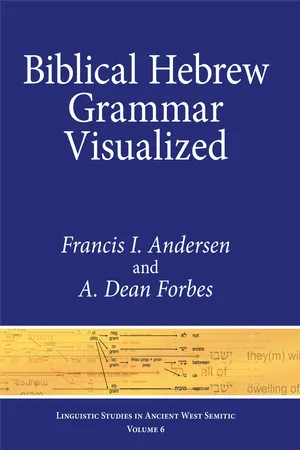
In Biblical Hebrew Grammar Visualized, Andersen and Forbes approach the grammar of Biblical Hebrew from the perspective of corpus linguistics. Their pictorial representations of the clauses making up the biblical texts show the grammatical functions (subject, object, and so on) and semantic roles (surrogate, time interval, and so on) of clausal constituents, as well as the grammatical relations that bind the constituents into coherent structures.
The book carefully introduces the Andersen-Forbes approach to text preparation and characterization. It describes and tallies the kinds of phrases and clauses encountered across all of Biblical Hebrew. It classifies and gives examples of the major constituents that form clauses, focusing especially on the grammatical functions and semantic roles. The book presents the structures of the constituents and uses their patterns of incidence both to examine constituent order ("word order") and to characterize the relations among verb corpora. It expounds in detail the characteristics of quasiverbals, verbless clauses, discontinuous and double-duty clausal constituents, and supra-clausal structures.
The book is intended for students of Biblical Hebrew at all levels. Beginning students will readily grasp the basic grammatical structures making up the clauses, because these are few and fairly simple. Intermediate and advanced students will profit from the detailed descriptions and comparative analyses of all of the structures making up the biblical texts. Scholars will find fresh ways of addressing open problems, while gaining glimpses of new research approaches and topics along the way.
Frequently asked questions
- Essential is ideal for learners and professionals who enjoy exploring a wide range of subjects. Access the Essential Library with 800,000+ trusted titles and best-sellers across business, personal growth, and the humanities. Includes unlimited reading time and Standard Read Aloud voice.
- Complete: Perfect for advanced learners and researchers needing full, unrestricted access. Unlock 1.4M+ books across hundreds of subjects, including academic and specialized titles. The Complete Plan also includes advanced features like Premium Read Aloud and Research Assistant.
Please note we cannot support devices running on iOS 13 and Android 7 or earlier. Learn more about using the app.
Information
Table of contents
- COVER Front
- Copyright Page
- Table of Contents
- Acknowledgments
- Chapter 1: Introduction: What We Mean by “Biblical Hebrew,” “Grammar,” and “Visualized
- Chapter 2: Text Division
- Chapter 3: Parts of Speech
- Chapter 4: Phrase Marker Concepts and Terminology
- Chapter 5: The Basic Phrase Types of Biblical Hebrew
- Chapter 6: Complex Phrases in Biblical Hebrew
- Chapter 7: Main Clauses
- Chapter 8: Embedded Clauses
- Chapter 9: Classifying Clause Immediate Constituents
- Chapter 10: Semantic Role CICs
- Chapter 11: Introduction to Clause Immediate Constituent Composition, Incidence, and Ordering
- Chapter 12 : The רמא Corpus
- Chapter 13: The היה Corpus
- Chapter 14: The השׂע Corpus
- Chapter 15: The ןתנ Corpus
- Chapter 16: Makeup of Clause Immediate Constituent Subtypes
- Chapter 17: Computing the Distances between Verb Corpora
- Chapter 18: The Five Quasiverbals
- Chapter 19: Verbless Clauses
- Chapter 20 : Non-Tree Phrase Markers
- Chapter 21; Discourse Analysis and Supra-Clausal Structures
- Chapter 22: Text Choice, Corrections, and Reductions
- Chapter 23 : Our Approach to Linguistics
- Chapter 24: Alternate Approaches to Positional Syntax
- Chapter 25: Indirect-Object Alternation in the רמא Corpus
- Chapter 26: Compositional Analysis
- Chapter 27: Two-CIC VLCs as Novel Sentences
- Appendix
- Bibliography
- Index