- 172 pages
- English
- ePUB (mobile friendly)
- Available on iOS & Android
eBook - ePub
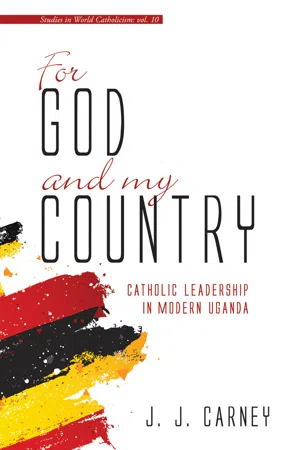
About this book
A devout Catholic politician assassinated by a capricious dictator. A Cardinal standing up for his people in the face of political repression. A priest leading his nation's constitutional revision. The "Mother Teresa of Uganda" transforming the lives of thousands of abandoned children. Two missionaries who founded the best community radio station in Africa. A peace activist who has amplified the voices of grassroots women in the midst of a brutal civil war.
Such are the powerful stories in For God and My Country, a book that explores how seven inspiring leaders in Uganda's largest religious community have shaped the social and political life of their country. Drawing on extensive oral research, J. J. Carney analyzes how personal faith, theological vision, and Catholic social teaching have propelled these leaders to embody Vatican II's call for the Church to be a sign of communion and unity in the world. Readers will gain rich insight into Uganda's postcolonial politics and the history of one of Africa's most important Catholic communities. Each chapter closes with leadership lessons and reflection questions, making this an ideal text for classroom and parish adoption.
Trusted by 375,005 students
Access to over 1.5 million titles for a fair monthly price.
Study more efficiently using our study tools.
Information
Topic
Theology & ReligionSubtopic
Christian Denominations1
The Catholic Politician
Benedicto K. M. Kiwanuka
The Chief Justice of Uganda’s Supreme Court had just entered his chambers to read through an overview of the day’s cases. It was a Thursday in September 1972. Benedicto K. M. Kiwanuka arrived at Uganda’s High Court straight from Catholic Mass at Rubaga Cathedral, a ritual in which he partook on a daily basis. A week earlier, he had taken the unusual step of requesting and receiving the Catholic sacrament of anointing, a ritual only granted in cases of serious illness or in anticipation of death. As Kiwanuka sat in his chambers, a commotion ensued. Plains-clothes intelligence officers with Uganda’s General Security Unit confronted and arrested him. As he was forcibly removed from the building, he shouted in Luganda to one of his assistants, “Matiya bantutte, naye abaana ba Maria tebafa!” (“Mathias, they have taken me, but children of Mother Mary do not die!”).59 These were the last public words of Benedicto Kiwanuka. To this day, his body has not been recovered.
One of the most important political leaders of the independence era, Benedicto Kiwanuka is largely unknown outside of Uganda. (His grandson, Matthias Kiwanuka, the former New York Giants defensive end and two-time Super Bowl winner, has far greater name recognition in my own United States). But as Uganda’s first chief minister and the architect of the Democratic Party’s rise to power between 1959 and 1962, Kiwanuka was one of the key players in Uganda’s transition from British colonialism to national independence. Even more significantly, he remains the only Ugandan prime minister or president to peacefully hand over power to a democratically elected successor. The most influential Catholic politician in modern Uganda, Kiwanuka embodied an eclectic mix of sometimes-competing identities: a devout and traditional Catholic layman, an anticolonial African nationalist, and a politician for whom democracy was a sacred cause. His brutal death at the hands of Amin also led many to see him as a martyr to the rule of law and judicial independence, and his family and friends are now pushing the Archdiocese of Kampala to introduce his cause as a “patron saint of Ugandan politicians.”60
Kiwanuka’s witness highlights the important if controversial question of what it means to speak of a “Christian” or “Catholic” political leader in the modern world. Such questions are fraught with ambiguities. The devout politician can overly assume God’s will, claiming that God has directly spoken to him and personally called him to lead the country into the promised land. On the other extreme are the Christian politicians who wholly privatize and compartmentalize their own religious faith. In the USA, the most famous example of this trend was John F. Kennedy who, in part to fend off Protestant fears of his own Catholic identity, claimed that “I believe in a President whose religious views are his own private affair.”61 Another challenge is the sheer breadth of the Catholic Church’s political and social teachings in service to the common good, defined at Vatican II as the “sum total of those conditions of social living which allow people, either as groups or as individuals, to reach their fulfillment more fully and more easily.”62 In the modern world, those teachings include standing up for religious freedom and human rights, supporting democratization and civic education, exercising a preferential option for the poor, caring for the environment, welcoming migrants, and advocating for the sanctity of human life from conception to natural death. But rare is the Catholic politician who is fully conversant with this tradition, much less one who embraces a range of positions that cut across the liberal-conservative ideological spectrum that dominate American politics in particular.
figure 4
-plgo-compressed.webp)
So, although the Church in both Africa and America often laments the dearth of truly “Catholic” politicians, the task may be harder than we imagine. Benedicto Kiwanuka is by no means a perfect model. In the words of the Ugandan historian Samwiiri Lwanga Lunyiigo, “no politician is a saint!”63 But Kiwanuka’s witness can teach us about what it could mean to see politics as a vocation in the modern world. In particular, I will emphasize four dimensions of Kiwanuka’s political witness: 1) his commitment to building the common good and popular political participation through democratic systems, 2) his uncompromising stand against injustice and oppression, 3) his embodiment of public Catholic witness as a martyr, and 4) his ability to model personal Catholic devotion without political sectarianism.
Benedicto Kiwanuka’s Biography64
Benedicto Kagimu Mugumba Kiwanuka was born in May 1922 in Buddu province, the historic heartland of Catholicism in Buganda (see introduction). His father, Fulgensio Musoke, was a minor village chief, but in Buganda’s hierarchical culture he was classified as a mukopi, or peasant. He was also an alcoholic who squandered his family’s limited property and wealth, dying in 1940 in relative penury from complications of gonorrhea. In the words of Kiwanuka’s biographer, Albert Bade, his father’s demise led Kiwanuka to “develop a permanent dislike for extravagance, polygamy and poverty.”65
Like nearly a...
Table of contents
- Title Page
- Illustrations
- Acknowledgments
- Abbreviations: Archives, Acronyms, and Foreign Terms
- Introduction
- Chapter 1: The Catholic Politician
- Chapter 2: The Bishop as Good Shepherd
- Chapter 3: Uganda’s Liberation Theologian
- Chapter 4: Solidarity on the Streets
- Chapter 5: Missionaries of the Media
- Chapter 6: Mama Peace
- Conclusion
- Bibliography
Frequently asked questions
Yes, you can cancel anytime from the Subscription tab in your account settings on the Perlego website. Your subscription will stay active until the end of your current billing period. Learn how to cancel your subscription
No, books cannot be downloaded as external files, such as PDFs, for use outside of Perlego. However, you can download books within the Perlego app for offline reading on mobile or tablet. Learn how to download books offline
Perlego offers two plans: Essential and Complete
- Essential is ideal for learners and professionals who enjoy exploring a wide range of subjects. Access the Essential Library with 800,000+ trusted titles and best-sellers across business, personal growth, and the humanities. Includes unlimited reading time and Standard Read Aloud voice.
- Complete: Perfect for advanced learners and researchers needing full, unrestricted access. Unlock 1.5M+ books across hundreds of subjects, including academic and specialized titles. The Complete Plan also includes advanced features like Premium Read Aloud and Research Assistant.
We are an online textbook subscription service, where you can get access to an entire online library for less than the price of a single book per month. With over 1.5 million books across 990+ topics, we’ve got you covered! Learn about our mission
Look out for the read-aloud symbol on your next book to see if you can listen to it. The read-aloud tool reads text aloud for you, highlighting the text as it is being read. You can pause it, speed it up and slow it down. Learn more about Read Aloud
Yes! You can use the Perlego app on both iOS and Android devices to read anytime, anywhere — even offline. Perfect for commutes or when you’re on the go.
Please note we cannot support devices running on iOS 13 and Android 7 or earlier. Learn more about using the app
Please note we cannot support devices running on iOS 13 and Android 7 or earlier. Learn more about using the app
Yes, you can access For God and My Country by J. J. Carney in PDF and/or ePUB format, as well as other popular books in Theology & Religion & Christian Denominations. We have over 1.5 million books available in our catalogue for you to explore.