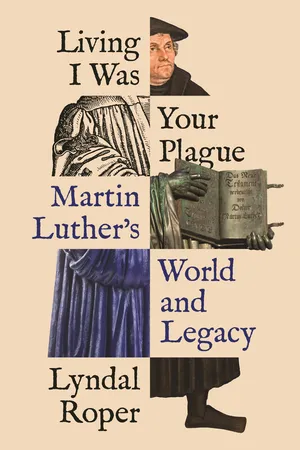
From the author of the acclaimed biography Martin Luther: Renegade and Prophet, new perspectives on how Luther and others crafted his larger-than-life image
Martin Luther was a controversial figure during his lifetime, eliciting strong emotions in friends and enemies alike, and his outsized persona has left an indelible mark on the world today. Living I Was Your Plague explores how Luther carefully crafted his own image and how he has been portrayed in his own times and ours, painting a unique portrait of the man who set in motion a revolution that sundered Western Christendom.
Renowned Luther biographer Lyndal Roper examines how the painter Lucas Cranach produced images that made the reformer an instantly recognizable character whose biography became part of Lutheran devotional culture. She reveals what Luther's dreams have to say about his relationships and discusses how his masculinity was on the line in his devastatingly crude and often funny polemical attacks. Roper shows how Luther's hostility to the papacy was unshaken to the day he died, how his deep-rooted anti-Semitism infused his theology, and how his memorialization has given rise to a remarkable flood of kitsch, from "Here I Stand" socks to Playmobil Luther.
Lavishly illustrated, Living I Was Your Plague is a splendid work of cultural history that sheds new light on the complex and enduring legacy of Luther and his image.
Trusted by 375,005 students
Access to over 1 million titles for a fair monthly price.
THE COLLABORATION BETWEEN Luther and the artist Lucas Cranach the Elder contributed perhaps more to the Reformation’s success than anything apart from Luther’s own writings. Cranach lived just around the corner from Luther and his workshop produced a series of likenesses of the reformer, as well as designing books, illustrating the German Bible, and creating the look of the new churches. Court painter to Luther’s ruler Frederick the Wise, he produced dramatically original, striking works, like his luscious scenes of the Fountain of Youth, his Adam and Eves, or his seductive nudes. By comparison, the workshop’s portraits of Luther are artistically poor, and yet they proved perhaps to be the most successful of all his image-making because they made Luther recognizable, an effect which endures up to our own time: it is Cranach’s Luther that graces the cover of just about every biography of the reformer on sale today, and it is his Luther who stares out even from the icing on the marzipan souvenirs in Wittenberg. Luther’s face, moreover, became famous at an important juncture in the history of portraiture, newly fashionable amongst the rich burgher classes of sixteenth-century German lands, as artists broadened out from religious iconographies and began to produce likenesses of individuals for a lay market. Luther was probably the first non-ruler whose face became so universally familiar.1
A decade older than Luther, Cranach became court painter to Frederick the Wise, Luther’s ruler, in 1504 and settled in Wittenberg. This was seven years before Luther moved there permanently, and he left only after Luther’s death, dying in Weimar in 1553, after which his son Lucas Cranach the Younger took over the workshop. Luther and the artist seem to have soon become fast friends; Luther liked to look in on the painter’s warehouse in the centre of town to see what was new from the Leipzig fair, for Cranach was not only a painter but the richest man in Wittenberg, holding a monopoly on fine wines and pharmaceutical goods.2 The ties between the older and the younger man were close: Cranach modelled family life for Luther when he was still an Augustinian, and the two men later acted as godparents to each other’s children. When Luther was waylaid and taken to the Wartburg after the Diet of Worms to go into hiding, it was Cranach to whom he wrote explaining he was safe.3 An outlaw and then endangered by his support for the authorities during the Peasants’ War, Luther was frequently confined to Wittenberg by ill health, unable to travel far from Saxony, so Cranach was the only artist who had access to the man himself. As the pair aged, we glimpse their sociability through the Table Talk, the notes Luther’s students took on the reformer’s dinner conversations, published after his death: they tease Cranach’s son at his wedding for being besotted with his wife, and share an apple in the summer garden, making coarse jokes about the destination of the apple pips they have swallowed.4 When Cranach’s gifted elder son, Hans, died in Italy, Luther tried to prevent a grief-stricken Cranach and his wife from falling into melancholy, the distemper from which Luther suffered himself.5
Cranach occupies an ambivalent position in the pantheon of German artists. Overshadowed by his brilliant contemporary Albrecht Dürer, his adolescent s-bend nudes go in and out of fashion today. Periodic attempts are made to rediscover him as a bold and daring artist, an easier task with his early, arresting representations of St Catherine’s martyrdom or his striking Holy Kindred incorporating Frederick the Wise and his brother Duke John amongst the Holy Family.6 But it is harder to see much artistic merit in the identikit portraits of Luther that his workshop churned out, and which were so reverently brought out of storage in galleries all over the world in 2017.
Seeing Cranach—the man dubbed the ‘fast painter’ by his contemporaries—as an Artist in the great tradition of Western European art, is fundamentally misconceived.7 He was above all an image-maker, a man who witnessed the explosion of the new medium of print, who himself owned a printing press for a time, and who was fascinated by these new possibilities of multiplying images.8 Dürer lived in bustling Nuremberg, crowded with artists and workshops and home to a thriving lay market of rich townsfolk; in tiny Wittenberg, a building site for much of his life, Cranach was the only major artist for miles around and had to import every panel and pigment.9 His workshop was huge and its output vast; his pictures are patterned assemblages of distinct, repeatable elements that could be put together by a staff of hired assistants.10 Order a Cranach, and you knew what you were getting. The Cranach ‘look’ became so recognizable with its signature winged serpent, that his second son Lucas Cranach the Younger barely altered the formula for another generation.11
Cranach’s portraits of Luther are not artistically dazzling, but they have endured for several hundred years and done much to shape the style of Lutheran piety itself. Cranach aimed not at visual singularity but at instant legibility. The huge corpus of images of Luther the workshop produced fall fairly readily into six or seven categories, tracking his life course. There is Luther the monk, an image which had run its course by 1524; Luther in the Wartburg; Luther as a married man; the standard portrait; the full-body Luther; and dead Luther. Each of these was made famous by the Cranach workshop. Finally, there is a type I shall term ‘Luther and Co.’ which was produced only after Luther’s death.
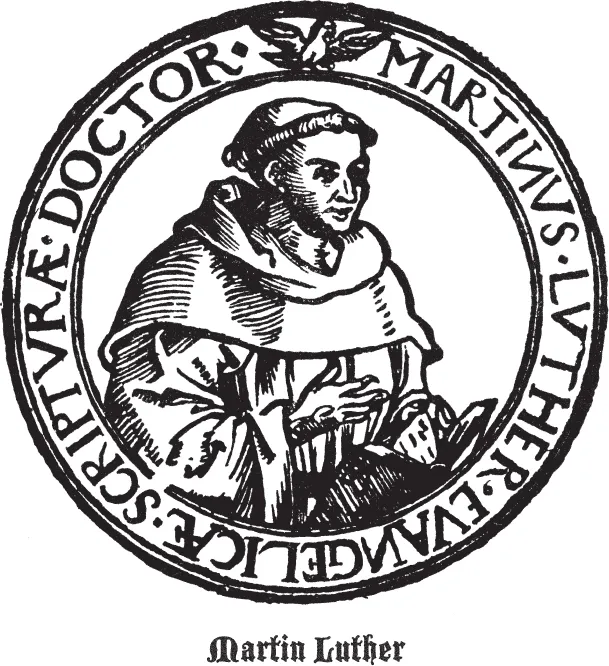
Just what the workshop achieved is evident if we look at the extraordinarily diverse early images of Luther, before Cranach became involved.12 The very first, from 1519, was produced not in Wittenberg but in Leipzig by the workshop of Wolfgang Stöckel. It shows a young and rather insecure looking monk, dwarfed by a giant cowl, his face obscured by his massive doctor’s hat. We know it is Luther because his name is clumsily written in the roundel, and because the Luther rose is shown, the humanistic symbol Luther had adopted as his logo.13 This image appeared in the wake of the Leipzig debate of 1519, the event which made Luther famous in humanist circles, and it shows him with his hand raised, in the pose of a disputant. He has no books beside him, his name is written as Martinus ‘Lvtter’ (though it is spelt correctly in print above), and the text in clumsy mirror writing tags him as an Augustinian, from Wittenberg, and a doctor. At least one printing press made a better attempt at the design a few years later, with a version attributed to Erhard Schön almost solving the problem of how to place reversed letters in a roundel; the design now shows a more robust-looking and tonsured monk, his doctor title visible to the left of his head, and a dove suggesting he is inspired by the Holy Spirit.14 Other images from this early period show a full-length figure dressed as a monk whose face is rather indistinct, whilst another, probably taken from an existing block, shows three Reformation heroes, possibly Luther, Hutten, and von Sickingen, but it is anyone’s guess which is Luther.15
1.1. Woodcut of Martin Luther. Ein Sermon geprediget tzu Leipßgk.… Anonymous, 1519. Martin Luther University Halle-Wittenberg.
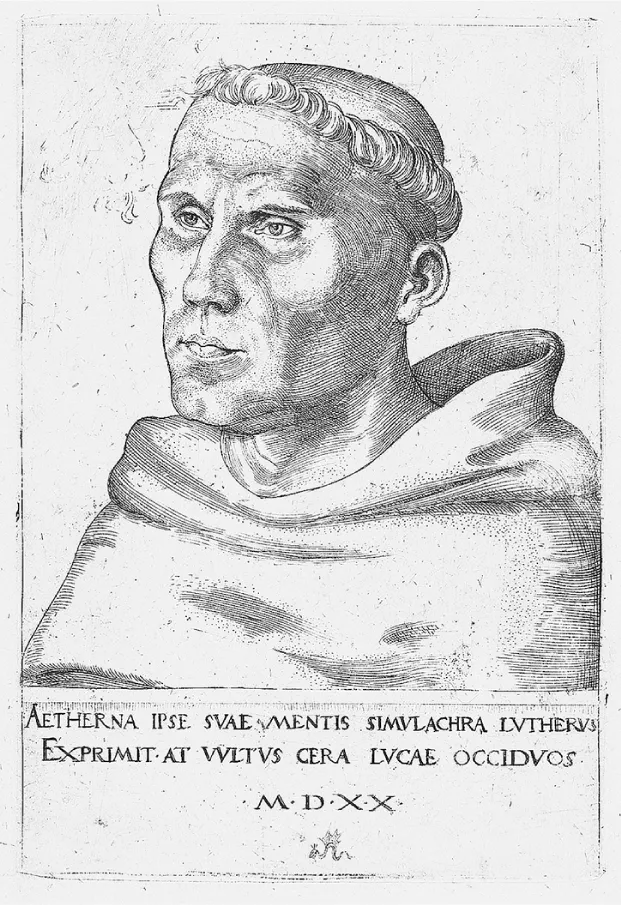
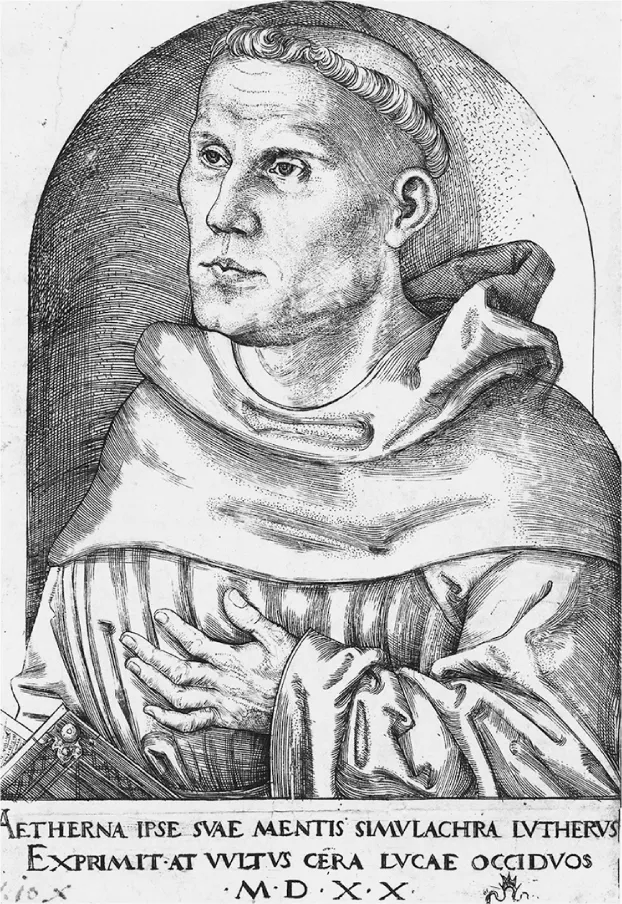
Cranach’s intervention in this profusion of likenesses was decisive. Around 1520 he produced two full-face etchings of Luther. The first version, which is best known today, seems to have been judged unsuitable at the time, for most of the surviving prints date from the second half of the sixteenth century, and show a doodle etched in the corner of the plate.16 A revision of the etching, however, became hugely influential at the time—although it is barely used now and seems not to suit contemporary taste. Altered to show a far less threatening, peaceable Luther, it shows him standing in front of a niche holding a Bible.17
The difference between the two etchings is revealing. The first is psychologically gripping—this is the intense monk who could write such iconoclastic works as the Appeal to the Christian Nobility; the second is a milder, more saccharine saint. In the first we see only the young monk’s head, and the artist focuses relentlessly on his physiognomy; in the other, we see his upper body and gesturing hands, along with a background niche. The change is a shift from inner to outer, from a man whose intense gaze unsettles, to a more distanced, broad-chested public figure, with less interiority. This was a decision Cranach made early on, and it would determine the nature of the portraits that followed, which became ever more clear, iconic, public, and, I would suggest, more psychologically shallow. They could be mass produced because they portrayed Luther in well-worn conventions, making him easy to grasp.
1.3. Martin Luther as an Augustinian Monk. Cranach the Elder, 1520. Metropolitan Museum of Art.
1.4. Portrait of Martin Luther. Cranach the Elder, 1520. British Museum.
Just how effective Cranach’s second, more bland image was can be seen in the range of pamphlets and presses which copied it fo...
Table of contents
Cover Page
Series Page
Title Page
Copyright Page
Dedication
Contents
Preface
Introduction
Chapter 1. The Luther Cranach Made
Chapter 2. Luther and Dreams
Chapter 3. Manhood and Pugilism
Chapter 4. Names
Chapter 5. ‘Living I Was Your Plague’
Chapter 6. Luther the Anti-Semite
Chapter 7. Luther Kitsch
Acknowledgements
Notes
Bibliography
Index
Series List
Frequently asked questions
Yes, you can cancel anytime from the Subscription tab in your account settings on the Perlego website. Your subscription will stay active until the end of your current billing period. Learn how to cancel your subscription
No, books cannot be downloaded as external files, such as PDFs, for use outside of Perlego. However, you can download books within the Perlego app for offline reading on mobile or tablet. Learn how to download books offline
Perlego offers two plans: Essential and Complete
Essential is ideal for learners and professionals who enjoy exploring a wide range of subjects. Access the Essential Library with 800,000+ trusted titles and best-sellers across business, personal growth, and the humanities. Includes unlimited reading time and Standard Read Aloud voice.
Complete: Perfect for advanced learners and researchers needing full, unrestricted access. Unlock 1.4M+ books across hundreds of subjects, including academic and specialized titles. The Complete Plan also includes advanced features like Premium Read Aloud and Research Assistant.
Both plans are available with monthly, semester, or annual billing cycles.
We are an online textbook subscription service, where you can get access to an entire online library for less than the price of a single book per month. With over 1 million books across 990+ topics, we’ve got you covered! Learn about our mission
Look out for the read-aloud symbol on your next book to see if you can listen to it. The read-aloud tool reads text aloud for you, highlighting the text as it is being read. You can pause it, speed it up and slow it down. Learn more about Read Aloud
Yes! You can use the Perlego app on both iOS and Android devices to read anytime, anywhere — even offline. Perfect for commutes or when you’re on the go. Please note we cannot support devices running on iOS 13 and Android 7 or earlier. Learn more about using the app
Yes, you can access Living I Was Your Plague by Lyndal Roper in PDF and/or ePUB format, as well as other popular books in Theology & Religion & Religious Biographies. We have over one million books available in our catalogue for you to explore.