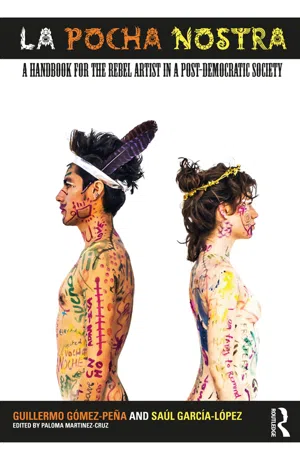
La Pocha Nostra: A Handbook for the Rebel Artist in a Post-Democratic Society marks a transformation from its sister book, Exercises for Rebel Artists, into a pedagogical matrix suited for use as a performance handbook and conceptual tool for artists, activists, theorists, pedagogues, and trans-disciplinary border crossers of all stripes.
Featuring a newly reworked outline of La Pocha Nostra's overall pedagogy, and how it has evolved in the time of Trump, cartel violence, and the politics of social media, this new handbook presents deeper explanations of the interdisciplinary pedagogical practices developed by the group that has been labeled "the most influential Latino/a performance troupe of the past ten years."
Co-written by Guillermo Gómez-Peña in collaboration with La Pocha Nostra's artistic co-director Saúl García-López and edited by Paloma Martinez-Cruz, this highly anticipated follow-up volume raises crucial questions in the new neo-nationalist era. Drawing on field experience from ten years of touring, the authors blend original methods with updated and revised exercises, providing new material for teachers, universities, radical artists, curators, producers, and students.
This book features:
Introductions by the authors and editor to Pocha Nostra practice in a post-democratic society.
Theoretical, historical, poetic, and pedagogical contexts for the methodology.
Suggestions for how to use the book in the classroom and many other scenarios.
Detailed, hands-on exercises for using Pocha Nostra-inspired methods in workshops.
A step-by-step guide to creating large-scale group performances.
New, unpublished photos of the Pocha Nostra methods in practice.
Additional texts by Reverend Billy and Savitri D., Dragonfly, Francesca Carol Rolla, VestAndPage, Micha Espinosa, Zulfikar Ali Bhutto, Praba Pilar, L. M. Bogad, Anuradha Vikram, and Annie Sprinkle and Beth Stephens, among many others.
The book is complemented by the new book Gómez-Peña Unplugged: Texts on Live Art, Social Practice and Imaginary Activism (2008–2019).
Trusted by 375,005 students
Access to over 1.5 million titles for a fair monthly price.
Working with La Pocha Nostra helped me to transcend many personal and professional borders. Working with them I felt an artistic freedom I had never experienced before. Coming from theater, where the methods are meant to limit the bodies into a specific technique and shape, performance feels very liberating in general, but Pocha Nostra’s radical tenderness gives it one more twist. After attending one of their workshops, my theater work has enriched but further than that; I gained the personal confidence to start research work for a solo performance for the first time and also joined a network/family of artists with whom I kept meeting and creating collaborative work, kept crossing borders (physical and mental ones) and kept putting them all under the spot together as a collective. Thank you very much, from the heart, there has definitely been a before and after. After Pocha Nostra there was more work, more art, more friends and of a better quality.
(Jessamyn Lovell, teacher and theorist)
With the full-scale, top-down assault on democratic institutions including the free press, elections, and the obstruction of democratic participation in national and global decision making, today’s need for artists and educators to foster sites of public dissent and oppositional art is fueled by do-or-die urgency. The techniques and contemplations offered in this volume provide a wide range of possibilities for harnessing public performance, social media, activism, and pedagogical actions as strategic technologies of defense against the ravages of despair and alienation. Knowing how much is at stake, this book offers tools to sharpen and enhance scholar-artivist practices and pedagogies that are at the core of any authentic democratic project.
As my following remarks will show, it’s difficult for me to locate a place in these activity spheres that is NOT fundamentally infused with the magic hatched in the seed life of Guillermo Gómez-Peña and Pocha Nostra’s offerings. Here, I introduce the pedagogical tools provided in this book by taking the metaphorical camera way, way out for an extremely wide shot before zooming in for an extreme close-up. I refer to these wide shots and close-ups as the Four P’s: the Planet, the People, the Pedagogy, and, finally, my Participation in the pages of the text. (Don’t you love alliteration? Isn’t alliteration with a series of plosives the best?) By providing these long and near views of Pocha pedagogy, I hope to offer a varied and customizable picture of how to make Pocha your own, so you can deejay the mix from the Pocha jukebox that speaks to the political, pedagogical, ecological, and personal urgencies of our pinche “post-democratic” predicament to suit the resistance front where you stand.
PLANETARY POCHA
Performance art will save the planet. A long time ago, the text became more sacred, more exalted than the body. In performance studies, we discuss this shift as the ascendance of archival knowledge over the repertoire of embodied knowledge. Performance allows us to “do” embodied knowledge by resisting the privileging of lettered over non-lettered societies. Why is this so important? To emphasize the body as a site of knowing resists the Western idea that the mind is supreme, and the body is little more than its throwaway Styrofoam cup. This kind of thinking results in “disposable” approaches to natural resources, because after the body dies, the soul is supernaturally transported to a superior plane in a magical off-site place beyond the clouds. The “it doesn’t matter what happens to the body or planet because we leave it behind when we die” mindset has its roots in the rise of textual knowledge in Europe, where the non-physical, extra-terrestrial heaven became everyone’s goal. Suppression of the body progressed alongside alphabetic literacy, and, with European colonization, the people who looked to nature and the body for knowledge flows (like the pagans and shamans) became cast out as uncivilized – even demonic – while the West insisted that intellectual authority was the exclusive realm of readers and writers.
Many excellent monographs, such as indigenous writer Leanne Betasamosake Simpson’s As We Have Always Done: Indigenous Freedom through Radical Resistance (2017) and David Abram’s The Spell of the Sensuous (1996), describe the philosophical journey away from the body that resulted in colonial disdain for ecological balance, but ecological metaphor does not have to figure centrally in a performance text for the work of performance to bring renewed focus to the body and its habitat. Just by turning to the principles of radical listening and radical safety as the source material for performance interventions, we resuscitate the carnal and re-inhabit the sensual territories of resistance.
By restoring the balance between mind and body, we take a first step towards reassessing the value of knowledge forms coming from non-lettered societies, and we contribute to the re-estimation of the sensual world. Pocha-based performance pedagogy has the potential to foster new kinds of stewardship of the body and the ecological environments we inhabit. It starts in your body: the perfect axis joining all the heavens and hells, the sensual solution to the destructive cycles of a disposable society. I’m not saying that a quick dose of performance art exercises will scrub the atmosphere of CO2 emissions or magically purge the oceans of apocalyptic levels of plastic waste. Instead, I submit that the shift to awaken and honor the body’s intelligence is the subtle, yet indispensable, first step in refuting the mind-over-body fallacy that the post-democratic overlords put in place in order for us to ignore the planetary destruction that paves their path to profit.
THE PEOPLE: POCHA HISTORY AS LEGACY OF DISMEMBERMENT
I wish to clarify: I don’t aspire to find myself. I wholeheartedly accept my constant condition of loss. I embrace my multiple and incomplete identities, and celebrate all of them (or to be more precise, most of them, since there are aspects of my multiple repertoire of performance personae that I truly hate, and that sometimes frighten me). [1]
(Guillermo Gómez-Peña)
According to lexicographer Francisco J. Santamaría and eminent Chicano literary historian Luis Leal, the root of today’s “pocho” was being used by the native Yaqui Californians in the nineteenth century to denote “lopped off” or “bob-tailed.” From there, it became the slur that referred to formerly Mexican Californians when Alta California was amputated from Mexico: the lost Californios who no longer belonged [2]. From these Uto-Aztecan, Yaqui roots, it grew to be a Mexican insult for speakers of anglicized Spanish, and arrives to the present day as an emblem of acerbic Chicanx self-irony.
The early 1990s witnessed a two-pronged heyday for this humor, as the blood and maize poetics of the early Chicano movement (1965–1975) shifted to embrace the inside humor of Mexican American self-deprecation. Observe the tragi-comic manifesto from the first issue of Pocho Magazine from 1990 created by Lalo Alcaraz and Esteban Zul: “We at Pocho Magazine accept Pocho as a term of empowerment for tacky, uncultured, fucked-up-Spanish-speaking Pochos everywhere and challenge both the US and the Mexican governments to a foot race down the streets of Oakland while wearing floppy red velvet sombreros and matching Anthony Quinn masks …” [3].
Recourse to pocho identity also took hold in the 1990s as a live art project when La Pocha Nostra (LPN) was founded by Guillermo Gómez-Peña, Roberto Sifuentes, and Nola Mariano in Los Angeles, California as a way to provide a framework for Gómez-Peña’s collaborations and experiments with artists of diverse backgrounds and disciplines. Since the 1990s, these reclamations of the term pocho have led to a new way to envision outsider identities and celebrate the exquisite impurities of bordered lives.
But “pochology” is not just a conglomeration of Spanglish puns and lowrider joy rides. You’ll find that, within the radically diffuse projects and aesthetic impulses thriving across Pocha Nostra projects, the decolonial ethos of the Chicanx movement has combined with the queer, anti-patriarchal, and increasingly anti-vertical methods and objectives of today’s LPN. In the ensuing pages you’ll see that even as producers and core members endeavor to radicalize the parameters of difference and inclusion, fidelity to the specificities of border art continues to thrive at the heart of Pocha’s productions, not as a set of prescribed politics or aesthetics, but as a method and discipline for creating radical spaciousness across political markers of difference. Here, you are invited to adopt the Pocha approach in your own way. While rooted in the politics of the US–Mexico border, el pueblo de la Pocha (the people of la Pocha) – a motley conglomeration of artists and activists around the world – is united in its unrelenting interrogation of all the borders that impinge on human mobility and self-defined determination.
Figure 1.2Footprints
Illustration: Perry Vasquez
California, 2019
PEDAGOGY
A quick snapshot of Pocha pedagogy in my life looks like this. One day, I am developing a performance curriculum for high school students on place-making and human mobility, and I facilitate the Call and Response collaborative jam session to get students to open up and explore the poetic pathways of their neighborhood and relationships (p. 134). On another occasion, I’m facilitating a diversity workshop wherein I ask members to use the Gaze (p. 88) to activate the depth of compassion and radical listening that can take place only in the silent expanse of another’s eyes.
And in my teaching, for an end-of-term project in an advanced US Latinx literature class, I assign Human Altars (p. 117) based on the essay “Nuestra América” by José Martí. Students are required to present photos of their collective altars, and provide a researched rationale for their aesthetic choices connecting Martí’s foundational essay to their creative interpretation of Latin American identity. What’s happening? I’ve never felt this way before! I’m not overwhelmed by the tedium of grading their final projects – I’m fascinated! How have I managed to find the cure for the monotony of grading while also handily eliminating the perils of plagiarism? With the help of Pocha Nostra pedagogy, that’s how!
What I’m trying to say is that, at all levels of engagement, whether they be devised social justice theater projects, undergraduate literature classrooms, courses on gender and power and border studies, or diversity workshops, meetings, and conventions where ensemble and community building are critical to a given gathering’s mission and vision, the Pocha Nostra techniques and examples (and, in some cases, existential warnings) will help you to heighten empathy, dignity, and collective empowerment across participants.
Take the plunge and cross a border. Work in open and inclusive dialogue with your community about when and how to jump into a given form or action. Be a facilitator who listens with the whole body. Deejay the exercises with immaculate compassion, meeting your collaborators and community members where they are.
I met La Pocha Nostra for the first time in 2011. I participated in their International Summer workshop hosted by the Performance Art Institute in San Francisco. I have many times in my art experienced encounters with the words international, intercultural, multi-gendered … It was the first time I embodied them. It’s one thing to travel, meet, and talk about the meaning of these trendy words and another thing to work face to face, body to body, breath to breath with the strange others. I was shocked with the inner conflicts that occurred and the outer controversies released among people. I realized we are never prepared enough, never open enough to the unknown although we love to pride ourselves on being artists, receptive and with no boundaries …
My art was not affected in terms of aesthetics or in the creative process itself. It was my understanding on art that was deeply transformed as I envisioned it for the first time in its real dimensions. Ruled by the same weaknesses of the everyday, art can be in a constant fight with itself when seen not as a unique, lifting moment but an effort to overcome the human deficiency. In that sense a Pocha workshop is a constant reminder of our human nature that artworks often may camouflage by promoting a refined form of it.
I was invited to work with the Pocha Nostra as this volume’s editor after participating in several Pocha projects in various capacities, starting as docent in The Mexterminator Pr...
Table of contents
Cover
Half Title
Endorsements
Title Page
Copyright Page
Dedication
Contents
Special thanks
Preface
Chapter 1 “Pochology” in a post-democratic society: A book introduction Paloma Martinez-Cruz
Chapter 2 Soundscapes for dark times: A border pedagogy for resistance: An introduction Guillermo Gómez-Peña aka El Mad Mex
Chapter 3 The 2019 Pocha Nostra Manifesto for a “Post-Democratic Era”
Chapter 4 What to expect from a Pocha workshop
Chapter 5 Important notes to producers and workshop facilitators
Chapter 6 Notes to workshop participants
Chapter 7 Radical pedagogy for a post-democratic society: A pedagogical introduction Saúl García-López aka La Saula
Chapter 8 Performance exercises, rituals, and games to cross borders
Chapter 9 With love from the trenches: Further techniques and reflections from Pocha and our partners in crime
Chapter 10 Sound outs for radical inclusion: Poetry and testimony unleashed by the Pocha method
Index
Frequently asked questions
Yes, you can cancel anytime from the Subscription tab in your account settings on the Perlego website. Your subscription will stay active until the end of your current billing period. Learn how to cancel your subscription
No, books cannot be downloaded as external files, such as PDFs, for use outside of Perlego. However, you can download books within the Perlego app for offline reading on mobile or tablet. Learn how to download books offline
Perlego offers two plans: Essential and Complete
Essential is ideal for learners and professionals who enjoy exploring a wide range of subjects. Access the Essential Library with 800,000+ trusted titles and best-sellers across business, personal growth, and the humanities. Includes unlimited reading time and Standard Read Aloud voice.
Complete: Perfect for advanced learners and researchers needing full, unrestricted access. Unlock 1.5M+ books across hundreds of subjects, including academic and specialized titles. The Complete Plan also includes advanced features like Premium Read Aloud and Research Assistant.
Both plans are available with monthly, semester, or annual billing cycles.
We are an online textbook subscription service, where you can get access to an entire online library for less than the price of a single book per month. With over 1.5 million books across 990+ topics, we’ve got you covered! Learn about our mission
Look out for the read-aloud symbol on your next book to see if you can listen to it. The read-aloud tool reads text aloud for you, highlighting the text as it is being read. You can pause it, speed it up and slow it down. Learn more about Read Aloud
Yes! You can use the Perlego app on both iOS and Android devices to read anytime, anywhere — even offline. Perfect for commutes or when you’re on the go. Please note we cannot support devices running on iOS 13 and Android 7 or earlier. Learn more about using the app
Yes, you can access La Pocha Nostra by Guillermo Gómez-Peña,Saúl García-López, Paloma Martinez-Cruz in PDF and/or ePUB format, as well as other popular books in Media & Performing Arts & Art General. We have over 1.5 million books available in our catalogue for you to explore.