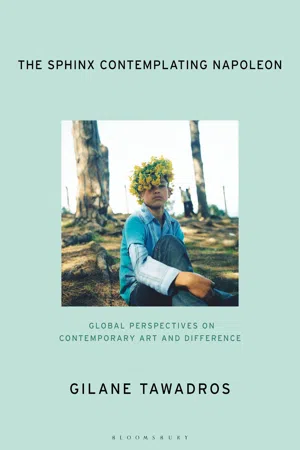
eBook - ePub
The Sphinx Contemplating Napoleon
Global Perspectives on Contemporary Art and Difference
- 304 pages
- English
- ePUB (mobile friendly)
- Available on iOS & Android
eBook - ePub
The Sphinx Contemplating Napoleon
Global Perspectives on Contemporary Art and Difference
About this book
Anchored in artistic practice, this vibrant collection of essays and writings spans a period from 1992-2017 and the work of leading artists such as Adel Abdessemed, Richard Avedon, Sonia Boyce, Frank Bowling, Omer Fast, Mona Hatoum, Susan Hiller, Alfredo Jaar, Glenn Ligon and Shen Yuan. A key figure in British and international art, Gilane Tawadros draws difference to the surface, recuperating it as a potentially radical frame through which to understand contemporary art and the everyday world. Playing with forms of writing, from critical analyses to fictional narratives, the book functions as a practice-based meditation on how to write about contemporary art.
Tools to learn more effectively

Saving Books

Keyword Search

Annotating Text

Listen to it instead
Information
Part One
The leftovers of translation
1
But what is the question?
Art, research and the production of knowledge
I
he reasoned that the fact that he had spent six months researching the history and culture of Benin and that he went there for work rather than leisure, set him apart from ordinary tourists. But did it really? He wondered whether the fact that the focus of his journey was research would justify the term field-trip used by anthropologists or archaeologists? If it was a field trip he was embarking on – his destination being a different culture to his own and his interest lying in the traces of history in contemporary Benin and its organisation of the past – didn’t this mean that he also had to adopt anthropological or archaeological research methods and aims? He was trained in neither discipline nor did he share their systematic approach or scientific objectives. But then what were his methods? What was he after? What did he hope to find? Or was the point that he didn’t actually want to find anything? That he would only try to experience the place and observe it without finding any answers? Would it be enough if he (or his work) might be able, as a result of his trip, to formulate some questions more precisely?
FROM URIEL ORLOW’S THE VISITOR, PART OF THE BENIN PROJECT, 2007.
In The Visitor, the artist Uriel Orlow regards himself, the practice of being an artist and the research that precedes the making of new work as a dispassionate, third-party observer (Figs 1.1–2). He reflects on the role and function of the artist as researcher, setting out on an enquiry that may not afford any answers but rather result in the formulation of more questions. How is the research of an artist different from that of an anthropologist or archaeologist? How does the approach and objectives of an artist differ from those of a scientist embarking on a systematic enquiry? Orlow’s questions to himself and to his audience probe the very nature of the artistic process and its similarity with and difference from other forms of knowledge production.

Fig. 1.1 Uriel Orlow, The Benin Project, 2007. Installation view at CAC Bordeaux. © Uriel Orlow. All rights reserved, DACS/Artimage, 2019. Photo: Arthur Pelquin.

Fig. 1.2 Uriel Orlow, The Visitor, 2007. Single-channel video, 16’. © Uriel Orlow. All rights reserved, DACS/Artimage, 2019.
To Orlow’s questions, we can bring additional questions about the specific nature of visual art and the making of artworks as a distinct practice and means of producing knowledge. What exactly do we mean when we talk about visual art as a form of knowledge production? And how does this differ from text-based forms of research and knowledge production? What new insights or investigations are made possible by the processes of making artworks (or, indeed, of making exhibitions)? What are the implications of this for the ways in which we have traditionally understood and validated knowledge produced in these ways? Finally, is it possible to develop a shared vocabulary and language for talking about the unique non-verbal insights that the visual arts offer as a primary process of research and investigation, rather than as secondary objects which have long been used to validate and exemplify written discourses across a variety of academic subject areas?
II
Orlow’s Benin Project also raises questions about the relationship between visual and linguistic forms of articulation, suggesting that the visual is a more open-ended and fluid domain than that of the linguistic which tends to frame and define the visual like a butterfly caught by a collector and fixed, frozen and immobile, on the end of a pin. But how then can we understand or describe this space which is beyond text. Where is this non-textual space located and what exists in this apparent no-man’s land of the unwritten, the non-verbal and the unspoken? Perhaps one way into this space is to think about it in terms of translation – translation from one culture to another, or from one language to another. In most cases, the process of translation involves moving from the familiar, the homely, the comfortable to the unfamiliar, the unhomely, the uncomfortable. And in the process of moving from one to another, occasionally something may get lost but equally something may get added. For Sarat Maharaj, works like James Joyce’s Finnegan’s Wake (1939) and Marcel Duchamp’s The Bride Stripped Bare by Her Batchelors, Even (The Large Glass) (1915–23) and The Bride Stripped Bare by Her Batchelors, Even (The Green Box) (1934) provide tools for thinking about the difficulties of translation and the limits of language:
What does it mean to be in the experience of the untranslatable? … [My] reflections through Joyce and Duchamp strengthened the idea that although certain things can be translated in the domain of the linguistic, culture is far more than simply language and words. This produced in me a deep sense of the limits of words and language as the exclusive model through which we might think about cultural life and the translation of our everyday experience. With Joyce and Duchamp, there emerged, it seems to me, a notion of translation which activates both the visual and the sonic. Beyond the sense of the word and image are sounds which cannot entirely be decoded or deciphered as meaning this, that or the other … the penumbra of the untranslatable that shadow and smudge language and for which we have to venture beyond language – became an increasingly important area of interest in my thinking about cultural translation.1
III
The illuminated books of the artist Hamad Butt are books without words. The circle of books that make up a part of his installation Transmission (1990) are drenched in a violet light that floods the space, while each individual tome, made from glass, carries its own electric charge (Figs 1.3 and 1.4). It is, as Sarat Maharaj describes it, ‘a whirling, wordless, circuit’. What is striking about Hamad Butt’s works in this context is the process of translation and movement between what is solid, concrete and material, and that which is not solid, immediately visible or able to be grasped and held. This is the space of difference but also the space of the artwork. It is the space that needs to be negotiated but is never entirely translatable. It is a space in which the subtle shifts and changes of a culture and society may be registered but not always tangibly or concretely.

Fig. 1.3 Hamad Butt, Transmission, 1990. Mixed media and ultra-violet light installation. Goldsmiths, University of London. © Hamad Butt. Courtesy of Jamal Butt.

Fig. 1.4 Hamad Butt, Transmission, 1990 (detail). Mixed media and ultra-violet light installation. Goldsmiths, University of London. © Hamad Butt. Courtesy of Jamal Butt.
IV
The cultural critic Stuart Hall has eloquently described the dynamic relationship between an artwork and the world:
Despite the sophistication of our scholarly and critical apparatus in art criticism, history and theory, we are still not that far advanced in finding ways of thinking about the relationship between the [art]work and the world. We either make the connection too brutal and abrupt, destroying that necessary displacement in which the work of making art takes place. Or we protect the work from what Edward Said calls its necessary ‘worldliness’, projecting it into either a pure political space where conviction—political will—is all, or into an inviolate aesthetic space, where o...
Table of contents
- Cover
- Half-Title Page
- Dedication
- Title Page
- Contents
- List of illustrations
- Acknowledgements
- Introduction
- Part One The leftovers of translation
- 1 But what is the question? Art, research and the production of knowledge
- 2 Extra-Extra: Interview with Raul Ortega Ayala
- 3 Dissonant chorus
- 4 Shen Yuan: The leftovers of translation
- 5 Voices off: Interview with Susan Hiller
- Part Two The banality of difference
- 6 ‘We are the Martians …’
- 7 Van Leo: Self-portraits
- 8 Shirana Shahbazi: The banality of difference
- 9 A case of mistaken identity: Notes from the scene of the crime
- 10 Electrifying Eve
- Part Three Re-siting the city
- 11 The real me
- 12 Vladimir and Estragon are still waiting
- 13 Alfred’s favourite tree
- 14 The leopard
- 15 Maps of desire
- Part Four Studies in a postcolonial body
- 16 The revolution stripped bare
- 17 Studies in a postcolonial body
- 18 Veil: Veiling, representation and contemporary art
- Part Five Relocating the remains: History and representation
- 19 Strangers and barbarians: Representing ourselves and others
- 20 Telling tales: Keith Piper’s Relocating the Remains
- 21 Sweet oblivion
- 22 Godville: Interview with Omer Fast
- Part Six Going global
- 23 Going global: 4th International Istanbul Biennial
- 24 Detonations: Jonathan Hernández and the Rongwrong series
- 25 Modern Europeans
- 26 Slipping away (or uncompliant cartographies)
- Part Seven Transmission interrupted
- 27 Interruption in four acts, or disappearing irises, broken-down buses and ceramic Citroens
- 28 Egypt at the Venice Biennale: 1967 and the year that changed everything
- 29 From zero to infinity: The work of Adel Abdessemed
- 30 Reading (and curating) from right to left
- 31 Dissonant divas: Sonia Boyce, sound and collaboration
- 32 A thousand and one
- Endnotes
- Index
- Copyright
Frequently asked questions
Yes, you can cancel anytime from the Subscription tab in your account settings on the Perlego website. Your subscription will stay active until the end of your current billing period. Learn how to cancel your subscription
No, books cannot be downloaded as external files, such as PDFs, for use outside of Perlego. However, you can download books within the Perlego app for offline reading on mobile or tablet. Learn how to download books offline
Perlego offers two plans: Essential and Complete
- Essential is ideal for learners and professionals who enjoy exploring a wide range of subjects. Access the Essential Library with 800,000+ trusted titles and best-sellers across business, personal growth, and the humanities. Includes unlimited reading time and Standard Read Aloud voice.
- Complete: Perfect for advanced learners and researchers needing full, unrestricted access. Unlock 1.4M+ books across hundreds of subjects, including academic and specialized titles. The Complete Plan also includes advanced features like Premium Read Aloud and Research Assistant.
We are an online textbook subscription service, where you can get access to an entire online library for less than the price of a single book per month. With over 1 million books across 990+ topics, we’ve got you covered! Learn about our mission
Look out for the read-aloud symbol on your next book to see if you can listen to it. The read-aloud tool reads text aloud for you, highlighting the text as it is being read. You can pause it, speed it up and slow it down. Learn more about Read Aloud
Yes! You can use the Perlego app on both iOS and Android devices to read anytime, anywhere — even offline. Perfect for commutes or when you’re on the go.
Please note we cannot support devices running on iOS 13 and Android 7 or earlier. Learn more about using the app
Please note we cannot support devices running on iOS 13 and Android 7 or earlier. Learn more about using the app
Yes, you can access The Sphinx Contemplating Napoleon by Gilane Tawadros in PDF and/or ePUB format, as well as other popular books in Art & History of Art. We have over one million books available in our catalogue for you to explore.