The American artists John La Farge preceded Gauguin to the Pacific, and in their time his reputation as the modern Pacific painter far overshadowed that of the Frenchman. This remarkable work is the record of a year-long artistic odyssey through the South Seas, during which La Farge braved the volcanoes of Hawaii, visited Robert Louis Stevenson in Samoa, was adopted by a noble Tahitian family and journeyed through the wild hills of Fiji, painting and sketching lyrical studies of island life. Lavishly illustrated with his work, this account of the Polynesian adventures that La Farge shared with his friend the historian Henry Adams is an important contribution to the literary and artistic heritage of the Pacific and a revealing insight into the life of a complex and fascinating man.
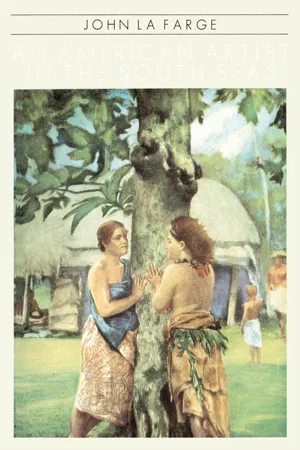
- 256 pages
- English
- ePUB (mobile friendly)
- Available on iOS & Android
eBook - ePub
American Artist In The South Sea
About this book
Trusted by 375,005 students
Access to over 1.5 million titles for a fair monthly price.
Study more efficiently using our study tools.
Information
Subtopic
AnthropologyIndex
Biological SciencesOff the island of Tutuila, on Board the Cutter Carrying Mail, Tuesday, Oct. 7, 1890 (Samoan Time).
The morning looked rainy with the contrary northwest wind that we had carried with us below the equator, when the shape of the little cutter that was to take us showed between the outstanding rocks of the coast of Tutuila. As the big steamer slowed up, a few native boats came out to meet it, manned with men paddling and singing in concert, some of them crowned with leaves, and wearing garlands about their necks, their naked bodies and arms making an indescribable red colour against the blue of the sea, which was as deep under this cloudy sky, but not so brilliant as under yesterday’s sun. They came on board, some plunging right into the sea on their way to the companion ladder, bringing fruit and curiosities for sale. But our time had come; and we could only give a glance at the splendid nakedness of the savages adorned by fine tattooing that looked like silk, and with waist drapery of brilliant patterns. We dropped into the dancing boat that waited for us and scrambled into the little cutter or schooner some thirty feet long, not very skilfully managed, that was to take us sixty miles against the wind to Apia. A few minutes, and the steamer was far away; and we saw the boats of the savages make a red fringe of men on the waves that outlined the horizon —a new and strange sensation, a realizing of the old pictures in books of travel and the child traditions of Robinson Crusoe.

FAYAWAY SAILS HER BOAT. SAMOA
Our crew was made up of the captain, a brown man from other and far-away islands, and two blacks, former cannibals from Solomon Islands, with gentle faces and manners, and rings of ivory in their noses. Our captain spoke of hurry, and used strange words not clear to understand in his curious lingo; but after an hour or so of heavy rain he announced his intention to beat in again and wait for some change of wind. And so we ran into a little harbour high with mountains, all wooded as if with green plumage, cornered by a high rock standing far out, on which stood out, like great feathers, a few cocoa-palms. Palms fringed the shore with shade. A blue-green sea ran into a thin line of breakers — like one of the places we have always read of in “Robinson Crusoe” and similar travellers: “A little cove with the surf running in, and a great swell on the shore.” Our cutter was anchored; then, as we declined to remain on board, either in the rain or in the impossible little cabin about eight feet long, we were taken into the boat, which was skilfully piloted through an opening in the inside reef; and, the surf being high, we were carried to shore on the backs of two handsome fellows whose canoe had come alongside. We walked up to the church, a curious long, low building behind the cocoa-palms; all empty, with thatched roofs and walls of coral cement; the doorway open, with two stones to block out casual straying pigs, I suppose. Inside I saw a long wooden trough, blocked out of a tree. I did not know that this was the old war-drum of pagan times, now used for the Christian bell.
Behind the church, a few yards off, was our destination a Samoan “grass-house,” the guest-house of the village, as I know now. It was thatched with sugar-cane leaves, was elliptical, with a turtle-backed roof, supported by pillars all around, and by three central pillars that were connected by curved beams, from which hung cocoanut cups and water-bottles, or which supported rolls of painted bark cloth. The pebble floor showed at places not covered with the mats, as well as near the centre pillars, where a fire still smoked. Most of the screens of matting, which make the only wall between the pillars, were down, making a gentle shade, in which one woman was sleeping; another, on the opposite side to us, her back turned and naked to the waist, was working at large folds of bark cloth. The women rose from this occupation, and offered their hands, saying, “alofa!”* A younger woman was lying sick, her wrapped-up head on the Samoan pillow of a long bamboo, supported at either end, so as to free it from the ground.
_______________
* ”Alofa“ means everything — hail, welcome, love, respect, etc.
With the same “ alofa” came an elegant young creature, perhaps some sixteen years old, wearing a gay waist drapery of flowered pattern, red, yellow, and purple — with a loose upper garment or chemise of red and violet — open at the sides. Then another, short and strong, with heavy but handsome arms and legs, and with bleared eyes. And we sat down on the mats, the girls cross-legged, and looked at each other while the captain talked, I know not what of.
As I changed my seat and sat near the entrance with my back against the pillars, which is the Samoan fashion, though I did not know it, another tall creature entered, and giving us her hand with the “ alofa” sat down against another pillar — also the proper dignified Samoan way. We did not notice her much; she was quieter, less pretty than the pretty one, with a longer face, a nose more curved at the end, a longer upper lip, and more quietly dressed in the same way. Then entered another with a disk-shaped face, her hair all plastered white with the coral lime they use to redden the hair, and dressed as the others, with the same bare arms and legs. She was heavy and strong below, and less developed above, with the same splendid walk and swing, the same beauty of the setting of the head on the neck.
And we drank cocoanut milk, while kava was being prepared for us in an enchantment of movement and gesture, that I had just begun to feel, as if these people had cultivated art in movement and personal gesture, because they had no other plastic expression.
The movements of the two girls preparing the stuff would have made Carmencita’s swaying appear conventional; so, perhaps, angels and divinities, when they helped mortals in the kitchen and household. As the uglier girl scraped the root into the four-legged wooden bowl set between the two, in front of us, and before the central pillars, she moved her hand and body to a rhythm distinctly timed; and when her exquisite companion took it up, and, wetting the scraped root from double cocoanut shells, that hung behind her, moved her arms around in the bowl and wiped its rim, and frothed the mass with a long wisp of leafy filaments, she tossed the wet bunch to her companion, as if finishing some long cadence of a music that we could not hear, too slow to be played or sung, too long for anything but the muscles of the body to render. And she who received it, squeezed it out with a gesture fine enough for Mrs. Siddons or Mademoiselle Georges. I use these names of the stage, of which I have no fixed idea; those that I have seen could never have given, even in inspired moments of passion, such a sinuous long line to arm and hand. Then in a similar repetition of conventional attitudes the cups were presented to us, one after the other, with a great under-sweep of the full-stretched arm, and we drank the curious drink, which leaves the taste filled with an aroma not unlike the general aromatic odour of all around us, of flowers and of shrubs. For all was clean and dry about us, house and surroundings and crowded people, at least to the senses that smell.
In the slow hypnotism produced by mutual curiosity, by gazing with attention all centred on movement, while pretending to notice all the social matters as they went on about us, I could not disentangle myself from the girl who had bewitched us; and as she sat clasping her elbows, with her legs crossed in her lap, like the images of Japanese Kwannon and of Indian goddesses, I tried to copy a few lines. But the original ones flowed out again like water, before I could fix them. My model was conscious of the attention she called up, and from that moment her eyes always met ours, with a flirting smile, half of encouragement, half of shyness.
And now the tall girl that sat beside me, with the quiet face and unquiet eyebrows, put out her hand languidly to reach for my sketch-book. She was the “virgin of the village” doubly important by being the old chief’s daughter, and elected to this representative position, which entails, at least, the inconvenience of her being always watched, guided, and intimately investigated by the matrons appointed thereto. The lines of my sketch, that would have puzzled the ordinary amateur, were clear to her: “See,” she said, “here is Sifá, clasping her elbows, but her face is not made. Draw me,” and she moved away the hanging mats that obscured the light. The sketch I made was bad, representing to my mind a European with strange features. I don’t know what she thought of it, but she recognized the chemise with ruffles on edges, that covered her shoulders, and made the motion of lifting it away, which I was slow to understand. Her eyebrows moved with some question for which I had no English in my mind. At last the word misonari ? as she looked toward Adams, explained what was meant; I said “no,” and looked approval. She rose, passed into the shade, and sat again before me, her upper garment replaced by a long, heavy garland of leaves and the aromatic square-sided fruit of the pandanus, that partly covered her firm young breast, and lay in her lap against the folds of the bent waist. But my drawing was scarcely better for all this, and I gave it to her, with the feeling that what made it bad for me, its resemblance to a European, might give it value for her. All the time the temptation was strong to treat this child of another civilization as a little princess. She had the slow manner, the slightly disdainful look, the appearance of knowing the value of her sayings and doings that make our necessary ideal of responsibility. What though the Princess puffed at my pipe, meanwhile having secured a cigar, less cared for, behind her pretty ear; what though she pressed two long, slender fingers against her lips, and spat through them, according to some native elegance, she knew that she was a personage and never was familiar, even when she pressed my arm and shoulder, and said, “alofa oi,” “I like you.” Her forehead was high and gently sloping, her eyebrows thin and movable, the eye looked gently and firmly and directly; the nose was a little curved at the heavy end, the upper lip a little long (and pulling on the pipe, if she used it, would lengthen it later yet more), the neck and back of the head had the same beauty of line and setting that I had seen in Hawaii, and her shoulders, and breast, and strong, lithe arms would have delighted a sculptor. She wore her hair gathered up by a European comb, and in front a forelock reddened to the tone of her face, with the coral lime they used. Her legs were strong and fine and her feat only as large as one could expect, with the soles hardened by use over stones and coral.
But she was not the pretty one; her sister, Sifá, was that. The charm of the older one, “the virgin of the village,” was in this incomparable savage dignity, that gave a formality to our visit. What to us was an amusement was to her evidently one of the necessities of hospitality, while Sifá could not move about or look without a ripple of laughter that undulated through her entire person. Occasionally, however, our “ chiefess” looked at me with a gentle smile, and said “alofa!” and by and by, after showing me that she could write, and doing so in my album, (where she dated her inscription Oketopa, our October), she gave me a ring with her name Uatea — or Watea as she wrote it. She partook of lunch, eating after us (along with the captain who appeared again on time), and she refused to taste of some apples we had until we had some of her own fruit, all I suppose according to some proprieties well defined. Then Sifá, her sister, met with a little adventure in unpacking our food for us. The captain of the steamer had given us a block of ice on our leaving, telling us that it was the last we should see in this part of the world, and that it might comfort us during our long, hot sail under the tropical sun. In unrolling it, and taking it up, Sifá, dropped it with a cry of “afi!” — “fire!” and for a few moments we struggled in an unknown tongue to explain what it might be. But I took it for granted that she must have had some Bible explanation of the places where the Bible comes from — that is to say, England and Scotland; hence about winter and bad weather, and perhaps snow and ice.
While the family arranged for their meal we took a walk, “now and again,” as our captain expressed it — almost all the words he knew. We walked across what appeared to be the village green — a space of grass neatly cared for — edged by huts and trees, the palms thickening in the distance and hiding the sudden and close slope of the mountain right above us. Bread-fruit trees were planted here and there near the houses, the large leaves making a heavy green pattern against the innumerable shades of green, the spotted trunks were dark; even the cocoanut trees were only white by the sea. ‘We passed a tomb, of a moundlike shape, one lengthened cube placed upon another, and the upper surfaces sloping to an edge like some of the early sarcophagi or Italian tombs — a shape as simple and elegant as one could wish in such an ideal landscape. I shall have to find out if this most typical shape has originated with them, or has come from some foreign influence. However that may be, it made another classical note. Had Ulysses in his wanderings left some companion here, some such monument might have well marked the tomb of a Greek. There it was, all covered with lichen; and another newer one, made also of coral mortar, still white, near trees, and by former homes, in this little shady “ agora.” As we passed into the path that seemed to run up the hill, young men went by with wreaths on their heads, draped to the waist, like the statues of the gods of the family of Jove; their wide shoulders and strong, smooth arms, and long back-muscles or great pectorals shining like red bronze. All this strength was smooth; the muscles of the younger men softened and passed into one another as in the modelling of a Greek statue. As with the girls we had just left, no rudeness of hair marred the ruddy surfaces, recalling all the more the ideal statues. Occasionally the hair reddened or whitened, and the drapery of the native bark cloth, of a brown ochre colour, not unlike the flesh, recalled still more the look of a Greek clay image with its colour and gilding broken by time. Never in any case was there a bit of colour that might rightly be called bar-baric; the patterns might be European, but no one could have chosen them better, for use with great surfaces of flesh. If all this does not tell you that there was no nakedness — that we only had the nude before us — I shall not have given you these details properly. Evidently all was according to order and custom; the proportion of covering, the manner of catching the drapery, and the arrangement of folds according to some meaning well defined by ancient usage.
Children played about in the open space; they were then at a game of marbles; when we returned, this had turned to some kind of blind-man’s-buff; there was no roughness, only a good deal of soft laughter; one youngster, draped to the chest like a Greek orator, too big for the children, too young for the men, leaned upon a long staff and looked on gravely, exactly like the figures on the Greek vases, or the frieze of the Parthenon.
We walked along into the forest, in the silence of noonday, but the abruptness and slipperiness of the path as it rose rapidly to walls of wet rock, stopped our feet. From the intricate tangle of green, we saw the amethyst sea, and the white line of sounding surf cutting through the sloping pillars of the cocoanuts, that made a mall along the shore; and over on the other side of the narrow harbour, the great high green wall of the mountain, warm in the sun, and its fringe of cocoanut grove, and the few huts hidden within it, all softened below by the haze blown up from the breakers. All made a picture, not too large to be taken in at a glance; the reality of the pictures of savage lands, in our school books, filled in with infinite details. From dark inter...
Table of contents
- Cover
- Title Page
- Copyright Page
- Introduction
- Prefatory Note
- Table of Contents
- En Route
- Honolulu
- Hawaii
- Samoa
- At Sea from Samoa to Tahiti
- Tahiti
- Tahiti to Fiji
- Fiji
- Epilogue
Frequently asked questions
Yes, you can cancel anytime from the Subscription tab in your account settings on the Perlego website. Your subscription will stay active until the end of your current billing period. Learn how to cancel your subscription
No, books cannot be downloaded as external files, such as PDFs, for use outside of Perlego. However, you can download books within the Perlego app for offline reading on mobile or tablet. Learn how to download books offline
Perlego offers two plans: Essential and Complete
- Essential is ideal for learners and professionals who enjoy exploring a wide range of subjects. Access the Essential Library with 800,000+ trusted titles and best-sellers across business, personal growth, and the humanities. Includes unlimited reading time and Standard Read Aloud voice.
- Complete: Perfect for advanced learners and researchers needing full, unrestricted access. Unlock 1.5M+ books across hundreds of subjects, including academic and specialized titles. The Complete Plan also includes advanced features like Premium Read Aloud and Research Assistant.
We are an online textbook subscription service, where you can get access to an entire online library for less than the price of a single book per month. With over 1.5 million books across 990+ topics, we’ve got you covered! Learn about our mission
Look out for the read-aloud symbol on your next book to see if you can listen to it. The read-aloud tool reads text aloud for you, highlighting the text as it is being read. You can pause it, speed it up and slow it down. Learn more about Read Aloud
Yes! You can use the Perlego app on both iOS and Android devices to read anytime, anywhere — even offline. Perfect for commutes or when you’re on the go.
Please note we cannot support devices running on iOS 13 and Android 7 or earlier. Learn more about using the app
Please note we cannot support devices running on iOS 13 and Android 7 or earlier. Learn more about using the app
Yes, you can access American Artist In The South Sea by John La Farge in PDF and/or ePUB format, as well as other popular books in Biological Sciences & Anthropology. We have over 1.5 million books available in our catalogue for you to explore.