Nearly 2,400 years ago, ancient philosopher Plato wrote the story of Atlantis, a compelling tale of an 11,000-year-old island civilization which has since captivated the imagination of poets, authors, and the minds of many scholars who over the centuries kept on searching for the legendary island. Today, numerous speculations place Atlantis in locations like the Azores Islands in the middle of the Atlantic, in Spain, somewhere off the coast of southeastern Cyprus, in Malta, or in more exotic lo
- 184 pages
- English
- ePUB (mobile friendly)
- Available on iOS & Android
eBook - ePub
About this book
Information
Atlantis Revealed
Ancient Technologies: Mechanical Computers and Batteries — Was the Great Flood a Real Event? — Was America Discovered by a Bronze-Age Civilization? — Were Caucasians in North America in 7000BC? — Did Bronze-Age Visitors Help “Form” the Mayan Civilization? — The Metcalf Stone — Who Were the Minoans? — Atlantis Revealed — Is the Great Sphinx Older than the Pyramids? — The Phaistos Disc: An Ancient Souvenir?
While, without a doubt, the twentieth century brought to us some of the most incredible scientific breakthroughs humanity ever witnessed, we must not discount the amazing achievements and technological wonders left behind by past human civilizations. Aside from the several megalithic monuments antiquity left behind, there are also many smaller marvels of ancient ingenuity that confront our awareness and demonstrate our ancestors’ amazing technological abilities.
Recent excavations on the Greek island of Santorini (Thira) revealed that houses in the 3,600-year-old city of Akrotiri had indoor plumbing, complete with sewer and water supply lines for both hot and cold water. This is incredible because up until recently, we were under the impression that it was the Romans who were first able to utilize such technology, nearly 1,500 years later.
What about the Antikythera Mechanism? An extremely complex device designed to calculate astronomical positions at any given moment in time. It was found at the bottom of the Aegean Sea near the Greek island of Antikythera, hence its name. Made out of several bronze wheels and other mechanical components more than 2,000 years ago, this device is so incredible that at first glance, it resembles a twentieth-century piece of equipment. Indeed, when it was first discovered, it was mistaken as such. An X-ray of the mechanism revealed that instruments of this complexity were not known to exist at least until the 17th century. Who designed and constructed this remarkable device or how this technology was lost afterwards, is not clear. Labeled by scientists as the first mechanical computer in human history, this amazing feat of engineering required that its maker had advanced knowledge of astronomy, as well as a diverse knowledge in mechanics and machine making.
Professor Michael Edmunds of Cardiff University, who led the most recent study of the mechanism, stated that:
This device is just extraordinary, the only thing of its kind. The design is beautiful, the astronomy is exactly right. The way the mechanics are designed just makes your jaw drop. Whoever has done this has done it extremely carefully…in terms of historic and scarcity value, I have to regard this mechanism as being more valuable than the Mona Lisa. [1]
Another one of the many yet unexplained artifacts that continuously raises eyebrows and stirs many debates among the scientific community, is the famous Baghdad Battery. This primitive version of a modern battery made out of clay vessels, copper tubes, and the right alkaline fluid was capable of producing electricity nearly 2,000 years ago. What was the purpose of the electricity produced by these batteries, and where did this knowledge come from, no one knows. Until their discovery, we were under the impression that battery technology was an 18th century invention.
With every new find, without a doubt, our ancestors continue to demonstrate that several millennia ago they were extremely knowledgeable and more technologically advanced than we have been giving them credit for. How, though, did they come across their incredible knowledge? How could they possess skills that until recently, we thought were acquired during the industrial revolution? Where these really brand new skills, or is it perhaps possible that we evolved much earlier in time and thus developed many of our technological capabilities over the millennia, long before our recorded history? And, if so, if our ancestors truly had advanced thousands of years earlier than anthropologists previously thought, what happened to all past human development?
The story of a “Great Flood” sent by God (or gods according to much earlier testimony) to destroy humanity for its sins is a widespread account shared by many religions and cultures around the world and dates back to our earliest recorded history. From India to ancient Greece, Mesopotamia and even among North American Indian tribes, there is no shortage of such tales that often enough sound very much alike. Some of these stories truly sound so similar that one could wonder whether all cultures around the planet had experienced such an event. Or is it possible they influenced each other by storytelling over the millennia?
Can it be that all flood accounts so zealously repeated around the world are a collection of myths or isolated incidents? Or was the Great Flood a single worldwide cataclysm that affected all humanity at one point during our prehistory? While small isolated disasters can stress and frighten affected populations equally, their overall effect is short-lived, and they often fade from memory within decades, if not years. In the case of the Great Flood, however, we have a story that seems to have no boundaries and one that every culture insists on its worldwide nature. How big and how destructive though, was such a disaster that managed to sear itself into our ancestors’ collective memory for thousands of years? Judging by the shared testimony, this must not only have been an event that affected everyone simultaneously, but in order for it to have become a permanent fixture in the human psyche, it must have been an experience that persisted not only for days or months, but for several generations.
Today, although science accepts that regional floods have indeed adversely affected many ancient populations over the millennia, it still denies that there was ever a single deluge that affected every civilization on the planet at once. Meanwhile, while the type, chronology, and magnitude of such an event is still highly debated, several scientific theories of the Great Flood are currently in circulation, and more of them continue to surface from time to time.
In recent years, and according to a published study in 1997 by William Ryan and Walter Pitman, the story of the Great Flood was linked to the “sudden flood” of the Black Sea. According to their hypothesis, at around 5600 BC, the melting of the glaciers—along with several other significant hydrological factors that included the flow of rivers and heavy rainfall—caused the Mediterranean Sea level to rise so rapidly that it ultimately and violently flooded the Black Sea, making it into the body of water we know today.
Ryan and Pitman speculated that the flooding from the Mediterranean occurred via a massive waterfall, nearly two hundred times larger than that of Niagara Falls, which daily dumped ten cubic miles of sea water into the Black Sea for a period of 300 days. By the time it was over, 60,000 square miles around the Black Sea had been submerged. This was the best evidence we had for nearly a decade in order to explain the story of the Great Flood. Although more of a regional flood, undoubtedly, such an event could have utterly destroyed any established civilization around the Black Sea during this period, and rightfully so could have been labeled as a great flood by those who experienced it.
Unfortunately for the Ryan and Pitman team though, another study conducted since reported differently. Although the later research agreed to the premise of the Black Sea being flooded, it contradicted the severity of the flood as well as the chronological time of the event. In 2005, a research project under the sponsorship of UNESCO was conducted by the International Union of Geological Sciences as well as a Ukrainian and Russian scientific team that included Valentina Yanko-Hoback. They published in 2009 that the flood of the Black Sea was more of a gradual event and less catastrophic to human life than previously thought. Most importantly, though, it was determined that the incident took place earlier chronologically, and much closer to 8000 BC. So, in essence, this study confirmed that the flooding of the Black Sea did not have the horrible devastation associated with the loss of human life, and unlike previous estimates, this event definitely took place during our prehistory.
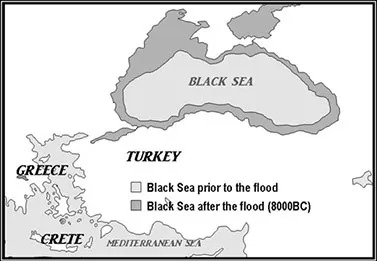
Water level around the Black Sea prior to and after the flood of 8000 BC
If not the flooding of the Black Sea, though, what other regional—or better yet—worldwide catastrophe qualifies to be called the Great Flood? Without a doubt, it was the rise of the oceans at the end of the last ice age. More particularly, it was the abrupt rise of the oceans around 8000 BC which led to the flooding of the Mediterranean first and ultimately to the flooding of the Black Sea. That was the single, long-lasting event which drastically reshaped the coastlines of our planet and the one which simultaneously affected every coastal civilization around the world at the time. In fact, if past periodic ice ages and floods did not manage previously to add salinity into the fresh water of the Black Sea, then undoubtedly the last global flood around 8000 BC must have been the greatest flood of all time.
Although adverse weather conditions, tsunamis, or hurricane-related floods can cause severe destruction several miles inland, the effects from such disasters are always temporary. The significant rise of the oceans, though—a worldwide disaster that erased millions of square miles of dry land around the planet—must have been the doomsday event every culture to this day inadvertently is talking about. Even when at first look, the gradual rise of the oceans does not seem to meet the criteria as the event behind the legend of the Great Flood, an incident responsible for the sea level to rise globally by more than 400 feet, surely had many random episodes when the flooding was absolutely unpredictable. When considering that humans, by nature, tend to settle in lower elevations and near water, it leaves no doubt that all prehistoric civilizations were totally devastated by this event. This must have been a period of constant relocation and adjustment as people continuously kept on looking for higher ground to rebuild and new valleys to grow crops to support those settlements.
To challenge this theory, at least until recently, anthropologists insisted that 10,000 years ago humans were way too primitive to have been aware of such an event. So, in essence, as there were no known civilizations around at the time that could have been affected by this natural catastrophe, the Great Flood story was thought to be a myth or a disaster that have taken place later in time, during our recorded history. Of course, as there are no clues of global cataclysms during our recorded history, this once more led to their eventual conclusion that the Great Flood was either a myth or a much smaller regional incident like the flooding of the Black Sea.
For many years, this was the general “logic” that dominated many academic minds and the greatest challenge to the Ice Age Flood theory, when this hypothesis was brought up.
Incidentally, all this changed in 1994 with the archaeological discovery of Gobekli Tepe, a 12,000-year-old mega site in southeastern Turkey, as well as in 2002 with the discovery of a 10,000-year-old city found submerged under 130 feet of water off the coast of West India in the Gulf of Cambay. In this case, several generations of fishermen insisted on stories of an underwater city in that area, but their claims went unnoticed until the site was accidentally discovered during pollution survey tests conducted by India’s National Institute of Ocean Technology. With the use of side-scan sonar, which sends a beam of sound waves to the bottom of the ocean, scientists found huge g...
Table of contents
- UCHRONIA?
- Prologue
- Introduction
- Atlantis Revealed
- The Human Genome
- The Sumerians
- The Technology and the Flying Machines of the Gods
- UFOs: Past and Present
- Our Mysterious Past
- Inexplicable Skulls of Antiquity
- Mysterious Places
- Epilogue
- About Atlantis
- Notes
- Bibliography
Trusted by 375,005 students
Access to over 1.5 million titles for a fair monthly price.
Study more efficiently using our study tools.
Frequently asked questions
Yes, you can cancel anytime from the Subscription tab in your account settings on the Perlego website. Your subscription will stay active until the end of your current billing period. Learn how to cancel your subscription
No, books cannot be downloaded as external files, such as PDFs, for use outside of Perlego. However, you can download books within the Perlego app for offline reading on mobile or tablet. Learn how to download books offline
Perlego offers two plans: Essential and Complete
- Essential is ideal for learners and professionals who enjoy exploring a wide range of subjects. Access the Essential Library with 800,000+ trusted titles and best-sellers across business, personal growth, and the humanities. Includes unlimited reading time and Standard Read Aloud voice.
- Complete: Perfect for advanced learners and researchers needing full, unrestricted access. Unlock 1.5M+ books across hundreds of subjects, including academic and specialized titles. The Complete Plan also includes advanced features like Premium Read Aloud and Research Assistant.
We are an online textbook subscription service, where you can get access to an entire online library for less than the price of a single book per month. With over 1.5 million books across 990+ topics, we’ve got you covered! Learn about our mission
Look out for the read-aloud symbol on your next book to see if you can listen to it. The read-aloud tool reads text aloud for you, highlighting the text as it is being read. You can pause it, speed it up and slow it down. Learn more about Read Aloud
Yes! You can use the Perlego app on both iOS and Android devices to read anytime, anywhere — even offline. Perfect for commutes or when you’re on the go.
Please note we cannot support devices running on iOS 13 and Android 7 or earlier. Learn more about using the app
Please note we cannot support devices running on iOS 13 and Android 7 or earlier. Learn more about using the app
Yes, you can access Uchronia by Christos a. Djonis in PDF and/or ePUB format, as well as other popular books in Social Sciences & Archaeology. We have over 1.5 million books available in our catalogue for you to explore.