Complete guide to explore 3d printing, scanning, sculpting, and milling. Key Features
Step-by-step guide to learn the techniques, methodologies, and finished products
Learn to employ 3D technology in new and inventive ways
Know to enlarge, reduce, and repurpose existing artwork.
Book is a practical tutorial, packed with real-world case studies to help you to design models that print right the first time.
Learn to design models, choose materials, work with different printers, and integrate 3D printing with traditional prototyping to make techniques more efficient.
Description This book 3D Printing Made Simple takes you through this exciting innovation, a technology called 3D Printing. It is revolutionising the way we do a lot of things and not just the creation of physical objects. The huge growth rates are a direct result of its applications for prototyping and mass production in a number of industries, thanks to an ever-increasing list of 3D printable materials. The World Economic Forum describes it as one of the four pillars of the 4th Industrial Revolution alongside AR, VR & AI, big data, blockchains etc. Many developing countries like India, completely missed the 1st two industrial revolutions (steam & petrol engines) and partially benefitted in the 3rd (electronics/computers). Now can we afford to not, or just partially participate in the 4th Industrial Revolution? Book adopts a practical approach, with step-by-step instructions to help guide readers. Lots of screenshots are given for each and every step where needed to design a high-quality model in Blender for 3D printing. What You Will Learn
3D Printing/3D Prototyping, its history, process, applications, SDG Goals.
3D Printing technologies, SWOT Analysis
Who This Book is For If you are a Blender user or someone who wants to make 3D objects suitable for 3D printing and if you are familiar with SketchUp and want to print the models which you have designed, then this book is ideal for you. Table of Contents 1. Part 1 1.1 What is the future going to be? An overview 1.2 4th Industrial Revolution 1.3 History of 3D Printing and what humans want 1.4 What is 3D Printing or 3D Prototyping and how it differs from the traditional prototyping?. 1.5 The process of 3D Printing 1.6 Example & Applications of 3D Printing 1.7 Utility of 3D Printing 1.8 Comparing 3D Printing to Mass Production 1.9 UN – SDG Goals & 3D Printing Summing up Part 1 2. Part 2 2.1 Advantages of 3D Printing & where it's ideal 2.2 Kinds of 3D Printing technologies 2.3 SWOT Analysis of 3D Printing & survey results 2.4 3D Printing in Schools & Universities 2.5 3D Printing & how to empower ourselves 2.6 Introduction to Design 2.7 Live Use cases 2.8 What we do Wrapping Up Part 2Glossary References Must-see videos About the Author Avikshit Saras went to Modern School – New Delhi, thereafter did his BSc. from University of Bradford and his MSc. from the University of Manchester. He has been involved in numerous businesses such as financing of vehicles, dairying, pharmaceuticals, investment advisory and 3D printing. In 3D printing they engage with organisations for 3D printing training, consulting, prototyping services & installations. He has trained students & teachers at Indian School Muscat, DPS Faridabad, Pathways Gurgaon, Shalom, Scottish High, numerous other individuals, delivered 3DP talks in about 100 institutions and consulted for organisations. LinkedIn Profile: linkedin.com/in/avikshit-saras-msc-coo-748721a
Trusted by 375,005 students
Access to over 1 million titles for a fair monthly price.
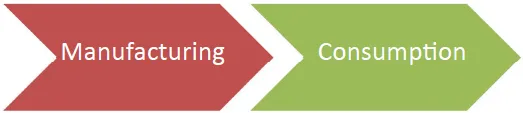
What you think is the future going to be like, in terms of the manufacturing to consumption eco – system?
1.
Will manufacturing come closer to the place of consumption?
2.
Will there be a reduced need for logistics or transport? or
3.
Will there be a reduced requirement of space to stock inventory?
So how many of us ever thought about the above? Traditionally we have been told and we do experience that there is manufacturing of goods in factories then there is distribution of the same using some means of transport / logistics. Thereafter it is stored in warehouses / godowns before it finally reaches the consumer. But in the current century we can say with confidence that the logistics & warehousing functions may undergo a sea change, if not get eliminated.
With 3D printing the whole concept of manufacturing then transporting then storing or vice versa is getting outdated.
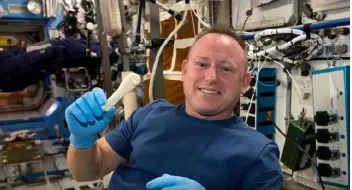
Figure 1: Astronaut 3D printing a tool in space (ISS) on demand
It is on demand manufacturing that is taking precedence and resulting in operational efficiency and productivity. For example NASA1 has installed a zero gravity 3D printer in the International Space Station (ISS) to 3D print parts on demand. Otherwise each time a payload was needed to be sent from earth to ISS, but now only 3D files can be sent to be 3D printed at ISS (Figure 1). Related to this, is the concept of mass manufacturing over customized manufacturing or mass customisation. Mass manufacturing took shape & popularity in the 19th - 20th century in US / Europe with the advent of the factory system, Fordism etc. Now days, there is more customization than ever before and gone are the days of, ‘I will give the customers a choice as long as their choice is black’, Henry Ford!
When I visited the Jaguar factory in Castle Bromwich, Birmingham, UK, each car on the assembly line was being made custom designed & suited to the customer’s choice of trims, colour, governmental regulation (left hand or right hand drive), technical specifications etc.
However there are ships being converted to factories2, workers producing goods on board, by the time the ship reaches its destination the goods are ready for dispatch to the buyer! The lead times are increasingly getting shorter, a great deal of automation is happening and above all we see a lot of data being captured by advanced analytical software. At times we do not realize this but it’s all around us. You look at a product at an ecommerce site, its starts to follow you in terms of ads in various other places, yours along with others probability of say booking an air ticket makes ticket prices fluctuate and there are loads of such examples. So the way things are being done is changing and we need to ask ourselves, are we ready for that change? (Figure 2)
Your decision to read this bespoke book on this cutting edge 21st century technology – 3D Printing, suggests that you are! So briefly answering our initial 3 questions, 3D (three dimensional) Printing has the potential to manufacture on demand which greatly impacts the need to transport the manufactured goods or store the same. (Figure 3)
Figure 2: 20th century & before scenario
Figure 3: 21st Century scenario
1.2 4th Industrial Revolution
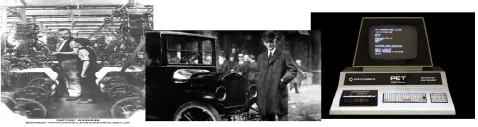
This has received wide spread attention recently. In 2016 Klaus Schwab Founder of the World Economic Forum3, highlighted the term the 4th Industrial Revolution, its role / significance and detailed the technologies that form its part. Many of us who have forgotten the earlier industrial revolutions, I shall recapitulate. The 1st Industrial Revolution happened in the late 1700s in Europe with the advent of the steam engines. The big impact was in the textile industry where the shift from handlooms to power looms took place. The next big industrial revolution (2nd) happened in the late 19th century with the advent of internal combustion engines. Automobiles became centre stage and mass produced. Alongside this the oil & gas industry also got a big boost. Thereafter around the 1960s – 1970s the advent of electronics & computers is considered the 3rd Industrial Revolution. (Figure 4)
Figure 4: From left 1st Industrial Revolution (I.R.) steam engines, 2nd I.R. internal combustion engines and 3rd I.R. electronics & computers
There are a few things to note here. Firstly, with the advent of technology productivity & effciency went up. Secondly there were only 1 or 2 technologies that needed to be mastered. However, those people who did not learn the upcoming technology of its time went from being unemployed, to unemployable. It’s pertinent to note that unemployment is temporary, but being unemployable is long term. So, meaning to say those people amenable to change continued to climb the economic / social ladder, some either stayed the way they were and the rest went down the ladder. There are dozens of professions that have disappeared even in the last 100 years & less, which again many people have forgotten like the chimney sweepers, street lamp oil lighters, carriage drivers, typists, telephone operators etc.
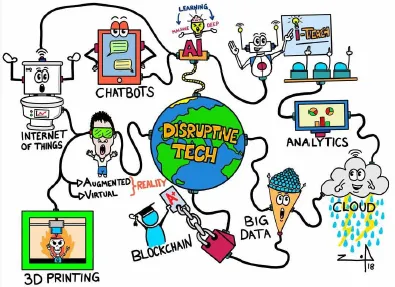
But there is a plethora of jobs / businesses that are associated with technologies that form a part of the 4th Industrial Revolution. These technologies are Big Data, Block Chains, 3D Printing, Artificial Intelligence, Machine Learning, Drones, Robotics, IoT, Virtual Reality, Augmented Reality etc. (Figure 5) Basically choices galore and people can choose what’s best suited to them, their interests, passion etc. Just as I early chose 3D Printing you should also choose one or more of the 4th Industrial Revolution technologies at the earliest. You will stay relevant longer in the job market or the entrepreneurial realm, as sooner or later these technologies will impact your lives, work, businesses etc. Those people or businesses who were adept say at making pagers, picture tubes, typewriters, video cassette players or other such obsolete technologies, have learnt it the hard way or if survived they might have embraced change early on.
Figure 5: 4th Industrial Revolution as depicted by Zaid Ali Alsagoff
The best example of this decade for obsolescence is of Nokia4 that at its height was valued over U$D 50 billion, but got sold to Microsoft for less than U$D 10 billion, because early on Nokia didn’t switch to touch screen based phones like all the other manufacturers that followed Apple. Among other things that led to Nokia’s collapse, its ability to innovate drastically fell. Correspondingly the Dubai Government for instance is adopting and surging ahead in the use of BlockChain technology in government transactions by 2020. Blockchains technology can be effectively deployed in various government transactions such as registering of land records, banking, insurance, legal fillings etc. as it is a publicly distributed secure ledger. So ask yourself a question, if you were based in Dubai would you have learnt & adopted Blockchains or not?
The super successful businesses or people of the 21st century will be the ones that are able to combine these above new age technologies, which is make them cross disciplinary. The change has begun, you can’t reverse globalization, you can’t reverse increase in life expectancy, and you can’t reverse the intertwining of our physical & digital worlds like it was before. The move is certainly from Homo Sapiens to Homo Deus as Yuval Harrari5 has described. Homo Deus in its literal meaning is human (homo) - god (deus) which in effect points to the assimilation of God like prowess/ powers by humans. With increased life expectancy people are drawing pensions for longer periods than their salary drawing active working life. So it’s imperative to keep the mind active, agile & engaged by imbibing new technologies.
Also a case in point is the power of social media that has totally changed the way we communicate. Many people for instance not familiar with WhatsApp based learning, asked me, how will the course happen, where will it happen etc. as WhatsApp for many is just a communication medium or at worst a form of entertainment. But as Sandeep Srivastav of IYC World says, ‘one would realize that this was the same with languages too, a communication medium, but when academic teaching, research etc. started happening in languages & through languages, that’s when we started to progress more than ever before.’ So now in the 4th Industrial Revolution one uses technology with a person’s own imagination, creativity, thinking, intuition etc. to become more progressive, productive & effcient.
What would you do to become more productive & effcient?
1.3 History of 3D Printing and what humans want
3D Printing was invented in the early 1980s by a Japanese inventor named Dr. Hideo Kodama6 who unfortunately did not file a patent for the same! Later in the decade an American named Chuck Hull who was also researching the technology filed a patent for it. So the technology has been around for about 3 decades, but has become more main stream now. Along that time various other people & organizations too were working on similar or related technologies to 3D Printing. Scott Crump who founded Stratasys also in the US, is credited for doing path breaking work in 3D Printing. The University of Bath, UK’s Rep Rap project opened up 3D printing to the world in the last decade before the patents started to expire. The common factor in the above methodology that people & organizations were attempting to do, was to create objects, prototypes etc. in the most effcient way, that is layer by layer adding material from bottom to top or vice versa and bringing it in the realm of the masses. Yes, the patents have got expired and they continue to do so. We see a lot of proliferation of 3D printers per say in the market, in businesses, factories, offces etc. So, 3D Printing isn’t just a B2B technology, but has gained traction to become more wide spread & mainstream, to become B2C even.
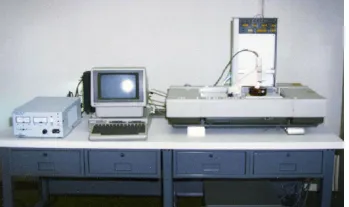
Figure 6: A 3D Printer setup in the 1980s’
The 1990s’ saw the emergence of various other kinds of 3D printing technologies such as binder jetting, SLM (selective laser melting), FDM (fused deposition modeling) etc. It also saw the emergence of various players in US & Europe that were focused both on Individual & Institutional uses. Additional material capable of 3D printing started to arrive at the scene. Around this time more CAD applications also started to develop. By the end of the decade medical applications of 3D printing started to appear. So the 2000 decade saw kidneys & internal organs being 3D printed. Prosthetics development also started to gain traction in this decade. 3D scanning started to emerge and when combined with 3D printing gave that ease of design. Colour 3D printers started to arrive in the market, but their costs still remain quite high vis a vis single colour based 3D printing.
By the end of the 2000 decade the first patents expired and 3D printing became accessible to more...
Table of contents
Cover
3D Printing Made Simple
Copyright
Preface
Foreword
Contents
Part 1
Part 2
Frequently asked questions
Yes, you can cancel anytime from the Subscription tab in your account settings on the Perlego website. Your subscription will stay active until the end of your current billing period. Learn how to cancel your subscription
No, books cannot be downloaded as external files, such as PDFs, for use outside of Perlego. However, you can download books within the Perlego app for offline reading on mobile or tablet. Learn how to download books offline
Perlego offers two plans: Essential and Complete
Essential is ideal for learners and professionals who enjoy exploring a wide range of subjects. Access the Essential Library with 800,000+ trusted titles and best-sellers across business, personal growth, and the humanities. Includes unlimited reading time and Standard Read Aloud voice.
Complete: Perfect for advanced learners and researchers needing full, unrestricted access. Unlock 1.4M+ books across hundreds of subjects, including academic and specialized titles. The Complete Plan also includes advanced features like Premium Read Aloud and Research Assistant.
Both plans are available with monthly, semester, or annual billing cycles.
We are an online textbook subscription service, where you can get access to an entire online library for less than the price of a single book per month. With over 1 million books across 990+ topics, we’ve got you covered! Learn about our mission
Look out for the read-aloud symbol on your next book to see if you can listen to it. The read-aloud tool reads text aloud for you, highlighting the text as it is being read. You can pause it, speed it up and slow it down. Learn more about Read Aloud
Yes! You can use the Perlego app on both iOS and Android devices to read anytime, anywhere — even offline. Perfect for commutes or when you’re on the go. Please note we cannot support devices running on iOS 13 and Android 7 or earlier. Learn more about using the app
Yes, you can access 3 D printing made simple by Avikshit Saras in PDF and/or ePUB format, as well as other popular books in Technology & Engineering & Electrical Engineering & Telecommunications. We have over one million books available in our catalogue for you to explore.