eBook - PDF
Inter Moesos et Thraces
The Rural Hinterland of Novae in Lower Moesia (1st – 6th Centuries AD)
- 253 pages
- English
- PDF
- Available on iOS & Android
eBook - PDF
Inter Moesos et Thraces
The Rural Hinterland of Novae in Lower Moesia (1st – 6th Centuries AD)
About this book
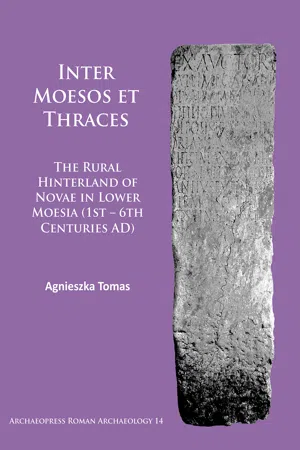
The Roman legionary base at Novae in Lower Moesia is one of the most important sites in the Lower Danubian provinces. Towards late Antiquity, the military camp was transformed into a civil town with Episcopal residence and survived until the beginning of the 7th century. The Polish-Bulgarian excavations carried out for more than 55 years revealed remains dated from the mid-1st up to the early Byzantine periods and more than 300 inscriptions on stone. The rural hinterland of Novae is exceptional and fascinating for the historian and archaeologist, not only due to the importance of the site itself, but also due to its location. The legionary camp at Novae was located halfway between the outlets of two rivers – the Os?m and Jantra, flowing nearly parallel to each other. This part of the Danubian Plain was inhabited by Geto-Thracians and tribes influenced by the Celts. The special position of the lands between the Os?m and Jantra rivers is well-expressed by a series of boundary stones set up in AD 136 by Emperor Hadrian, who divided the tribal territories of Moesos and Thraces. This special geopolitical situation must have caused considerable difficulties in administering the area by the Romans. At present this poses a challenge for scholars, who search for answers to various questions concerning the universal solutions applied in borderlands in the past.
Trusted by 375,005 students
Access to over 1.5 million titles for a fair monthly price.
Study more efficiently using our study tools.
Information
Table of contents
- Front Cover
- Title Page
- Copyright information
- Dedication
- Acknowledgements
- Transcription of the Cyrillic script
- Contents
- Introduction
- Chapter 1
- Fig. 1. Relief map of south-eastern Europe. Black box marks the area of study (by. A. Tomas)
- GEOGRAPHY OF THE REGION
- Fig. 2. The Danube at Novae (phot. M. Pisz)
- Fig. 3. The Danube at Vardim (phot. T. Sarnowski)
- Fig. 4. The Danube at Nikopol (phot. Nuray Tatarov)
- Fig. 5. The Jantra river basin (http://iantra.com/index.php?option=com_content&task=view&id=104&Itemid=101) and a view on the river (www.joanna-in-bulgaria.com, phot. John Dennahy)
- Fig. 6. The Osăm river at Čerkovica (phot. A. Tomas)
- Fig. 7. The Lomja river at Butovo (phot. A. Tomas)
- Fig. 8. Čatala hill near Vărbovka (phot. A. Tomas)
- Fig. 9. Limestone outcrops near the Lozica village (phot. A. Tomas)
- Chapter 2
- HISTORICAL SETTING
- Fig. 10. Moesia and Thrace around AD 45 (by A. Tomas, based on the map by Sarnowski et al. 2014)
- Fig. 11. Moesia around AD 70 (by T. Sarnowski)
- Fig. 12. Moesia around AD 150 (by T. Sarnowski)
- Fig. 13. Moesia around AD 212 (by T. Sarnowski)
- Fig. 14. The Lower Danube and Moesia II around AD 375 (by T. Sarnowski)
- Chapter 3
- METHODOLOGICAL REMARKS AND CLASSIFICATION OF THE SITES
- Chapter 4
- Fig. 15. Novae. The digital elevation model of the fortress and its surroundings (by P. Zakrzewski)
- SETTLEMENT STRUCTURES
- Fig. 16. Nicopolis ad Istrum. Reconstruction painting of the early Byzantine city ca. 500 (after A. Poulter 1995, pl. I)
- Fig. 17. Novae. Reconstruction of the barracks’ wall in the wood-and-earth camp (after E. Genčeva 2002)
- Fig. 18. Teliṭa-Amza, Dobrogea (Romania). The plan and reconstruction of a pit-house discovered in the Roman-Getic settlement, ca. AD 100 (after T. Sarnowski, L. Kovalevskaja, J. Kaniszewski)
- Fig. 19. The map of rock outcrops identified in Novae; 1 – sandstone outcrops; 2 – outcrops of limestone, types 1-6; 3 – outcrops of limestone, type 7 (based on Skoczylas, Čolakov, Walkiewicz 1979)
- Fig. 20. Limestone outcrops near Bjala and an extracted stone (phot. A. Tomas)
- Fig. 21. The Čatala basalt hill near Butovo. The view from the south and its interior bearing traces of exploitation
- Fig. 22. Architectural elements. 1, 2 – Butovo I; 3 – Karanci I; 4 – Batak I; 5 – Belene I; 6 – Pavlikeni II; 7 – Batak I; 8 – Pavlikeni I; 9 – Kucina I; 10 – Patreš I (Nos. 3, 4, 9, 10 after Stefanov 1956, no. 5 after Škorpil 1905, no 8 after Sultov 1962
- Fig. 23. Crafts and trade. A – plan of the pottery workshop at Pavlikeni (after Sultov 1983а, tab. V.3 ); B – plan and reconstruction of the pottery workshop in Hotnica (by T. Sarnowski, J. Kaniszewski, after Sultov 1983a, tab. II.2); C – pottery kiln at
- Fig. 24. Religious life. A – Stežerovo. A votive plate with representation of Artemis (phot. A. Tomas, courtesy of MSv); B – Asenovo. A bronze figurine of Epona (after Reinach 1899b); C – Pavlikeni. A sculpted group representing the Bacchic thiasos. Origi
- Fig. 25. Burial rites. 1 – Typical tumulus from the Roman period (surroundings of Novae); 2 – the column from Pavlikeni; 3 – the mausoleum in Lesičeri; 4 – a ground plan of the cemetery near Novae (Svištov VII; after Vălov 1965); 5-9 – graves in the cemet
- Fig. 26. Aqueducts. A – the aqueducts of Novae and its surroundings (after M. Biernacka-Lubańska 1997); B – a cross section of the aqueduct of Novae (after Stefanov 1956); C – an aqueduct of the villa Pavlikeni II (photo T. Sarnowski)
- Fig. 27. The harbour at Novae. A – a brick with a ‘boat stamp’ (phot. by J. Pisz); B – Plan of the harbour remains (after T. Sarnowski 1996); C – plans and profiles of the remains documented by the Danube (after T. Sarnowski 1996);
- Fig. 28. Roads in the hinterland of Novae; A – ancient roads and archaeological remains near Bjala Čerkva (after Jordanov 1991); B – a cross section of the road Nicopolis – Marcianopolis at the Krušeto village (after Stefanov 1956); C – the road Nicopolis
- Chapter 5
- LOCAL ADMINISTRATION AND GOVERNMENT
- Fig. 29. Provincial borders of Lower Moesia (A) and Moesia Secunda (B) (after B. Gerov, M. Tačeva)
- Fig. 30. Stones with a phrase inter Moesos et Thraces discovered in the Jantra river basin. Numbers MTh refer to the Catalogue Appendix 1. (Maslarevo, Butovo, Svištov after B. Gerov and A. Tomas; Polski Senovec after Banev, Lazov 1981; Novae after J. Kole
- Fig. 31. Stones with a phrase inter Moesos et Thraces discovered in the Iskăr valley; 1 – ILBulg 184; 2-5 – AE 2004, 1306a-b; 6 – signs on the stone no. 5 (after B. Gerov, ILBulg; Hristov 2004; Th. Elliott)
- Fig. 32. Svištov I (Novae). The map of settlements in the surrounding of Novae (by A. Tomas)
- Fig. 33. Svištov I (Novae). Plan of the legionary fortress with the canabae and the late Roman town (by A. Tomas)
- Fig. 34. Plan of the Svištov II (Ostrite Mogili) – presumed vicus near Novae (by A. Tomas)
- THE LANGUAGES IN USE, ETHNIC AND SOCIAL STRUCTURES
- Chapter 6
- Chapter 7
- MILITARY AND CIVILIAN INTERACTION: RELATIONS, IMPACT AND DEVELOPMENT
- CATALOGUE
- Fig. 35. Aleksandrovo III. Area of the site (after P. Donevski, P. Dragančev, unpublished)
- Fig. 36. Aleksandrovo IV. Area of the site (after P. Donevski, P. Dragančev, unpublished)
- Fig. 37. Belene IV. Plan of the preserved tower (?) of the fort (after Mitova-Džonova 1979, fig. 6б)
- Fig. 38. Butovo I. Plan of the site with references to the development phases of the settlement. I – pre-Roman period (localization unknown); II – beginning of the 2nd century; III – the second half of the 2nd century; IV – beginning of the 3rd century; V
- Fig. 39. Butovo I. Plan of the buildings discovered on the site (after Sultov 1983a, tab. VIII.1; not to scale).
- Fig. 40. Bălgarsko Slivovo I. Area of the site (after P. Donevski, P. Dragančev; unpublished)
- Fig. 41. Bălgarsko Slivovo II. Area of the site (after P. Donevski, P. Dragančev; unpublished)
- Fig. 42. Bălgarsko Slivovo III. Area of the site (after P. Donevski, P. Dragančev; unpublished)
- Fig. 43. Gorna Studena I. Area of the site (after P. Donevski, P. Dragančev; unpublished)
- Fig. 44. Hadžidimitrovo I. Area of the site (after P. Donevski, P. Dragančev; unpublished)
- Fig. 45. Krušeto I. Location and area of the site (after Stefanov 1956, fig. 12)
- Fig. 46. Lozica I. Area of the site (by A. Tomas)
- Fig. 47. The aqueducts of Nicopolis (Nikjup IIIa-c) (after Cončev, Nikolov 1933, fig. 1)
- Fig. 48. Novgrad I. Location and area of the site (after Stefanov 1956, fig. 1v).
- Fig. 49. Map of the sites situated between Karamanovo and Novgrad (based on Stefanov 1974, fig. 37)
- Fig. 50. Novgrad III. Plan of the building unearthed on the site (after Stefanov 1974, fig. 38)
- Fig. 51. Obedinenie I. Location and area of the site (after Stefanov 1956, fig. 17A)
- Fig. 52. Obedinenie II. Location and area of the site (after Stefanov 1956, fig. 17B)
- Fig. 53. Obedinenie III. Location and area of the site
- Fig. 54. Plan of the Obnova village with places of unearthed ancient remains; 1, 10 — a wall of 1.30–1.50 m thickness, 2 – a stone press for grapes (?); 3 – an aqueduct of clay pipes, 4, 5 — walls of 2 m thickness, 6, 7 — concentrations of roof tiles and
- Fig. 55. Plan of the villa at Pavlikeni II (after Sultov 1983a, tab. IV.1)
- Fig. 56. Polsko Kosovo I. Localization and plan of the site (after Stefanov 1956, fig. 8)
- Fig. 57. Radanovo I. Localization and plan of the site (after Stefanov 1956, fig. 11)
- Fig. 58. Somovit I. Localization and outline of the defensive walls (after Kovačeva 1977, fig. 1)
- Fig. 59. Stărmen I. Plan of the site with trenches and unearthed ancient remains (after Hensel et al. 1980)
- Fig. 60. Map of the sites in the surroundings of Stărmen, Botrov and Bjala (after Hensel et al. 1980)
- Fig. 61. Svištov I (Novae). Plan of the late Roman town; 1 – principia, 2 – bishopric residence, ptochotrophium, cathedral and church, 3, 4 – private houses, 5, 6 – late Roman churches (after T. Sarnowski)
- Fig. 62. Svištov I (Novae). Plan of the villa in the canabae and a late Roman church with the adjacent cemetery (after Sarnowski et al. 2012, p. 80, Čičikova 1987, fig. 2; elab. A. Tomas)
- Fig. 63. Topography of finds discovered in Svištov (based on Hensel et al. 1965)
- Fig. 64. Area of the site Vardim II (after P. Donevski, P. Dragančev; unpublished)
- Epigraphic monuments
- Fig. 65. Epigraphic evidence. E.3 – Belene; E.7 – Belene; E.22 – Butovo; E.91 – Nikopol (phot. A. Tomas)
- Fig. 66. Epigraphic evidence. E.93. – Nikopol; E.111. – Obnova (facsimile after Gerasimova-Tomova 1986, fig. 7); E.140 – Strahilovo; E.144 – Svištov-Kălna češma (phot. A. Tomas)
- (present and former place names)
- INDEX OF PLACE NAMES
- Bibliography
- Back Cover
Frequently asked questions
Yes, you can cancel anytime from the Subscription tab in your account settings on the Perlego website. Your subscription will stay active until the end of your current billing period. Learn how to cancel your subscription
No, books cannot be downloaded as external files, such as PDFs, for use outside of Perlego. However, you can download books within the Perlego app for offline reading on mobile or tablet. Learn how to download books offline
Perlego offers two plans: Essential and Complete
- Essential is ideal for learners and professionals who enjoy exploring a wide range of subjects. Access the Essential Library with 800,000+ trusted titles and best-sellers across business, personal growth, and the humanities. Includes unlimited reading time and Standard Read Aloud voice.
- Complete: Perfect for advanced learners and researchers needing full, unrestricted access. Unlock 1.5M+ books across hundreds of subjects, including academic and specialized titles. The Complete Plan also includes advanced features like Premium Read Aloud and Research Assistant.
We are an online textbook subscription service, where you can get access to an entire online library for less than the price of a single book per month. With over 1.5 million books across 990+ topics, we’ve got you covered! Learn about our mission
Look out for the read-aloud symbol on your next book to see if you can listen to it. The read-aloud tool reads text aloud for you, highlighting the text as it is being read. You can pause it, speed it up and slow it down. Learn more about Read Aloud
Yes! You can use the Perlego app on both iOS and Android devices to read anytime, anywhere — even offline. Perfect for commutes or when you’re on the go.
Please note we cannot support devices running on iOS 13 and Android 7 or earlier. Learn more about using the app
Please note we cannot support devices running on iOS 13 and Android 7 or earlier. Learn more about using the app
Yes, you can access Inter Moesos et Thraces by Agnieszka Tomas in PDF and/or ePUB format, as well as other popular books in Social Sciences & Archaeology. We have over 1.5 million books available in our catalogue for you to explore.