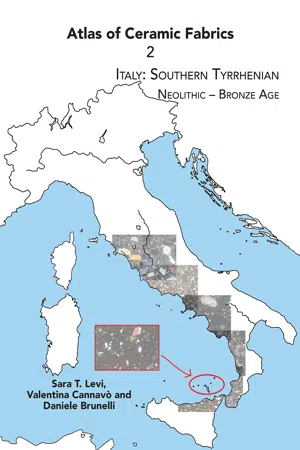
'Atlas of Ceramic Fabrics 2. Italy: Southern Tyrrhenian. Neolithic – Bronze Age' presents and interprets the petrographic composition of pre-protohistoric pottery (6th-1st millennia BCE) found in southwestern part of Italy. This is the second in a Atlas series organised according to geographical areas, chronology and types of wares. In this book 890 samples from 29 sites are discussed, encompassing results of more than 50 years of interdisciplinary archaeological, technological and archaeometric research by the authors' team. Ninety petrographic fabrics (the potters' 'recipes') are defined and presented based on their lithological character – a tool that can be used to compare different components of the ceramic pastes and to check possible provenance of non-local pots. The volume is organized in chapters focused on methodology, fabric description and distribution, followed by the archaeological implications and the database, with contribution by Andrea Di Renzoni (CNR-ISMA, Roma). Illustrations and descriptions of the fabrics and a list of samples provide a rigorous and transparent presentation of the data. The archaeological implications are discussed through cross-correlatios between origin and technology, variability, standardisation, chronology, function, social organization, circulation, style, typology and cultural identity. We hope that this work will be considered an another stepping-stone in demonstrating that technological variability is as important as stylistic distinctions.
eBook - PDF
Atlas of Ceramic Fabrics 2
Italy: Southern Tyrrhenian. Neolithic – Bronze Age
- 183 pages
- English
- PDF
- Available on iOS & Android
eBook - PDF
Atlas of Ceramic Fabrics 2
Italy: Southern Tyrrhenian. Neolithic – Bronze Age
About this book
Trusted by 375,005 students
Access to over 1.5 million titles for a fair monthly price.
Study more efficiently using our study tools.
Information
Table of contents
- Cover
- Title Page
- Copyright Page
- Dedication
- Contents Page
- List of Figures
- List of Tables
- List of Plates
- Introduction: QandA
- Figure 1 Distribution of the 18 archaeological localities considered in the present Volume. The complete list of the 29 specific sites is reported in Table 1.
- Table 1 Sites, analyses and archaeometric bibliography.
- Figure 2 Stratigraphic sequence in the Acropolis of Lipari (Courtesy Regione Siciliana, Assessorato per i Beni Culturali, Museo Archeologico Regionale Luigi Benabò Brea – Lipari – ME).
- Table 2 General synthesis and summary of the Southern Italian/Aeolian/Sicilian archaeological phases and chronology.
- Figure 3a John’s thin sections collection is integrated in the present study.
- Figure 3b John and Paola in the Museum of Lipari (2007)
- Figure 3c John and Sara in the storage room at Lipari (2007)
- Figure 3d Sampling,,,,
- Fabrics
- Figure 4 Fabrics according their numerical consistency (from 1 sample to >100 samples).
- Figure 5a Samples according the Groups. E=Effusive; Eq/m=Effusive with quartz/mica groundmass; EI=Effusive+Intrusive; I=Intrusive; IM=Intrusive+Metamorphic; IS=Intrusive+Sedimentary; M=Metamorphic; MS=Metamorphic+Sedimentary; S=Sedimentary; G=Generic; Gr
- Figure 5b Samples of the Effusive group. EB=basaltic; EBq=basaltic with quartz/mica groundmass; EA=andesitic; EAqm=andesitic with quartz+mica groundmass; ED=daci-rhyolitic; EDq=daci-rhyolitic with quartz groundmass; EP=phonolitic; EPq/m=phonolitic with q
- Figure 6a Geographical areas of the local samples according to the Groups. E=Effusive; Eq/m=Effusive with quartz/mica groundmass; I=Intrusive; IM=Intrusive+Metamorphic; M=Metamorphic; MS=Metamorphic+Sedimentary; S=Sedimentary; G=Generic; Grog=generic wit
- Figure 6b Geographical areas of the local effusive samples according to the Groups. EB=basaltic; EBq=basaltic with quartz groundmass; EA=andesitic; EAqm=andesitic with quartz+mica groundmass; ED=daci-rhyolitic; EDq=daci-rhyolitic with quartz groundmass;
- Figure 6c Geographical areas of the imported samples according to the Groups. E=Effusive; Eq/m=Effusive with quartz/mica grou dmass; EI=Effusive+Intrusive; I=Intrusive; intrusive+Metamorphic; IS=Intrusive+Sedimentary; M=Metamorphic; MS=Metamorphic+Sedime
- Figure 7a Geographical distribution of the main fabrics with effusive basaltic components (local with imported clay in white; non local in grey).
- Figure 7b Geographical distribution of the main fabrics with effusive andesitic components (local with imported clay in white; non local in grey).
- Figure 7c Geographical distribution of the main fabrics with effusive daci-rhyolitic components (local with imported clay in white; non local in grey).
- Figure 7d Geographical distribution of the main fabrics with effusive phonolitic components.
- Figure 7e Geographical distribution of the main fabrics with intrusive, intrusive+metamorphic and effusive basaltic+intrusive components (non local in grey).
- Figure 7f Geographical distribution of the main fabrics with intrusive+metamorphic components (non local in grey).
- Figure 7g Geographical distribution of the main fabrics with metamorphic components (non local in grey).
- Figure 7h Geographical distribution of the main fabrics with metamorphic+ sedimentary components (non local in grey).
- Figure 7i Geographical distribution of the main fabrics with sedimentary components (non local in grey).
- Figure 7j Geographical distribution of the main fabrics with generic components (non local in grey).
- Figure 7k Geographical distribution of the main fabrics with generic +grog components (non local in grey).
- Figure 8a Local samples distribution according to the petrographic groups in different geographical areas. E=Effusive; Eq/m=Efusive with quartz/mica groundmass; I=Intrusive; IM=Intrusive+Metamorphic; M=Metamorphic; MS=Metamorphic+Sedimentary; S=Sediment
- Figure 8b Local effusive samples distribution according to the petrographic groups in different geographical areas. EB=basaltic; EBq=basaltic with quartz/mica groundmass; EA=andesitic; EAqm=andesitic with quartz+mica groundmass; ED=daci-rhyolitic; EDq=da
- Figure 8c Imported samples distribution according to the petrographic groups in different geographical areas. E=Effusive; Eq/m=Effusive with quartz/mica groundmass; EI=Effusive+Intrusive; I=Intrusive; IM=Intrusive+Metamorphic; IS=Intrusive+Sedimentary; M
- Figure 9a Aeolian samples according to the compositional groups, imports are detailed in the small pie-plot. E=Effusive; Eq/m=Effusive with quartz/mica groundmass; EI=Effusive+Intrusive; I=Intrusive; IM=Intrusive+Metamorphic; IS=Intrusive+Sedimentary; M=
- Figure 9b Distribution of the effusive compositions for the local productions in various Aeolian Islands:. EB+EBq= basaltic + basaltic with quartz groundmass; EA+EAq=andesitic+andesitic with quartz groundmass; ED+EDq= daci-rhyolitic+daci-rhyolitic with q
- Figure 9c Relative proportions of vessels with local raw materials, imported clays and imported vessels in the various Aeolia Islands.
- Figure 9d Composition of the imported vessels in the various Aeolian Islands. E+=Effusive+other components; I=Intrusive; IM=I trusive+Metamorphic; IS=Intrusive+Sedimentary; M=Metamorphic; MS=Metamorphic+Sedimentary; S=Sedimentary; G=Generic; Grog=generic
- Figure 10 Sicilian samples according to the compositional groups, imports are detailed in the small pie-plot. E=Effusive; I=I trusive; M=Metamorphic; S=Sedimentary; G=Generic; G (Grog)=generic with Grog.
- Figure 11 Peninsular samples according to compositional groups, imports are detailed in the small pie-plot. E=Effusive; Eq/m=Effusive with quartz/mica groundmass; EI=Effusive+Intrusive; I=Intrusive; IM=Intrusive+Metamorphic; M=Metamorphic; MS=Metamorphic
- _GoBack
- Archaeological implications
- Figure 12 Percentages of local products, local products with imported clays and imported pots at Lipari in the various chronological phases.
- Figure 13 Bowl filled with ‘ready made’ ceramic paste, Capo Graziano delta IV hut Lipari – Acropolis (Courtesy Regione Siciliana, Assessorato per i Beni Culturali, Museo Archeologico Regionale Luigi Benabò Brea – Lipari – ME).
- Figure 14 The pumice industry at Lipari (EcoMuseo della Memoria, Lipari)
- Figure 15 Pignataro di Fuori ship’s cargo (Courtesy Regione Siciliana, Assessorato per i Beni Culturali, Museo Archeologico Regionale Luigi Benabò Brea – Lipari – ME).
- Figure 16 Incised map in a Capo Graziano bowl, Lipari-Acropolis trench N, level, inv 7773 (Levi et al. 2014 fig. 9; Meligunis Lipara IV fig CXXVIII,2). This is also the logo of the ArchEOLogiE project, elaborated by P. Vertuani and V. Corazza.
- Figure 17 Styles of the Capo Graziano incised decoration: 1. Seurat (pointilist); 2.Michelangelo (composite figurative); 3. Fontana (spacious wavy); 4. Boetti (metope); 5. Kandinsky (lower multilinear); 6. Klee (simple wavy or ripple) (Levi et al. 2014).
- Figure 18a Exported Capo Graziano decorated vessels produced at Lipari (fabric ED101): 1. Vivara (VIV1-4, Cazzella et al. 1997, fig. 2); 2. Messina (ME3, Martinelli et al. 2012, fig. 3.4).
- Figure 18b Exported pithoi and cooking pots produced at Filicudi, Stromboli and/or Salina (fabric EA103). Capo Graziano: 1. Tindari (TIN11, Martinelli et al. 2012, fig. 3.1); 2, 3, 4. Milazzo (MVC31-2, 31-3, 31-10, Levi et al. 2009, tavv. VI, VII, XIII).
- Databases
- Plate 1 Capo Graziano bowl with inside ‘ready made’ ceramic paste: in this representation the ceramic paste is replaced by its own microscopic image (sample ACRd2, PPL; from hut delta IV Lipari – Acropolis).
- Plate 2 Microscope images of Effusive Basaltic and Andesitic Fabrics; horizontal dimension 5.5 mm. EB101 Basalt (Messina, ME5, XP); EB102 Pyroxene-Basalt (Salina, POR3, XP); EB103 Clinopyroxene-Plagioclase-Basalt (Filicudi, FBR23, XP); EB104 Hypocrsitalli
- Plate 3 Microscope images of Effusive Basaltic and Andesitic Fabrics; horizontal dimension 2.8 mm. EB101 Basalt (Messina, ME5, XP); EB102 Pyroxene-Basalt (Salina, POR3, XP); EB103 Clinopyroxene-Plagioclase-Basalt (Filicudi, FBR23, XP); EB104 Hypocrsitalli
- Plate 4 Microscope images of Effusive Andesitic, Dacitic and Phonolitic Fabrics; Effusive Basaltic in siliceous groundmass and Effusive Basaltic-Intrusive Fabrics; horizontal dimension 5.5 mm. EA106 Plagioclase-Pyroxene (Filicudi, CGII5, XP); EA107 (+g og
- Plate 5 Microscope images of Effusive Andesitic, Dacitic and Phonolitic Fabrics; Effusive Basaltic in siliceous groundmass and Effusive Basaltic-Intrusive Fabrics; horizontal dimension 2.8 mm. EA106 Plagioclase-Pyroxene (Filicudi, CGII5, XP); EA107 (+g og
- Plate 6 Microscope images of Effusive Basaltic, Dacitic and Phonolitic in siliceous/micaceous groundmass Fabrics; horizontal dimension 5.5 mm. EAq101 Pyroxene andesite; Quartz-muscovite groundmass (Lipari, SDA22/13, XP); EAq102 Andesite; Sandy quartz grou
- Plate 7 Microscope images of Effusive Basaltic, Dacitic and Phonolitic in siliceous/micaceous groundmass Fabrics; horizontal dimension 2.8mm. EAq101 Pyroxene andesite; Quartz-muscovite groundmass (Lipari, SDA22/13, XP); EAq102 Andesite; Sandy quartz groun
- Plate 8 Microscope images of Effusive Phonolitic in siliceous groundmass and Intrusive Fabrics; horizontal dimension 5.5 mm. EPq101 Nepheline -Basalt (La Starza, LST7, PPL); EPq102 Plagioclase-Pyroxene; Nepheline groundmass (Fidene, FID12, PPL); EPq103 Fe
- Plate 9 Microscope images of Effusive Phonolitic in siliceous groundmass and Intrusive Fabrics; horizontal dimension 2.8 mm. EPq101 Nepheline -Basalt (La Starza, LST7, PPL); EPq102 Plagioclase-Pyroxene; Nepheline groundmass (Fidene, FID12, PPL); EPq103 Fe
- Plate 10 Microscope images of Intrusive-Metamorphic, Intrusive-Sedimentary and Metamorphic Fabrics; horizontal dimension 5.5 mm. IM101 Granite-Schist (Lipari, Capri32, XP); IM102 Granite-Mica (Stromboli, SVN240, XP); IM104 Granite; Micaceous groundmass (M
- Plate 11 Microscope images of Intrusive-Metamorphic, Intrusive-Sedimentary and Metamorphic Fabrics; horizontal dimension 2.8 mm. IM101 Granite-Schist (Lipari, Capri32, XP); IM102 Granite-Mica (Stromboli, SVN240, XP); IM104 Granite; Micaceous groundmass (M
- Plate 12 Microscope images of Metamorphic-Sedimentary and Sedimentary Fabrics; horizontal dimension 5.5 mm. MS101 Quartz-Quarzite-Siltstone (Salina, POR33, XP); MS102 Quartz; Micaceous groundmass (Lipari, Capri16, XP); MS103 Siltstone; Micaceous groundmas
- Plate 13 Microscope images of Metamorphic-Sedimentary and Sedimentary Fabrics; horizontal dimension 2.8 mm. MS101 Quartz-Quarzite-Siltstone (Salina, POR33, XP); MS102 Quartz; Micaceous groundmass (Lipari, Capri16, XP); MS103 Silstone; Micaceous groundmass
- Plate 14 Microscope images of Generic and Generic with Grog Fabrics; horizontal dimensions 5.5 mm. G101 Quartz- Nepheline -Feldspar-Pyroxene (Fidene, FID10, XP); G102 Quartz- Nepheline -Feldspar (Fidene, FID4, XP); G103 Quartz-Feldspar (Taureana, TAU1, X
- Plate 15 Microscope images of Generic and Generic with Grog Fabrics; horizontal dimensions 2.8 mm. G101 Quartz- Nepheline -Feldspar-Pyroxene (Fidene, FID10, XP); G102 Quartz- Nepheline -Feldspar (Fidene, FID4, XP); G103 Quartz-Feldspar (Taureana, TAU1, X
- Plate 16 Microscope images of Generic with Grog Fabrics; horizontal dimensions 5.5 mm (top) 2.8 mm (bottom). G113 (+grog) G og-Quartz- Nepheline -Alkali-feldspar (Vivara, VIV9, XP); G114 (+grog) Quartz-Grog (Pertosa, PER5, PPL); G115 (+grog) Grog-Quartz (
- Bibliography
Frequently asked questions
Yes, you can cancel anytime from the Subscription tab in your account settings on the Perlego website. Your subscription will stay active until the end of your current billing period. Learn how to cancel your subscription
No, books cannot be downloaded as external files, such as PDFs, for use outside of Perlego. However, you can download books within the Perlego app for offline reading on mobile or tablet. Learn how to download books offline
Perlego offers two plans: Essential and Complete
- Essential is ideal for learners and professionals who enjoy exploring a wide range of subjects. Access the Essential Library with 800,000+ trusted titles and best-sellers across business, personal growth, and the humanities. Includes unlimited reading time and Standard Read Aloud voice.
- Complete: Perfect for advanced learners and researchers needing full, unrestricted access. Unlock 1.5M+ books across hundreds of subjects, including academic and specialized titles. The Complete Plan also includes advanced features like Premium Read Aloud and Research Assistant.
We are an online textbook subscription service, where you can get access to an entire online library for less than the price of a single book per month. With over 1.5 million books across 990+ topics, we’ve got you covered! Learn about our mission
Look out for the read-aloud symbol on your next book to see if you can listen to it. The read-aloud tool reads text aloud for you, highlighting the text as it is being read. You can pause it, speed it up and slow it down. Learn more about Read Aloud
Yes! You can use the Perlego app on both iOS and Android devices to read anytime, anywhere — even offline. Perfect for commutes or when you’re on the go.
Please note we cannot support devices running on iOS 13 and Android 7 or earlier. Learn more about using the app
Please note we cannot support devices running on iOS 13 and Android 7 or earlier. Learn more about using the app
Yes, you can access Atlas of Ceramic Fabrics 2 by Sara T. Levi,Valentina Cannavo,Daniele Brunelli in PDF and/or ePUB format, as well as other popular books in Social Sciences & Archaeology. We have over 1.5 million books available in our catalogue for you to explore.