This book describes advanced research results on Modeling and Control designs for Fuel Cells and their hybrid energy systems. Filled with simulation examples and test results, it provides detailed discussions on Fuel Cell Modeling, Analysis, and Nonlinear control. Beginning with an introduction to Fuel Cells and Fuel Cell Power Systems, as well as the fundamentals of Fuel Cell Systems and their components, it then presents the Linear and Nonlinear modeling of Fuel Cell Dynamics. Typical approaches of Linear and Nonlinear Modeling and Control Design methods for Fuel Cells are also discussed. The authors explore the Simulink implementation of Fuel Cells, including the modeling of PEM Fuel Cells and Control Designs. They cover the applications of Fuel cells in vehicles, utility power systems, and stand-alone systems, which integrate Fuel Cells, Wind Power, and Solar Power. Mathematical preliminaries on Linear and Nonlinear Control are provided in an appendix.

eBook - ePub
Fuel Cells
Dynamic Modeling and Control with Power Electronics Applications, Second Edition
- 411 pages
- English
- ePUB (mobile friendly)
- Available on iOS & Android
eBook - ePub
Fuel Cells
Dynamic Modeling and Control with Power Electronics Applications, Second Edition
About this book
Trusted by 375,005 students
Access to over 1 million titles for a fair monthly price.
Study more efficiently using our study tools.
Information
1 Introduction
DOI: 10.1201/9781315369860-1
1.1 Past, Present, and Future of Fuel Cells
1.1.1 What Are Fuel Cells?
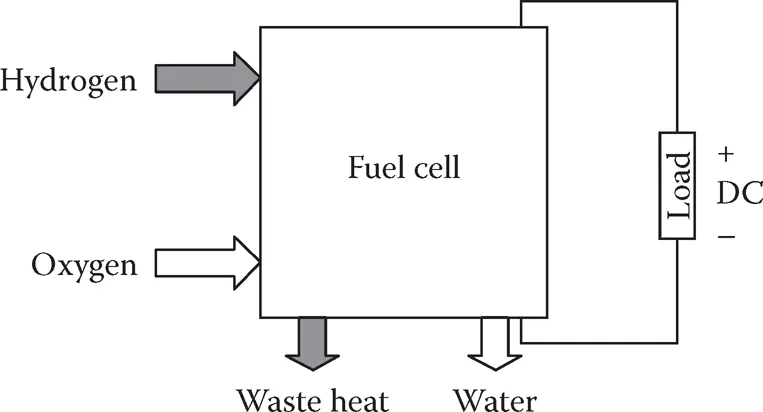
A fuel cell operates like a battery by converting the chemical energy from reactants into electricity, but it also differs from a battery in that as long as the fuel (such as hydrogen) and an oxidant (such as oxygen) is supplied, it will produce DC electricity (plus water and heat) continuously, as shown in Figure 1.1. In the 1960s, the first practical fuel cell was developed and then used in the US Gemini and Apollo programs for space applications. Since then, fuel cells have been increasingly applied in other areas although it remains a “new” technology since its commercialization is still a hot research topic today. As some of the fundamental obstacles are being overcome, fuel cells have become more feasible for a few applications and are gradually being developed and commercialized.
For example, in 1993, Ballard Power Systems demonstrated fuel cell-powered buses. Then almost all major automotive manufacturers developed fuel cell vehicle prototypes in the late 1990s and the early 2000s, which are under-going tests in the United States, Japan, and Europe. For stationary power applications, more than 2500 fuel cell stationary power systems have already been installed globally at hospitals, office buildings, utility power plants, and so on. In 2005, Samsung Electronics also unveiled a prototype of fuel cells for portable power applications that can run a laptop for about 15 h. However, challenges remain to the commercialization of fuel cells still exist. The most significant problems are reducing their cost as well as improving their operating reliability.
The recent increasing impetus in developing and commercializing fuel cells are due to its several advantages. These include “clean” by-products (e.g., water when operated on pure hydrogen), which means it is “zero emission” with extremely low (if any) emission of oxides of nitrogen and sulfur. They also operate quietly, not having any moving parts, even when working with extra fuel processing and supply equipment. Furthermore, they have high-power density and high efficiency, typically more than 40% efficiency in electric power production, which is better than traditional combustion engine/generator sets, and the “waste” heat from a fuel cell can be used for heating purposes, thus increasing its overall efficiency. Finally, they can increase national energy security, since different types of fuel cells can operate on various conventional and alternative fuels such as hydrogen, ethanol, methanol, and natural gas, and hydrogen itself can be produced by harnessing a variety of renewable energy sources; such capability can help to reduce US dependence on foreign oil.
1.1.2 Types of Fuel Cells
Fuel cells are most commonly classified by the kind of electrolyte being used. These include proton exchange/polymer electrolyte membrane fuel cells (PEMFCs), direct methanol fuel cells (DMFCs), alkaline fuel cells (AFCs), phosphoric acid fuel cells (PAFCs), molten carbonate fuel cells (MCFCs), solid oxide fuel cells (SOFCs), zinc air fuel cells (ZAFCs), and photonic ceramic fuel cells (PCFCs), which vary widely in their required operating temperature. But this book will only focus on PEMFCs, which are low-operating-temperature fuel cells intended for use in mass-production fuel cell vehicles that are currently under development by the major auto manufacturers, as well as in offices and residences.
1.2 Typical Fuel Cell Power System Organization
The fundamental components of a fuel cell power system are a fuel cell (most commonly a stack or multilayer connection of fuel cells), a fuel and oxidant supply, an electrical load, and an electric power conditioner (see Figure 1.2). The fuel and oxidant supply along with the electric power conditioner are typically lumped together with the fuel reformer, the thermal management subsystem, and the humidification subsystem, when these are present, under the term balance of plant (BOP).

1.3 Importance of Fuel Cell Dynamics
For the successful commercialization of fuel cell vehicles, their performance, reliability, durability, cost, fuel availability, and public acceptance should be considered [1]. The most important disadvantage of fuel cells now is their cost. However, the performance of the fuel cell systems during transients is another key factor. Therefore, during transients, to generate a reliable and efficient power response and to prevent membrane damage as well as detrimental degradation of the fuel cell stack voltage and oxygen depletion, it is necessary to design better control schemes to achieve optimal air and hydrogen inlet flow rates, i.e., a fuel cell control system that can perform air and hydrogen pressure regulation and heat–water management precisely based on the current drawn from the fuel cell [2,3].
This book essentially addresses the issue of fuel cells’ slow transient response to load changes, which is important since the dynamic behavior of a fuel cell is integral to the overall stability and performance of the power system formed by the fuel supply, fuel cell stack, power conditioner, and electrical load. Normally fuel cells have transient (dynamic) responses that are much slower than the dynamic responses of the typical power conditioner and load to which they are attached. As such, the fuel cell’s inability to change its electrical output (current) as quickly as the electrical load changes has significant implications on the overall power system design. In particular, some form of energy storage with a quick charge/discharge capability is needed to function as a firm power backup during electrical load increases if the fuel flow to the fuel cell is not being kept constant at its maximum level (which is wasteful and inefficient). The slower the fuel cell’s response, the larger the amount of energy storage that is needed with the attendant increases in its size, weight, and cost; it also reduces the number of suitable energy-storage options (ultracapacitor [UC], flywheel, battery, etc.). Therefore, the fuel cell’s dynamic response is of significant importance, particularly in mobile applications.
1.4 Organization of This Book
Chapter 2 describes PEMFCs and the fuel cell power system BOP components in more detail. Chapter 3 describes the modeling of a PEMFC’s dynamic behavior as an initial step to prescribe controller designs to improve its transient behavior. It is followed by Chapter 4, which presents the understanding of the design of feedback controllers. Chapter 5 features the Simulink implementations of fuel cell models and controllers. Finally, Chapters 6 and 7 discuss two important applications of fuel cells where dynamic response is important to vehicles and to fixed-voltage hybrid power generation systems. Chapter 8 discusses hybrid renewable energy systems where the fuel cell is working with other alternative energy sources such as wind and solar energy. Chapter 9 presents a multiobjective optimization in terms of the cost and efficiency of PEMFC (proton exchange/polymer electrolyte membrane fuel cell). Chapter 10 discusses power electronics applications for fuel cells, especially the designing of linear and sliding mode control for a power factor correction converter and bi-directional converter. Chapter 10 describes predictive controllers for fuel cell vehicles. Chapter 11 deals with a temperature controller design for PEMFC by considering its thermal transfer function. Lastly, Chapter 12 presents the implementation of digital signal processor-based power electronics control for a sliding mode control in a DC/DC converter.
References
- F.Barbir and T.Gomez, Efficiency and economics of PEM fuel cells, International Journal of Hydrogen Energy, 22(10/11), 1027–1037, 1997.
- A.M.Borbely and J.G.Kreider, Distributed Generation: The Power Paradigm for the New Millennium, New York, CRC Press, 2001.
- F.Barbir, PEM Fuel Cells: Theory and Practice, Elsevier Academic Press, Burlington, MA, USA, 2005.
2 Fundamentals of Fuel Cells
DOI: 10.1201/9781315369860-2
2.1 Introduction
The PEMFC, also called a solid polymer fuel cell, was first developed by General Electric in the United States in the 1960s for use by NASA (National Aeronautics and Space Administration) on their first manned space vehicles [1]. This type of fuel cell primarily depends on a special polymer membrane that is coated with highly dispersed catalyst particles. Hydrogen is fed to the membrane’s anode side (possibly at a pressure greater than atmospheric pressure) where the catalyst causes the hydrogen atoms to release its electrons and become H+ ions (protons)
(2.1)
as shown in Figure 2.1. The proton exchange membrane (PEM) only allows the H+ ions to pass through it, whereas the electrons are collected and utilized as electricity by an outside electrical circuit (doing useful work) before they reach the cathode side. There, the electrons and the hydrogen ions diffusing through the membrane combine with the supplied oxygen (typically from air) to form water, which is a reaction that releases energy in the form of heat

(2.2)
This water by-product must be removed to prevent the cell from being flooded and rendered inoperative (more details later). In addition, any unu...
Table of contents
- Cover Page
- Half Title Page
- Series
- Title Page
- Copyright Page
- Contents
- Preface
- Authors
- 1 Introduction
- 2 Fundamentals of Fuel Cells
- 3 Linear and Nonlinear Models of Fuel Cell Dynamics
- 4 Linear and Nonlinear Control Design for Fuel Cells
- 5 Simulink Implementation of Fuel Cell Models and Controllers
- 6 Applications of Fuel Cells in Vehicles
- 7 Application of Fuel Cells in Utility Power Systems and Stand-Alone Systems
- 8 Control and Analysis of Hybrid Renewable Energy Systems
- 9 Optimization of PEMFCs
- 10 Power Electronics Applications for Fuel Cells
- 11 A PEM Fuel Cell Temperature Controller
- 12 Implementation of Digital Signal Processor-Based Power Electronics Control
- Appendix A: Linear Control
- Appendix B: Nonlinear Control
- Appendix C: Induction Machine Modeling and Vector Control for Fuel Cell Vehicle Applications
- Appendix D: Coordinate Transformation
- Appendix E: Space Vector PWM
- Index
Frequently asked questions
Yes, you can cancel anytime from the Subscription tab in your account settings on the Perlego website. Your subscription will stay active until the end of your current billing period. Learn how to cancel your subscription
No, books cannot be downloaded as external files, such as PDFs, for use outside of Perlego. However, you can download books within the Perlego app for offline reading on mobile or tablet. Learn how to download books offline
Perlego offers two plans: Essential and Complete
- Essential is ideal for learners and professionals who enjoy exploring a wide range of subjects. Access the Essential Library with 800,000+ trusted titles and best-sellers across business, personal growth, and the humanities. Includes unlimited reading time and Standard Read Aloud voice.
- Complete: Perfect for advanced learners and researchers needing full, unrestricted access. Unlock 1.4M+ books across hundreds of subjects, including academic and specialized titles. The Complete Plan also includes advanced features like Premium Read Aloud and Research Assistant.
We are an online textbook subscription service, where you can get access to an entire online library for less than the price of a single book per month. With over 1 million books across 990+ topics, we’ve got you covered! Learn about our mission
Look out for the read-aloud symbol on your next book to see if you can listen to it. The read-aloud tool reads text aloud for you, highlighting the text as it is being read. You can pause it, speed it up and slow it down. Learn more about Read Aloud
Yes! You can use the Perlego app on both iOS and Android devices to read anytime, anywhere — even offline. Perfect for commutes or when you’re on the go.
Please note we cannot support devices running on iOS 13 and Android 7 or earlier. Learn more about using the app
Please note we cannot support devices running on iOS 13 and Android 7 or earlier. Learn more about using the app
Yes, you can access Fuel Cells by Bei Gou,Woonki Na,Bill Diong in PDF and/or ePUB format, as well as other popular books in Technology & Engineering & Electrical Engineering & Telecommunications. We have over one million books available in our catalogue for you to explore.