- 176 pages
- English
- ePUB (mobile friendly)
- Available on iOS & Android
eBook - ePub
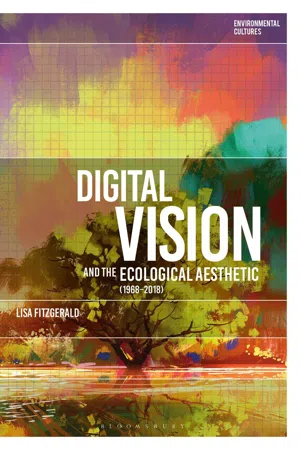
Digital Vision and the Ecological Aesthetic (1968 - 2018)
About this book
Digital technology has transformed the way that we visualise the natural world, the art we create and the stories we tell about our environments. Exploring contemporary digital art and literature through an ecocritical lens, Digital Vision and the Ecological Aesthetic (1968 - 2018) demonstrates the many ways in which critical ideas of the sublime, the pastoral and the picturesque have been renewed and shaped in digital media, from electronic literature to music and the visual arts. The book goes on to explore the ecological implications of these new forms of cultural representation in the digital age and in so doing makes a profound contribution to our understanding of digital art practice in the 21st century.
Trusted by 375,005 students
Access to over 1.5 million titles for a fair monthly price.
Study more efficiently using our study tools.
Information
1
Generative aesthetics
The emerging visual language of eco-digital art
Mechanical aesthetics featured greatly in the art developments of the twentieth century. Challenges to the centrality of the humanist narrative (such as the bacterial revolution of the late nineteenth century) acknowledged not just the benefit of employing technology as a means for advancement but opened up microscopic worlds imperceptible to the human eye. As Mark Coeckelbergh points out in his examination of the interchange between human, animal and robot relations, the ‘technology that shows things at that level is indispensable, not as a mere “instrument” but as a way of seeing (and manipulating) the world’ (2011: 198). A myriad of terms for microbial species and the tools devised to see them entered the lexicon during the Victorian age. Devices such as microscopes, aquaria and other instruments became an extension of the hand and the eye and gave unrivalled access to a microscopic world. These tools granted us the opportunity to move beyond our inherently human capacities. This chapter traces the emergence of eco-digital art from the beginnings of computational art through to digital technologies and the growth of the internet. Moreover, it argues that thinking about the historical background for eco-digital art, and looking at how artists have responded to technological advances, will offer a nuanced context for the genre’s emergence.
In the final decades of the nineteenth century with the impact of the Industrial Revolution influencing the understanding of neo-materialist theorists such as Henri Bergson and Alfred North Whitehead, and certainly in the science fiction of writers such as H. G. Wells, the development of mechanical technologies grew alongside the growing interest in the systematic inner workings of the natural world. In both instances, the importance lay in the processes of both machines and natural objects. The realization that smaller entities were not inert but animated led to an emergence of vital materialism during this age. Bergson, who was hugely influential in twentieth-century modernism, articulated the immersive qualities of the material world in a manner that collapses distinctions between art and science. His views on the understanding of temporality and duration are palpable in the modernist preoccupation with time. Concepts such as difference, duration, intuition and becoming supported a more immediate interdependence between humans and the environment. The publication of L’Évolution Créatrice in 1907 (and the English translation, Creative Evolution, in 1910) introduced his idea of élan vital and the argument that an inner vitality was determining much of an actor’s agency. Bergson considers the role of post-industrial mechanics on the human organism as the beginnings of the animal/technology conflation, noting that
If our organs are natural instruments, our instruments must be artificial organs. The workman’s tool is the continuation of his arm, the tool-equipment of humanity is therefore a continuation of its body . . . machines which run on oil or coal . . . have actually imparted to our organism an extension so vast, have endowed it with a power so mighty, so out of proportion with the size and strength of that organism, that surely none of all this was foreseen in the structural plan of our species. ((1932) 1935: 267–8)
Bergson’s philosophy of interconnection relied on the sense of difference (a concept that we can now trace through to Deleuze) that depended on the interrelational codependence of organisms and environment. Other twenty-first-century art movements have claimed Bergson as a crucial influence. Futurism, cubism, fauvism were all affected by Bergsonian philosophy and its tradition of interconnectivity. The underlying structures in Bergson’s work attest to the complexity of a world in which a pattern of relationality appeared to undergird an immense orchestra of seemingly, to the human eye, automatic functionalism in the natural world.
In the initial years of the twentieth century, the unrelenting development in technology seemed unstoppable. While science fiction writers were inspired by a new millennium that seemed to be charging forward, and artists were using ready-mades to highlight the potential of industrial design on a purely aesthetic level, craft enthusiasts often bemoaned the mass production of everyday items. In 1934, an example of this emerging fetishization of the mechanical was an exhibition organized by MOMA called Machine Art heralding the triumph of industry in bringing high-quality design to the public. Rather than highlighting the functional aspects of mechanics, the exhibition focused on the design quality of mechanical objects. In the place of artworks from artists, ordinary objects were mounted on plinths. Founding director of MOMA, Alfred H. Barr, worked with Philip Johnson to exhibit some 600 mechanical objects. Incorporating these mechanical designs into the museum space, while not new, pointed towards the increasing prevalence of an aesthetic that moved away from the artisan style of craft-making that had previously been associated with authenticity and high culture.
The exhibition was a monumental success and embarked on a nationwide tour showcasing the aesthetic quality of American machine manufacture. Jennifer Jane Marshall has noted that the ‘(n)eoplatonic formalism in the Machine Art show had real social significance given the historical circumstance of value’s increasing dematerialisation, especially as signalled by the end of the American gold standard in 1933’ (2008: 598–9). The end of the American gold standard pointed to a change in concrete connections between finance and material value and was an indicator of increasing modernization. In an age of expanding awareness of fluctuation, and with fluidity becoming the sign of a new modernity, the machine was the exemplar of high-standard precision manufacturing. Not only that, but it emphasized the change in the scale (as machines were created with ever-increasing complexity) that was infiltrating everyday production. But there was also a conservatism evident in the Machine Art exhibition which had been interwoven through the valuation of mechanic design. As Marshall points out, this was a turn to the ‘Platonic Form’ which was ‘both the origin and the standard of all artistic value – a conceit underscored both in Barr’s text for the show and in Johnson’s installation – the two men advanced a model of artistic beauty guaranteed by timeless ideals’ (2008: 598). Machine Art was the acknowledgement of mechanical aesthetics as the ‘stabilizing force of . . . realness’ made up of the ‘palpable stuff of modern life’ (2008: 598). And yet a conne ction emerged between the functionality of the design and the aesthetic of classic beauty. The performativity of the object was tied to its aesthetic value.
The flip side of this functional (and performative) mechanical design is the anarchic and inherently relational (but often useless) subjective Dada movement and the emergence of the ready-made. While both Dada and the formalist aesthetic are mechanical, the wit and humour evident in Dada contributed to its success in reconfiguring what a machine is and its relationship to its function. In Europe, the Dadaists sought to challenge the expressionism that had preceded them. They were still very much in the thrall of how materiality and spirituality intersected. There was an attempt to find the spiritual in the mechanical and to counter the perceived hierarchy between the two prevalent in dualist interpretations of the world. In 1937, a few years after the Machine Art exhibition, Alan Turing famously published the paper ‘On Computable Numbers, with an Application on the Entscheidungsproblem’ where he described a general working computer, the universal Turing machine. The term Entscheidungsproblem (German for a decision problem) was a challenge whereby an algorithm can be found that delivers a direct yes/no response. The previous year, in 1936, both Alan Turing and Alonzo Church had demonstrated that the problem was unsolvable. The paper proved to be a foundational text in computer programming where Turing showed how computable numbers result from being processed by a mechanical machine: ‘It is possible to invent a single machine which can be used to compute any computable sequence’ (241).
Turing’s first device, the bombe, was produced in 1939 and was designed to decipher the German Enigma machine. Other code-breaking machines formed the COLOSSUS series. Turing’s findings were foundational in bringing early computing and advanced mechanical technology closer to the advent of digital computing. Soon after that publication, German engineer Konrad Zuse invented the first programmable digital computer, the Z3, in 1941. The Z1 completed in 1938 never worked, but a revised version, the Z2, finished in 1940 proved to be fully functioning. In the following decade, these computers, because of their size and expense to manufacture, proved inaccessible to most. Also, although these machines were becoming prevalent, there was no accompanying software, and the interface did not assist users in navigating the commands. Some devices, however, allowed for modification and use in the creative arts. One of the early pioneers of computer-generated art was Ben F. Laposky whose Oscillon series, as we saw in the introduction, were made using analogue electronic equipment. It was at this point that pioneers such as Laposky began to see the creative potential in computers to reflect, in many ways, the monist, philosophical interpretation of the world, thereby capturing and representing a relational dynamic that preceded dualistic divisions of spirit and matter. These artworks were an attempt at the expulsion of authorial control in favour of a randomized and generative design.
The tension between a generative art that operates independently of the artist and the idea that the original artwork must be produced by the artist themselves was becoming increasingly polarized. While large and expensive computers remained mainly in the control of scientists and engineers, there was an emerging home-grown movement tinkering with older Second World War machines. Precursors to the digital computer, such as the Henry drawing machines (of which there were three made), allowed artists to experiment with mechanics and automotive movement. In the early 1960s, Desmond Paul Henry’s modified Second World War bombsight computers were the beginnings of the growth of media art. They allowed for an aesthetic that was visibly mechanical and, along with the work of John Whitney Sr, Christopher Strachey and others, are an early example of computer-generated art. The Henry drawing machines were precursors for the use of digital technology in art practice but were in themselves analogue in the sense that they were set in motion and adjusted manually and could not be pre-programmed. John Whitney Sr is regarded as the founding figure in computer graphics and built his own analogue computer from a converted Second World War anti-aircraft gun director in the 1950s. Whitney’s work (the computer animations he created for graphic designer Saul Bass in the title sequence for Alfred Hitchcock’s Vertigo in 1958 is his most well known) with its spirals and strong colour patterns were influential on eco-digital aesthetics in that the non-figurative forms foreshadow the focus on generative and relational patterns that pre-empt much of the later media art. The impact of the technology on process-based art practice was profound, as tools allowed the artist to step back from the creative process. Many artists in the late 1950s and early 1960s were heavily influenced by Eastern philosophy and spiritual mysticism and attempted to introduce a design aesthetic that no longer focused on the figurative or landscape themes that had historically been the nub of Western art practice.
Moving towards the interaction and incorporation of the artwork and the user that we see in contemporary media art, the 1960s saw (along with the rise of performance art) an eagerness to delve into the space between individual bodies and the environment. Other artists were beginning to merge creative work with computers, notably in music. The early 1960s saw musicians such as Pauline Oliveros using a tape delay system (along with her accordion) to enhance her improvisatory, experimental music. Oliveros founded the San Francisco Tape Music Center in 1962, alongside Morton Subotnick and Ramon Sender, to explore the emergence of tape and analogue synthesizers. For instance, her concept of the Expanded Instrument System used computers to manipulate acoustic sounds through delays, ambiance and modulation. Oliveros’s method emphasizes the practice of deep listening and the creation of a sound-space where the listener is enfolded in the environment. The practice highlighted the relational interaction between two focal points and worked towards representing the networked embeddedness of the listener. Her work, she noted, served to capture the layers of sound that is processed in the environment. The Sonosphere 1 captures human experience ‘according to the bandwidth and resonant frequencies and mechanics of the ear, skin, bones, meridians, fluids and other organs and tissues of the body as coupled to the earth and its layers from the core to the magnetic fields as transmitted and perceived by the audio cortex and nervous system’ (2006: 481). Oliveros coupled the Sonosphere with the Biosphere and Technosphere and sought to include various innovative and unconventional soundscapes in her work. Artworks, such as these sonic pieces created by Oliveros, sought to establish a connection with and use new forms of technology. The feature that differentiated these forms of electronic art from their predecessors was, according to Lev Manovich, its emphasis on a new value: the ‘modification of an already existing signal’ (2001: 126). Whereas art forms such as photo montage challenged the focus on original authorship through appropriating rather than creating original images, these mediated forms of art s ought to incorporate technology while ideally retaining the creative spirit with which they were made. There was a glimmer of the adaptive, rather than the attempts at originality that had predominated creative direction, which would be the foundation of media art.
The year 1965 was pivotal for computer-generated art with three exhibitions featuring the scientists/artists that constituted the first wave of this specific genre. The first exhibition in computer art was Computergrafik at the Technische Hochschule in Stuttgart in February 1965. Computergrafik was a selection of the works of Georg Nees, who created algorithmic art on a ZUSE Graphomat Z64. Nees’s technique created plotter drawings (visual images generated with a printer) from a program run by the computer. (The ZUSE Graphomat Z64 was a drawing machine created in 1961 by Konrad Zuse and designed for use in planning.) The process sought to eliminate the human element as much as was conceivable. Nees was working with, and influenced by, the philosopher and proponent of the concrete poetry movement, Max Bense, who along with the mathematician and computer scientist Frieder Nake formed the Stuttgart School loosely centred around the themes emerging from computational mathematics and aesthetics. Bense was professor of philosophy and technology at the Stuttgart School where his theory of existential rationalism sought to remove the distinction between the humanities and the social sciences. It is Bense who originated the term ‘generative aesthetics’ in a German-language pamphlet, ROT 19, where he attempted to capture the non-anthropocentric drive behind much of this computer-generated art. This new attitude towards subjective creativity illustrates the directions that the movement expected to develop. Eliminating or at least downgrading the human element meant the establishment of an original and arguably more non-anthropocentric digital vision for art.
This new direction and corresponding aesthetic emerged from an amalgam of art and science where the artwork resulted from computer programming: beauty based on mathematics. The algometric approach to composition was palpable in much of the post-war artistic developments that bore the pre-war modernist inclination towards rationalism and purity. The computer enabled a vision for art that was impartial, balanced and harmonious. Frieder Nake later described it as an ‘Algorithmic Revolution’:
The revolution of transforming into machinic computable form everything that is already computable, and of reducing to computable form everything that is not yet computable. This enormous epochal task has started its path through cultures soon after the founding scientists had come up with their ground-breaking results: Kurt Gödel, Alan M. Turing, and John von Neumann. More and new works are still under way for the algorithmic revolution to creep into all the arteries of human individual and social life. (2018: 29)
The energy and capacities associated with imaginative production were being extended to computational technology. In terms of environmental thinking, although ...
Table of contents
- Cover
- Half-Title
- Series
- Title
- Contents
- List of illustrations
- Acknowledgements
- Introduction: Technology, relationality and the eco-digital aesthetic
- 1 Generative aesthetics: The emerging visual language of eco-digital art
- 2 Synthetic landscapes, Google Street View and other-than-human agency
- 3 Natura naturans: Immersion, gardening and natural systems design
- 4 DIY: Biomimetics, robotics and the glitch aesthetic
- 5 Coding climate change: Petro-cultures in digitally simulated environments
- Conclusion: Biophilia and the parameters of eco-digital art
- Works cited
- Index
- Copyright
Frequently asked questions
Yes, you can cancel anytime from the Subscription tab in your account settings on the Perlego website. Your subscription will stay active until the end of your current billing period. Learn how to cancel your subscription
No, books cannot be downloaded as external files, such as PDFs, for use outside of Perlego. However, you can download books within the Perlego app for offline reading on mobile or tablet. Learn how to download books offline
Perlego offers two plans: Essential and Complete
- Essential is ideal for learners and professionals who enjoy exploring a wide range of subjects. Access the Essential Library with 800,000+ trusted titles and best-sellers across business, personal growth, and the humanities. Includes unlimited reading time and Standard Read Aloud voice.
- Complete: Perfect for advanced learners and researchers needing full, unrestricted access. Unlock 1.5M+ books across hundreds of subjects, including academic and specialized titles. The Complete Plan also includes advanced features like Premium Read Aloud and Research Assistant.
We are an online textbook subscription service, where you can get access to an entire online library for less than the price of a single book per month. With over 1.5 million books across 990+ topics, we’ve got you covered! Learn about our mission
Look out for the read-aloud symbol on your next book to see if you can listen to it. The read-aloud tool reads text aloud for you, highlighting the text as it is being read. You can pause it, speed it up and slow it down. Learn more about Read Aloud
Yes! You can use the Perlego app on both iOS and Android devices to read anytime, anywhere — even offline. Perfect for commutes or when you’re on the go.
Please note we cannot support devices running on iOS 13 and Android 7 or earlier. Learn more about using the app
Please note we cannot support devices running on iOS 13 and Android 7 or earlier. Learn more about using the app
Yes, you can access Digital Vision and the Ecological Aesthetic (1968 - 2018) by Lisa FitzGerald in PDF and/or ePUB format, as well as other popular books in Literature & Art Theory & Criticism. We have over 1.5 million books available in our catalogue for you to explore.