The book deals with the geotechnical analysis and design of foundation systems for high-rise buildings and other complex structures with a distinctive soil-structure interaction. The basics of the analysis of stability and serviceability, necessary soil investigations, important technical regulations and quality and safety assurance are explained and possibilities for optimised foundation systems are given. Additionally, special aspects of foundation systems such as geothermal activated foundation systems and the reuse of existing foundations are described and illustrated by examples from engineering practice.
eBook - ePub
Foundation Systems for High-Rise Structures
- 298 pages
- English
- ePUB (mobile friendly)
- Available on iOS & Android
eBook - ePub
Foundation Systems for High-Rise Structures
About this book
Information
Chapter 1
Introduction
According to the technical regulations, all types of foundation systems for high-rise buildings and civil engineering structures have to be analyzed for stability and serviceability. Analyses are based on the mechanical parameters of the soil and on the modeling of the soil–structure interaction. The analysis of the stability and the serviceability of the following foundation systems will be explained:
• Spread foundations, for example, strip foundations and raft foundation
• Deep foundations, for example, pile foundations
• Combined foundations, for example, Combined Pile-Raft Foundations (CPRF)
• Special foundations, for example, caisson foundations and well foundations
The development of foundation systems related to the height of the super-structure can be seen by the example of Frankfurt am Main, Germany, where in the last decades several high-rise buildings were founded in the settlement-active Frankfurt Clay (Figure 1.1).
This book covers the basics of stability and serviceability and the necessary soil investigation parameters, the valid technical regulations, and the measures to guarantee the four-eye principle. In addition, special aspects of foundation systems such as geothermal use and the reuse of existing foundations are described.
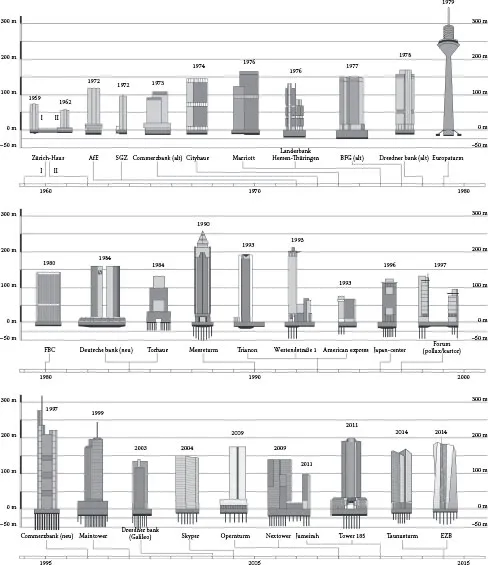
Figure 1.1 Development of high-rise buildings in Frankfurt am Main, Germany.
Chapter 2
Basics of geotechnical analysis
2.1 SOIL–STRUCTURE INTERACTION
To ensure the stability and the serviceability of any project with sufficient certainty, the interaction between the subsoil and the bearing structure generally has to be considered. Therefore, an accurate theoretical model for the description of this interaction is necessary. At the junction between structural engineering and geotechnical engineering, the soil-structure interaction is of enormous importance [1].
For a realistic and correct theoretical model of the three-dimensional and often time-variant soil–structure interaction, the following have to be taken into account:
• Modeling of the structure and its mechanical behavior
• Modeling of the soil and its mechanical behavior in relation to the multiphase material soil
• Determination of the contact behavior between subsoil and structure
During the design process for the various elements of a structure, different theoretical models can be used for considering the soil–structure interaction. The soil is not only a stabilizing or a loading element, but also, in combination with other construction elements, it is a hybrid bearing system. On the one hand, the loads from the structures create the main limit state for the analysis of the stability of the structures and the foundation elements. On the other hand, the settlements and differential settlements in the soil cause the main limit state for the analysis of the serviceability of the structures.
The soil is a part of the static system, but it may also add loading on structures due to its own weight. Therefore, two construction types have to be distinguished:
• Foundation systems (spread foundations, deep foundations, etc.), which are sustained by the soil
• Support structures (retaining walls, tunnels, etc.), which resist the soil
For analysis of stability and serviceability, the material behavior of the soil and the structure has to be taken into account. Often, elastoplastic, nonlinear constitutive laws are used, depending on the stress level and the velocity of the application of the load.
Moreover, the time-dependent effect of soil–structure interaction must also be considered [2–5]. This effect is caused by
• Successive construction works involving structural changes and load changes
• Changes of the rigidity
• Shifts of the load center
• Successive excavation or deconstruction works
• Successive installations, modifications or removals of anchors, stiffeners, and so on.
• Changes of the material behavior (creep, shrinkage, consolidation)
Thus, continuously changing static systems occur during the construction phases. Figure 2.1 shows the development of the qualitative deformations and loads in the bottom of an excavation during a construction project and the resulting deformations of construction elements that are built at various times [1,6].
2.2 ANALYSIS ACCORDING TO EUROCODE 7 (EC 7)
After 30 years of development and implementation of the Eurocodes, an integrative regulation of the analysis in civil engineering disciplines was achieved. The Eurocodes are based on the principle of the partial safety factor concept, which replaces the global safety factor concept.
Eurocode 7 (EC 7), consisting of two parts, was developed for geotechnical engineering. The first part [7] contains general regulations, the second part [8] contains the field investigations.
In Germany, for example, EC 7 was established with the following regulations in December 2012:
• DIN EN 1997-1 [9]
• DIN EN 1997-1/NA [10]
• DIN EN 1997-2 [11]
• DIN EN 1997-2/NA [12]
• DIN 1054 [13]
• DIN 1054/A1 [14]
• DIN 4020 [15]
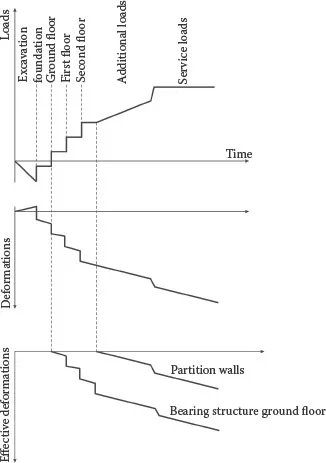
Figure 2.1 Loads and deformations during the construction process. (From Katzenbach et al., Handbuch für Bauingenieure: Technik, Organisation und Wirtschaftlichkeit. Springer-Verlag, Heidelberg, Germany, 1471–1490, 2012; Katzenbach et al., Die Berücksichtigung und Modellierung der Interaktion zwischen Baugrund und Tragwerk ist für die Standsicherheit und Gebrauchstauglichkeit der Konstruktion von entscheidender Bedeutung. Prüfingenieur, Vogel Druck und Medienservice, Germany, 44–62, 2013.)
These standards were integrated in user-friendly compendiums [16], which are separated in the different parts 1 [17] and 2 [18].
2.2.1 Design situations
Eurocode 0 distinguishes the following design situations [19–23]:
• Permanent
• Transient
• Accidental
• Earthquake
According to EC 7 [7] and DIN 1054 [13], the specification of the partial safety factors is differentiated in the following design situations:
• Permanent design situation BS-P (P = permanent)
• Transient design situation BS-T (T = transient)
• Accidental design situation BS-A (A = accidental)
• Earthquake design situation BS-E (E = earthquake)
The first three design situations are in accordance to the previous loading cases LF1, LF2 and LF3 of the former DIN 1054 from the year 2005 [24]. The design situation BS-E has since been added. The characteristic of the design situation BS-E is that no partial safety factors are included in the analysis that leads to a factorization of 1.0.
According to the design situations and the different ultimate limit states, the partial safety factors are represented in Tables 2.1 through 2.3 [13].
To determine the partial safety factors, the approved level of safety of the global safety factor concept was preserved. For example, the result of an analysis of a foundation system using the partial safety factor concept leads to similar results of analysis...
Table of contents
- Cover
- Half Title
- Title Page
- Copyright Page
- Table of Contents
- Preface
- Authors
- 1 Introduction
- 2 Basics of geotechnical analysis
- 3 Spread foundations
- 4 Deep foundations
- 5 Combined pile-raft foundation (CPRF)
- 6 Dynamic behavior of foundation systems
- 7 Special foundations
- Appendix A
- Index
Trusted by 375,005 students
Access to over 1.5 million titles for a fair monthly price.
Study more efficiently using our study tools.
Frequently asked questions
Yes, you can cancel anytime from the Subscription tab in your account settings on the Perlego website. Your subscription will stay active until the end of your current billing period. Learn how to cancel your subscription
No, books cannot be downloaded as external files, such as PDFs, for use outside of Perlego. However, you can download books within the Perlego app for offline reading on mobile or tablet. Learn how to download books offline
Perlego offers two plans: Essential and Complete
- Essential is ideal for learners and professionals who enjoy exploring a wide range of subjects. Access the Essential Library with 800,000+ trusted titles and best-sellers across business, personal growth, and the humanities. Includes unlimited reading time and Standard Read Aloud voice.
- Complete: Perfect for advanced learners and researchers needing full, unrestricted access. Unlock 1.5M+ books across hundreds of subjects, including academic and specialized titles. The Complete Plan also includes advanced features like Premium Read Aloud and Research Assistant.
We are an online textbook subscription service, where you can get access to an entire online library for less than the price of a single book per month. With over 1.5 million books across 990+ topics, we’ve got you covered! Learn about our mission
Look out for the read-aloud symbol on your next book to see if you can listen to it. The read-aloud tool reads text aloud for you, highlighting the text as it is being read. You can pause it, speed it up and slow it down. Learn more about Read Aloud
Yes! You can use the Perlego app on both iOS and Android devices to read anytime, anywhere — even offline. Perfect for commutes or when you’re on the go.
Please note we cannot support devices running on iOS 13 and Android 7 or earlier. Learn more about using the app
Please note we cannot support devices running on iOS 13 and Android 7 or earlier. Learn more about using the app
Yes, you can access Foundation Systems for High-Rise Structures by Rolf Katzenbach,Steffen Leppla,Deepankar Choudhury in PDF and/or ePUB format, as well as other popular books in Technology & Engineering & Civil Engineering. We have over 1.5 million books available in our catalogue for you to explore.