Applying scriptural insight to contemporary issues is one of the most important, yet most difficult, tasks that the church faces. The Bible, though written long ago, can speak authoritatively to contemporary ethical, doctrinal, and practical issues. Respected author I. Howard Marshall offers guidance for this perennial task in Beyond the Bible.
Using a "principled approach," Marshall moves from Scripture itself to contemporary understanding and application of Scripture. He examines how principles can be established from Scripture, whether explicitly or implicitly, and explores how the continuing development of insight can provide us with guidelines for the ongoing task of developing and applying Christian theology. Responses from Kevin Vanhoozer and Stanley Porter are included.
Students and scholars of the Bible and theology will be interested in this latest work from I. Howard Marshall, and it offers an accessible approach to a perennial topic of concern that pastors, church leaders, and interested laity will appreciate.
Beyond the Bible is the first book of the Acadia Studies in Bible and Theology series. Produced in partnership with Acadia Divinity College in Wolfville, Nova Scotia, this series gathers leading authorities to succinctly assess the major issues faced by the twenty-first century church and present their findings in a way that is rewarding to scholars yet accessible to students, pastors and laity. Readers will gain a fresh understanding of important issues that will enable them to take part meaningfully in discussion and debate. Series editors are Craig A. Evans and Lee Martin McDonald. Forthcoming series volumes will include contributions from J. D. G. Dunn, John J. Collins, and Craig Evans.
eBook - ePub
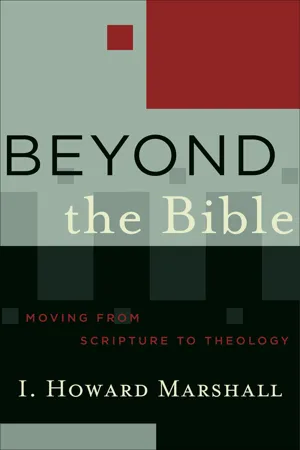
Beyond the Bible (Acadia Studies in Bible and Theology)
Moving from Scripture to Theology
- 136 pages
- English
- ePUB (mobile friendly)
- Available on iOS & Android
eBook - ePub
Beyond the Bible (Acadia Studies in Bible and Theology)
Moving from Scripture to Theology
About this book
Trusted by 375,005 students
Access to over 1.5 million titles for a fair monthly price.
Study more efficiently using our study tools.
Information
Topic
Theology & ReligionSubtopic
Biblical Studies
Evangelicals and Hermeneutics
Over the past couple of decades I have encountered several students who wished to do research in the area of hermeneutics. This represents one symptom of where we are in biblical research at the present time. Hermeneutics is a central concern in biblical studies. Galloping professional narrowness will force me to deal here primarily with problems arising in the area of the New Testament rather than in the Bible as a whole, but what I have to say will, I hope, represent the position regarding evangelical biblical studies generally.
Sometimes it has seemed to me that students who expressed this aim were not sure exactly what they really wanted to do, whether to attempt some fresh approach to a biblical passage or theme or to discuss broad principles of interpretation. I propose to use the term “interpretation” to refer to the former activity of interpreting the biblical text and to use the term “hermeneutics” to refer to the science or art of interpretation; so “interpretation” is what we do when we are actually dealing with the text, and “hermeneutics” is what we do when we discuss what is going on when we do interpretation. There is great uncertainty about this entire general area of hermeneutics and interpretation, not only in the narrower sector of biblical studies, but also in the broader field of literary studies and philosophy. Biblical interpretation, once perhaps almost taken for granted, has come to the fore as a disputed topic that demands scholarly attention[1] It is not surprising that in this situation fresh attention has been paid to biblical interpretation within that branch of Christian faith and scholarship called “evangelical,” and it is within this context that I wish to examine some key issues. My remarks, therefore, are addressed primarily to the evangelical constituency in the hope of helping us to put our own house in order, but I also hope that my observations will say something useful to all who are concerned to interpret the Bible for today.
The Importance of Evangelical Hermeneutics
Our topic is a broad one, and I will approach it from a particular angle that will help to focus our discussion. Hermeneutics is particularly important to us for two reasons. First, as Christian scholars who adhere to the evangelical faith, we are committed to the academic study of Scripture within a confessional framework, and therefore we must consider how this situation both liberates and constrains us as we carry out this task. But, second, as practicing Christians, we are also committed to Christian witness in the contemporary world, and therefore we need to ask questions about how we discover the message of the Bible for today, both for our fellow believers and for our non-Christian neighbors, and how we convey it to them. Clearly, these two commitments are interrelated, and it is increasingly recognized that they cannot be separated from one another. It is the latter task of expressing the Christian message for today that will be our focus in this series. So in these three lectures I am particularly concerned with the question of how we use the Bible in our theology, ecclesiology, and ethics, but more especially in the first of these.[2] But first, it may be helpful to put the matter in a broader context.
Evangelicals share some problems of interpretation and hermeneutics with any other scholars or readers of texts as they attempt to understand what is being said; other problems arise from the fact that we are Christian believers, for whom the Bible is somehow different from other books, and we think rightly that the way in which we interpret it is or should be different.
What makes the Bible different from other books for us, of course, is that it is Scripture, which signifies (among other things) that it possesses authority over its readers, speaking in the language of truth and command. This alone, however, is not what makes the question of what the Bible says all the more important. If it is authoritative, we need to be as sure as possible about what it is that God says to us by way of promise and warning and what we are authoritatively called to believe and to do. Furthermore, there may be ways in which the process of interpretation is also different. If the Bible is a book that is in some sense authored by God, then an appropriate manner of interpretation is required.
Three Levels of Study
The contemporary discussion of interpretation proceeds on three levels.
First, there is the level of general hermeneutics, which asks what is going on in interpretation in general and then in biblical interpretation in particular. Clearly, it is important to investigate hermeneutics at this level. I cite as examples two of the many vital questions that arise here. The first example is the question of whether texts can have “meaning” in themselves, meaning that is objectively there, so to speak, or whether meaning is somehow created afresh through the interaction between the reader and the text, it being assumed that texts in themselves have no fixed meaning; clearly, this has considerable implications for our understanding of biblical authority.[3] The second example is the question of how language “works”[4]— how texts work, the roles of their authors and their readers, and so on. Study of these matters helps us to have some idea about what we may legitimately expect from different kinds of texts, how we should approach them, and what are the implications of this for recognizing what is actually going on in biblical texts and in our reading of them.[5] However, largely out of comparative ignorance of this area and also because it is perhaps less immediately fruitful for the nitty-gritty of biblical interpretation than the other two levels of study, I propose to leave it to one side.
Second, there is the level of exegesis. Here we consider the specific procedures that may be applied to textual study, such as linguistic study, contextual study, source criticism, and much else. These methods and tools are used in approaching a text so as to understand it as it was understood or was meant to be understood in its own time.
Third, there is the level of exposition or application, where we raise the question of how to determine what an ancient text is saying to contemporary readers as opposed to original readers. Even if, say, Luke or Paul understood themselves to be writing “Scripture” in the sense of works meant for Christians everywhere for the foreseeable future,[6] they did so within the boundaries of their particular world and did not foresee the world of which we are part, and therefore there is a legitimate and necessary question about how their works can continue to function as Scripture for us.
These three levels of discussion are inextricably bound together. The classic modern example of the interrelatedness comes perhaps in the person of R. Bultmann, who read the New Testament in light of the philosophy of M. Heidegger, so that to some extent a demythologized version of its teaching emerges even in his New Testament Theology. Bultmann, in other words, was to some extent setting out what he thought Christians ought to believe today rather than simply describing the theology of the New Testament on its own terms.[7]
The Development of Evangelical Biblical Interpretation
Until comparatively recently evangelicals, like biblical scholars and preachers generally, did not recognize how great are the problems in these three areas. Of course, handbooks of biblical interpretation were available. In my student days, for example, Alan M. Stibbs wrote three booklets at a fairly nontechnical level, one of which was called Understanding God’s Word. Some of us jokingly suggested at the time that Stibbs might also have written a book on liberal interpretation of the Bible to be called Misunderstanding God’s Word. That was a characteristic example of juvenile conceit and a typical triumphalist evangelical claim that we alone are right.
Nevertheless, there was a growing awareness of the need for deeper discussion. A single example must suffice. Thirty years ago we were no doubt influenced by the mood of the times when the New Testament study group of the Tyndale Fellowship devoted its meeting in 1973 to the topic and discussed a set of papers that eventually were published in 1977 under the title New Testament Interpretation: Essays on Principles and Methods. The book was intended to be a comprehensive introductory textbook for theological students. In his essay “Approaches to New Testament Exegesis” in that book, R. P. Martin commended what he termed “the grammatico-historical method.” He contrasted it with what he called “the dogmatic approach” and “the impressionistic approach.” The former approach viewed Scripture as a series of theological proof-texts, often interpreted in light of later ecclesiastical statements, while the latter worked more with the “blessed thoughts” that a passage of Scripture excited in the minds of the readers. It is fair to say that at a popular level these kinds of interpretation were used often. By contrast, “the grammatico-historical method” takes seriously the fact that the Bible is a book from a particular historical setting and consists of words in the original languages; genuine interpretation must take account of the setting and attempt to understand the text using all possible resources that will explain the wording. Scripture must be understood on its own terms.[8]
In commending the “grammatico-historical method,” Martin probably also was distancing himself from the “historical-critical method,” which was the dominant approach in biblical scholarship. These two terms sound very similar, and the latter method used the same tools as the former. However, as formulated by scholars such as E. Troeltsch, the historical-critical method was based on a denial of the supernatural and attempted to understand the biblical text as simply a human, fallible collection of documents. As a consequence, historical criticism in the broad sense was viewed with disfavor by evangelicals; they believed that its presuppositions were invalid and therefore that its conclusions must be false, and so they were tempted to reject it lock, stock, and barrel. Evangelicals were also wary of a method that seemed to work largely by discovering errors and contradictions in the Bible and building theories upon them. Underlying all of this was also the perception that this method was spiritually barren because it seemed to be more concerned with exploring how texts came into existence than with elucidating their theological significance. Students walked out of theological seminaries with the feeling that they had learned very little that would help them to preach from Scripture.
To cite a favorite example, the documentary theory about the origins of the Pentateuch was regarded with disfavor because: (1) it denied the Mosaic authorship of Genesis (which was assumed to be asserted in the Bible [e.g., John 1:45]); (2) to a considerable extent it based the dissection of the narrative into sections from different sources on the exposure of discrepancies and contradictions between different texts; and (3) it tended to ignore the divine authority of the text. Thus, serious questions arose about what the documentary theory did in trying to explain the biblical text in terms of its sources and the influences upon its writers in such a way that its claim to be in some way based upon revelation was disputed. More recent criticism of it (not just by evangelicals) has also claimed that in principle the method could not bring out the message of the Bible for today. Maybe the reason for this was that it did not really try to do so and simply stopped short of asking what the text might mean for its readers as Scripture. Yet a great deal of biblical study was conducted in this manner.
Faced by the prevalence of this approach, evangelicals reacted in two ways.
First, a few scholars attempted to deal with such problems by taking on the critics on their own ground, producing reasoned refutations of their theories and attempting to frame better ones. Among scholars who did so we might mention G. Ch. Aalders, whose Short Introduction to the Pentateuch kept me going during my student days, G. T. Manley, author of The Book of the Law, and, towering above them all on the New Testament side, J. G. Machen, whose Virgin Birth of Christ came to my rescue after a series of seminars in Germany back in 1959.[9] The point to be emphasized is that whether or not these evangelical scholars were right in their historical conclusions, they recognized the need for scholarly historical study of the issues. The questions asked by the critics were legitimate and demanded answers.
Second, probably the majority of evangelicals simply took refuge in their belief in scriptural infallibility, claiming that whatever critics might say, the biblical statements about authorship and forecasts made in predictive prophecies were, by definition, historically infallible. Many interpreters, therefore, simply ignored the “higher critics” (as they called them) and their conclusions. There was a consequent distrust of scholarship of any kind. For a long time, very little serious evangelical scholarship was undertaken, and evangelical candidates for ministry sometimes were counseled by their elders to avoid pursuing theological degrees lest they be infected with higher criticism and lose their faith.
As for actual interpretation of the text, evangelical scholars followed the practices of the time. Essentially, exegesis was carried on perfectly properly by linguistic and syntactical study to discover what the text was saying. Background information was drawn upon to explain it. There was, however, a tendency to focus on elucidating the details of the text verse by verse rather than to look at larger units of text and their total thrust. For those of us who were students at the time, the publication of the Tyndale New Testament Commentaries series was an absolute Godsend, but even then I was sadly aware that in some cases insufficient attention was paid to the structure of the biblical books and to the elucidation of their theology.
It was then assumed that the text would speak to the modern reader more or less as it stood. There was, therefore, little need for “interpretation” in the sense of reapplying the text to different circumstances or translating it to make it intelligible to people who did not stand in the original situation. For the most part it could be assumed that there was little or no difference between the original readers and the contemporary readers. It may be significant that even in my 1977 symposium only one out of eighteen essays was directly concerned with the question of how one expounds the text for the modern reader.[10]
We thus have a situation in which there was little or no scholarship (despite the exceptions already noted), evangelicalism was largely defensive, and hermeneutics was not seen as a problem. It is fair to say that at the center of whatever discussion did take place were the questions of authorship and historicity, since these issues were most germane to the authenticity and authority of the biblical texts.
But then came several books like the...
Table of contents
- Cover Page
- Title Page
- Copyright Page
- Endorsements
- Series Page
- Contents
- Preface
- 1. Evangelicals and Hermeneutics
- 2. The Development of Doctrine
- 3. The Search for Biblical Principles
- 4. Into the Great “Beyond”: A Theologian’s Response to the Marshall Plan
- 5. Hermeneutics, Biblical Interpretation, and Theology: Hunch, Holy Spirit, or Hard Work?
- Notes
- Scripture Index
- Subject Index
Frequently asked questions
Yes, you can cancel anytime from the Subscription tab in your account settings on the Perlego website. Your subscription will stay active until the end of your current billing period. Learn how to cancel your subscription
No, books cannot be downloaded as external files, such as PDFs, for use outside of Perlego. However, you can download books within the Perlego app for offline reading on mobile or tablet. Learn how to download books offline
Perlego offers two plans: Essential and Complete
- Essential is ideal for learners and professionals who enjoy exploring a wide range of subjects. Access the Essential Library with 800,000+ trusted titles and best-sellers across business, personal growth, and the humanities. Includes unlimited reading time and Standard Read Aloud voice.
- Complete: Perfect for advanced learners and researchers needing full, unrestricted access. Unlock 1.5M+ books across hundreds of subjects, including academic and specialized titles. The Complete Plan also includes advanced features like Premium Read Aloud and Research Assistant.
We are an online textbook subscription service, where you can get access to an entire online library for less than the price of a single book per month. With over 1.5 million books across 990+ topics, we’ve got you covered! Learn about our mission
Look out for the read-aloud symbol on your next book to see if you can listen to it. The read-aloud tool reads text aloud for you, highlighting the text as it is being read. You can pause it, speed it up and slow it down. Learn more about Read Aloud
Yes! You can use the Perlego app on both iOS and Android devices to read anytime, anywhere — even offline. Perfect for commutes or when you’re on the go.
Please note we cannot support devices running on iOS 13 and Android 7 or earlier. Learn more about using the app
Please note we cannot support devices running on iOS 13 and Android 7 or earlier. Learn more about using the app
Yes, you can access Beyond the Bible (Acadia Studies in Bible and Theology) by I. Howard Marshall in PDF and/or ePUB format, as well as other popular books in Theology & Religion & Biblical Studies. We have over 1.5 million books available in our catalogue for you to explore.