- 272 pages
- English
- ePUB (mobile friendly)
- Available on iOS & Android
eBook - ePub
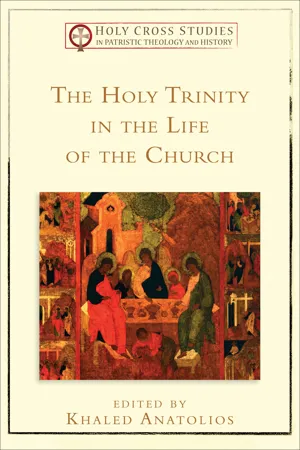
The Holy Trinity in the Life of the Church ()
About this book
In this volume, a noted theologian brings together an ecumenical roster of leading scholars to explore trinitarian faith as it is concretely experienced in the life of the church. Drawing upon and fostering renewed interest in trinitarian theology, the contributors--including Brian E. Daley, John Behr, and Kathleen McVey--clarify the centrality of trinitarian doctrine in salvation, worship, and life. This is the third volume in Holy Cross Studies in Patristic Theology and History, a partnership between Baker Academic and the Pappas Patristic Institute of Holy Cross Greek Orthodox School of Theology. The series is a deliberate outreach by the Orthodox community to Protestant and Catholic seminarians, pastors, and theologians.
Trusted by 375,005 students
Access to over 1.5 million titles for a fair monthly price.
Study more efficiently using our study tools.
Information
Topic
Theology & ReligionSubtopic
Christian DenominationsPart 1
The
Trinity
in Christian
Worship
1
The Baptismal Command (Matthew 28:19–20) and the Doctrine of the Trinity
When I first read Gregory of Nyssa’s Great Catechetical Oration, or, as it is sometimes called, the Address on Religious Instruction, one paragraph caught my attention, and it has held it ever since. Toward the end of the treatise Gregory writes:
We are taught in the gospel that there are three Persons and Names through whom believers come to be born. He who is born of the Trinity is born equally of Father, Son, and Holy Spirit. For this is how the gospel speaks about the Spirit: “That which is born of the Spirit is spirit” [John 3:6]. Paul, moreover, gives birth “in Christ” [1 Cor. 4:15], and the Father is the “Father of all” [cf. Eph. 4:6]. And here I ask the reader to judge soberly, lest he make himself the offspring of an unstable nature, when he could have that which is unchangeable as the source of his life. For what happens in the sacrament of baptism depends upon the disposition of the heart of him who approaches it. If he confesses that the holy Trinity is uncreated, then he enters on the life which is unchanging. But if, on a false supposition, he sees a created nature in the Trinity and then is baptized into that, he is born once more to a life which is subject to change. For offspring and parents necessarily share the same nature. Which, then, is more advantageous: to enter upon the life which is unchanging or to be tossed about once more in a life of instability and fluctuation?1
The words spoken at baptism are powerful words, Gregory says; they can incorporate us into the true God or into a false god, depending on what words are used and what meaning is intended. So, be careful of what God you are baptized into. Baptism is a form of paternity, and offspring share the nature of their parents. If you are baptized into an Arian or Anomoean god,2 then you are the offspring of a mutable god, and you are baptized into a life that is subject to change, a life of instability and fluctuation. If you are baptized into the Trinity who is three Persons and three Names, the Three who are equal, then you enter into a life that is unchanging; so, know who your Father is before you are baptized into him.
There is far more than a rhetorical conceit here. Gregory is drawing a close connection between the words spoken at baptism and the reality of God himself. The passage raises an important topic: the relation between baptism in the Triple Name, on the one hand, and Christian faith in the Trinity and the theology of the Trinity in the early church, on the other.
The fathers of the church often used Matthew 28:19 in their doctrinal and theological argumentation. In some significant passages in their writings, they cited the baptismal command (Matt. 28:19) more or less verbatim and drew doctrinal or theological conclusions from it. The texts that meet these criteria are not numerous, but the ones that do are quite interesting. They fall roughly into three groups. The first group consists of passages relating the baptismal command to the development of the creed and, later, to the explication of the creed. The second group includes passages dealing with a specific, single word in the baptismal command and drawing a conclusion from the sense of that single word. The third group comprises passages that make more general theological points when quoting the baptismal command.
The Baptismal Command and the Creed
The baptismal command appears to be the origin of the creed, or at least the point from which baptismal creeds grew.3 But there is no consensus about the precise origin of the creeds. One reads sometimes that creeds developed when phrases and clauses were added to the Triple Name of baptism to refute heresies. There is some evidence for this claim, but not enough to reach certainty.4
A few highlights that trace the development of the creeds can be pointed out. The baptismal command in Matthew 28:18–20 is one of the most familiar texts in the New Testament. In the translation of the Revised Standard Version, it reads:
And Jesus came and said to them, “All authority in heaven and on earth has been given to me. Go therefore and make disciples of all nations, baptizing them in the name of the Father and of the Son and of the Holy Spirit, teaching them to observe all that I have commanded you; and lo, I am with you always, to the close of the age.”
The Greek has one imperative, “make disciples,” and three participles parallel to that imperative, so that Jesus’s words are equivalent to four commands: “go,” “make disciples,” “baptize,” and “teach.” One of the commands is to travel, one is to administer the sacrament, and two are to teach. The roots of Christianity as a doctrinal religion and a religion that has a creed, truths that must be accepted, are in this passage.
To mention just a few highlights in the development of the teaching and practice of baptism, we might begin with the Didache. In this famous document, which probably dates from the first half of the second century, baptism is a liturgical rite that is already developed. There is an almost rubrical concern about how the sacrament should be administered. But also, the Matthean formula with the Triple Name is clearly invoked:
The procedure for baptizing is as follows. . . . Immerse in running water, “In the Name of the Father, and of the Son, and of the Holy Spirit.” If no running water is available, immerse in ordinary water. This should be cold if possible; otherwise warm. If neither is practicable, then pour water three times on the head “In the Name of the Father, and of the Son, and of the Holy Spirit.” Both baptizer and baptized ought to fast before the baptism, as well as any others who can do so; but the candidate himself should be told to keep a fast for a day or two beforehand.5
In the Didache, the emphasis is on moral rather than doctrinal instruction; the first six chapters of this work treat “the two ways”: the way of life and the way of death. The Didache gives little evidence of doctrinal norms, except perhaps in regard to the Eucharist: the Eucharist may be given only to those who have been baptized.6
Justin Martyr, in his First Apology, mentions some points that the Didache already made. Those who accept the truth of what the Christians say and teach pledge themselves to live according to Christian norms. They pray and fast to seek forgiveness. Then they are brought to water and baptized. The next sentence in Justin’s work shows what is probably the beginning of a creedal development—that is, the addition of some further phrases to the Triple Name of Father, Son, and Holy Spirit: “In the name of God, the Father and Lord of all, and of our Savior, Jesus Christ, and of the Holy Spirit, they then receive the washing with water.”7
Further evidence is found in Tertullian’s treatise On Baptism, the only treatise on any sacrament preserved from the pre-Nicene period. Tertullian makes a clearer connection between the profession of right faith and the sealing of baptism. He writes of “faith signed and sealed in the Father and the Son and the Holy Spirit.”8 Tertullian interprets the Triple Name in light of the three witnesses of Matthew 18:16. “It is,” he continues, “under the charge of the three that profession of faith and promise of salvation are in pledge”; “there is a necessary addition, the mention of the Church: because where there are the three, the Father and the Son and the Holy Spirit, there is the Church, which is a body of three.”9 Tertullian appears to be alluding to a primitive creed, in which the names of Father, Son, and Holy Spirit and the church are mentioned.10 In a later development, mention of the church was incorporated into the third article of the creed.
An early witness to the use of a baptismal creed at the moment the sacrament is administered may be the Apostolic Tradition, a work traditionally attributed to Hippolytus of Rome. This text’s portrayal of the rite of baptism as it may have been administered at Rome early in the third century (or even earlier, since its purpose was to preserve authentic tradition, which it says is being corrupted) includes the profession of the creed, in interrogatory form, as the candidate is being baptized. The rite takes place at cockcrow. Prayers are offered over the water. If possible, the water should be flowing; but, if necessary, one may use still water. Candidates should undress. Children should be baptized first. Those who can speak for themselves should speak; otherwise their parents should speak for them. Then the men are baptized, and finally the women, after they have loosened their hair and put aside their jewelry. No one should take a foreign object into the font. At the moment of baptism, the bishop gives thanks over the oil; this oil is called the oil of thanksgiving (eucharistia). One deacon places the oil of exorcism at the left of the bishop; another deacon takes the oil of thanksgiving and places it at the right of the bishop. The bishop orders the candidates to renounce Satan and all his pomps and works. Then the baptism itself takes place:
A deacon will descend with him in this manner. When he who is being baptized will have descended into the water, he who baptizes will say to him, while imposing his hand on him: “Do you believe in God the Father almighty?” And he who is being baptized will say in turn, “I believe.” And immediately, he (who is baptizing), holding his hand placed on his head, will baptize him one time. And then he will say, “Do you believe in Christ Jesus, Son of God, who was born by the Holy Spirit of the Virgin Mary, was crucified under Pontius Pilate, died, was raised on the third day alive from...
Table of contents
- Cover
- Series Page
- Title Page
- Copyright Page
- Contents
- Foreword
- Preface
- Part 1: The Trinity in Christian Worship
- Part 2: Jesus Christ, the Trinity, and Christian Salvation
- Part 3: The Trinity and Ecclesial Being
- Conclusion
- Abbreviations
- List of Contributors
- Subject Index
- Modern Authors Index
- Ancient Sources Index
- Notes
- Back Cover
Frequently asked questions
Yes, you can cancel anytime from the Subscription tab in your account settings on the Perlego website. Your subscription will stay active until the end of your current billing period. Learn how to cancel your subscription
No, books cannot be downloaded as external files, such as PDFs, for use outside of Perlego. However, you can download books within the Perlego app for offline reading on mobile or tablet. Learn how to download books offline
Perlego offers two plans: Essential and Complete
- Essential is ideal for learners and professionals who enjoy exploring a wide range of subjects. Access the Essential Library with 800,000+ trusted titles and best-sellers across business, personal growth, and the humanities. Includes unlimited reading time and Standard Read Aloud voice.
- Complete: Perfect for advanced learners and researchers needing full, unrestricted access. Unlock 1.5M+ books across hundreds of subjects, including academic and specialized titles. The Complete Plan also includes advanced features like Premium Read Aloud and Research Assistant.
We are an online textbook subscription service, where you can get access to an entire online library for less than the price of a single book per month. With over 1.5 million books across 990+ topics, we’ve got you covered! Learn about our mission
Look out for the read-aloud symbol on your next book to see if you can listen to it. The read-aloud tool reads text aloud for you, highlighting the text as it is being read. You can pause it, speed it up and slow it down. Learn more about Read Aloud
Yes! You can use the Perlego app on both iOS and Android devices to read anytime, anywhere — even offline. Perfect for commutes or when you’re on the go.
Please note we cannot support devices running on iOS 13 and Android 7 or earlier. Learn more about using the app
Please note we cannot support devices running on iOS 13 and Android 7 or earlier. Learn more about using the app
Yes, you can access The Holy Trinity in the Life of the Church () by Anatolios, Khaled, Khaled Anatolios in PDF and/or ePUB format, as well as other popular books in Theology & Religion & Christian Denominations. We have over 1.5 million books available in our catalogue for you to explore.