eBook - ePub
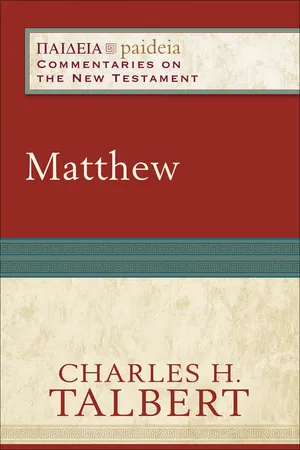
Matthew (Paideia: Commentaries on the New Testament)
- 400 pages
- English
- ePUB (mobile friendly)
- Available on iOS & Android
eBook - ePub
Matthew (Paideia: Commentaries on the New Testament)
About this book
In this fresh commentary, the fourth of eighteen volumes in the Paideia series, a leading New Testament scholar examines cultural context and theological meaning in Matthew. Paideia commentaries explore how New Testament texts form Christian readers by
• Attending to the ancient narrative and rhetorical strategies the text employs
• Showing how the text shapes theological convictions and moral habits
• Commenting on the final, canonical form of each New Testament book
• Focusing on the cultural, literary, and theological settings of the text
• Making judicious use of maps, photos, and sidebars in a reader-friendly format
• Attending to the ancient narrative and rhetorical strategies the text employs
• Showing how the text shapes theological convictions and moral habits
• Commenting on the final, canonical form of each New Testament book
• Focusing on the cultural, literary, and theological settings of the text
• Making judicious use of maps, photos, and sidebars in a reader-friendly format
Tools to learn more effectively

Saving Books

Keyword Search

Annotating Text

Listen to it instead
Information
Matthew 1:1–2:23
Birth Narratives

Introductory Matters
Several questions of structure call for discussion before we trace the flow of the narrative in the first two chapters of Matthew’s Gospel.
Why Separate Matthew 1–2 from 3–4?
First, the question arises, Why separate 1:1–2:23 from 3:1–4:17? For those who regard the phrase apo tote ērxato (from then [Jesus] began) in 4:17 and 16:21 as the marker of Matthew’s three major divisions (e.g., Krentz 1964; Kingsbury 1989, 7–25), 1:1–2:23 belongs with 3:1–4:17, making up the first division of the First Gospel.
Moreover, there is a significant link between 2:22–23 and 4:12–14.
When he heard (2:22/4:12)
he withdrew (2:22/4:12)
to/into Galilee (2:22/4:12)
to/from Nazareth (2:23/4:13)
the word fulfilled (2:23/4:14)
There are weighty reasons, however, to see a significant break between 2:23 and 3:1 (Davies and Allison 1988, 1:287). First, apo tote ērxato (from then he began) is not a reliable guide to Matthew’s division of his narrative. In 26:16 we find apo tote (from then) and in 11:20 tote ērxato (then he began) without any sign of their being significant markers. The two uses of the full three-word formula, furthermore, do not compare with the fivefold repetition of kai egeneto hote etelesen ho Iēsous (and when Jesus had finished: 7:28; 11:1; 13:53; 19:1; 26:1) as narrative markers. Second, the story in 1:1–2:23 deals with the birth and infancy of Jesus while that in 3:1–4:17 focuses on Jesus as a young adult. There is a twenty- to thirty-year gap between the two. Third, 3:1–12 shifts to a new subject: the Baptist. Fourth, except for son of God, the christological designations of 1:1–2:23 (e.g., son of Abraham, Emmanuel, son of David, king of the Jews, one like Moses) fade into the background in 3:1–4:17. Fifth, the narratives in 1:1–2:23 and in 3:1–4:17 draw on different sources for their material and constitute different genres. If Matt. 3:1–17 draws material from Mark and Q, the genre is theologically interpreted tradition with ties to biography. If 1:1–2:23 is theologically interpreted tradition, its genre is a matter of debate: history? haggadah? midrash? Of the three options only haggadah (edifying narratives that graphically elaborate events associated with and meaningful to faith) comes close (Soares Prabhu 1976, 13–14). Sixth, 1:1–2:23 and 3:1–4:17 each has its own structural organization. Structure divides rather than joins the two segments of narrative. For these reasons, this commentary will treat 1:1–2:23 as a self-contained section of the Gospel.
Sources of Matthew 1–2
A second matter concerns sources. Although attempts have been made to argue for a pre-Matthean source or sources behind chapters 1–2 (e.g., Davies and Allison 1988, 1:190–95, who claim three stages of development), none has produced a consensus among scholars. That there was tradition from which the First Evangelist worked, however, is indicated by the independent use of similar material in Luke (Brown 1977, 34–35). Their common material includes: (1) Joseph is of Davidic descent (Matt. 1:16, 20; Luke 1:27, 32; 2:4); (2) Joseph and Mary, though betrothed, do not yet live together (Matt. 1:18; Luke 1:27, 34); (3) an angel announces the coming birth (Matt. 1:20–23; Luke 1:30–35); (4) the conception is not through intercourse of Mary with Joseph (Matt. 1:20, 23, 25; Luke 1:34) but through the Holy Spirit (Matt. 1:18, 20; Luke 1:35); (5) the angel instructs that the name of the child be Jesus (Matt. 1:21; Luke 1:31); (6) an angel says Jesus is to be Savior (Matt. 1:21; Luke 2:11); (7) the birth of the child takes place after Joseph and Mary have come to live together (Matt. 1:24–25; Luke 2:5–6); (8) the birth is in Bethlehem (Matt. 2:1; Luke 2:4–6); (9) the birth is during the reign of Herod the Great (Matt. 2:1; Luke 1:5); (10) the child is reared at Nazareth (Matt. 2:23; Luke 2:39). Each evangelist, while using this common tradition, has developed it very differently. Our task will be to discern Matthew’s distinctive development of the tradition.
The Components and Arrangement of Matthew 1–2
The third introductory matter concerns the components of the Matthean narrative of Jesus’s origins and their organization and development in chapters 1–2. Matthew 1:1–17 has a genealogy. In 1:18–2:23 are five scenes, each with the same components, though the order varies:
- 1:18–25: Dream command, fulfillment of Scripture, obedience to the command
- 2:1–12: Fulfillment of Scripture, dream command, obedience to the command
- 2:13–15: Dream command, obedience, fulfillment of Scripture
- 2:16–21: Fulfillment of Scripture, dream command, obedience
- 2:22–23: Dream warning, obedience, fulfillment of Scripture
Three of the pericopes have dream reports (1:18–25; 2:13–15; 2:16–21); two contain references to dreams (2:12; 2:22; Dodson 2002).
At one level, the genealogy (1:1–17) and the first dream report (1:18–25) go together logically while the final four pericopes with dreams logically belong together. This yields a twofold division that corresponds roughly to the current chapter divisions. It will be in these terms that the following section, the rhetorical development and function of Matt. 1–2, will initially unfold.
Matthew 1:1–2:23 in the Narrative Flow
Tracing the Narrative Flow
Genealogy and Birth (1:1–25)
Matthew 1:1–25 is the first component of chapters 1–2. It consists of four main units: a heading (1:1), the genealogy (1:2–16), a concluding summary (1:17), and a dream and a birth (1:18–25).
1:1. The heading (1:1) reads: Book of the genesis of Jesus Christ, son of David, son of Abraham (cf. Gen. 5:1 LXX, the book of the genesis of humans). The major question regarding 1:1 is whether this heading refers to the genealogy only (Garland 2001, 15), to 1:2–25 (Brown 1977, 59), to 1:2–2:23, to 1:2–4:17 (Bauer 1990), or to the entire Gospel (Davies and Allison 1988, 1:153–54; Boring 1995, 125). For our purposes here, it is sufficient to say that verse 1 covers at least the first chapter of Matthew (the genealogy and first dream report).
1:2–16. The genealogy itself (1:2–16) consists of three subunits (1:2–6a, 6b–11, 12–16) specified by the concluding summary in 1:17. It unfolds in reverse order from that of the heading (1:1: Jesus Christ, son of David, son of Abraham): Abraham, David, the Christ (1:17). It was not uncommon in Israel’s scriptures to have a genealogy open a narrative (cf. Gen. 5–9: a genealogy and the story of Noah; Gen. 11:10–25:11: a genealogy and the story of Abraham). Hellenistic biographies also often opened with genealogies or accounts of a hero’s ancestors (e.g., Plutarch, Alex. 2; Brut. 1; Suetonius, Jul. 6; Tacitus, Agr. 4; Josephus, Life 1–6).
To refer to Jesus as “son of Abraham” would have evoked certain connections. Three seem relevant here. First, T. Levi 8.14–15 (“from Judah a king will arise, . . . a descendant of Abraham, our father”) connects the messianic king with Abrahamic lineage (cf. Gal. 3:16; Gen. 17:6). Second, Abraham, the gentile who became the father of the Jews, signals the First Gospel’s interest in gentiles (cf. Gen. 17:6; 1 Macc. 12:21; Matt. 3:9; 8:11–12; Gal. 3:8; Rom. 15:8–12). Indeed, Josephus (Ant. 1.162–68) portrays Abraham as a missionary going down to Egypt. Third, Jubilees portrays Abraham as one who resisted evil spirits and the devil (12.20: “Save me from the hands of evil spirits which rule over the thought of the heart of man, and do not let them lead me astray from following you, O my God” [OTP 2:81]; 17.15–18.19: Abraham’s willingness to sacrifice Isaac is depicted in the context of a test by Prince Mastema to determine Abraham’s faithfulness).
To refer to Jesus as “son of David” would have evoked at least two connections in the auditors of Matthew. First, “son of David” had become a messianic reference by Matthew’s time (cf. Pss. Sol. 17; 4QFlor 1.11–13; 4QpIsa, frags. 8–10, col. 3.11–25; 2 Esd. [4 Ezra] 12:32; Rom. 1:3–4). Second, in the OT (with the exception of 2 Sam. 13:1), “son of David” refers to Solomon, through whom Matthew’s genealogy traces the royal line (unlike Luke 3:31, which traces the line through David’s otherwise insignificant son Nathan; Bohler 1998). Solomon had become associated with healing and exorcism (L.A.B. 60.3; Josephus, Ant. 8.45–49; T. Sol; b. Git. 68a–b). Quite apart from Solomon, however, the Davidic messiah was expected to feed the sheep, strengthen the weak, heal the sick, bind up the crippled, bring back the straying, and seek the lost (Ezek. 34). In Matthew’s references to Jesus as son of David (1:1; 9:27; 12:23; 15:22; 20:30, 31; 21:9, 15), both messianic and healing overtones are found. A son of David was expected by some Jews to be a messianic shepherd for God’s people. The historical David was to be shepherd over Israel (2 Sam. 5:1–2; 1 Chron. 11:1–2; Ps. 2:9 LXX; Tg. Ps. 2.9; Ps. 78:70–71; 4Q504, frags. 1–2, col. 4.6–8). The ideal Davidic figure of the future was also expected to shepherd the people (Mic. 5:4; Ezek. 34:23–24; 37:24; Pss. Sol. 17.40–41: the Davidic Messiah will shepherd the Lord’s flock). Later, in Matt. 2:6, a composite quotation from Mic. 5:1–2 and 2 Sam. 5:2 speaks of an eschatological ruler who will shepherd God’s people; 26:31, in a composite quotation from Zech. 13:7 and Ezek. 34:31, speaks about striking the shepherd and the sheep being scattered; 9:36, echoing 1 Kings 22:17, says Jesus had compassion on the crowds because they were like sheep without a shepherd (Willitts 2007).
To refer to Jesus as “the Christ” (1:17) would have been only to focus the implications of “son of Abraham” and “son of David.” To speak of Jesus as messiah at the end of this genealogy would be to insert him into a history and a people. God gave promises to Abraham (Gen. 12:2–3; 18:18) and to David (2 Sam. 7:12–14). In Jesus, the climax of the list, the genealogy says, these promises have been fulfilled. This establishes the point of view in terms of which the following narrative about Jesus is to be understood (Bauer 1990, 464). Jesus brings to realization all that was implicit in the events, persons, and declarations of Israel’s history.
That God has brought Israel’s history to its fulfillment in Jesus was not without its challenges. On the one hand, God’s redemptive activity has had to deal with the unexpected, the unrespectable, the unconventional as agents in salvation history (cf. Judah, 1:3; Tamar, 1:3; Rahab, 1:5a; Ruth, 1:5b; David, 1:6; the wife of Uriah, 1:6; other kings starting with Solomon, 1:7; Mary, 1:16; Schnackenburg 2002, 17; Mattila 2002, 81) and with catastrophes (like the exile, 1:11–12). On the other hand, the genealogy itself presents a problem. It is Joseph’s genealogy. It is he who is of the lineage of David. He, however, is not said to be the father of Jesus, only the husband of Mary, of whom Jesus, the one called Christ, was born (1:16). How then can Joseph’s genealogy locate Jesus within the Davidic line?
The Women in Matthew’s Genealogy
Explanations for the presence of women in Matthew’s genealogy follow two trajectories. If emphasis is on similarities among the women, the argument runs like this: The first four women were probably all gentiles. Tamar (Gen. 38) and Rahab (Josh. 2, 6) were Canaanites. Ruth (Ruth 1–4) was a Moabite. Bathsheba (2 Sam. 11–12), who was married to Uriah the Hittite, was also probably a gentile. So gentiles were a part of God’s plan from early on. Also, all four were involved in sexual activity that outsiders might view negatively. Tamar tricked her father-in-law into having sex with her (though levirate marriage was acceptable by Jewish standards); Rahab was a prostitute; Ruth seduced her kinsman Boaz; Bathsheba committed adultery with David. Although the rabbis regard some of them as righteous gentiles (e.g., Rahab and Ruth in Eccles. Rab. 5.11.1), one would have to conclude that God worked through unconventional women. That a young, betrayed, pregnant girl would be ...
Table of contents
- Cover
- Series Page
- Title Page
- Copyright Page
- Dedication
- Contents
- List of Figures and Tables
- Foreword
- Preface
- Abbreviations
- Introduction
- Matthew 1:1–2:23 Birth Narratives
- Matthew 3:1–8:1 Part 1: Jesus’s Ministry Begins
- Matthew 8:2–11:1 Part 2: Jesus’s Authority Is Revealed
- Matthew 11:2–13:53 Part 3: Jesus’s Ministry Creates Division
- Matthew 13:54–19:2 Part 4: Jesus Focuses on His Disciples
- Matthew 19:3–26:1a Part 5: Jesus and Judgment
- Matthew 26:1b–28:20 Passion and Resurrection Narrative
- Bibliography
- Subject Index
- Index of Modern Authors
- Index of Scripture and Ancient Sources
Frequently asked questions
Yes, you can cancel anytime from the Subscription tab in your account settings on the Perlego website. Your subscription will stay active until the end of your current billing period. Learn how to cancel your subscription
No, books cannot be downloaded as external files, such as PDFs, for use outside of Perlego. However, you can download books within the Perlego app for offline reading on mobile or tablet. Learn how to download books offline
Perlego offers two plans: Essential and Complete
- Essential is ideal for learners and professionals who enjoy exploring a wide range of subjects. Access the Essential Library with 800,000+ trusted titles and best-sellers across business, personal growth, and the humanities. Includes unlimited reading time and Standard Read Aloud voice.
- Complete: Perfect for advanced learners and researchers needing full, unrestricted access. Unlock 1.4M+ books across hundreds of subjects, including academic and specialized titles. The Complete Plan also includes advanced features like Premium Read Aloud and Research Assistant.
We are an online textbook subscription service, where you can get access to an entire online library for less than the price of a single book per month. With over 1 million books across 990+ topics, we’ve got you covered! Learn about our mission
Look out for the read-aloud symbol on your next book to see if you can listen to it. The read-aloud tool reads text aloud for you, highlighting the text as it is being read. You can pause it, speed it up and slow it down. Learn more about Read Aloud
Yes! You can use the Perlego app on both iOS and Android devices to read anytime, anywhere — even offline. Perfect for commutes or when you’re on the go.
Please note we cannot support devices running on iOS 13 and Android 7 or earlier. Learn more about using the app
Please note we cannot support devices running on iOS 13 and Android 7 or earlier. Learn more about using the app
Yes, you can access Matthew (Paideia: Commentaries on the New Testament) by Charles H. Talbert, Parsons, Mikeal C., Talbert, Charles, Mikeal C. Parsons,Charles Talbert in PDF and/or ePUB format, as well as other popular books in Theology & Religion & Biblical Commentary. We have over one million books available in our catalogue for you to explore.