An in-depth look at the history, customs, word meanings, contemporary application and Pentecostal perspective of Paul's letters to the church at Corinth. Sections include an introduction, outlines, NIV translation, notes, and comments for each letter. Also includes study questions, a map of Paul's journeys, Scripture index, subject index, and a selected bibliography.
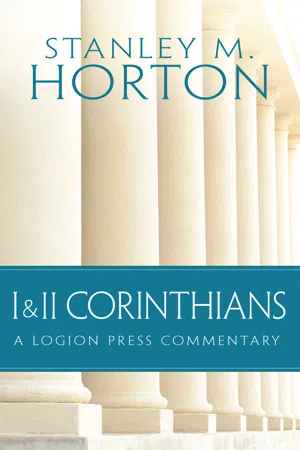
- 272 pages
- English
- ePUB (mobile friendly)
- Available on iOS & Android
eBook - ePub
1 & 2 Corinthians
About this book
Trusted by 375,005 students
Access to over 1 million titles for a fair monthly price.
Study more efficiently using our study tools.
Information
Topic
Theology & ReligionSubtopic
Biblical CommentaryFIRST CORINTHIANS
INTRODUCTION TO FIRST CORINTHIANS
CORINTH IN THE FIRST CENTURY
The splendid commercial city of Corinth was located just south of the ten-mile wide isthmus that connects central Greece with the Peloponnesus. It dominated the harbors of Lechaeum two miles on the west and Cenchreae six miles on the east (Acts 18:18; Rom. 16:1–2). To avoid a two-hundred-mile trip around the stormy Cape Malea, ships would dock at these harbors and have their cargoes transported across the isthmus and loaded on ships waiting on the other side. Small boats were also hauled across. Dominating this commerce made Corinth wealthy.
Though the site of Corinth was occupied as early as the Neolithic Period, Romans destroyed it about 146 B.C. and left it deserted until 44 B.C., when Julius Caesar rebuilt it as a Roman colony for freed slaves (mostly Syrians, Egyptians, and Jews). Though Latin was made the official language, Greek was the language spoken by the people, and the culture was definitely Greek. The people were proud of their culture and many were intellectually arrogant.
The emperor Augustus made Corinth the capital of Achaia, which was governed by a proconsul (Acts 18:12). Its situation and prosperity attracted a large population, possibly 250,000 citizens plus 400,000 slaves, with quite a number of Jews being found in both groups. It was also a host city to sailors and travelers coming on business or looking for pleasure.
Just southwest of the ancient city, Mount Acrocorinth rose to an elevation of 1,886 feet and had a temple of Aphrodite on its summit. A large marketplace (Gk. agora) in the center of the city was surrounded by shops. These would include the meat markets mentioned in 1 Corinthians 10:25. Archaeologists have found inscriptions, one mentioning Erastus, a friend of Paul, as the commissioner of public works (see Acts 19:22; Rom. 16:23; 2 Tim. 4:20), and another found in a residential district reading “Synagogue of the Hebrews” (Acts 18:4).1
Corinth was famous for its art, architecture, bronze foundries, baths, temples, and law courts. But the morals of its pagan society were so corrupt that “to Corinthianize” came to mean to live a most dissolute life. There were thousands of priestesses in the temples (especially the temple of Aphrodite, the so-called goddess of love) who were slave girls used as prostitutes selling their bodies as a religious act to raise money for the temples. They also acted as entertainers in the night life of the city. Every kind of sin was common and open in the city.
Paul would also have been aware of the Isthmian games held every year about ten miles east of Corinth; it included footraces, chariot races, wrestling, jumping, discus and javelin throwing, and a combination of boxing and wrestling. In addition there were competitions in music, oratory, and drama. The victor’s crown was a wreath of dried wild celery. No wonder Paul called it a crown that will not last (1 Cor. 9:25).
PAUL’S MINISTRY IN CORINTH
Paul must have recognized both the great need in Corinth as well as its strategic location for evangelism. He arrived there during his second missionary journey, probably in A.D. 50 or 51. Shortly after his arrival he met Aquila, a Jew born in the Roman province of Pontus in northern Asia Minor, and his wife, Priscilla (Acts 18:2; 1 Cor. 16:19). Since Aquila was a common slave name it may be that when the Romans invaded Pontus, they captured his family and sold or gave them as slaves in Rome. Later, many Romans considered it a religious thing to set slaves free and would even set them up in business. Because Priscilla (a diminutive form of Prisca) was a common name among high-class Romans, it may be that Aquila won her to the worship of the one true God, was set free, and married her.
In any case, Aquila and Priscilla were successful tentmakers in Corinth and Paul joined them, working daily at the tentmaking trade and preaching in the synagogue on the Sabbath. With great intensity he proclaimed Jesus as the Messiah, God’s anointed Prophet, Priest, and King. Soon most of the unbelieving Jews took a strong stand against the gospel, even using abusive language against Paul. He shook his outer garments against them to show he rejected their blasphemy and called down their blood on their heads, thus warning them that they would be responsible for the judgment God would send on them (cf. Ezek. 3:16–21). Paul then went next door to the house of Titius Justus, who was probably a Roman citizen. A number of Jews joined Paul, including Crispus, the ruler (elder) of the synagogue, and his household. A large number of Gentiles believed and were baptized.
In a night vision Jesus told Paul not to fear, that he should keep on proclaiming the Word, that the Lord would not let anyone harm him. Many then did come to Jesus, and no one harmed Paul, just as Jesus promised. But in the spring of A.D. 51 a new proconsul, Gallio, was appointed by the Roman Senate.2 Probably thinking they could take advantage of Gallio’s lack of knowledge of the situation, unbelieving Jews rose up against Paul and brought him before the proconsul’s tribunal. They accused Paul of persuading people to worship God in a way contrary to Roman law. (Judaism was a legal religion, so they were saying Christianity was different from Judaism and therefore illegal.) Gallio saw that the case really involved only their Jewish law, and he had them driven from the tribunal. This pleased the (Greek) crowd, and they seized Sosthenes, the new ruler of the synagogue, and punched him with their fists. Paul continued to minister for a time in Corinth and even Sosthenes accepted the gospel (1 Cor. 1:1).
AUTHORSHIP, OCCASION OF WRITING, AND DATE
Paul came to Ephesus during his third missionary journey.3 He spoke freely in the synagogue for three months, then opposition arose. He then withdrew and for two years he taught and preached daily in the lecture hall of Tyrannus (Acts 19:8–10). Apollos taught in Corinth during part of this time. But when problems arose, the Corinthian believers sent Paul letters, to which he replied. The first brief reply (see 1 Cor. 5:9), which has not been preserved, counseled them to avoid fellowship with immoral people; they took this to mean immoral unbelievers, though Paul meant Christians who became immoral (5:10–11).4 Then some Corinthians belonging to the household of Chloe reported disharmony to Paul. Following that, a letter (probably brought by Stephanas, Fortunatus, and Achaicus; 16:17) raised several questions involving serious problems. Paul, inspired by the Holy Spirit, proceeded to deal with these matters in 1 Corinthians about A.D. 54 or 55. In addition to dealing with sins, he deals with marriage, public worship, the Holy Spirit’s gifts and ministries, and an offering for the Jerusalem saints. Some commentators suppose Titus delivered the letter. Others think the brothers mentioned in 16:17 may have been the bearers.
First Corinthians was circulated and recognized very early as being from Paul. Clement of Rome referred to it in his first epistle to the Corinthians about A.D. 95. 5 The Muratorian Canon (about A.D. 170) put it at the head of the list of Paul’s epistles. The Church as a whole, down through the centuries, has continued to recognize it as authored by Paul and as being a part of the inspired canon of Scripture.
FIRST CORINTHIANS OUTLINE
I. INTRODUCTION 1:1–9
A. Greeting 1:1–3
B. Complimenting the Corinthians 1:4–9
II. DISSENSION IN THE CHURCH 1:10–4:21
A. An appeal for unity 1:10–12
B. Reasons for unity 1:13–3:23
1. The message of the Cross 1:13–2:16
a) Christ is not divided 1:13–17
b) Salvation through the crucified Christ 1:18–25
c) No one can boast before God 1:26–31
d) Paul’s preaching 2:1–5
e) The wisdom of God 2:6–16
2. The Church is God’s field, God’s building 3:1–9
3. A judgment day is coming 3:10–15
4. The Church is God’s temple 3:16–17
5. All things are yours 3:18–23
C. Paul’s faithfulness 4:1–21
1. The Lord will judge 4:1–5
2. No reason for boasting 4:6–7
3. The apostles a spectacle to the universe 4:8–13
4. Paul their father through the gospel 4:14–17
5. Paul will deal with arrogant people 4:18–21
III. SINNING CHRISTIANS MUST BE JUDGED 5:1–6:19
A. Sexual immorality ignored 5:1–13
1. The sinner needs to be dealt with 5:1–5
2. Get rid of the old yeast 5:6–8
3. Judge and expel sinning Christians 5:9–13
B. Let believers judge believers 6:1–8
C. The wicked will not inherit the kingdom of God 6:9–11
D. Flee sexual immorality 6:12–19
1. The body is meant for the Lord 6:12–17
2. The body is the temple of the Holy Spirit 6:18–19
IV. QUESTIONS ANSWERED 7:1–11:2
A. Marriage 7:1–40
1. Avoid immorality 7:1–7
2. Advice to the unmarried and widows 7:8–9
3. Divorce forbidden by the Lord 7:10–11
4. Living in peace with unbelieving spouses 7:12–16
5. Remaining in the situation God calls one to 7:17–24
6. Should virgins marry? 7:25–38
7. A widow is free to remarry 7:39–40
B. Food sacrificed to idols 8:1–13
1. Love builds up 8:1–3
2. Idols are nothing 8:4–6
3. Do not become a stumbling block to the weak 8:7–13
C. Paul’s apostleship 9:1–27
1. Paul’s clai...
Table of contents
- Cover
- Title Page
- Copyright
- Contents
- Preface
- First Corinthians
- Second Corinthians
- Appendixes
- Selected Bibliography
- Scripture Index
- Subject Index
Frequently asked questions
Yes, you can cancel anytime from the Subscription tab in your account settings on the Perlego website. Your subscription will stay active until the end of your current billing period. Learn how to cancel your subscription
No, books cannot be downloaded as external files, such as PDFs, for use outside of Perlego. However, you can download books within the Perlego app for offline reading on mobile or tablet. Learn how to download books offline
Perlego offers two plans: Essential and Complete
- Essential is ideal for learners and professionals who enjoy exploring a wide range of subjects. Access the Essential Library with 800,000+ trusted titles and best-sellers across business, personal growth, and the humanities. Includes unlimited reading time and Standard Read Aloud voice.
- Complete: Perfect for advanced learners and researchers needing full, unrestricted access. Unlock 1.4M+ books across hundreds of subjects, including academic and specialized titles. The Complete Plan also includes advanced features like Premium Read Aloud and Research Assistant.
We are an online textbook subscription service, where you can get access to an entire online library for less than the price of a single book per month. With over 1 million books across 990+ topics, we’ve got you covered! Learn about our mission
Look out for the read-aloud symbol on your next book to see if you can listen to it. The read-aloud tool reads text aloud for you, highlighting the text as it is being read. You can pause it, speed it up and slow it down. Learn more about Read Aloud
Yes! You can use the Perlego app on both iOS and Android devices to read anytime, anywhere — even offline. Perfect for commutes or when you’re on the go.
Please note we cannot support devices running on iOS 13 and Android 7 or earlier. Learn more about using the app
Please note we cannot support devices running on iOS 13 and Android 7 or earlier. Learn more about using the app
Yes, you can access 1 & 2 Corinthians by Stanley M. Horton in PDF and/or ePUB format, as well as other popular books in Theology & Religion & Biblical Commentary. We have over one million books available in our catalogue for you to explore.