- 17 pages
- English
- ePUB (mobile friendly)
- Available on iOS & Android
eBook - ePub
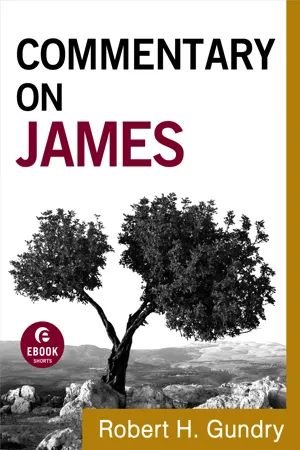
Commentary on James (Commentary on the New Testament Book #16)
About this book
Delve Deeper into God's Word
In this verse-by-verse commentary, Robert Gundry offers a fresh, literal translation and a reliable exposition of Scripture for today's readers.
This letter is a manual of Christian conduct that assumes a foundation of faith. James emphasizes a faith that is productive in the midst of trials. The manual deals especially with Christians' conduct toward one another.
Pastors, Sunday school teachers, small group leaders, and laypeople will welcome Gundry's nontechnical explanations and clarifications. And Bible students at all levels will appreciate his sparkling interpretations.
This selection is from Gundry's Commentary on the New Testament.
In this verse-by-verse commentary, Robert Gundry offers a fresh, literal translation and a reliable exposition of Scripture for today's readers.
This letter is a manual of Christian conduct that assumes a foundation of faith. James emphasizes a faith that is productive in the midst of trials. The manual deals especially with Christians' conduct toward one another.
Pastors, Sunday school teachers, small group leaders, and laypeople will welcome Gundry's nontechnical explanations and clarifications. And Bible students at all levels will appreciate his sparkling interpretations.
This selection is from Gundry's Commentary on the New Testament.
Tools to learn more effectively

Saving Books

Keyword Search

Annotating Text

Listen to it instead
Information
James
This letter is a manual of Christian conduct that assumes a foundation of faith. The manual deals especially with Christians’ conduct toward one another.
ADDRESS AND GREETING
James 1:1
1:1: James, a slave of God and of the Lord, Jesus Christ, to the twelve tribes in the Diaspora: [I wish you] to rejoice [= the Greek way of saying “Greetings” or “Hello”]. As was customary, the letter writer starts by identifying himself. The name “James” in the New Testament is equivalent to the name “Jacob” in the Old Testament. Though several Jameses appear in the New Testament, the present James is probably to be identified with a half brother of Jesus and full brother of the author of Jude. For more information, see the comments on Jude 1–2. “A slave of God and of the Lord, Jesus Christ” implies that James is carrying out orders by writing this letter. To be a slave of someone prominent and powerful, moreover, brought great honor on the slave. And who greater than God and the Lord, Jesus Christ? So James’s audience had better listen up. He’s carrying out orders from above. The designation of Jesus Christ as “the Lord” and the pairing of him with “God” point to Jesus’ sharing deity with God the Father. “The Diaspora” means “the scattering” and refers to Jews living scattered outside the land of Israel. Though the term is used figuratively in 1 Peter 1:1–2 for Christians as the new Israel regardless of ethnicity, James’s specification of “the twelve tribes,” the Jewish tone of the rest of the letter, and James’s base in Jerusalem favor a limitation of this address to Jews. The reference to Jesus Christ as “the Lord” and especially the reference in 2:1 to James’s audience as “holding faith in our glorious Lord, Jesus Christ” show that James is writing even more limitedly to Jewish Christians living abroad. According to Acts 12:17; 15:13; 21:18; Galatians 1:19; 2:9, 12 this James rose to leadership in the church at Jerusalem. According to Acts 8:4; 11:19 Jewish Christians living there were scattered to outlying countries because of a persecution associated with the martyrdom of Stephen (Acts 6:8–8:3). And from time to time James will bring up the testing of faith by persecution. So as those Jewish Christians’ former pastor in Jerusalem, James may be writing to them in particular. Let’s assume so.
AN EXHORTATION TO REJOICE WHEN TEMPTED IN TRIALS
James 1:2–4
1:2–4: Whenever you fall into various temptations, my brothers, consider [it] all joy 3because of knowing that the authenticity of your faith produces perseverance. 4And perseverance is to have a complete product, so that you’re complete and whole, lacking in nothing. “Brothers” means fellow Christians. The attachment of “my” brings James himself into the brotherhood and thus expresses affection for his audience and establishes rapport with them. “Temptations” translates a Greek word which also means “trials” and is often translated with that word here. In fact, though, every trial consists in a temptation to lose faith; and every temptation consists in a trial of faith. To maintain the element of trials as temptations, then, and to link up with the topic of temptation in 1:12–15, the translation “temptations” will serve well. “Various” describes the temptations in that they included displacement from homeland, social ostracism, economic boycott, and the loss of loved ones and friends through martyrdom—all because of persecution. (Later, James himself suffered martyrdom.) The audience are to consider falling into these temptations to lose faith not merely with joy but to be joy. Furthermore, to be all joy—in other words, entirely joyful. How so, especially in view of the variety of trying temptations? Answer: Because perseverance under various temptations lets you know that your faith is authentic, and such knowledge should bring you joy. James then personifies perseverance and issues an indirect command that it “have a complete product.” A complete product is a finished one, so that to “have” it is to have finished it. The finished product consists in a Christian who has persevered by resisting temptations to give up faith under trial. To stress the completeness of such a Christian, James adds “and whole, lacking in nothing”—that is, lacking in nothing that would authenticate his faith. No wonder he tells them to “consider [it] all joy,” a command that picks up on James’s greeting, “[I wish you] to rejoice” (1:1).
AN EXHORTATION TO ASK GOD FOR WISDOM
James 1:5–8
1:5: But if anyone of you lacks wisdom, he’s to be asking [for it] from God, who generously gives to all and doesn’t demean [the asker for asking]. And it [wisdom] will be given to him. “Lacking in nothing” (1:4) triggers in James the thought that some in his audience may not yet be “complete and whole.” They may lack wisdom, particularly on how to cope with temptations brought on by the trials of persecution. Such a Christian is to be asking for wisdom as a gift from God. Not “you ask,” but “he’s to ask.” The indirectness of this command softens it and thus makes it sympathetic. Then James cites God’s generosity as an encouragement to ask. The word translated “generously” means, when translated more literally, “singly.” Unlike the double-minded doubter whom James is about to mention, God gives single-mindedly. He gives without going back and forth on whether to give. Strengthening this encouragement to ask are his giving “to all” (he doesn’t play favorites among Christians) and his not “demean[ing]” any Christian for asking (they won’t lose his respect). There’s a qualification, however.
1:6–8: But he’s to be asking in faith, doubting not at all [compare Mark 11:24; Matthew 21:21–22]. For the person who’s doubting is like sea surf being blown and tossed about by the wind. 7–8For that man—double-minded, unstable in all his ways—isn’t to suppose that he’ll receive anything from the Lord. James repeats the indirect command, “he’s to be asking” (see the comments on 1:5). To ask in faith is not to doubt at all that God will grant a request for wisdom. Even the slightest such doubt would dishonor him by calling in question his generosity. And doubting not only says something about God that’s uncomplimentary and untrue. It also says something about the asker that’s uncomplimentary—but true in his case. He has two minds (or, more literally, “two souls,” indicating a kind of split personality). With one he believes. With the other he doesn’t. He switches back and forth between believing and not believing. (Doubt isn’t disbelief; it’s switching, waffling.) Being of two minds, the doubter is unstable—not a good condition for a persecuted Christian to be in. James makes a comparison to wind-blown, wind-tossed sea surf as opposed to terra firma, solid ground. “In all his ways” indicates that doubting God’s generosity to give wisdom represents an instability caused by doubt in all other aspects of the asker’s Christian life. In other words, doubt is pervasive. It can’t be isolated. It produces instability all the way around. So why ask God believingly for wisdom? First, because an asker who doubts is like unstable sea surf. Second, because he won’t receive anything—whether wisdom or anything else—from the Lord. In 1:1 James called Jesus Christ “the Lord.” But in 1:5 he wrote about asking “God” for wisdom. Therefore God and the Lord Jesus Christ are interchangeable so far as their deity is concerned. Yet again James uses an indirect command (not “don’t you suppose,” but “that man . . . isn’t to suppose”), which here suggests he doesn’t expect anyone in his audience to fall into the category of a doubter: “that man [over there, as distinct from you] . . . isn’t to suppose that he’ll receive anything from the Lord.” So the doubter, who because of his doubt can’t be sure the Lord will give him wisdom if he asks for it, can be sure the Lord won’t give him anything at all because of his doubt.
AN EXHORTATION NOT TO DESIRE WEALTH
James 1:9–11
1:9–11: And the low brother [= the Christian of low social status because of lacking wealth] is to be boasting in his height [= high status before God because of being a Christian]. 10But the rich [man is to be boasting] in his lowering, because he’ll pass away as the flower of grass [passes away (compare Isaiah 40:6–7)]. 11For the sun rose with scorching heat and dried up the grass, and its flower fell off and the beauty of its face [= appearance] was lost. In this way the rich [man] too will fade away in the midst of his journeys. James continues to use indirect commands. The boasting of a low brother doesn’t connote arrogance. He has no accomplishments that would elevate him to an honorable position in worldly society. So he’s to boast in the sense of expressing pride in having been elevated to an honorable position before God, and this through no merit of his own—rather, by God’s grace. In view especially of 2:5–7, where the rich are said to be suppressing James’s “beloved brothers” and slandering “the good name” of Jesus that was invoked over them (at baptism), the rich man here in 1:10 is hardly a Christian. If he isn’t, James is using sarcasm in saying that as a non-Christian the rich man should be “boasting in his lowering”—that is, in God’s lowering him into hell—as though even that kind of divine attention provides a ground for boasting. God’s elevating the poor and persecuted combines with his lowering the rich and oppressive to encourage perseverance on the part of Christians. See the comments on 1 Peter 1:24 for the comparison to field grass and its flowers. Like the lowering of the rich man, his passing away and fading away allude to his dying and going to hell. “In the midst of his journeys” suggests that death (or the second coming?) will catch the rich man unawares during his travels, whether for business or for pleasure.
AN EXHORTATION TO PERSEVERE
James 1:12–18
1:12: Fortunate is a man who perseveres under a temptation [by resisting it], because on becoming authenticated he’ll receive the crown of life that he [the Lord] has promised to those who love him. The word for “a man” usually refers to an adult male. James uses it here to portray Christians, whatever their age or sex, who are “complete and whole, lacking in nothing” (1:4). Such Christians can persevere, do persevere, and thereby become authenticated as true Christians. As a result, they’ll get “the crown of life,” that is, eternal life portrayed in terms of a victor’s wreath. Good fortune indeed! They will have conquered the temptation to give in under trial. James cites the Lord’s promise as an encouraging assurance. “To those who love him” implies that the true Christian perseveres out of love for the Lord, and that temptation tests that love.
1:13–15: No one being tempted is to say, “I’m being tempted by God [in...
Table of contents
- Cover
- Title Page
- Copyright Page
- Contents
- Acknowledgments
- Introduction
- James
- Notes
- Back Cover
Frequently asked questions
Yes, you can cancel anytime from the Subscription tab in your account settings on the Perlego website. Your subscription will stay active until the end of your current billing period. Learn how to cancel your subscription
No, books cannot be downloaded as external files, such as PDFs, for use outside of Perlego. However, you can download books within the Perlego app for offline reading on mobile or tablet. Learn how to download books offline
Perlego offers two plans: Essential and Complete
- Essential is ideal for learners and professionals who enjoy exploring a wide range of subjects. Access the Essential Library with 800,000+ trusted titles and best-sellers across business, personal growth, and the humanities. Includes unlimited reading time and Standard Read Aloud voice.
- Complete: Perfect for advanced learners and researchers needing full, unrestricted access. Unlock 1.4M+ books across hundreds of subjects, including academic and specialized titles. The Complete Plan also includes advanced features like Premium Read Aloud and Research Assistant.
We are an online textbook subscription service, where you can get access to an entire online library for less than the price of a single book per month. With over 1 million books across 990+ topics, we’ve got you covered! Learn about our mission
Look out for the read-aloud symbol on your next book to see if you can listen to it. The read-aloud tool reads text aloud for you, highlighting the text as it is being read. You can pause it, speed it up and slow it down. Learn more about Read Aloud
Yes! You can use the Perlego app on both iOS and Android devices to read anytime, anywhere — even offline. Perfect for commutes or when you’re on the go.
Please note we cannot support devices running on iOS 13 and Android 7 or earlier. Learn more about using the app
Please note we cannot support devices running on iOS 13 and Android 7 or earlier. Learn more about using the app
Yes, you can access Commentary on James (Commentary on the New Testament Book #16) by Robert H. Gundry in PDF and/or ePUB format, as well as other popular books in Theology & Religion & Biblical Commentary. We have over one million books available in our catalogue for you to explore.