Examine the New Testament from within the living tradition of the Catholic Church
What message was the author of Acts seeking to convey, and what would the original audience have understood? How is God speaking to believers today through Acts as it has been used by the church throughout the centuries?
In this addition to the Catholic Commentary on Sacred Scripture, respected New Testament scholar William Kurz offers a close reading and explanation of the entire narrative of Acts, grounded in the original Greek but keyed to the NABRE for liturgical use.
The CCSS relates Scripture to Christian life today, is faithfully Catholic, and is supplemented by features designed to help pastoral ministers, lay readers, and students better comprehend the Bible and use it more effectively.
Commentary features include:
● Biblical text from the New American Bible, Revised Edition (NABRE)
● References to the Catechism, the Lectionary, and related biblical texts
● Theological insights from Church fathers, saints, and popes
● Reflection and application sections for daily Christian living
● Suggested resources and an index of pastoral subjects
Attractively packaged and accessibly written, the CCSS aims to help readers understand their faith more deeply, nourish their spiritual life, and share the good news with others.
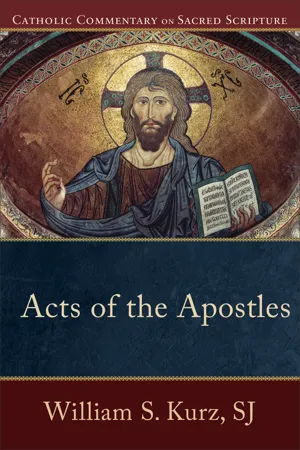
eBook - ePub
Acts of the Apostles (Catholic Commentary on Sacred Scripture)
- 400 pages
- English
- ePUB (mobile friendly)
- Available on iOS & Android
eBook - ePub
Acts of the Apostles (Catholic Commentary on Sacred Scripture)
About this book
Trusted by 375,005 students
Access to over 1.5 million titles for a fair monthly price.
Study more efficiently using our study tools.
Information
Topic
Theology & ReligionSubtopic
Biblical CommentaryLuke’s Introduction to Acts
Acts 1:1–11
Luke’s Gospel left off in the middle of the action. The risen Jesus ascended into heaven after commissioning his followers to preach in his name to all nations. He had instructed them to wait in Jerusalem and promised that he would send the Holy Spirit to empower them. But before reporting this event, Luke’s Gospel ends with the disciples’ worshiping God in the temple. Readers might wonder how Jesus’ promise would come true and how his commission would be carried out. Here at the beginning of Acts, Luke resumes his account, retelling the last scene of the previous installment to bring the readers back into the flow of the story.
A Sequel to the Gospel Story (1:1–2)
1In the first book, Theophilus, I dealt with all that Jesus did and taught 2until the day he was taken up, after giving instructions through the holy Spirit to the apostles whom he had chosen.
NT: Luke 1:1–4; 24:45–51
Catechism: “all that Jesus did and taught,” 512
Lectionary: Acts 1:1–11: Ascension of the Lord (Years A–C)
[1:1–2]
Luke’s reference to his Gospel as the first book highlights that Acts is a second book or sequel that continues the story begun in the Gospel. He first addresses Theophilus directly (see Luke 1:3). Though we know nothing about Theophilus, most scholars believe he was the patron, the person of means and influence who helped Luke get his Gospel published and distributed. His name has a further possible significance. In Greek, Theo-philos means “lover of God.” Thus Theophilus can stand symbolically for all readers of Acts, lovers and beloved of God.
Luke summarizes the content of his Gospel as all that Jesus did and taught before his ascension. A literal translation of the Greek would be “all that Jesus began to do and teach” (RSV, NIV). This remarkable phrase clarifies why Luke sees a sequel as necessary. If the Gospel narrates all that Jesus began to do and teach, this volume recounts what Jesus will continue to do and teach through the ministry of his disciples when they are filled with his Spirit.
The Gospel of Luke reported Jesus’ activities until the day he was taken up to heaven in his ascension. Before this final departure he gave instructions through the holy Spirit[1] to the apostles whom he had chosen,[2] to equip them further for their leadership role. We know the risen Jesus’ instructions included an explanation of why it had been necessary for Israel’s Messiah to suffer and die and then be raised (Luke 24:26–27, 46–47). We may suppose his instructions included guidance on leading the Church after his ascension.
Jesus Prepares His Apostles for His Departure (1:3–5)
3He presented himself alive to them by many proofs after he had suffered, appearing to them during forty days and speaking about the kingdom of God. 4While meeting with them, he enjoined them not to depart from Jerusalem, but to wait for “the promise of the Father about which you have heard me speak; 5for John baptized with water, but in a few days you will be baptized with the holy Spirit.”
OT: Isa 44:2–3; Ezek 39:29; Joel 3:1–2
NT: Luke 3:16; 24:49; John 16:12–13; Acts 13:30–31; 1 Cor 15:3–8
Catechism: appearances of the risen Jesus, 641–44; Jesus’ ascension, 659–64; promise of the Holy Spirit, 729
Liturgy: Acts 1:3–8: confirmation; Acts 1:1–11: ascension of the Lord (Years A–C)
[1:3]
After addressing Theophilus directly, Luke resumes his story. First he recounts what Jesus did between his resurrection and ascension. Luke’s Gospel reported Jesus’ ascension into heaven (Luke 24:51) but left the timing vague. Now Luke clarifies that time frame: after Jesus’ resurrection and before his ascension, he spent forty days in preparing his disciples for his departure and their future mission.
Luke emphasizes that Jesus presented himself alive to them by many proofs. According to Luke’s Gospel, the risen Jesus not only appeared to the apostles but also let them touch him and ate some fish before them so they could be assured he was truly risen and not a ghost or spiritual apparition (Luke 24:36–43). Those who encountered the risen Lord did not need arguments to be fully convinced that he is alive (see sidebar).[3] Acts explicitly notes that the risen Jesus showed himself only to his followers, who then had to witness to others about his resurrection (Acts 13:30–31). He will show himself to all people only at his return for judgment at the end of the world (Luke 21:26–27). Thus, although Jesus’ appearances were incontestable proofs for the apostles who saw him, later Christians depend by faith on the testimony of those apostolic witnesses that the Jesus who “suffered, died, and was buried” (Nicene Creed) is now truly risen and alive.[4]
The forty days are the period between Jesus’ resurrection and ascension. Jesus’ many post-resurrection appearances (1 Cor 15:3–8) and further instruction of his disciples took place during this time (except for the later appearance to Paul, who stresses the uniqueness of his own case in 1 Cor 15:8). Later †Gnostic heretics would claim that this period of post-Easter appearances extended to eighteen months, apparently to make more plausible their claim that the risen Jesus revealed a whole new secret religion to them.[5] Such later heresies illustrate how providential is Acts’s mentioning a definite endpoint—Jesus’ visible ascension after forty days—after which no more appearances were to be expected.
The number forty calls to mind biblical events in which God’s people received divine revelation: the forty days when Moses received the law on Mount Sinai and the forty years when God led Israel in the desert (Exod 24:18; Deut 8:2). Just as the number forty appeared at the birth of the nation of Israel and its instruction, so too it marks the birth and instruction of the Church. Moreover, just as Jesus underwent forty days of preparation for his earthly ministry (Luke 4:1–2), his disciples are now prepared for their mission during the same length of time. By emphasizing the number forty, Luke underlines that the life of Jesus is relived in the Church.

Miracles: Proofs or Signs?
Are the miracles in Acts proofs that compel belief or signs that require some further explanation to be understood? Luke is aware of both kinds of evidence, which are described by the Greek philosopher Aristotle (fourth century BC). In his Rhetoric, Aristotle distinguishes between two legal terms: a “sign” (sēmeion), evidence needing further explanation to be fully persuasive in court; and a “proof” (tekmērion), self-evident judicial proof not needing any explanation. Aristotle’s example of a sign is a bloody knife that is insufficient to convict the accused without further evidence that the knife was found with him. His example of a proof is a birth more than nine months after a husband’s absence in the army: the timing proves that the child is not the husband’s.
The word Luke uses for “proofs” of Jesus’ resurrection in Acts 1:3 is tekmērion. Thus Luke regards the multiple appearances of the risen Jesus as self-evident proofs to the apostles that Jesus is alive after his death. Luke treats most other miracles not as self-evident proofs but as signs that require explanation or evidence to be persuasive. For example, Peter’s healing of a lame man is a “sign” (4:22) because it requires Peter’s explanation to be understood. The healing was caused not by Peter’s power but by the “God of Abraham,” who glorified Jesus by raising him from the dead and healed this lame man through faith in Jesus’ name (3:12–16). The signs done by the disciples in Jesus’ name attest that Jesus is alive and are an invitation to faith in him, but faith always remains a free decision.
During this interval, the risen Jesus continued to teach his followers about the kingdom of God, which had also been his principal message during his earthly ministry. The kingdom of God is the fulfillment of Israel’s hope that God would one day fully manifest his sovereignty over the whole world, beginning with Israel (see Isa 24:23; 52:7). Even with this additional teaching, the apostles’ response in verse 6 will show that their understanding of God’s kingdom remained limited.[6]
[1:4–5]
Before taking any action, the apostles are to wait until they are empowered by the Spirit from on high, since only then will they have the divine grace and power they need to carry out their daunting commission. As Jesus’ farewell address in the Gospel of John indicates, he had more to teach his disciples than they could understand without the aid of the Spirit (John 16:12–13). Here the risen Jesus enjoins them not to depart from Jerusalem, but to wait for “the promise of the Father . . . for John baptized with water, but in a few days you will be baptized with the holy Spirit.” Jesus thus reinforces his command in Luke 24:49: “I am sending the promise of my Father upon you; but stay in the city until you are clothed with power from on high.”
The promise that believers would be “baptized with the holy Spirit” is one of the most frequently repeated prophecies in the New Testament.[7] John had contrasted his own baptism in water with the baptism of the mightier One to come: “I am baptizing you with water. . . . He will baptize you with the holy Spirit and fire” (Luke 3:16). The word “baptize” in Greek means to dip, drench, or immerse in water. It recalls the biblical promises that in the final times God would pour out his Spirit like water on thirsty ground.[8] The phrase “baptized with the holy Spirit” conveys a vivid image of what would soon occur. The disciples would receive a far greater baptism than that of John; they would be immersed in God’s own divine life! This promise will be realized at Pentecost, and then in Christian baptism, which involves both water and the Spirit’s indwelling and empowerment. In Acts 2 Luke will describe how this baptism with the Spirit fills the disciples with God’s love, life, power, and insight into his work in the world.
Reflection and Application (1:3–5)
It is impossible to exaggerate the importance for Christian belief and practice of the insistence that Jesus is alive (Acts 1:3). He is not merely a “historical Jesus” who lived and died in the first century. Jesus presented himself as alive to the apostles, no more to die, and he is still alive today and forever.
Christian faith is grounded in the eyewitness testimony of the apostles who en...
Table of contents
- Cover
- Series Page
- Title Page
- Copyright Page
- Contents
- Illustrations
- Editors’ Preface
- Abbreviations
- Introduction
- Outline of Acts
- Luke’s Introduction to Acts (Acts 1:1–11)
- Prayer in the Upper Room (Acts 1:12–26)
- The Coming of the Holy Spirit and the Birth of the Church (Acts 2)
- Healing Spurs the Growth of the Church (Acts 3:1–4:4)
- Bold Testimony and a New Outpouring of the Spirit (Acts 4:5–31)
- Sharing of Goods: Two Contrary Examples (Acts 4:32–5:11)
- Signs and Wonders and Trials (Acts 5:12–42)
- The Ordination of the Seven and the Preaching of Stephen (Acts 6:1–15)
- Stephen’s Overview of Biblical History (Acts 7:1–53)
- Martyrdom, Persecution, and Mission (Acts 7:54–8:40)
- Paul’s Conversion and Baptism (Acts 9:1–22)
- Saul’s Escape; Peter’s Healing of Aeneas and Tabitha (Acts 9:23–43)
- The Conversion of Cornelius (Acts 10:1–11:18)
- Church Growth at Antioch; Peter’s Escape (Acts 11:19–12:24)
- The Mission of Barnabas and Saul (Acts 12:25–13:52)
- Paul in Asia Minor: Iconium, Lystra, Derbe (Acts 14:1–28)
- The Jerusalem Council (Acts 15:1–35)
- The Separation of Paul and Barnabas (Acts 15:36–16:15)
- Imprisonment and Release at Philippi (Acts 16:16–40)
- Paul in Thessalonica, Beroea, and Athens (Acts 17:1–34)
- Paul’s Mission in Corinth (Acts 18:1–28)
- Ephesus (Acts 19:1–41)
- Paul the Itinerant Pastor (Acts 20:1–16)
- Paul’s Farewell Speech (Acts 20:17–38)
- Paul’s Journey to Jerusalem (Acts 21:1–26)
- Paul’s Arrest and Defense (Acts 21:27–23:35)
- Trials before Roman Governors (Acts 24:1–25:12)
- Paul before Agrippa (Acts 25:13–26:32)
- Shipwreck en Route to Rome (Acts 27:1–44)
- From Malta to Rome (Acts 28:1–16)
- Testimony in Rome (Acts 28:17–31)
- Suggested Resources
- Glossary
- Index of Pastoral Topics
- Index of Sidebars
- Notes
- Back Cover
Frequently asked questions
Yes, you can cancel anytime from the Subscription tab in your account settings on the Perlego website. Your subscription will stay active until the end of your current billing period. Learn how to cancel your subscription
No, books cannot be downloaded as external files, such as PDFs, for use outside of Perlego. However, you can download books within the Perlego app for offline reading on mobile or tablet. Learn how to download books offline
Perlego offers two plans: Essential and Complete
- Essential is ideal for learners and professionals who enjoy exploring a wide range of subjects. Access the Essential Library with 800,000+ trusted titles and best-sellers across business, personal growth, and the humanities. Includes unlimited reading time and Standard Read Aloud voice.
- Complete: Perfect for advanced learners and researchers needing full, unrestricted access. Unlock 1.5M+ books across hundreds of subjects, including academic and specialized titles. The Complete Plan also includes advanced features like Premium Read Aloud and Research Assistant.
We are an online textbook subscription service, where you can get access to an entire online library for less than the price of a single book per month. With over 1.5 million books across 990+ topics, we’ve got you covered! Learn about our mission
Look out for the read-aloud symbol on your next book to see if you can listen to it. The read-aloud tool reads text aloud for you, highlighting the text as it is being read. You can pause it, speed it up and slow it down. Learn more about Read Aloud
Yes! You can use the Perlego app on both iOS and Android devices to read anytime, anywhere — even offline. Perfect for commutes or when you’re on the go.
Please note we cannot support devices running on iOS 13 and Android 7 or earlier. Learn more about using the app
Please note we cannot support devices running on iOS 13 and Android 7 or earlier. Learn more about using the app
Yes, you can access Acts of the Apostles (Catholic Commentary on Sacred Scripture) by William S. Kurz, Williamson, Peter S., Healy, Mary, Peter S. Williamson,Mary Healy in PDF and/or ePUB format, as well as other popular books in Theology & Religion & Biblical Commentary. We have over 1.5 million books available in our catalogue for you to explore.