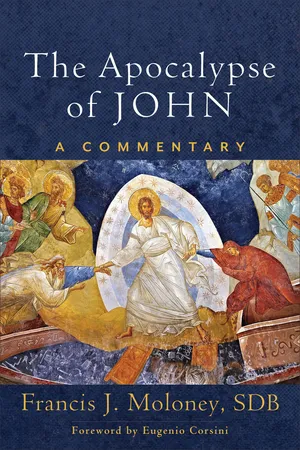
- 432 pages
- English
- ePUB (mobile friendly)
- Available on iOS & Android
eBook - ePub
About this book
In this major, paradigm-shifting commentary on Revelation, internationally respected author Francis Moloney brings his keen narrative and exegetical work to bear on one of the most difficult, mysterious, and misinterpreted texts in the biblical canon. Challenging the assumed consensus among New Testament scholars, Moloney reads Revelation not as an exhortation to faithfulness in a period of persecution but as a celebration of the ongoing effects of Jesus's death and resurrection. Foreword by Eugenio Corsini.
Information
Topic
Theologie & ReligionSubtopic
Biblischer KommentarOne
Introduction
Introductory decisions about the book of the Apocalypse inevitably affect an eventual interpretation of the text itself. Detailed investigations into the identification of a possible author; the unity of the text as we have it; the date of its composition; the author’s use of Jewish, classical, and other early Christian traditions; the social setting of its reception; its genre, literary structure, and rhetorical features; and the reliability of the textual tradition have been examined in detail by recent commentators.1 These important questions will only be touched on in this chapter. Given the abundance of excellent treatments, there is no need to rehearse them again. Mainstream critical opinion is well established. However, some interpretive possibilities other than that lying behind the following interpretation of the Apocalypse call for closer focus. This introduction will offer a discussion of these and then propose a detailed literary structure of the document. It suggests that the argument of the Apocalypse does not close with a consoling message of God’s definitive eschatological triumph over the wicked, but confidently proclaims the perennial saving effects of Jesus’ death and resurrection.
Introductory Questions
Most contemporary commentators regard the text as a unified literary whole, whatever its prehistory may have been, and interpret the text without recourse to possible earlier and later editions.2 Others, puzzled by apparent literary non sequiturs, and especially by different strata within the book that appear to reflect earlier (60s CE) and later (90–110 CE) periods, identify a number of editions. Some have suggested that the earliest strata may come from the pre-Christian reflections of an eventual Christian convert from Judaism.3
Decisions scholars make about the period of life in the early church reflected in the book and its numerous visions, exhortations, blessings, and condemnations influence the sources they propose for the text. It appears to hint at the first documented persecution of Christians by the emperor Nero (64 CE), who ruled from 54 to 68 CE,4 and allude to the sentiment, widespread in the late first century, that Nero was not dead but would return from the East (Parthia) to overthrow the current Roman authority. This so-called Nero redivivus expectation is generally associated with such passages as the description of the beast rising out of the earth in 13:12 (“It exercises all the authority of the first beast on its behalf, and it makes the earth and its inhabitants worship the first beast, whose mortal wound had been healed”)5 and the interpretation of the number 666 as “Nero Caesar.”6 Since late in the second Christian century, especially under of the influence of Irenaeus’s Against Heresies 5.30.3 (ca. 180 CE), the book of the Apocalypse has been associated with the latter years of the emperor Domitian (reigned 81–96 CE). It is possible, especially if one resorts to a theory of multiple editions, that the Apocalypse reflects traditions that come from across fifty years, from the 60s until the end of the first century CE. Some suggest that they reach into the early second century and the reign of the emperor Trajan (98–117).
Close attention devoted to the study of the Gospels over more than a century has made it clear that NT narratives are the result of a long literary history.7 This is also the case for the Apocalypse. Some of the material in the final document may have come from the Neronic period (64–68 CE), from the years between Nero and Domitian, and from the latter years of Domitian (91–96 CE). Indeed, it would be incredible if such were not the case. Difficulties arise in any attempt, however detailed and scholarly, to determine, down to the verse, the half-verse, and even the single word, what belonged to various editions, and the process by which they were eventually unified into the Apocalypse, already part of early Christian literature by the time of Justin Martyr (100–165 CE).8 For theological reasons, and no doubt for pastoral reasons, an author late in the first century gathered prophetic and apocalyptic material and added his own contribution to address a Christian audience. His contribution was the final production of the document as we have it in the Christian Scriptures. Whatever may have been the Sitze im Leben der Kirche that produced earlier strata, they have been taken over by the point of view that determines the shape and the message of our Christian book of the Apocalypse.9
The question of authorship has also been widely debated. The Apocalypse is regarded as being part of the so-called Johannine literature, a corpus made up of the Gospel of John, 1–3 John, and the Apocalypse. Among these five potentially independent documents, only in the Apocalypse does an author name himself “John” (Apoc. 1:1, 4, 9; 22:8). The identification of John the son of Zebedee as the author of the Apocalypse was made very early by Justin Martyr. It continued in Irenaeus’s association of the Beloved Disciple of the Gospel of John with Jesus’ disciple John the son of Zebedee late in the second century CE (Haer. 2.22.5; 3.1.2; 3.3.4; 3.11.7; 5.30.3).
A few early authorities questioned the association of an apostle with the Apocalypse. The Roman priest Gaius (early third century CE) regarded the document as lacking in authentic Christian teaching and suggested that it may have been written by an obscure heretic, Cerinthus, influenced by the ascetical Jewish-Christian Ebionites. Dionysius of Alexandria (latter half of the third century) pointed out that it differed too radically from the Johannine Gospel and Letters. Both writers raised the possibility that the author was a figure known as John the Elder (presbyteros), whose activity in Asia Minor, and especially Ephesus, is sometimes acknowledged.10
The suggestions of Gaius and Dionysius are preserved as fragments reported by the first Christian church historian, Eusebius, in the fourth book of his Historia ecclesiastica early in the fourth century CE (ca. 322–26 CE).11 About a third of that book discusses the authorship of the Apocalypse. In Eusebius’s interpretation of Christian history, the first Roman emperor to favor Christianity, Constantine (274–337 CE; reigned 306–37 CE), played a key role. Eusebius’s appreciation of Constantine as a God-sent figure who brought God’s rule to the kingdoms of this world influenced his interpretation of the Apocalypse. For Eusebius, the millenarian interpretation, generated by the exegetical puzzle of the “thousand-year reign” of those who had not worshiped the beast in 20:4–6, did not do justice to Constantine, the divinely appointed Roman emperor. Eusebius therefore is ambiguous about the authorship of the Apocalypse. He joins Gaius and Dionysius in raising the possibility that it is the work of John the Elder of Ephesus, and not John the disciple of Jesus.
Nevertheless, these voices are rare exceptions. From earliest Christian times John, the son of Zebedee, has been regarded as the author of the Apocalypse. Some contemporary scholars continue to regard the apostle as the likely author.12
Majority scholarship, however, would claim that it is not possible for us to identify the person and the role of the author with any precision. Most would reject the suggestion that the same person wrote the Gospel of John and the Apocalypse of John. They would also reject that the apostle John the son of Zebedee wrote the Gospel or the Apocalypse. The author names himself “John,” and that name should be accepted. Given that much of the document contains visions of heavenly and earthly events, the author has often been given the name “John the Seer.” However, this was a widely used name, and there are no clear indications who this “John” might be. We simply do not have enough information from the world that produced the Apocalypse, or from the document itself, to make a firm decision about the precise identity of the John of the Apocalypse.
However, the location of the writing is less in doubt. There is no serious reason to question the location of his writing at Patmos, an island close to the eastern coast of Asia Minor. John reports that he is there “because of the word of God [dia ton logon tou theou] and the testimony of Jesus [kai tēn martyrian Iēsou]” (Apoc. 1:9). These words are widely interpreted as indicating forced imprisonment in Patmos because of his Christian faith.13 John the Seer’s use of the expression “testimony” (martyria) and its associated “witness” (martys) suggests the introduction of a theme of witnessing that has wider ramifications across the Apocalypse. As we will see in our reading of 1:9–20, the Greek original could indicate that he was in Patmos as a consequence of his Christian missionary activity. That role brought tribulation and required patient endurance (1:9).14
Perhaps the best we can do in our search for the identity of the author is to cite a modified version of David Aune’s description:
While the final author-editor of Revelation was named “John,” it is not possible to identify him with any other early Christian figures of the same name, including John the son of Zebedee or the shadowy figure of John the Elder. The otherwise unknown author of Rev...
Table of contents
- Cover
- Half Title Page
- Title Page
- Copyright Page
- Dedication
- Epigraph
- Contents
- Foreword
- Preface
- Abbreviations
- 1. Introduction
- 2. Interpreting the Apocalypse 1:1–8
- 3. Interpreting the Apocalypse 1:9–3:22
- 4. Interpreting the Apocalypse 4:1–8:1
- 5. Interpreting the Apocalypse 8:2–11:19
- 6. Interpreting the Apocalypse 12:1–18
- 7. Interpreting the Apocalypse 13:1–18
- 8. Interpreting the Apocalypse 14:1–20
- 9. Interpreting the Apocalypse 15:1–16:21
- 10. Interpreting the Apocalypse 17:1–19:10
- 11. Interpreting the Apocalypse 19:11–21:8
- 12. Interpreting the Apocalypse 21:9–22:5
- 13. Interpreting the Apocalypse 22:6–21
- Bibliography
- Index of Authors
- Index of Scripture and Other Ancient Sources
- Cover Flaps
- Back Cover
Trusted by 375,005 students
Access to over 1.5 million titles for a fair monthly price.
Study more efficiently using our study tools.
Frequently asked questions
Yes, you can cancel anytime from the Subscription tab in your account settings on the Perlego website. Your subscription will stay active until the end of your current billing period. Learn how to cancel your subscription
No, books cannot be downloaded as external files, such as PDFs, for use outside of Perlego. However, you can download books within the Perlego app for offline reading on mobile or tablet. Learn how to download books offline
Perlego offers two plans: Essential and Complete
- Essential is ideal for learners and professionals who enjoy exploring a wide range of subjects. Access the Essential Library with 800,000+ trusted titles and best-sellers across business, personal growth, and the humanities. Includes unlimited reading time and Standard Read Aloud voice.
- Complete: Perfect for advanced learners and researchers needing full, unrestricted access. Unlock 1.5M+ books across hundreds of subjects, including academic and specialized titles. The Complete Plan also includes advanced features like Premium Read Aloud and Research Assistant.
We are an online textbook subscription service, where you can get access to an entire online library for less than the price of a single book per month. With over 1.5 million books across 990+ topics, we’ve got you covered! Learn about our mission
Look out for the read-aloud symbol on your next book to see if you can listen to it. The read-aloud tool reads text aloud for you, highlighting the text as it is being read. You can pause it, speed it up and slow it down. Learn more about Read Aloud
Yes! You can use the Perlego app on both iOS and Android devices to read anytime, anywhere — even offline. Perfect for commutes or when you’re on the go.
Please note we cannot support devices running on iOS 13 and Android 7 or earlier. Learn more about using the app
Please note we cannot support devices running on iOS 13 and Android 7 or earlier. Learn more about using the app
Yes, you can access The Apocalypse of John by Francis J. Moloney in PDF and/or ePUB format, as well as other popular books in Theologie & Religion & Biblischer Kommentar. We have over 1.5 million books available in our catalogue for you to explore.