Martin Luther was classically orthodox.
Scholars often portray Luther as a heroic revolutionary, totally unlike his peers and forebears--as if he alone inaugurated modernity. But is this accurate? Is this even fair? At times this revolutionary model of Luther has come to some shocking conclusions, particularly concerning the doctrine of the Trinity. Some have called Luther modalist or tritheist--somehow theologically heterodox.
In The Trinity and Martin Luther, Christine Helmer uncovers Luther's trinitarian theology. The Trinity is the central doctrine of the Christian faith. It's not enough for dusty, ivory tower academics to know and understand it. Common people need the Trinity, too. Doctrine matters. Martin Luther knew this. But how did he communicate the doctrine of the Trinity to lay and learned listeners? And how does his trinitarian teaching relate to the medieval Christian theological and philosophical tradition? Helmer upends stereotypes of Luther's doctrine of the Trinity.
This definitive work has been updated with a new foreword and with fresh translations of Luther's Latin and German texts.
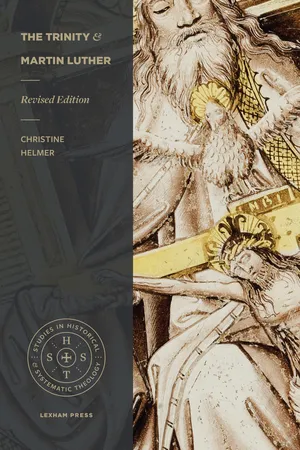
eBook - ePub
The Trinity and Martin Luther (Studies in Historical and Systematic Theology)
- 320 pages
- English
- ePUB (mobile friendly)
- Available on iOS & Android
eBook - ePub
The Trinity and Martin Luther (Studies in Historical and Systematic Theology)
About this book
Trusted by 375,005 students
Access to over 1.5 million titles for a fair monthly price.
Study more efficiently using our study tools.
Information
Topic
Theology & ReligionSubtopic
Christian Theology1
Introduction
AIM OF THE STUDY
The Trinity comes to view as both mystery and doctrine. As a mystery, the Trinity surpasses comprehension in its groundlessness, yet it provides the surest foundation for those who live from it ecstatically. As a doctrine, the Trinity invites the use of reason’s tools only to limit the mind’s expansion to what can be confessed in ancient words of faith. Where the limits are encountered, contemplation merges with awe, and the mystery is adored once again. That Martin Luther (1483–1546) can be associated with the Triune mystery and doctrine is, perhaps, a curiosity for those accustomed to a Reformer who preaches Christ on the cross rather than reflecting on the eternal Trinity and who asserts on the basis of Scripture rather than conversing with his theological predecessors. Yet Luther is not silent on this subject of “holy speculation”; he articulates a doctrine of this glorious mystery.
The aim of this investigation is to study Luther’s understanding of the Trinity as he articulated it from 1523 to 1546 in the language particular to three theological genres: the disputation, the hymn, and the sermon. In order to approach and tease out Luther’s Trinitarian understanding, a method will be applied that is an adaptation of what could be called the “hermeneutical model” of Luther research to fit a systematic-theological theme. This study intends to show how the genre that presents the subject matter shapes the language Luther uses to convey, explain, and interpret the Trinitarian dogma. In each genre-language constellation, I examine how Luther arranges the two factors, promissio and narrative, in order to infuse the articulation of the subject matter with a specific Trinitarian content.1 This study suggests that the interplay between promissio and narrative determines the theological structuring of the subject matter that, in turn, is accessible by investigating the relationship between genre and language. Presented in the genres of the disputation, the hymn, and the sermon, Luther’s Trinitarian understanding is seen to be a consequent explication of the promissio of the Triune God and is conceived as a narrative of the Trinitarian movement towards creation.
In this study, I prefer to use the term “understanding of the Trinity” rather than “doctrine of the Trinity.” Luther himself does not use the terms “doctrine” or “doctrine of the Trinity” (Trinitätslehre) in the modern sense of a systematic-theological locus, which implies a logical or material relation to other doctrines. For Luther, the Trinity is the object of the confession of faith, the name of, rather than the doctrine about, the Christian God. Luther refers to the Trinity in a variety of ways. He uses the technical term Trinity (Dreifaltigkeit or trinitas) and discusses the “article of the Trinity” as “the important article of the divine majesty.”2 As the article of the confession of faith, the Trinity forms the center of the Christian faith. When it is contested, its truth must be explicitly articulated, and when doubt terrifies the conscience, its certainty must be confessed. Diverse genre-language constellations present different understandings of the Trinitarian article of faith. Each constellation sheds particular light on the subject matter in different ways that depend on Luther’s biographical context, the historical context of his utterances, and the communication structure of the genre that generates a particular language of articulation. The term “understanding” underlines how each genre-language constellation offers a unique shaping of specific Trinitarian-theological factors that remain constant in each constellation. It seeks to avoid the connotation that Luther proposes one normative doctrinal summary that can be formulated in discourses other than the confession of faith and the proposition that three res are one and the same as one res.3
The perspective of the present study is oriented by what I perceive to be Luther’s own understanding of the theological task. For Luther, the Trinitarian article articulates the object of the Christian faith in a way that circumscribes a particular area on which the work of theology takes place. As the rule of faith (regula fidei), the Trinitarian article demarcates the border of the area, distinguishing the “inside” from the “outside.” At the center of the “inside” is the Trinitarian article that in the Middle Ages was considered to be composed of the revealed articles of faith.4 Luther reflects a distinctly medieval position when he considers the articles of faith to be the summary of what is contained in Scripture.5 Scripture is not regarded solely as a historical document, whose isolated and contingent references to a binity or a trinity are only later articulated by the church as the necessary Trinitarian dogma or creed. For Luther, the article of faith summarizes the content of Scripture in assertions that are formulated, and to which assent is given, under the Spirit’s guidance.6 Mutually related to each other by virtue of their identical subject matter, Scripture and dogma circumscribe the area in which reason is engaged in the theological task.
Reason is used to understand the object of faith in an area formed by the center and circumscribed by the boundary. When attacks from the boundary threaten to erode the center, or when the certainty of the center is shaken, the theological task begins. In Luther’s case, the tension between center and boundary becomes painfully apparent in the work of his later, more vitriolic years. Litanies of early church heretics and harsh statements directed with one fell swoop against philosophers and other religions appear against the backdrop of Luther’s own desire for a council to rehabilitate his excommunication from the church and ban from the empire. Luther considers urgent what he perceives to be the attacks of ancient heresies clothed in sixteenth-century dress: the elevation of reason above the revealed word (2 Thess 2:4)7—by Jews;8 by Muslims;9 and by philosophers.10 Luther argues against these positions with rhetorical vigor, excluding any philosophical or religious attempts to undermine the certainty of faith in the divine mercy.11 If the crassness of Luther’s rhetoric can be excused as medieval custom, its denigrative and destructive intention must be received more critically. In a modern context sensitive to absences of interreligious and ecumenical conversation, central claims debated on the boundary are not to be confused with extratheological matters. Great care must be taken to interpret any judgments made about groups or positions that are incompatible with the basic soteriological core of biblical faith. If caution is exercised, Luther’s responses to attacks from the boundary can be studied in ways that do not discredit reason, as the surface polemic suggests, but in ways that appreciate the use of reason to articulate the truth.
The theological task is concerned with the articulation of truth. For Luther, the Christian doctrine is the “most certain conviction of the truth.”12 Its formulation in the confession of faith makes a truth claim that falsifies any other statements uttered in the situation of extreme trial (Anfechtung) or madness.13 That God does not lie does not condemn the theologian to silent worship of mystery but compels reason to articulate the truth in ways that are multivaried and genre specific.14 The academic form of the disputation brings this truth to light in a way that unpacks the proposition that three persons are one and the same as the divine essence. The saving congruence of this truth is rendered in the nonacademic and nondisputational form of hymnody. Finally, preaching articulates this truth in language that is at once language of belief and of glorification. Each genre-language constellation represents a facet of the theological task that employs reason to understand the truth of the Triune God.
REVIEW OF LITERATURE
The subject matter of Luther’s Trinitarian understanding has inspired few scholars in the history of Luther research. This gap in the field of Luther scholarship is surprising, given the current interest, at least since Barth, in orienting theology toward Trinitarian doctrine as a matrix for systematic-theological reflection.15 The potential of Trinitarian thinking has been recovered by recent theologians in order to structure the theological enterprise as a whole, to apprehend the mystery of the divine essence of love, and to propose social models of freedom and political justice.16 In spite of the current favor bestowed on the doctrine of the Trinity, the case of Luther’s contribution to the history of this doctrine has been neglected. The subject matter of this study, Luther’s understanding of the Trinity, has not figured significantly in many nineteenth- and twentieth-century reconstructions of his theology. Nor has investigating the late Luther and his theology been the object of great scholarly interest.17 Some Luther scholars have noticed the gap in their field.18 Could it be that Luther himself had little to say concerning the Trinity? Or is it the case that Luther scholars have been prevented from seeing Luther’s commitment to teaching, singing, and preaching about the Trinity?
The initial task of this study is to examine what has prevented scholars from accessing Luther’s understanding of the Trinity. By reviewing the history of why Luther scholars have traditionally overlooked this study’s theme, I critically investigate the way in which Luther has been, and is being, interpreted. For the purpose of this introduction, I intend to clarify, in a series of observations, the presuppositions underlying Luther scholarship since Ritschl that have led to the neglect of the topic of the Trinity in Luther’s thought.19 The question regarding how scholars have determined the “new” in Luther’s thought, and its relation to the “old,” will guide the preliminary look at the characteristic lens through which Luther is viewed and obscured. Scholarly positions have been caught between presenting Luther as the champion of the new—whether theologically, as the proponent of evangelical freedom, or philosophically, in the neo-Kantian shape of a new metaphysical and epistemological paradigm. The old—Luther as the proponent of the Christological and Trinitarian dogmas—is viewed in less favorable terms. I suggest that the determination of the intersection between “new” and “old” is related to a neo-Kantian philosophical conception. Formed by neo-Kantian presuppositions, Luther scholarship is characterized by privileging Luther’s “new” evangelical principle, eroding the significance of the “old” Trinitarian dogma in his theology.
OBSERVATIONS ON THE RECENT HISTORY OF LUTHER SCHOLARSHIP
The historical and theological interest in the so-called Reformation breakthrough is motivated by the question concerning the determination of the “new” in its relation to the “old.” Historians are not theologically neutral when they approach the seemingly genetic question of what is defined to be a key Reformation concept. Differing theological perspectives contribute to the various dates scholars assign to Luther’s breakthrough.20 By looking at what he calls Luther’s transcendentalism, Reinhold Seeberg dates the breakthrough early, to the summer of 1509.21 Bizer, and more recently Bayer, show that Luther arrived at the Reformation shape of the concepts of the righteousness of God (iustitia dei) and the promissio relatively late, respectively by 1520/21.22 The historical dating dovetails with the theological determination of the “new” to be what is specifically Protestant. Elert captures a wide scholarly consensus when he labels Luther’s breakthrough to be a distinctive Protestant approach, carrying the weight of the history of Lutheranism that follows.23 From the fresh perspective of the “new,” the “old” is consequently painted in drab, pejorative colors. The “old” is determined to be the “unchanging and monolithic” block24 of “metaphysical theology,” the specifically medieval shape of theology from which Luther, in the eyes of his interpreters, is distanced.25 When the “old” is distinguished from the “new” in this way, Luther’s...
Table of contents
- Cover
- Title Page
- Copyright
- Contents
- Preface to the New Edition
- Select Bibliography of Recent Literature on the Trinity in the Middle Ages and Early Modernity
- Foreword to the Original Edition
- Preface to the Original Edition
- Acknowledgments
- Abbreviations
- Chapter 1: Introduction
- Chapter 2: Luther’s Understanding of the Trinity in the Doctoral Disputation of Georg Major and Johannes Faber (Dec. 12, 1544)
- Chapter 3: Luther’s Understanding of the Trinity in the Hymn, “Now Rejoice, Dear Christians” (1523)
- Chapter 4: Luther’s Understanding of the Trinity in the Two Sermons on Romans 11:33–36 Preached on Trinity Sunday (May 27, 1537) and the First Sunday after Trinity (June 3, 1537)
- Chapter 5: Conclusion
- Bibliography
- Names Index
- Scripture Index
Frequently asked questions
Yes, you can cancel anytime from the Subscription tab in your account settings on the Perlego website. Your subscription will stay active until the end of your current billing period. Learn how to cancel your subscription
No, books cannot be downloaded as external files, such as PDFs, for use outside of Perlego. However, you can download books within the Perlego app for offline reading on mobile or tablet. Learn how to download books offline
Perlego offers two plans: Essential and Complete
- Essential is ideal for learners and professionals who enjoy exploring a wide range of subjects. Access the Essential Library with 800,000+ trusted titles and best-sellers across business, personal growth, and the humanities. Includes unlimited reading time and Standard Read Aloud voice.
- Complete: Perfect for advanced learners and researchers needing full, unrestricted access. Unlock 1.5M+ books across hundreds of subjects, including academic and specialized titles. The Complete Plan also includes advanced features like Premium Read Aloud and Research Assistant.
We are an online textbook subscription service, where you can get access to an entire online library for less than the price of a single book per month. With over 1.5 million books across 990+ topics, we’ve got you covered! Learn about our mission
Look out for the read-aloud symbol on your next book to see if you can listen to it. The read-aloud tool reads text aloud for you, highlighting the text as it is being read. You can pause it, speed it up and slow it down. Learn more about Read Aloud
Yes! You can use the Perlego app on both iOS and Android devices to read anytime, anywhere — even offline. Perfect for commutes or when you’re on the go.
Please note we cannot support devices running on iOS 13 and Android 7 or earlier. Learn more about using the app
Please note we cannot support devices running on iOS 13 and Android 7 or earlier. Learn more about using the app
Yes, you can access The Trinity and Martin Luther (Studies in Historical and Systematic Theology) by Christine Helmer in PDF and/or ePUB format, as well as other popular books in Theology & Religion & Christian Theology. We have over 1.5 million books available in our catalogue for you to explore.