Maintaining hope in Christ for the weary soul.
In the face of trials and tribulations, persevering in the faith can be a difficult task. For Puritan pastor and theologian William Gouge, this question was of critical importance for those he shepherded. His theology of assurance during the difficult seasons in life provided direction and help to weary souls.
In Christ Is Yours, Eric Rivera explores Gouge's theology, revealing a man who cared deeply about the truths of Scripture and the spiritual lives of his community. His theology was focused on the promises of God found in Scripture while staying grounded in the realities of life. This message of perseverance and hope is just as necessary for Christ-followers today as it was then. Written for academics and pastors alike, Rivera brings this important theology to a modern audience.
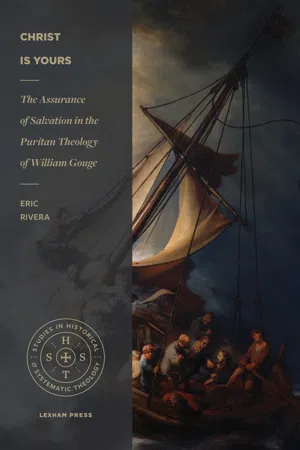
eBook - ePub
Christ Is Yours (Studies in Historical and Systematic Theology)
The Assurance of Salvation in the Puritan Theology of William Gouge
- 280 pages
- English
- ePUB (mobile friendly)
- Available on iOS & Android
eBook - ePub
Christ Is Yours (Studies in Historical and Systematic Theology)
The Assurance of Salvation in the Puritan Theology of William Gouge
About this book
Trusted by 375,005 students
Access to over 1.5 million titles for a fair monthly price.
Study more efficiently using our study tools.
Information
Topic
Theology & ReligionSubtopic
Christian Ministry1
Introduction: “From Blackfriars to Heaven”
DEFINING PURITANISM
In the middle of the sixteenth century, Protestant leaders sought to bring reformation to the English church. Harsh opposition met these efforts of reform during the reign of Henry VIII (1491–1547) before a new and hopeful day arrived for Protestants under the leadership of the child king, Edward VI (1547–1553). During his reign the Catholic mass was abolished and “replaced by a vernacular communion service,” priests were allowed to marry, religious images were removed from churches, purgatory was rejected, and auricular confession to priests was no longer mandated.1 However, much of the progress in ecclesiastical reform that was gained under Edward VI’s Protestant leadership was brought to a sudden and bloody halt under the swift and heavy hand of Mary I (1553–1558) and her “Catholic (Counter-) Reformation.”2 After Mary’s death, Elizabeth I (1558–1603) became queen of England following her half-sister’s reign of terror. Elizabeth I needed to reestablish the nation’s ecclesiastical and political stability and did so through what historians call the Elizabethan Settlement. Under the queen’s leadership, the Church of England became theologically Protestant while retaining some similarities with Catholic practice, such as priestly vestments, genuflecting, statues, the burning of incense, the office of bishop, and the use of a liturgical guide for worship such as Thomas Cranmer’s Book of Common Prayer. The queen’s settlement did not please everybody and it is during her reign that the word “Puritan” finds its genesis.
Initially, the term “Puritan” was a label of insult and derision.3 The Puritans were those “nonconformist clergy within the newly reformed Elizabethan church, zealous Protestants who refused to wear prescribed liturgical vestments, particularly the white surplice, and who gained a reputation as ‘opposers of the hierarchy and church-service.’ ”4 They believed that the Elizabethan Settlement prematurely halted the progress of reformation in England, and further purification was needed ecclesiologically, theologically, and morally. The majority of these “Puritans” remained inside the state church and sought to reform it from within, while others considered the church unredeemable, separating from it entirely.5
The multifaceted context of the rise of Puritanism accentuates the challenges of defining the movement when considering how the movement developed in the seventeenth century.6 Some historians have found the term so problematic that they have proposed avoiding the word “Puritanism” altogether. However, other scholars have chosen to retain the name. Bozeman prefers the term because “it depicts accurately a substantive and often obsessive trait of the quest for further reformation: a hunger for purity” in English Protestantism.7 In this same vein of thought, Coffey and Lim offer a definition that represents the diversity and challenges of research into Puritanism. Broadly speaking, they define it as an “intense variety of early modern Reformed Protestantism” within the Church of England. Still, their definition also narrows to encompass the ways in which Puritanism did not remain in neither England nor the Church of England but branched “off into divergent and dissenting streams” in other nations and lands.8
Coffey and Lim’s definition takes into account the unique contexts of Puritanism’s beginning, while recognizing the deviating directions of Puritanism seen in the seventeenth century. This understanding of Puritanism is assumed throughout this work.
PRESENTATION OF THESIS AND METHOD OF RESEARCH
As attempts to reform the Church of England in the late sixteenth century were met with resistance by the established Church, those Puritans seeking reform had to redirect their purifying goals from the institutional church to the individuals within. Their aim was to instruct the believer in the manner of how to lead a godly life. This Puritan approach to pastoral care came to be known as practical divinity. One of the primary concerns of this instruction was to provide Christians with grounds for personal assurance of their salvation, thus discerning whether they were truly elect and consoling the anxious soul.9 Many of these practical matters are evident in the ministry and published works of William Gouge.
For Gouge and other Puritans, practical divinity encouraged rigorous reflection, introspection, and a disciplined life in order to help believers discern even the tiniest degree of faith that testifies that they are elect, thereby bringing consolation to the anxious soul.10 They were concerned that if one overemphasized justification and assurance at the neglect of a sanctified life, then moral standards would be lost. On the opposite side, they were equally concerned that if assurance was found in sanctification, the grace of God displayed at the cross of Christ might be neglected.11 Thus, they sought to navigate a middle ground that emphasized Christ’s finished work on the cross for the believer and a Christian life that bears fruit.12
Since the middle of the twentieth century, scholars such as Basil Hall and R. T. Kendall challenged the successfulness of the Puritans’ practical agenda.13 They maintain that the Puritan teaching on faith (which includes saving faith and temporary faith) fails to aid Christians in attaining a sense of assurance of salvation. Furthermore, they argue that this Puritan teaching failed because it grounded the locus of assurance on works of sanctification (signs of election) in the Christian’s life rather than upon the finished work of Christ. Their arguments sparked a rigorous debate on the Puritan theology of assurance of salvation as it relates to their practical instruction that spans to the present day.
In light of the ongoing discussion and controversies related to Puritan practical divinity, I will focus this work on the practical divinity of William Gouge, who was prominent in his own day for this pastoral strategy. I will specifically argue that in his practical divinity, William Gouge does not represent a shift in emphasis in the Reformed tradition from assurance of salvation based on the promises of God to assurance being achieved through the introspective efforts of the Christian. Instead, we will see that William Gouge was a pastorally attentive minister who understood the spiritual needs of the church in England in general and those of his parishioners in particular—especially as it related to the practical outworking of their faith. We will also see that Gouge’s practical divinity was born out of his understanding of the Bible, theology of atonement, and belief in God’s providence and moved him to guide specifically Christians who struggled in their faith and doubted the reality of their salvation because of personal sin, physical ailments, and cultural circumstances. In summary, Gouge’s practical divinity taught an assurance of salvation that placed the primary ground of assurance in the promises of God and the secondary grounds for assurance on the testimony of the Holy Spirit in the Christian’s life.
Along the way, this work will also provide answers to a variety of important subsidiary questions: What do Gouge’s writings tell us about his pastoral concerns and the spiritual needs of his audience? What were the goals of his teaching in practical divinity? What were the theological underpinnings to Gouge’s practical divinity? How is Gouge’s interpretive approach to the Bible reflected in his teaching? Concerning his writings, what do the years of publication tell us about the occasional nature of his instruction and to which matters of practical divinity did Gouge give prominence on these occasions? What types of opposition or resistance did Gouge face because of his teachings and approach to pastoral care? To what extent is his practical divinity a reflection or reworking of Catholic devotional practices?
This project will make a twofold contribution. First, it will advance the study of a respected and noteworthy seventeenth-century figure whose career, influence, and works on practical divinity are largely unknown.14 Second, this study will contribute to the ongoing scholarly discussions on the nature of Puritan practical divinity. Gouge’s instruction on the relationship between faith, assurance, and self-inspection in his practical divinity will be examined to determine whether he represents a shift in Reformed Christianity from christocentrism to introspection as grounds for assurance.
PRACTICAL DIVINITY AND ASSURANCE OF SALVATION
The Puritans recognized that people are sinners deserving of God’s wrath and that salvation was found in the complete saving work of Jesus Christ on the cross. Therefore, how one might know that one is elect, and thus, in right standing with God was of utmost importance. Francis Bremer writes concerning how one might gain assurance:
Some clergy suggested that men and women look to their lives, not in the hope that they could ever merit heaven, but on the assumption that grace changed the saints and that the fruits of that change would be godly behaviour. Others feared that such advice would lead people to come to rely on their works for assurance, subtly leading them to accept the discredited covenant of works. These Puritans relied instead on the sensation of God’s caress that they had received at the first intimation that they had been elect and that they periodically were refreshed anew. Many drew on both of these methods of gaining assurance.15
Assurance of salvation reflected in a life of godliness gave way to practical divinity. For this reason, Michael P. Winship maintains that Puritan practical divinity was not simply a product of an ecclesiological shift from attempting to purify the church from without to doing so from within. Nor is it simply a by-product of ecclesiastical politics seeking to make a move from the Church of England’s influence to that of the Presbyterians in the 1590s. While both of these approaches contributed to the rise and prominence of Puritan practical divinity, the underlying component is found in the desire of ministers to shepherd their people that they might be neither “carnal-gospelers” nor weary and distressed souls with no direction or hope for assurance.16
While Hambrick-Stowe, Bremer, and Winship effectively demonstrate the pragmatic questions that gave way to the emergence of Puritan practical divinity, this practical relationship raises important questions about the theological relationship that exists between practical divinity and assurance of salvation. What are the grounds by which a believer can be assured of his or her salvation? Is assurance of salvation of the essence of faith or is it something attained by only a few? Were the Puritans, represented by the Westminster Confession, following the theological trajectory of their Reformation predecessors like John Calvin or were they presenting something new in the Protestant tradition? These questions have spawned decades of vibrant dialogue among contemporary scholars.
In the 1960s, scholars such as Basil Hall and R. T. Kendall argued that the Puritans departed from the theological teachings of John Calvin and replaced them with a pseudo-Arminian teaching on assurance of salvation. They contend that the Puritans, exemplified in their works of practical divinity and in the Westminster Confession, changed the locus of assurance from the finished work of Christ on the cross and grounded it on the Christian’s ability to discern signs of election in their lives (evidence of the Spirit’s sanctifying work). According to Kendall, this teaching evidenced in the Confession, separated assurance from the essence of saving faith. Kendall contends that the plainest example of this shift is found in the Westminster Confession 18.3, which reads, “This infallible assuran...
Table of contents
- Cover
- Title Page
- Copyright
- Dedication
- Contents
- Acknowledgments
- Chapter 1: Introduction: “From Blackfriars to Heaven”
- Chapter 2: The Foundation for Gouge’s Practical Divinity
- Chapter 3: The Christian’s Battle against the World, Flesh, and the Devil
- Chapter 4: Humiliation, Suffering, Death, and the Practice of Piety
- Chapter 5: Prayer and the Christian Home
- Chapter 6: Conclusion
- Bibliography
- Scripture Index
- Subject Index
Frequently asked questions
Yes, you can cancel anytime from the Subscription tab in your account settings on the Perlego website. Your subscription will stay active until the end of your current billing period. Learn how to cancel your subscription
No, books cannot be downloaded as external files, such as PDFs, for use outside of Perlego. However, you can download books within the Perlego app for offline reading on mobile or tablet. Learn how to download books offline
Perlego offers two plans: Essential and Complete
- Essential is ideal for learners and professionals who enjoy exploring a wide range of subjects. Access the Essential Library with 800,000+ trusted titles and best-sellers across business, personal growth, and the humanities. Includes unlimited reading time and Standard Read Aloud voice.
- Complete: Perfect for advanced learners and researchers needing full, unrestricted access. Unlock 1.5M+ books across hundreds of subjects, including academic and specialized titles. The Complete Plan also includes advanced features like Premium Read Aloud and Research Assistant.
We are an online textbook subscription service, where you can get access to an entire online library for less than the price of a single book per month. With over 1.5 million books across 990+ topics, we’ve got you covered! Learn about our mission
Look out for the read-aloud symbol on your next book to see if you can listen to it. The read-aloud tool reads text aloud for you, highlighting the text as it is being read. You can pause it, speed it up and slow it down. Learn more about Read Aloud
Yes! You can use the Perlego app on both iOS and Android devices to read anytime, anywhere — even offline. Perfect for commutes or when you’re on the go.
Please note we cannot support devices running on iOS 13 and Android 7 or earlier. Learn more about using the app
Please note we cannot support devices running on iOS 13 and Android 7 or earlier. Learn more about using the app
Yes, you can access Christ Is Yours (Studies in Historical and Systematic Theology) by Eric Rivera in PDF and/or ePUB format, as well as other popular books in Theology & Religion & Christian Ministry. We have over 1.5 million books available in our catalogue for you to explore.