Look to Christ, the ultimate revelation of God.
The letter to the Hebrews asks questions aimed at the heart of what it looks like for Christians to walk in Christ's footsteps. How should Christians relate to the Old Testament? What are we to make of the New Testament's urgent pleas to persevere in the faith? Can we really lose our salvation? How does Jesus model both humility in his humanity and the glory of God through his earthly life? These questions continue to be fiercely debated by Christians. The ancient letter to the Hebrews answers all by focusing on Christ's magnificent love and greatness. In Christ Above All, Adrio König puts readers in the shoes of the original audience of Hebrews and shows how, in a world full of competing claims to power and authority, Christ--in all his glory and humanity--really does surpass all others.
In the Transformative Word series, you'll read the Bible with a global cast of church leaders and scholars. In conversational tone, contributors from around the world explain the importance of a biblical book, showing how it can transform your life.
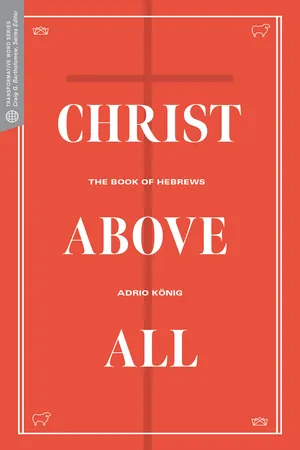
eBook - ePub
Christ Above All (Transformative Word)
The Book of Hebrews
- 112 pages
- English
- ePUB (mobile friendly)
- Available on iOS & Android
eBook - ePub
Christ Above All (Transformative Word)
The Book of Hebrews
About this book
Trusted by 375,005 students
Access to over 1.5 million titles for a fair monthly price.
Study more efficiently using our study tools.
Information
Topic
Theology & ReligionSubtopic
Biblical Studies1
INTRODUCTION: THE MAIN THEMES IN HEBREWS
Some think that the Letter to the Hebrews is the most neglected of all the New Testament writings. Why? Is it because it is so different from all the other letters? Even the great German Reformer Martin Luther had doubts about the canonicity of Hebrews.
Several issues make Hebrews a challenge to interpret. Firstly, we do not know who wrote this letter; most modern scholars reject the ancient view that it was by Paul,1 although the mention of “our brother Timothy” in Hebrews 13:23 indicates that the recipients of the letter were associated with the apostle Paul and his circle. We do not know to which community the letter was written, and its date can only be positioned somewhere between ad 50–90.2 Luke, of the Gospel of Luke and the Acts of the Apostles, and Apollos have been proposed as authors, but we cannot be sure who wrote Hebrews. Cockerill notes:
The description of Apollos in Acts 18:24–19:1 is a description of the kind of person who wrote Hebrews. The superior education of the writer of Hebrews is evident from his rhetorical skill. Its writer was steeped in Scripture and a competent expositor of its meaning, just as was Apollos. The book of Hebrews is the work of a powerful preacher with a deep pastoral concern for his hearers. Apollos’s skill in demonstrating Christ’s messiahship from the OT is in accord with the pastor’s Christological exposition. Apollos’s ability to confound Jews who did not acknowledge Christ fits well with the apparent Jewish-Christian elements in the recipients’ background.3
Secondly, Hebrews not only refers more often to the Old Testament than any other New Testament book, but it includes alarmingly negative views of the Old Testament. One sometimes feels it is rejecting the Old Testament (e.g., chapter 10), a heresy that Marcion fell into in the time of the early church. But then it can also be so surprisingly positive about the Old Testament (Heb 11)!
MARCION Marcion (c. AD 85–c. 160) was an influential figure in the early church whose teaching was eventually denounced. He drew a sharp distinction between the God of the New Testament and Yahweh of the Old Testament and rejected the Old Testament as non-Christian. |
Thirdly, together with Galatians, it has the gravest warnings to believers about losing out on salvation—six in total. Believers can, therefore, find Hebrews a very disturbing letter to read.
We will come to these tough issues, but I encourage the reader not to be discouraged from diving into this book. In the foreword, I referred to how important the love of Jesus was in enabling me to see that the racism of apartheid was unacceptable. At the heart of Hebrews is a magnificent view of Jesus, a view that you do not want to miss out on.
Let us run through this letter to get a sense of just how exciting and relevant its message is for today.
OUTLINE OF HEBREWS4 I.The Finality of God’s Word in the Son (1:1–2:18) II.The True Home of God’s People (3:1–4:13) III.The High Priesthood of Jesus (4:14–6:20) IV.The Order of Melchizedek (7:1–28) V.Covenant, Sanctuary, and Sacrifice (8:1–10:18) VI.A Call to Faith and Perseverance (10:19–12:29) VII.Concluding Exhortation, Prayer, and Postscript (13:1–25) |
Overview
We do not know who wrote Hebrews. However, from this letter, we can work out the state of its recipients.5 The “Hebrews” had come to faith in Christ, but as they discovered just how hard the Christian life can be, they were tempted to fall back into the Judaism from which they had come to faith in Christ. They needed to be reminded again who Jesus is. Hebrews sets out to confront them again and again with the magnificent Christ.
Thus, although Hebrews makes for relatively easy reading, it has an urgent message. The main thrust of the message is clear. Simply page through this letter, and chapter after chapter, you will see the main theme for yourself: “Christ is greater than.…”
•Chapter 1: Christ is greater than the angels (1:4).
•Chapter 3: Christ is greater than Moses (3:3–6).
•Chapter 4: Christ is greater than Joshua and the rest that came through him (4:8–11).
•Chapter 7: Christ is greater than the priests (7:23–25).
•Chapter 8: Christ brings a better covenant (8:6, 7, 13).
•Chapters 8; 9: Christ offers his sacrifice in a bigger sanctuary (8:2; 9:11, 24).
•Chapters 9; 10: Christ offers a bigger sacrifice (9:11–14; 10:9–12).
In the context of this remarkable emphasis on the magnificence of Christ, the following themes come to the fore.
The Humanity and Humility of Christ
When you think of greatness, what comes to mind? We tend to associate magnificence with power, wealth, and authority, but, remarkably, in Hebrews we find the most emphatic emphasis in the entire New Testament on Christ’s humility, his humanity, his being equal to us (2:10, 14–18; 4:15–16; 5:7–10).
The Use of the Old Testament
Not surprisingly in light of the readers’ Jewish background, the Old Testament plays a major role in Hebrews. Hebrews is full of references and allusions to the Old Testament, and its use of the Old Testament is central to its structure.6 So prevalent is the Old Testament in Hebrews that scholars are unclear how many quotations and allusions there are: numbers of quotations range from thirty-eight to twenty-nine.7 Some twenty of the passages quoted are not cited elsewhere in the New Testament. Hebrews draws heavily on the Pentateuch and the Psalms, “the fundamental Law and the Book of common devotion,” as Westcott describes them.8 Psalms is the author’s primary source for Christology, especially Psalm 110:1, 4.9 Throughout the letter, the author uses the early Greek translation of the Old Testament, the Septuagint.
George Caird has proposed that Hebrews’s argument is arranged around four Old Testament texts: Psalm 110:1–4; Psalm 8:4–6; Psalm 95:7–11; and Jeremiah 31:31–34. In each section after the first, the main quote is placed at the beginning. These texts make the case for the ineffectiveness of the Old Testament institutions, and other scriptural references supplement these four. Caird’s creative theory did have a weakness: how to account for the exhortation in 10:19–13:21, which is integral to the structure of the letter. However, J. Walters developed Caird’s theory, suggesting that the author of Hebrews arranged his argument in a series of six scriptural explications (illustrations), each framed with exhortation. He added Habakkuk 2:3–410 and Proverbs 3:11–12 to Caird’s four passages.11
Caird’s work has illuminated the way the author of Hebrews interpreted the Old Testament. Rather than the exegesis being allegorical and fanciful, it was “one of the earliest and most successful attempts to define the relationship between the Old and the New Testaments, and that a large part of the value of the book is to be found in the method of exegesis which was formerly dismissed with contempt.”12 The author is alert to the diversity in the Old Testament (Heb 1:1) but clearly sees the same God at work there as the one who has now spoken in his Son (Jesus). The author clearly embraces a theology of fulfillment, although he does not use the word.13 Jesus fulfills and goes beyond the Old Testament.
The Six Warnings
The readers are in imminent danger of losing their faith in Jesus, and, as a result, a major feature of Hebrews is the repeated warnings, six in total. These are very serious admonitions, the most pressing ones in the entire New Testament (2:1–4; 3:1–4:13; 5:11–6:20; 10:26–39; 12:14–17; 12:25–29). It is clear that they relate directly to the main issue: the greatness of Christ. Letting go of Christ means losing out on everything.
The Calls to Persevere
Almost as urgent as these warnings are the calls to persevere. It is obvious that the author fears that the readers may opt out of the faith and turn their backs on Christ (2:1–3; 3:12–14; 4:11, 14; 5:11; 6:1–3, 11–12; 10:22–25, 35–36; 12:1–3, 12, 25; 13:9). But on the other hand, even some of these calls contain assurances that the readers will persevere (6:9–10; 10:39).
SUGGESTED READING ☐Using the outline of Hebrews above, browse through the letter as a whole, trying to get a sense of the major sections. ☐O... |
Table of contents
- Cover
- Title Page
- Copyright
- Table of Contents
- Foreword
- Chapter 1: Introduction: The Main Themes in Hebrews
- Chapter 2: The Magnificence of Christ in a Nutshell
- Chapter 3: The Humanity of Christ
- Chapter 4: The Magnificence of Christ
- Chapter 5: The Use of the Old Testament in Hebrews
- Chapter 6: The Six Warnings: Can Grace Be Lost?
- Chapter 7: The Unforgivable Sin
- Conclusion
- Resources for Further Study
Frequently asked questions
Yes, you can cancel anytime from the Subscription tab in your account settings on the Perlego website. Your subscription will stay active until the end of your current billing period. Learn how to cancel your subscription
No, books cannot be downloaded as external files, such as PDFs, for use outside of Perlego. However, you can download books within the Perlego app for offline reading on mobile or tablet. Learn how to download books offline
Perlego offers two plans: Essential and Complete
- Essential is ideal for learners and professionals who enjoy exploring a wide range of subjects. Access the Essential Library with 800,000+ trusted titles and best-sellers across business, personal growth, and the humanities. Includes unlimited reading time and Standard Read Aloud voice.
- Complete: Perfect for advanced learners and researchers needing full, unrestricted access. Unlock 1.5M+ books across hundreds of subjects, including academic and specialized titles. The Complete Plan also includes advanced features like Premium Read Aloud and Research Assistant.
We are an online textbook subscription service, where you can get access to an entire online library for less than the price of a single book per month. With over 1.5 million books across 990+ topics, we’ve got you covered! Learn about our mission
Look out for the read-aloud symbol on your next book to see if you can listen to it. The read-aloud tool reads text aloud for you, highlighting the text as it is being read. You can pause it, speed it up and slow it down. Learn more about Read Aloud
Yes! You can use the Perlego app on both iOS and Android devices to read anytime, anywhere — even offline. Perfect for commutes or when you’re on the go.
Please note we cannot support devices running on iOS 13 and Android 7 or earlier. Learn more about using the app
Please note we cannot support devices running on iOS 13 and Android 7 or earlier. Learn more about using the app
Yes, you can access Christ Above All (Transformative Word) by Adrio König, Craig G. Bartholomew,David Beldman in PDF and/or ePUB format, as well as other popular books in Theology & Religion & Biblical Studies. We have over 1.5 million books available in our catalogue for you to explore.