eBook - ePub
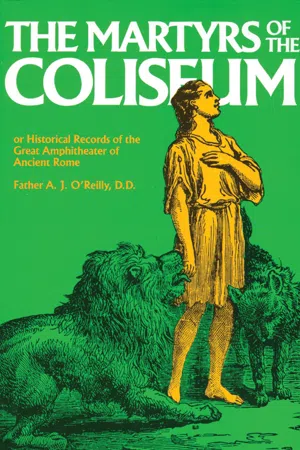
The Martyrs of the Coliseum or Historical Records of the Great Amphitheater of Ancient Rome
- 441 pages
- English
- ePUB (mobile friendly)
- Available on iOS & Android
eBook - ePub
The Martyrs of the Coliseum or Historical Records of the Great Amphitheater of Ancient Rome
About this book
Here is told both the fascinating history of the Roman Coliseum and the lives and deaths of many famous Roman martyrs, such as St. Ignatius of Antioch, St. Prisca, Pope St. Stephen, St. Vitus and companions, St. Marinus, St. Martina, etc. Tells the heroism of the martyrs, the cruelty of the Roman mob, and the incredible miracles God worked on behalf of His saints. Exciting and vivid even today.
Trusted by 375,005 students
Access to over 1 million titles for a fair monthly price.
Study more efficiently using our study tools.
Information
Topic
Theology & ReligionSubtopic
Christian Denominations
CHAPTER VII.
THE ROMAN GENERAL.
I.
BEFORE introducing to our reader the extraordinary records that have come down to us regarding the great St. Eustachius and his martyred family, it may be well to contemplate for a moment a grand and consoling feature of triumph which Almighty God vouchsafed to His servants in the days of persecution. Although hundreds of martyrs have gone to heaven from the arena of the Coliseum, yet few have been killed by the wild beasts. This strange fact is a beam of sunshine amid all its horrors of cruelty and bloodshed. He who knew how to change the ferocious nature of those animals which prowl through their native mountains and deserts in search of food, so that they became the protectors and even companions of His hermits and solitaries, made them (instead of being the instruments of the most awful death) the defenders of the chastity of His virgins, and the witnesses of the sanctity of His saints. The great Creator of all things intended the dumb animal to be the servant of man, and, with a few exceptions, He refused to allow it to be the executioner of the innocent. One of the most consoling pages in the history of these terrible times, is the oft-repeated miracle of Daniel in the lion's den; not, however, in the silence and darkness of the gloomy cavern into which the youthful prophet was cast, but under the noon day sun, in the great amphitheatre of the capital of the world, and before 100,000 spectators. Miracles have been destined by God to be the handmaids of truth and the medium of conviction. In the visible interposition of His power in preserving His servants from the fury of the beasts in the Coliseum, He presented to the pagans of Rome an incontestable proof of the divinity of Christianity, and a mercy they knew not how to appreciate. If the old walls of the Coliseum could speak, they would tell us some consoling scenes of the triumph of the martyrs and their wonderful preservation. St. Eusebius, who was eye-witness to some of those terrible scenes, describes with eloquence and feeling how the furious wild beasts were unable to harm the Christians, and would turn on the pagans with destructive rage. "Sometimes," he says, "they rushed on the naked and defenceless champions of Christ, but checked as if by some divine power, they returned to their dens. This happened repeatedly, and excited the wonder of the spectators; at their demand the first wild beast having been abashed, a second and third were sent against the same martyr, but to no effect.
"You would have been filled with admiration," he continues, "at the steadfast intrepidity of those holy champions, and at the immovable fortitude displayed by persons of the most tender years. You might have seen a youth who had not yet completed his twentieth year, standing motionless in the midst of the arena with his hands stretched forth in the form of a cross, as he prayed with fervour to God, and not shrinking from the spot in which he stood, even when the bears and leopards, breathing forth rage and death, almost touched his very flesh with their jaws. Again, you might have seen others thrown before an enraged bull, which attacked the pagans who came near him, tossing them with his horns into the air, and leaving them to be taken away half-dead. But when with rage and bellowing he rushed upon the martyrs, he could not approach them, but stamping on the ground with his feet, tossing his horns to and fro, and breathing forth rage and madness, by reason of his being irritated by red-hot goads, the infuriated animal was, in despite of all, held back by an invisible hand. Other wild animals having been tried to no purpose, the Christians were at last put to death by the sword, and their relics, instead of being interred, were consigned to the surges of the deep" (Eccles. Hist., book viii).
The scenes described by Eusebius were frequent all over the Empire. Wherever the name of Christian was found the persecution raged. It would seem that Almighty God adopted this means to give His infant Church publicity and a sign of the stamp of divinity, Hence in His mercy and goodness He made the persecutions the fruitful harvest of souls. Baronius mentions (An. 307) that in the persecution of Diocletian, when the slain were counted by thousands daily, the holy Pope Marcellus had to appoint twenty-five new parishes in the city, to baptize and instruct the people who multiplied beneath the sword. The hideous and execrable character of the barbarities to which the Christians were subjected, with a view not only to force them to apostatize, but to deter others from embracing the proscribed belief, had the very contrary effect. As to the martyrs, persons of both sexes, and of the tenderest and most infirm age, not only bore their sufferings with superhuman fortitude, but hailed them with joy, as tending to the greater glory of God and the conversion of the pagans. Their very persecutors were forced to applaud the heroism of those whom they so bitterly hated, and to feel disgusted and afflicted at the atrocities they were once so vociferous in demanding.
The reverence which the animals shewed the martyrs is touchingly displayed in a scene we will quote from the Acts of three martyrs of Tarsus, given in the Annals of Baronius, under the year 290. They did not suffer in the Coliseum at Rome, yet their martyrdom took place in another amphitheatre of the Empire, and the records of their death serve as a sample of what generally happened in those days of horror. These martyrs, Tharasius, Probus and Andronicus, had been tortured in a most cruel manner at Tarsus in Cilicia; they were conveyed thence to Mopsueste, and were again submitted to the most horrible barbarities, and a third time they were tormented at Anazobus; so that being covered all over with wounds, and their bones being broken and wrenched from their sockets, when the Governor Maximus wished to have them finally exposed in the amphitheatre to the wild beasts, it became necessary for the soldiers to press men from the streets in order carry thither their almost lifeless bodies.
"When we beheld this," say the three devout Christians who wrote the Acts, and interred the relics of the martyrs, "we turned away our faces and wept; but when their mangled frames were cast down from the men's shoulders on the arena, all the spectators were horrified at the sight, and began to murmur at the president for this order, and many of them rose up and left the theatre, expressing their dislike of this ferocious cruelty; on which Maximus told his guards, who were near him, to take down the names of all who acted thus, that they might be afterwards brought to an account. He then commanded the wild beasts to be let loose on the martyrs and, when they would not touch them, he ordered the keepers to be scourged. A bear was then let out which had devoured three men that day; but crouching at the feet of Andronicus, it began gently to lick his wounds, and continued thus mildly to demean itself, notwithstanding that the martyr plucked its hair and tried to irritate the animal. Then the president in a fury, ordered the lancers to run the bear through the body: and Terentianus (the editor of the games) dreading the president's anger, determined to make sure by letting in on the martyrs a lioness which had been sent from Antioch by Herod; but the lioness, to the terror of the spectators, began bounding to the place where they were reclining; and when at length she came to the martyrs, as it were kneeling down before Theracius, who dragged and annoyed her, she seemed, by cowering down submissively, to attest her veneration, conducting herself less like a lioness than a lamb. Shouts of admiration burst forth from the whole amphitheatre, overpowering Maximus with confusion; who screamed to the keepers to infuriate and goad on the lioness. But the beast, with another bound, broke through the palisade back to her men, and the manager, Terentianus, was ordered to proceed, without further interlude, with the gladiators; directing them first to dispatch the martyrs with their swords."
There are on record one or two extraordinary facts where animals refused to touch slaves who were cast to them; but these were exceptional cases of recognition and gratitude—a trait of nobility often found more practised in the brute creation than in reasoning man. Our readers are familiar with the story of Androclus and the Lion.
Seneca also mentions in his 2nd Book, and 9th chap., De Beneficiis, that a lion would not touch one of his keepers who was condemned to be exposed to the wild beasts. In the life of St. Sabba, a fact similar to that of Androclus is mentioned, and the grateful lion lived at the monastery with his monks.
These facts, interesting and strange as they may be, were not miracles. There was no more of the supernatural about them than there is in the fidelity of a dog, who would lose his life in defence of even an unkind master. It is only the interposition of the divine power that can stay the enraged animals in their spring upon a defenceless victim, or make them crouch at the feet of persons they could never have seen before, whilst at the same moment the very men who fed them become victims of their rage. These wonders Almighty God worked in behalf of His servants; and the great St. Eustachius, with his family, is another instance of this wonderful preservation.
In the life of this great martyr we have one of the extraordinary sacred romances of the second century, a conversion more wonderful than St. Paul's, a life of trial and affliction like the patriarch Job, and a glorious death by martyrdom, the most terrible in the annals of persecution. No sensational novel of modern days ever detailed the imaginary vicissitudes of life more strange and more interesting than what we have here in reality, and handed down to us with all the authority of history. There are men accustomed to doubt of everything strange in history, and they smile with sarcasm at our credulity in believing some of the most sacred records of the past; but we will first give an epitome of the extraordinary events of the life of St. Eustachius, and then show that we are recording a scene from the pages of ecclesiastical history, the truth of which there is no reason to doubt.
2.
The Romans were from the very birth of their dynasty a brave and warlike people; the heroes who led them on to battle and conquest were men of consummate skill and intelligence, and are justly immortalised on the pages of history. In ancient times the art of warfare was rude and undeveloped, and the whole existence of an army depended upon the skill of its general. He had to direct where there was no order, no intelligence, no judgment, save that which flashed from his own superior mind; he moved the mighty machine of brutal and living force as he willed; the roughest and wildest spirits were cemented together into the irresistible phalanx by one element alone, it was confidence in their leader; his skill was more to the army than numbers, position, or courage. Thus it was that Cæsar, one of the greatest warriors of the past, said he feared more the general without an army than an army without a general. Eustachius or Placidus (by which name he was more generally known) was one of the great generals of the Roman army at the commencement of the second century.
His influence and name were as great amongst the soldiers on account of his virtues as for his triumphs and military skill. He was admired by all for his mildness, love of justice and charity. He was the father of his soldiers, and treated them with leniency and justice; virtues unknown to the barbarian soldier, but loved the moment their benign influence was felt. He was generous and charitable to the unfortunate, and although a pagan, he was eminently chaste. True greatness is incompatible with the indulgence of the brutal propensities of man. The virtues and exalted position of Placidus rendered him the most conspicuous man of the time, like the solitary star shining through the dark masses of cloud on a stormy night. No wonder he was signalled out by Providence as the object of special grace and the instrument of great wonders, for Almighty God loves virtue and order, although practised by an infidel, and He never fails to reward it in due time.
A soldier offered alms to St. Francis. In recompense for this act of charity, Almighty God revealed to the Saint the soldier's approaching death. Francis gave him the prophetic warning, and prepared him for a happy end. Perhaps it was charity, some silent act of benevolence in the life of Placidus that brought down from heaven the great grace of conversion and made him a vessel of election. This seems even more probable from the words addressed to him by our Blessed Lord Himself, at the moment of his call to Christianity.
One day Placidus went out according to his custom to hunt. He proceeded with some officers of the cavalry division over which he had the command, to the brow of the Sabine hills, and fell in with a troop of beautiful stags. Amongst them there was one larger and more beautiful than the rest, and Placidus immediately pursued it with all the ardour of the chase. In the excitement, which huntsmen alone know, he was soon separated from his companions, and passed over hills and rapid rivers and on the edges of the most terrible precipices. He knew no danger; he was not accustomed to defeat; on he went, over mountains and through valleys, until he came up with his magnificent prize in a wild and lonely ravine, not far from the spot where now stands the picturesque village of Guadagnolo. This was the moment and place in which the providence of God destined to illumine the mind of the great general with the light of Christianity. The stag stood on the ledge of a rock just over him, and between its beautiful and branching horns there was a dazzling light; in the midst of an aureola of splendour he saw an image of the crucifixion. Struck with wonder and amazement, be heard a voice saying to him, "Placidus, why dost thou follow Me? Behold I have taken this form to speak to thee; I am the Christ, whom thou servest without knowing. Thy charity and deeds of benevolence to the poor have stood before Me, and have made Me follow thee with My mercy. The just man, dear to me on account of his works, must not serve devils and false gods, who cannot give life or reward."
Placidus dismounted in terror and confusion. He could not remove his eyes from the beautiful vision that shone more brilliantly than the sun between the horns of the stag, and although he heard he did not understand the voice that spoke to him. At length gaining courage, he cried out in an excited and tremulous tone—
"What voice is this? Who speaks?—reveal Thyself that I may know Thee."
Again the heavenly sounds fell on his ears, and he heard these words:—
"I am Jesus Christ, who created heaven and earth out of nothing, who threw all matter into shape, and made the light spring from the chaos of darkness. I am He who created the moon and the stars, and caused the day and the night; who created man from the slime of the earth, and for his redemption appeared in human flesh, was crucified, and rose the third day from the dead. Go, Placidus, to the city, and seek the chief pastor of the Christians and be baptized."
A ray—the last ray of the brilliant light which had dazzled his eyes, had entered his heart, and he understood all. He remained for hours on his knees, in his first warm and grateful prayer to the true God. When he awoke from his deep reverie of adoration and prayer, he found all was dark and silent. The sun had disappeared behind the mountains, and his faithful and wearied horse and dog slept beside him. He rose, like the Apostle Paul on the road to Damascus, with the courage of a lion, to proclaim the truth of the Christian religion, and the wonderful mercy of God. He roused his horse, and returned slowly through the bleak passes of the mountain towards the city.
In the meantime, alarms for the safety of Placidus were increasing at his residence in the city. He was gifted with a noble and amiable spouse; their union had been strengthened by long years of peace. In the similar and moral tendencies of their virtuous souls their home presented a scene of domestic bliss rarely found in pagan circles. The unusual absence of the general gave her immense anxiety; all night she sat up watching for his well-known tread on the threshold, but the grey dawn was breaking on the horizon and still no sign of Placidus.
Starting from the momentary repose of a delusive dream she found her slave awaiting returning consciousness to deliver a message.
"Most noble lady, Rufus, who had accompanied the general this morning to the hunt, has returned and prays an audience."
"Quick, quick, Sylvia, bring him to my presence."
She sprung from her seat, met the veteran soldier at the door, and trembling with excitement, she addressed him:—
"Say Rufus, knowest thou aught of the general; thou wert ever a true soldier, and kept by his side in the darkest hour, how came you separated from him? Speak, I fear thy silence."
The veteran leaned on his halbert; after a moment's pause, he spoke in a deep, solemn voice.
"Noble lady, I am loath to fan thy misgivings to darker anticipations of ill, but we fear for the safety of the general."
"I conjure thee, Rufus, tell me all," she cried frantically, "has his trusty steed fallen and cast him down the awful precipice, have ravenous wolves fed on his mangled corpse?"
"None of these calamities, noble lady, have befallen our brave commander," interrupted Rufus. "We believe he has but lost his way in the mountains, and shall be here before noon. This morning I was by his side when a large stag started from the copse; the dogs gave chase, and our steeds flew over the rugged mountain side. The stag was the largest ever seen in these hills, and the chase the fleetest ever run. Our inferior horses soon fell back, and we saw the glittering helmet of our commander rushing like a ball of fire through the woods; he was soon lost from our sight near the ravines of Marino. We halted under the shade of a figtree, hoping each moment to see our gallant commander return with the spoils of his brilliant chase. The hours passed slowly on; anxiously we listened for the echoes of his horn; no dog returned with blood-stained mouth to tell of victory; each moment of anxiety made the hammer of life beat with a heavier throb. We searched the mountain side, and called louder and louder the name of our general; there was no response save the mournful echoes that broke the stillness of the olive groves. Trembling for his safety, I hurried back to headquarters to ask a detachment of horse to scour the mountain. Behold, noble lady, how I am separated from the general. The life stream of my heart's blood is not dearer than the safety of thy lord—Rufus shall serve under no other commander but Placidus."
Whilst Rufus was yet ...
Table of contents
- Title Page
- Copyright Page
- CONTENTS
- I. INTRODUCTION
- II. THE ORIGIN AND EARLY HISTORY OF THE COLISEUM
- III. ITS ENTERTAINMENTS AND SPECTACLES
- IV. THE CHRISTIANS
- V. THE FIRST MARTYR
- VI. ST. IGNATIUS
- VII. THE ROMAN GENERAL
- VIII. THE YOUNG BISHOP
- IX. THE SARDINIAN YOUTH
- X. ST. ALEXANDER
- XI. THE SENATORS
- XII. MARINUS
- XIII. MARTINA
- XIV. THE PERSIAN KINGS
- XV. THE ACTS OF POPE STEPHEN
- XVI. TWO HUNDRED AND SIXTY SOLDIERS
- XVII. ACTS OF ST. PRISCA
- XVIII. CHRYSANTHUS AND DARIA
- XIX. PERSECUTION OF DIOCLETIAN
- XX. ACTS OF ST. VITUS AND COMPANIONS
- XXI. META SUDANS
- XXII. THE LAST MARTYR
- XXIII. TELEMACHUS STILL TRIUMPHANT
- XXIV. THE COLISEUM IN THE MIDDLE AGES
- XXV. OTHER REMARKABLE EVENTS
- XXVI.THE CONCLUSION
Frequently asked questions
Yes, you can cancel anytime from the Subscription tab in your account settings on the Perlego website. Your subscription will stay active until the end of your current billing period. Learn how to cancel your subscription
No, books cannot be downloaded as external files, such as PDFs, for use outside of Perlego. However, you can download books within the Perlego app for offline reading on mobile or tablet. Learn how to download books offline
Perlego offers two plans: Essential and Complete
- Essential is ideal for learners and professionals who enjoy exploring a wide range of subjects. Access the Essential Library with 800,000+ trusted titles and best-sellers across business, personal growth, and the humanities. Includes unlimited reading time and Standard Read Aloud voice.
- Complete: Perfect for advanced learners and researchers needing full, unrestricted access. Unlock 1.4M+ books across hundreds of subjects, including academic and specialized titles. The Complete Plan also includes advanced features like Premium Read Aloud and Research Assistant.
We are an online textbook subscription service, where you can get access to an entire online library for less than the price of a single book per month. With over 1 million books across 990+ topics, we’ve got you covered! Learn about our mission
Look out for the read-aloud symbol on your next book to see if you can listen to it. The read-aloud tool reads text aloud for you, highlighting the text as it is being read. You can pause it, speed it up and slow it down. Learn more about Read Aloud
Yes! You can use the Perlego app on both iOS and Android devices to read anytime, anywhere — even offline. Perfect for commutes or when you’re on the go.
Please note we cannot support devices running on iOS 13 and Android 7 or earlier. Learn more about using the app
Please note we cannot support devices running on iOS 13 and Android 7 or earlier. Learn more about using the app
Yes, you can access The Martyrs of the Coliseum or Historical Records of the Great Amphitheater of Ancient Rome by A. J. O'Reilly in PDF and/or ePUB format, as well as other popular books in Theology & Religion & Christian Denominations. We have over one million books available in our catalogue for you to explore.