- 80 pages
- English
- ePUB (mobile friendly)
- Available on iOS & Android
eBook - ePub
The Old World and America
About this book
An extremely valuable and helpful resource that will save hours for the busy teacher or homeschooling parent. It will also enable the 5th-8th grade student to work his way independently through the 37 chapters of The Old World and America. Clear, easy to use, well laid out. Gives page numbers for easy reference. Any potential difficulties are noted. Makes using the text a pleasure.
Tools to learn more effectively

Saving Books

Keyword Search

Annotating Text

Listen to it instead
Information
Topic
Theology & ReligionSubtopic
Christian Denominations
AIM
To show how the Teutonic peoples acquired the gifts of the Romans.
To show how the Church saved western civilization after the fall of the Roman Empire.
THE mighty Roman Empire decayed and finally came to an end in Western Europe. Meanwhile the German tribes for various reasons crossed into the Roman Empire. The tribes would probably have completely destroyed the civilizations of Greece and Rome except for the Church. The Church converted these tribes. Great kings rose to help the Church in the struggle against disorder.

Unit V
Part 1: THE AGE OF INVASIONS
The Roman Empire was slowly but surely growing so weak that it was only a matter of time when a more powerful people would conquer it. The people who were to do this were the Germans who were Teutonic barbarians of northern Europe.
THE GREAT THOUSAND YEARS
THE TEUTONIC PEOPLES. You remember that Julius Cæsar had great difficulty in conquering the people who lived east of the Rhine and north of the Danube. These folk were the Teutons or Germans. There were many thousands of them. They lived in groups or tribes. You must not think they were the same as the people who live in modern Germany. It is true that the inhabitants of Germany are descendants of this race. But the Teutonic peoples we are to study about spread over most of Europe in later times. Their descendants form a goodly part of the population of practically every country in western Europe or what was once the Roman Empire. For this reason we say that the Teutons succeeded or took the place of the Romans.
QUALITIES OF THE TEUTONIC PEOPLES. The Romans always spoke of the Germans as barbarians, but they were a sturdy race. The men were big and strong and handsome. They had fair hair and blue eyes, quite in contrast to the dark Italians. Brought up in the forests and accustomed to hardships from their earliest years, the Teutons were trained to fearlessness. Their religion also had an effect upon their character. It was the religion of a warlike people. We are reminded of their gods by some of the names of the days in the week. Wednesday is named for Woden, the king of the gods, while Thursday is named for Thor, the god of thunder.

The Teutons in their Forest Home
The Warrior took first place among these people.
THE TEUTONS IN THEIR FOREST HOME. The Teuton homes were very unlike the homes of the people in the Roman Empire. The houses of the Teutons were merely huts. One style resembled somewhat an Indian wigwam but in place of a covering of skins, the Teutons used thatch. A more elaborate type also was in use. For this a stone wall was built, circular in form; then a roof of thatch was placed above it. Perhaps the commonest form of dwelling was a simple hut made of logs. Each hut was usually surrounded by a small patch of cleared land. Huts were built in clusters forming villages. Beyond the circle of huts was the common pasture land belonging to the village. The villages of the Teutons were usually not permanent for the warriors moved about too much.
OCCUPATIONS OF THE TEUTONS. The Teutons cultivated some grain and corn but perhaps their main occupation was cattle raising. Their wealth they reckoned in terms of cattle. To provide more food and also to obtain materials for clothing the Teutons hunted in the forest for wild boar, deer, and antelope. Except for hunting they had few amusements. The Teutons prided themselves upon their ability as warriors. They were unusually determined. They had a desire for liberty and respect for women. But they had vices. They frequently gambled, even gambling their freedom. Sometimes they drank to excess intoxicating liquors. They were often brutal and coarse.
TEUTON GOVERNMENT. The Teuton government was simple in form and under the control of all the freemen of the village. Their slaves, of course, had no rights. All the warriors were equal. They had kings or leaders but a man could hold such a position only because the freemen permitted it. All matters concerning the welfare of the tribe were discussed in a meeting held in the open air. If the warriors approved of a measure urged by the king or one of the chiefs, they made a loud noise by striking their shields with their spears or battle axes. They showed their disapproval by shouting. While each village managed its own affairs a certain number of villages banded themselves into a larger unit called a "hundred." The clan or tribe was composed of "hundreds."
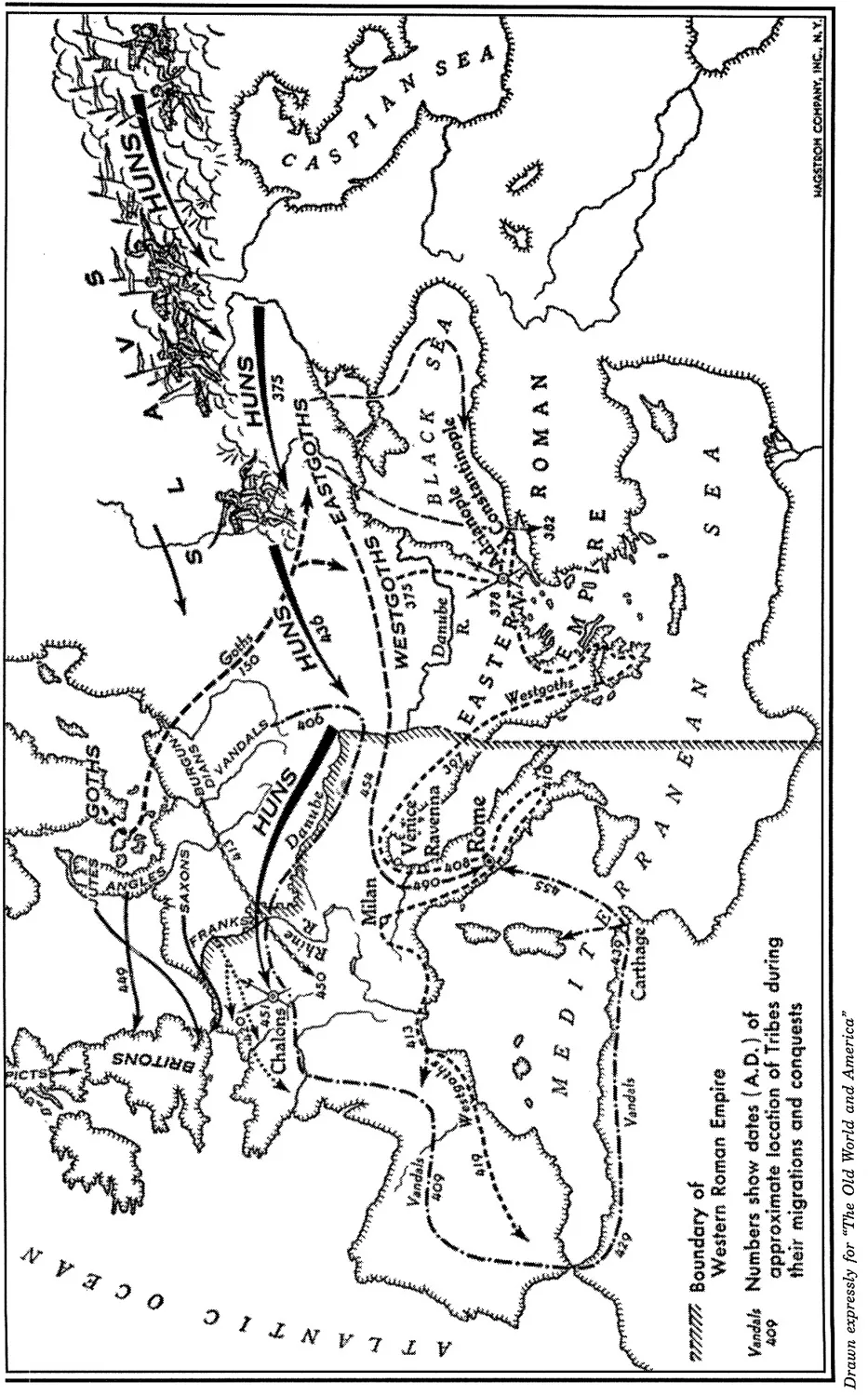
Map of the Teutonic Invasions. Refer to this map as you read about the various tribes.
THE ENTRANCE OF THE TEUTONS INTO THE ROMAN EMPIRE. For some years Teutons or Germans had been employed as soldiers in the Roman army. When the Teutonic tribes who lived across the Rhine decided to move into the territory of the Roman Empire there was nothing to stop them. Their own kinsmen who were fighting in the Roman army could not be expected to repel these invaders. The Romans had to allow some Germans, as they called them, to cross the borders of the Roman Empire. Gradually the number of Germans in the Roman Empire became very great. At one time or another they would have taken possession of a large part of it. But taking possession of the Roman Empire was forced upon them perhaps sooner than they expected.
THE HUNS. More and more the Teutons felt forced to invade the Roman Empire to save themselves. In the fourth century a fierce race of men from Asia, called Huns, moved in behind the eastern Teutonic tribes. The Huns were the most terrible invaders Europe ever saw. Wherever they went they left a trail of destruction. They rode into ...
Table of contents
- Cover Page
- Copyright Page
- AUTHOR'S NOTE
- CONTENTS
- Unit I THE BEGINNINGS OF CIVILIZATION
- Unit II OUR DEBT TO THE GREEKS
- Unit III CONTRIBUTIONS OF ROME TO CIVILIZATION
- Unit IV CHRIST AND HIS CHURCH
- Unit V THE TRIUMPH OF THE CHURCH
- Unit VI THE PEOPLE OF THE MIDDLE AGES
- Unit VII THE IDEALS OF THE MIDDLE AGES
- Unit VIII THE AGE OF NEW INTERESTS
- Unit IX THE AGE OF CHANGE
- Unit X THE AGE OF DISCOVERY
- Unit XI SPAIN'S WORLD EMPIRE
- Unit XII RIVALRIES IN EUROPE
- Unit XIII THE FOUNDATIONS OF AMERICA
- Summary
Frequently asked questions
Yes, you can cancel anytime from the Subscription tab in your account settings on the Perlego website. Your subscription will stay active until the end of your current billing period. Learn how to cancel your subscription
No, books cannot be downloaded as external files, such as PDFs, for use outside of Perlego. However, you can download books within the Perlego app for offline reading on mobile or tablet. Learn how to download books offline
Perlego offers two plans: Essential and Complete
- Essential is ideal for learners and professionals who enjoy exploring a wide range of subjects. Access the Essential Library with 800,000+ trusted titles and best-sellers across business, personal growth, and the humanities. Includes unlimited reading time and Standard Read Aloud voice.
- Complete: Perfect for advanced learners and researchers needing full, unrestricted access. Unlock 1.4M+ books across hundreds of subjects, including academic and specialized titles. The Complete Plan also includes advanced features like Premium Read Aloud and Research Assistant.
We are an online textbook subscription service, where you can get access to an entire online library for less than the price of a single book per month. With over 1 million books across 990+ topics, we’ve got you covered! Learn about our mission
Look out for the read-aloud symbol on your next book to see if you can listen to it. The read-aloud tool reads text aloud for you, highlighting the text as it is being read. You can pause it, speed it up and slow it down. Learn more about Read Aloud
Yes! You can use the Perlego app on both iOS and Android devices to read anytime, anywhere — even offline. Perfect for commutes or when you’re on the go.
Please note we cannot support devices running on iOS 13 and Android 7 or earlier. Learn more about using the app
Please note we cannot support devices running on iOS 13 and Android 7 or earlier. Learn more about using the app
Yes, you can access The Old World and America by Maureen K. McDevitt in PDF and/or ePUB format, as well as other popular books in Theology & Religion & Christian Denominations. We have over one million books available in our catalogue for you to explore.