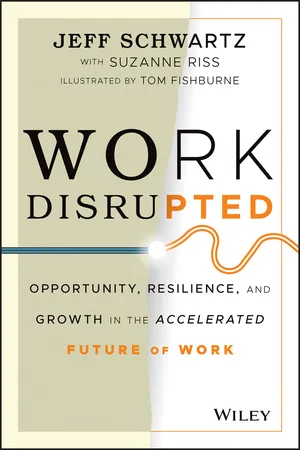
Work Disrupted
eBook - ePub

Work Disrupted

Opportunity, Resilience, and Growth in the Accelerated Future of Work

  1. English
  2. ePUB (mobile friendly)
  3. Available on iOS & Android
eBook - ePub

Work Disrupted

Opportunity, Resilience, and Growth in the Accelerated Future of Work

About this book

If you only read one book on the future of work, Work Disrupted: Opportunity, Resilience, and Growth in the Accelerated Future of Work should be that book.

The future of work swept in sooner than expected, accelerated by Covid-19, creating an urgent need for new maps, new mindsets, new strategies-- and most importantly, a trusted guide to take us on this journey. That guide is Jeff Schwartz. A founding partner of Deloitte Consulting's Future of Work practice, Schwartz brings clarity, humor, wisdom, and practical advice to the future of work, a topic surrounded by misinformation, fear, and confusion. With a fundamental belief in the power of human innovation and creativity, Schwartz presents the key issues, critical choices, and potential pitfalls that must be on everyone's radar.

  • If you're anxious about robots taking away your job in the future, you will take comfort in the realistic perspective, fact-based insights, and practical steps Schwartz offers.
  • If you're not sure where to even begin to prepare, follow his level-headed advice and easy-to-follow action plans.
  • If you're a business leader caught between keeping up, while also being thoughtful about the next moves, you will appreciate the playbook directed at you.
  • If you're wondering how Covid-19 will change how and where you will work, Work Disrupted has you covered.

Written in a conversational style by Schwartz, with Suzanne Riss, an award-winning journalist and book author, Work Disrupted offers a welcome alternative to books on the topic that lack a broad perspective or dwell on the problems rather than offer solutions. Timely and insightful, the book includes the impact of Covid-19 on our present and future work. Interviews with leading thinkers on the future of work offer additional perspectives and guidance.Cartoons created for the book by leading business illustrator Tom Fishburne bring to life the reader's journey and the complex issues surrounding the topic.

Told from the perspective of an economist, management advisor, and social commentator, Work Disrupted offers hope--and practical advice--exploring such topics as:

How we frame what lies ahead is a critical navigational tool. Discover the signposts that can serve as practical guides for individuals who have families to support, mortgages to pay, and want to stay gainfully employed no matter what the future holds.

The importance of recognizing the rapidly evolving opportunities in front of us. Learn how to build resilience—in careers, organizations, and leaders—for what lies ahead.

Why exploring new mental models helps us discover the steps we need to take to thrive. Individuals can decide how to protect their livelihood while businesses and public institutions can consider how they can lead and support workforces to thrive in twenty-first-century careers and work.

"Jeff's marvelous book is a roadmap for the new world of work with clear signposts. His insights will help readers discover opportunities, take action, and find hope in uncertain times. The ideas are fresh, beautifully crafted, and immediately applicable. This is not only a book to be read, but savored and used."
— Dave Ulrich, Rensis Likert Professor, Ross School of Business, University of Michigan;Partner, the RBL Group; Co-author Reinventing the Organization

Frequently asked questions

Yes, you can cancel anytime from the Subscription tab in your account settings on the Perlego website. Your subscription will stay active until the end of your current billing period. Learn how to cancel your subscription.
No, books cannot be downloaded as external files, such as PDFs, for use outside of Perlego. However, you can download books within the Perlego app for offline reading on mobile or tablet. Learn more here.
Perlego offers two plans: Essential and Complete
  • Essential is ideal for learners and professionals who enjoy exploring a wide range of subjects. Access the Essential Library with 800,000+ trusted titles and best-sellers across business, personal growth, and the humanities. Includes unlimited reading time and Standard Read Aloud voice.
  • Complete: Perfect for advanced learners and researchers needing full, unrestricted access. Unlock 1.4M+ books across hundreds of subjects, including academic and specialized titles. The Complete Plan also includes advanced features like Premium Read Aloud and Research Assistant.
Both plans are available with monthly, semester, or annual billing cycles.
We are an online textbook subscription service, where you can get access to an entire online library for less than the price of a single book per month. With over 1 million books across 1000+ topics, we’ve got you covered! Learn more here.
Look out for the read-aloud symbol on your next book to see if you can listen to it. The read-aloud tool reads text aloud for you, highlighting the text as it is being read. You can pause it, speed it up and slow it down. Learn more here.
Yes! You can use the Perlego app on both iOS or Android devices to read anytime, anywhere — even offline. Perfect for commutes or when you’re on the go.
Please note we cannot support devices running on iOS 13 and Android 7 or earlier. Learn more about using the app.
Yes, you can access Work Disrupted by Jeff Schwartz,Suzanne Riss,Tom Fishburne in PDF and/or ePUB format, as well as other popular books in Business & Business Strategy. We have over one million books available in our catalogue for you to explore.

Information

Publisher
Wiley
Year
2020
Print ISBN
9781119762270
eBook ISBN
9781119763512
Edition
1

CHAPTER 1
From Fear to Growth : Mindsets and Playbooks for Twenty-first-century Careers and Work

When we least expect it, life sets us a challenge to test our courage and willingness to change; at such a moment, there is no point in pretending that nothing has happened or in saying that we are not yet ready. The challenge will not wait. Life does not look back.
—Paulo Coelho, novelist1
When the coronavirus pandemic took root in the United States, we entered a time machine to the future.2 Practically overnight, people in industries that had restricted telecommuting found themselves crawling out of bed and dialing into Zoom conference calls from their couch. For many teachers, bankers, lawyers, even NASA aerospace engineers, the coronavirus crisis was a trial run for remote work.3 With most of the country under orders to shelter in place, many business leaders pivoted on a dime to reimagine products, reassign workers, reshape supply chains, and reconfigure operations to join the heated race to save lives. Near the top of the critical list of needs was the demand for ventilators, potentially hundreds of thousands of ventilators. In an unprecedented move, Ford and General Motors shut down car production and went into the ventilator production business.4
Overhauling production and ramping up that production beyond anything your company has ever done before are feats of magic that business leaders have known they would be expected to perform in the future world of work. When Anne-Marie Slaughter, the chief executive of New America, said the coronavirus exposed “an opportunity to make the changes we knew we were going to have to make eventually,” and also “deep fissures and failures in our culture,” she captured both the sense of inevitability and vulnerability that many business leaders were experiencing.5 They knew the future world of work would require boosting efficiency, proceeding at warp speed, seeking talent and expertise outside the walls of their organization, and a heavy dose of resourcefulness. However, they did not realize the future would arrive wholesale and so soon. After all, in survey after survey, business leaders consistently reported they did not feel ready for the future of work.6
Cartoon illustration of a time machine, a man, and a woman on the screen. The man has a caption that reads, wow, everything has completely changed. I must have traveled at least 10 years into the future. The woman on the screen has a caption that reads, actually, it's only been 10 weeks.
Enter the coronavirus pandemic, an abrupt fast-forward to the future of work. Changes expected to take decades, occurred within weeks. Slaughter, a former director of policy planning for the U.S. Department of State, declared that with the pandemic “the future of work is here.”7 Indeed, the coronavirus has illustrated both the extreme challenges and inspiring possibilities ushered in by a future that swept in sooner than expected.

Panic or Pivot

Around the country, business leaders were among the first to act during the pandemic. Why the need for so many ventilators? The coronavirus often kills through the lungs as patients develop Covid-19 pneumonia.8 Ventilators help the sickest patients stay alive by providing extra oxygen to keep their lungs pumping once they fill with fluid. General Motors scrambled to train workers and locate the 700 parts needed to create a prototype ventilator, sourced from about 80 global suppliers.9 Leaders at the car manufacturer were well-suited to the challenge: Assembling a 700-part ventilator sounds daunting but cars are typically assembled from about 2,500 parts. Auto makers have already demonstrated their ability to mass produce technical equipment quickly. However, the usual pace of production had to spring into overdrive. What normally might take months had to be done in weeks. They had to produce more, faster than ever before. At stake were the lives of acute Covid-19 patients.
Many companies relinquished business-as-usual approaches to tackle a variety of coronavirus-related shortages, including not only vital medical equipment but personal protective equipment (PPE) and hand sanitizer. In New York City, many doctors and nurses improvised, using trash bags to replace medical scrubs and protective gowns. The Gap Inc., parent company of Banana Republic and Old Navy, shifted its factories to create protective cloth masks, gowns, and scrubs. Fanatics, an online seller of Major League Baseball gear, also started producing masks and gowns.10 Meanwhile, Pernod Ricard, the alcohol brand, donated pure alcohol for hand sanitizer. French luxury powerhouse LVMH, which owns Louis Vuitton, Bulgari, and other high-end brands, also entered the hand-sanitizer business, using its perfume and make-up factories to produce hydroalcoholic gels.11
To keep their doors open and their employees on the payroll, many companies changed direction, navigated red tape, and devised innovative approaches. The ability to pivot rather than panic allowed some people to apply their capabilities in new ways.12 Small mom-and-pop shops like Essations, started by Stephanie Luster's parents almost 40 years ago, could not stay in the business of shipping hair products to salons. When salons shut their doors, after city after city ordered businesses to close and social distancing rules to take effect, Luster had an idea. She would sell directly to customers who were sheltering but still wanted their hair to look styled for Zoom video calls for work. What if the stylists created home-hair-care videos that featured Essations hair products and then posted them on Facebook? At the end of the tutorial, the stylist could provide a code customers could use to get a discount on the Essations website. Essations would know from the code which stylist had sent the customer, and the stylist could get a cut of the sale. Many stylists liked the idea and made videos featuring Essations' products, allowing online product sales to increase by 20 percent.13
Some businesses soared during the pandemic. Instacart, the grocery pick-up and delivery service, hired more than 300,000 full-time employees in one month to meet the increased demand at the start of the pandemic, with plans to hire 250,000 more.14 However, a far greater number of businesses and individuals had to change direction to survive. Furloughed hotel call center operators found themselves subcontracted to operate state and city call centers. Uber launched a courier service so that drivers who could no longer transport passengers could continue to work by delivering packages, medicine, and pet supplies.15 Spiffy, the U.S. on-demand car cleaning company, rolled-out a service to sanitize and disinfect facilities and properties.16
Innovation and experimentation will continue to be lifelines as we transition to a very different world. Author William Gibson reminded us more than 15 years ago that, “The future is already here, it's just not evenly distributed.”17 An important corollary is that the future comes at us in accelerated bursts. The coronavirus is one such accelerator to the future. We have witnessed similar accelerators in recent years, with the great financial crisis of 2008–2009 and Y2K. The challenge is how we navigate and take advantage of these sudden shifts.
Cartoon illustration of a family in campfire and the figure has a caption that reads, ok, Jim that's enough about A I coming for everyone's jobs.

Racing with the Machines

“Are robots really coming for our jobs?” a longtime client asked me in hushed tones, his brow furrowed, his voice filled with anxiety.
His business partner leaned in, reframing his question with another. “Won't new technologies relieve us of all the b...

Table of contents

  1. Cover
  2. Table of Contents
  3. Advanced Praise for Work Disrupted
  4. Title Page
  5. Copyright
  6. Dedication
  7. Foreword
  8. Introduction
  9. CHAPTER 1: From Fear to Growth 
  10. PART I: Find Opportunity in a Time of Accelerated Change
  11. PART II: Build Long-Term Resilience for Uncertain Futures
  12. PART III: Playbooks for Growth
  13. Acknowledgments
  14. About the Authors
  15. Index
  16. End User License Agreement