eBook - ePub
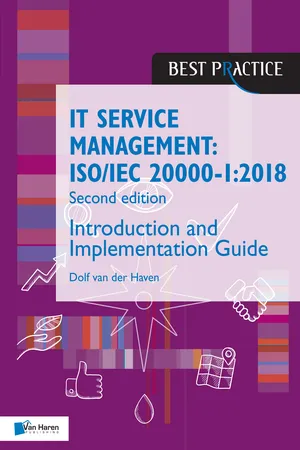
IT Service Management: ISO/IEC 20000 1:2018 - Introduction and Implementation Guide - Second edition
- English
- ePUB (mobile friendly)
- Available on iOS & Android
eBook - ePub
IT Service Management: ISO/IEC 20000 1:2018 - Introduction and Implementation Guide - Second edition
About this book
The revised standard for Service Management, ISO/IEC 20000-1: 2018 is the third version of the international standard for service management, replacing the 2011 edition. It provides requirements for the planning, design, transition, delivery and improvement of a Service Management System, which is the coordinated set of policies, processes, organisational structure and people to manage services.
This book introduces the ISO/IEC 20000-1 standard as well as providing extensive practical advice on implementing an SMS that conforms to the requirements. It does so by referring to the ISO/IEC 20000-1:2018 documentation toolkit, which is separately available and contains dozens of templates that allow you to provide the documented evidence necessary.
Trusted by 375,005 students
Access to over 1 million titles for a fair monthly price.
Study more efficiently using our study tools.
Information
Topic
EducationSubtopic
Business Development
The revised standard for service management, ISO/IEC 20000-1:2018, was published in September 2018 and is the third version of the International Standard for service management, replacing the 2011 edition.
ISO/IEC 20000-1 provides requirements for the planning, design, transition, delivery and improvement of a Service Management System (SMS), which is the coordinated set of policies, processes, organizational structures, people, etc. involved in managing services.
This book introduces the ISO/IEC 20000-1 standard as well as providing extensive practical advice on implementing an SMS that conforms to the requirements. It does so by referring to the ISO/IEC 20000-1:2018 documentation toolkit, which is separately available and contains dozens of templates that allow you to provide the documented evidence necessary. This book, however, can also be read without using the templates, or using others in their place.
This book contains the following chapters:
Chapter 2 deals with a general overview of service management and why you need it — services are everywhere, even if you don’t realize it.
In Chapter 3, an overview is given of the ISO/IEC 20000-1 standard and the other parts of the ISO/IEC 20000 series.
High-level steps on how to implement the requirements of ISO/IEC 20000-1 are provided in Chapter 4.
Chapter 5 contains the practical guidance for conforming to the requirements of the standard. It extensively details the documented information needed as well as referring to the documentation toolkit developed together with this book.
Chapter 6 highlights the practical aspects of running an SMS beyond the documented information discussed in Chapter 5, instead focusing on planning, running, measuring and improving the SMS and other services.
Chapter 7 provides information on the certification process, in case your organization may want to get formal certification against the standard through external audits.
To conclude, Chapter 8 describes two models that can help you go beyond the requirements of the standard and look at service management from a holistic perspective.
Appendix A lists further resources that may be helpful during your journey in implementing ISO/IEC 20000-1.
Finally, Appendix B lists the main differences between the 2018 edition of the standard and the previous 2011 edition.
Note that the documentation toolkit, containing several dozen templates that can be used to conform to the requirements of the standard, is available from www.vanharen.net.

Services are as old as the world – various forms of services have been around for a long time, including legal services, transport services and governmental services. As a subset, Information Technology (IT) services have been around a bit shorter. IT services importantly gave rise to what was known as IT Service Management (ITSM), because a need was felt better to control these services and the costs of them. ITSM, in turn, has been generalized to general Service Management, by applying its principles to other services than IT. In fact, most, if not all, services today contain some IT component, if even as limited as a payment method or a website. This book, and the ISO/IEC 20000-1 standard, therefore refer to Service Management rather than ITSM, just to show how it can be applied to all types of services.
Contrary to popular belief, service management does not have to be an old-fashioned, rigid framework that slows down every effort in bringing positive changes. This is despite the fact that the fast-paced development of services today, pushed by (and, in turn, leading to) rapidly evolving customer requirements, result in many developers believing that traditional service management needs to make way for “newer” frameworks, such as Lean, Agile, DevOps and other related methodologies. In reality, the new ISO/IEC 20000-1 standard fully supports the use of these newer methodologies, but it can also be used with more traditional approaches to service management.
A standard like ISO/IEC 20000-1 does not prescribe how you should implement your service management processes; it only states what these processes should conform to. This opens up a range of possibilities for organizations to implement their processes in a way that is suited to their circumstances. Even a framework such as ITIL®, which is far more prescriptive, is clear regarding the modification of its processes to the organization’s needs. I tend to modify its slogan to Adapt and Adopt. You need to be able to adapt your service management practices to your organization’s culture and then adopt said practices to maximize the outcome.
You can conform to all requirements of ISO/IEC 20000-1 in various ways, adapted to the management practices you have adopted and the services you provide. It applies to both waterfall-type service implementations and restrictive change management practices, as well as to continuous delivery practices with a rapid change approval turnaround time. It is all dependent on what your service management policy (the high-level statement by which service management is governed) and your principles (the related statements on what is permissible in, for example, change or incident management) are. These, in turn, are dependent on the culture of the organization.
What makes service management so valuable is that it enables a structure for provisioning that can be adapted to the culture of the organization. People working within this structure know the level of flexibility and autonomy needed to make decisions independently for the organization. Customers are aware that they can expect consistent value from the services they purchase, and management know they have a structure in place that promotes efficiency, reduces costs and keeps customers satisfied.

◾ 3.1 THE ISO/IEC 20000 SERIES OF DOCUMENTS
ISO/IEC 20000 is not a single document — there is actually a series of ten, in which the primary standard (i.e. ISO/IEC 20000-1:2018) is included. ISO decided to distinguish these documents as parts of the 20000 series by assigning numbers to them, hence the primary standard is 20000-1.
Other parts of the 20000 series are as follows:
(Note that with the release of the 2018 edition of Part 1, some dependent parts that are currently published still refer to the 2011 edition and will be updated.)
◾ ISO/IEC 20000-1 is the international standard for service management, providing requirements to which a service management system (SMS) should conform.
◾ ISO/IEC 20000-10 (also known as Part 10, and updated in 2018) is the general introduction to the series, containing descriptions of the aims of ISO/IEC 20000, as well as the various other parts and ISO standards related to it. It also contains all terms and definitions used in the series.
◾ ISO/IEC 20000-2 (Part 2) is a larger document. Part 1 specifies concise and precise requirements that can be audited, whereas Part 2 provides further guidance on how to interpret and implement the requirements.
◾ ISO/IEC 20000-3 (Part 3) provides guidance on how to define a scope for Part 1: we will see that this is an important aspect in implementing the standard, which may become complex if you are using one or more internal or external suppliers.
◾ ISO/IEC 20000-5 (Part 5) is an example of an implementation plan for an SMS according to Part 1. As well as a project plan, it also includes guidance on areas such as a business case and templates.
◾ ISO/IEC 20000-6 (Part 6) provides requirements for certification bodies when they audit an SMS based on ISO/IEC 20000-1. Part 6 is valid for both the 2011 and the 2018 editions of Part 1.
◾ ISO/IEC 20000-7 (Part 7) provides guidance on the integration and correlation of management systems based on ISO/IEC 20000-1, ISO 9001 (quality management) and ISO/IEC 27001 (information security management).
◾ ISO/IEC 20000-11 (Part 11) makes a comparison between Part 1 and the Information Technology Infrastructure Library (ITIL).`
◾ ISO/IEC 20000-12 (Part 12) makes a comparison between Part 1 and the Capability Maturity Model Integration for Services (CMMI®-SVC).
◾ ISO/IEC 20000-13 (Part 13) makes a comparison between Part 1 and Control Objectives for Information Technology (COBIT®).
◾ Some parts (4, 8 and 9) seem to be missing from this series; this is due to either cancelling their development, withdrawing or renumbering them.
◾ 3.2 THE STRUCTURE AND CONTENTS OF ISO/IEC 20000-1:2018
ISO/IEC 20000-1 is now aligned with the high-level structure and terminology of what is referred to as the “Annex SL”, which is an appendix to the ISO Directives. This structure has been, or will be, applied to all management system standards, including the latest editions of ISO 9001 (Quality Management Systems), ISO/IEC 27001 (Information Security Systems), ISO 14001 (Environmental Management Systems) and many others, now also including ISO/IEC 20000-1. Applying the high-level structure results in many requirements being identical or at least very similar right across these standards, making the integration of multiple management systems much easier. If you already have, for example, an ISO 9001:2015 certification, then part of the work you have completed to achieve that can be re-used for your ISO/IEC 20000-1:2018 certification.
This new structure of ISO/IEC 20000-1:2018 is quite different from the 2011 edition, but you will still find similar requirements in both editions, although these will be in different places. If you want to know exactly what has changed between the two editions, refer to Appendix B for an overview.
The high-level structure of these standards is indicated below. In what follows, the specific content of ISO/IEC 20000-1 is described.
Clause 1 – Scope
A general description of what the standard entails. It states that ISO/IEC 20000-1 covers the establishment, implementation, maintenance and continual improvement of an SMS. The standard is applicable to all types of services, be it IT, such as cloud hosting, or non-IT, such as transport or health care. It is also applicable to organizations of any size, ra...
Table of contents
- Cover
- Title
- Colophon
- Table of Contents
- 1. Introduction
- 2. Service management why is it needed?
- 3. The ISO/IEC 20000 standard
- 4. Implementing the requirements of ISO/IEC 20000-1 – general considerations
- 5. Implementing the requirements of ISO/IEC 20000-1 – practical guidance on documented information
- 6. Implementing the requirements of ISO/IEC 20000-1:2018 running the sms and the services
- 7. Certification
- 8. Beyond ISO/IEC 20000
- Appendix A: ISO/IEC 20000 resources
- Appendix B: Differences between the 2011 and the 2018 editions of ISO/IEC 20000-1
- About the author
Frequently asked questions
Yes, you can cancel anytime from the Subscription tab in your account settings on the Perlego website. Your subscription will stay active until the end of your current billing period. Learn how to cancel your subscription
No, books cannot be downloaded as external files, such as PDFs, for use outside of Perlego. However, you can download books within the Perlego app for offline reading on mobile or tablet. Learn how to download books offline
Perlego offers two plans: Essential and Complete
- Essential is ideal for learners and professionals who enjoy exploring a wide range of subjects. Access the Essential Library with 800,000+ trusted titles and best-sellers across business, personal growth, and the humanities. Includes unlimited reading time and Standard Read Aloud voice.
- Complete: Perfect for advanced learners and researchers needing full, unrestricted access. Unlock 1.4M+ books across hundreds of subjects, including academic and specialized titles. The Complete Plan also includes advanced features like Premium Read Aloud and Research Assistant.
We are an online textbook subscription service, where you can get access to an entire online library for less than the price of a single book per month. With over 1 million books across 990+ topics, we’ve got you covered! Learn about our mission
Look out for the read-aloud symbol on your next book to see if you can listen to it. The read-aloud tool reads text aloud for you, highlighting the text as it is being read. You can pause it, speed it up and slow it down. Learn more about Read Aloud
Yes! You can use the Perlego app on both iOS and Android devices to read anytime, anywhere — even offline. Perfect for commutes or when you’re on the go.
Please note we cannot support devices running on iOS 13 and Android 7 or earlier. Learn more about using the app
Please note we cannot support devices running on iOS 13 and Android 7 or earlier. Learn more about using the app
Yes, you can access IT Service Management: ISO/IEC 20000 1:2018 - Introduction and Implementation Guide - Second edition by Dolf van der Haven in PDF and/or ePUB format, as well as other popular books in Education & Business Development. We have over one million books available in our catalogue for you to explore.