An understanding of applied ecology and conservation is an important requirement of a wide range of programmes of study including applied biology, ecology, environmental science and wildlife conservation. This book is a study and revision guide for students following such programmes. It contains 600 multiple-choice questions (and answers) set at three levels - foundation, intermediate and advanced - and grouped into 10 major topic areas: History and foundations of applied ecology and conservation Environmental pollution and perturbationsWildlife and conservation biologyRestoration biology and habitat managementAgriculture, forestry and fisheries managementPest, weed and disease managementUrban ecology and waste managementGlobal environmental change and biodiversity lossEnvironmental and wildlife law and policyEnvironmental assessment, monitoring and modellingThe book has been produced in a convenient format so that it can be used at any time in any place. It allows the reader to learn and revise the meaning of terms used in applied ecology and conservation, study the effects of pollution on ecosystems, the management, conservation and restoration of wildlife populations and habitats, urban ecology, global environmental change, environment law and much more. The structure of the book allows the study of one topic area at a time, progressing through simple questions to those that are more demanding. Many of the questions require students to use their knowledge to interpret information provided in the form of graphs, data or photographs.
eBook - ePub
Key Questions in Applied Ecology and Conservation
A Study and Revision Guide
- 240 pages
- English
- ePUB (mobile friendly)
- Available on iOS & Android
eBook - ePub
About this book
Information
1 History and Foundations of Applied Ecology and Conservation
This chapter contains questions about the history of applied ecology and conservation along with others concerned with some basic principles.
Foundation
1.1f Ernst Haeckel was a German zoologist who first used the term
a. ecosystem
b. ecology
c. applied ecology
d. pollution
1.2f The term ‘biodiversity’ was first used in the
a. 1960s
b. 1970s
c. 1980s
d. 1990s
1.3f The oldest national park in the world is
a. the Serengeti National Park, Tanzania
b. the Peak District National Park, England
c. Banff National Park, Canada
d. Yellowstone National Park, United States
1.4f A sacred grove is an area of religious and cultural importance in some societies that affords protection to wildlife. It consists predominantly of
a. grassland
b. woodland
c. marshland
d. fresh water
1.5f The original focus of the World Wildlife Fund (now the World Wide Fund for Nature) was on the plight of
a. East African game animals
b. Indian wildlife
c. whales and dolphins
d. the Amazon rainforest
1.6f Biophilia is
a. the scientific name for a fear of animals
b. a type of naturalistic zoo enclosure design
c. the scientific name of a group of rare amphibians
d. the emotional affiliation of human beings to other living organisms
1.7f The extinct bird shown in Fig. 1.1 is
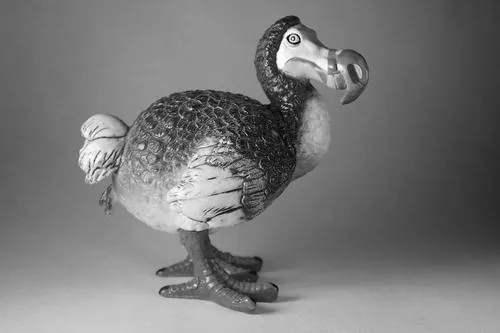
Fig. 1.1.
a. a bush moa (Anomalopteryx didiformis)
b. a dodo (Raphus cucullatus)
c. an elephant bird (Aepyornis maximus)
d. a crested moa (Pachyornis australis)
1.8f Which of the following could not be considered one of the founders of the modern environmental movement?
a. Barry Commoner
b. Rachel Carson
c. Paul Ehrlich
d. Ralph Nader
1.9f Which of the following categories of protected area defined by the International Union for the Conservation of Nature (IUCN) would you expect to experience the lowest levels of human presence and activity?
a. National park
b. Wilderness area
c. Protected landscape
d. Habitat management area
1.10f The Swedish schoolgirl Greta Thunberg is famous for encouraging young people to lobby governments to take action on
a. biodiversity loss
b. plastic pollution of the oceans
c. climate change
d. excessive product packaging
1.11f The Gaia hypothesis suggests that the Earth may be studied as a single functioning organism and was proposed by
a. Paul Ehrlich
b. Norman Myers
c. Carl Sagan
d. Aldo Leopold
1.12f Complete the following sentence by selecting the most appropriate word from the list below: ‘The …............ use of a resource ensures that it is not over-exploited.’
a. sustainable
b. predictable
c. quantifiable
d. managed
1.13f The book written by the American biologist ...
Table of contents
- Cover
- Half Title
- Title
- Copyright
- Contents
- About the Author
- Preface
- Acknowledgements
- How to Use This Book
- 1. History and Foundations of Applied Ecology and Conservation
- 2. Environmental Pollution and Perturbations
- 3. Wildlife and Conservation Biology
- 4. Restoration Biology and Habitat Management
- 5. Agriculture, Forestry and Fisheries Management
- 6. Pest, Weed and Disease Management
- 7. Urban Ecology and Waste Management
- 8. Global Environmental Change and Biodiversity Loss
- 9. Environmental and Wildlife Law and Policy
- 10. Environmental Assessment, Monitoring and Modelling
- 11. Answers
- References
- Back
Trusted by 375,005 students
Access to over 1.5 million titles for a fair monthly price.
Study more efficiently using our study tools.
Frequently asked questions
Yes, you can cancel anytime from the Subscription tab in your account settings on the Perlego website. Your subscription will stay active until the end of your current billing period. Learn how to cancel your subscription
No, books cannot be downloaded as external files, such as PDFs, for use outside of Perlego. However, you can download books within the Perlego app for offline reading on mobile or tablet. Learn how to download books offline
Perlego offers two plans: Essential and Complete
- Essential is ideal for learners and professionals who enjoy exploring a wide range of subjects. Access the Essential Library with 800,000+ trusted titles and best-sellers across business, personal growth, and the humanities. Includes unlimited reading time and Standard Read Aloud voice.
- Complete: Perfect for advanced learners and researchers needing full, unrestricted access. Unlock 1.5M+ books across hundreds of subjects, including academic and specialized titles. The Complete Plan also includes advanced features like Premium Read Aloud and Research Assistant.
We are an online textbook subscription service, where you can get access to an entire online library for less than the price of a single book per month. With over 1.5 million books across 990+ topics, we’ve got you covered! Learn about our mission
Look out for the read-aloud symbol on your next book to see if you can listen to it. The read-aloud tool reads text aloud for you, highlighting the text as it is being read. You can pause it, speed it up and slow it down. Learn more about Read Aloud
Yes! You can use the Perlego app on both iOS and Android devices to read anytime, anywhere — even offline. Perfect for commutes or when you’re on the go.
Please note we cannot support devices running on iOS 13 and Android 7 or earlier. Learn more about using the app
Please note we cannot support devices running on iOS 13 and Android 7 or earlier. Learn more about using the app
Yes, you can access Key Questions in Applied Ecology and Conservation by Paul A. Rees in PDF and/or ePUB format, as well as other popular books in Biological Sciences & Ecology. We have over 1.5 million books available in our catalogue for you to explore.