eBook - ePub
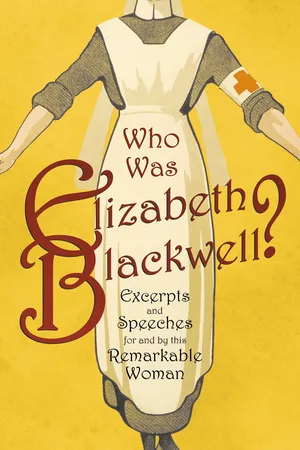
Who was Elizabeth Blackwell? - Excerpts and Speeches For and By this Remarkable Woman
- 118 pages
- English
- ePUB (mobile friendly)
- Available on iOS & Android
eBook - ePub
Who was Elizabeth Blackwell? - Excerpts and Speeches For and By this Remarkable Woman
About this book
Elizabeth Blackwell (1821–1910) was a British physician. She was first woman to study medicine at university in the United States, as well as the first to be put on the Medical Register of the General Medical Council. She was a key reformer in both the United States and the United Kingdom who pioneered the education of women in medicine. Blackwell also played an important role as an organiser of nurses during the American Civil War. Her most notable works include: "The Causes and Treatment of Typhus, or Shipfever" (1949), "The Laws of Life with Special Reference to the Physical Education of Girls" (1952), and "An Appeal in Behalf of the Medical Education of Women" (1856). "Who Was Elizabeth Blackwell?" contains a fantastic collection of essays by various authors dedicated to Blackwell, together with some of her most significant speeches on the topic of medicine and education. Contents include: "Elizabeth Blackwell, by Frances E. Willard and Mary A. Livermore", "Elizabeth Blackwell, by Charlotte Fell Smith", "Elizabeth Blackwell, by Alfreda B. Withington", "Obituary of Elizabeth Blackwell", "Medicine as a Profession for Women", "Address on the Medical Education of Women", "Wrong and Right Methods of Dealing with Social Evil", "The 'Let Alone' System", "The Female Regulation System", "The Repressive System, in Reference to Municipal Action", and "The Repressive System, in Reference to National Law". Brilliant Women - Read & Co. is proudly publishing this brand-new collection of classic essays and speeches for the enjoyment of readers now and in years to come.
Trusted by 375,005 students
Access to over 1.5 million titles for a fair monthly price.
Study more efficiently using our study tools.
Information
SPEECHES
AND ESSAYS
BY ELIZABETH BLACKWELL
MEDICINE AS A
PROFESSION FOR WOMEN[1]
1860
In inviting consideration to the subject of medicine as an occupation for women, it is not a simple theory that we wish to present, but the results of practical experience. For fourteen years we have been students of medicine; for eight years we have been engaged in the practice of our profession in New York; and during the last five years have, in addition, been actively occupied in the support of a medical charity. We may therefore venture to speak with some certainty on this subject; and we are supported by the earnest sympathy of large numbers of intelligent women, both in England and America, in presenting this subject for the first time to the public.
The idea of the education of women in medicine is not now an entirely new one; for some years it has been discussed by the public, institutions have been founded professing to accomplish it, and many women are already engaged in some form of medical occupation. Yet the true position of women in medicine, the real need which lies at the bottom of this movement, and the means necessary to secure its practical usefulness and success, are little known. We believe it is now time to bring this subject forward and place it in its true light, as a matter not affecting a few individuals only, but of serious importance to the community at large; and demanding such support as will allow of the establishment of an institution for the thorough education of women in medicine.
When the idea of the practice of medicine by women is suggested the grounds on which we usually find sympathy expressed for it are two. The first is, that there are certain departments of medicine in which the aid of women physicians would be especially valuable to women. The second argument is, that women are much in need of a wider field of occupation, and if they could successfully practice any branches of medicine it would be another opening added to the few they already possess. In some shape or other, these two points are almost universally regarded (where the matter has been considered at all) as the great reasons to be urged in its behalf.
Now, we believe that both these reasons are valid, and that experience will fully confirm them; but we believe also that there is a much deeper view of the question than this; and that the thorough education of a class of women in medicine will exert an important influence upon the life and interests of women in general, an influence of a much more extended nature than is expressed in the above views. The question of the real value to the community of what women may do in medicine is an eminently practical matter, for upon it is based the aid which they may ask for its accomplishment; and upon the position of women in medicine depends the kind and extent of education which should be given to fit them for it. A great deal of well-meant effort has been, and is still being expended upon the institutions which have been established for this purpose. Sometimes we have heard much discouragement expressed at the slight result that has followed from them; while, on the other hand, it is often said, "after all, it is a matter for women to settle for themselves, if they can be doctors, and want to, they will find the way to do it, there is no need of doing any thing in the matter." Now as I have said, we believe it to be by no means a matter concerning only the limited number of women who may be actually engaged in the pursuit itself; and it is also certain that to insure the success of the work it is not enough that women should wish to study, the coöperation and support of public sentiment is needed to enable them to do so. We hope, by showing the value of the work, to prove it to be the interest of the community to carry it out; and we desire to show the means by which this may be done.
Let me then say a few words on the influence which would be exerted on society by the opening of medicine as a profession to women. The interests and occupations of women, as they actually are at present, may be referred to four distinct forms of effort:—Domestic life; the education of youth; social intercourse, and benevolent effort of various kinds. All these avocations, by unanimous consent, are especially under the superintendence of women, and every woman, as she takes her place in society, assumes the responsibility of participation in some of them.
While these pursuits have always formed the central interest of the majority of women, their character, and the requirements which they make for their proper performance, have widened, with the advance of modern society, in a remarkable degree. Social intercourse—a very limited thing in a half civilized country, becomes in our centres of civilization a great power, establishing customs more binding than laws, imposing habits and stamping opinions, a tribunal from whose judgment there is hardly an appeal. All who are familiar with European life, and the life of our great cities, know what an organized and powerful force it ever tends to become.
In like manner, benevolent efforts have little influence in new countries, but in Europe, especially in England, the extent of such work, and the amount of it which is done by women would be incredible, did we not see here, in our midst, the commencement of a similar state of things.
Domestic life is not less affected by the growth of the age; the position and duties of the mother of a family call for very different qualifications, in the wide and complicated relations of the present, from what was needed a century ago.
Now it is evident that the performance of all these forms of work, extended and organized as they are, is in its practical nature a business requiring distinct knowledge and previous preparation, as much as actual trades and professions. This fact would be more commonly recognized were it not that there is so much moral and spiritual life interwoven into woman’s work by the relations upon which it is founded, and out of which it grows, as to make it more difficult to separate this business aspect of her work from her personal life, than is the case with the business life of men; consequently its practical character is too often considered entirely subordinate, or lost sight of. Every woman, however, who brings thought and conscience to the performance of everyday duties, soon realizes it in her own experience. The wider the view she takes of life, the higher her ideal of her domestic and social relations, the more keenly she will feel the need of knowledge with regard to this matter of fact basis upon which they rest. The first and most important point in which she will feel the want of this previous training will be in her ignorance of physiological and sanitary science, in their application to practical life; of the laws of health and physical and mental development; of the connection between moral and physical conditions, and the influences which our social and domestic life exert upon us. These and similar questions will meet her at every step, from the commencement of her maternal life, when the care of young children and of her own health bring to her a thousand subjects of perplexity, to the close of her career, when her children, assuming their positions as men and women, look to her as their natural counsellor.
It may be said, at first sight, that in these things it is not so much knowledge as common sense and earnestness that is wanted; that as health is the natural condition, it will be secured by simply using our judgment in not positively disregarding what our natural instincts teach us in regard to our lives. This would be true if civilization were a simple state directed by instinct; but every advance in social progress removes us more and more from the guidance of instinct, obliging us to depend upon reason for the assurance that our habits are really agreeable to the laws of health, and compelling us to guard against the sacrifice of our physical or moral nature while pursuing the ends of civilization.
From the fact, then, that our lives must be directed more by reason than instinct, arises at once the necessity for a science of health, and that comprehension of it which will lead to its daily application. Take in illustration the simplest physical need, that which is most completely instinctive in its character—the question of food. Animals make no mistake on this point, being governed infallibly by instinct, but what conflicting theories it has given rise to among men! It is very rare to find among women, the heads of families, any clear idea of what are the requisites for a healthy table; and what is true of this very simple material want is still more so with regard to higher questions of physical law, those more intimately connected with the intellect and affections, and the family and social relations growing out of them. Nothing is more striking in a wide observation of daily life than the utter insufficiency of simple common sense to secure wise action in these matters. Numbers of people, of very good common sense in other things, violate the fundamental laws of health without knowing it; and when they think upon the subject they are just as likely to follow some crude popular theory as to find out the truth.
That progress is needed in sanitary matters is widely admitted; sanitary conventions are held; the medical profession and the press are constantly calling attention to defects of public and private hygiene, pointing out the high rate of mortality amongst children, etc.; but it is far from being as generally recognized how essential to progress it is that women, who have the domestic life of the nation in their hands, should realize their responsibility, and possess the knowledge necessary to meet it.
In education, as in domestic life, the same necessity for hygienic knowledge exists. Statistics show that nine-tenths of our teachers are women, and it is obviously a matter of great importance that they should be familiar with the nature and needs of the great body of youth which is intrusted to their care. It is not possible that our systems of education should be really suited to childhood, training its faculties without cramping or unduly stimulating the nature, unless those by whom this work is done understand the principles of health and growth upon which school training should be based. Our school education ignores, in a thousand ways, the rules of healthy development; and the results, obtained with much labor and expense, are gained very generally at the cost of physical and mental health.
If, then, it be true that health has its science as well as disease; that there are conditions essential for securing it, and that every day life should be based upon its laws; if, moreover, women, by their social position, are important agents in this practical work, the question naturally arises, how is this knowledge to be widely diffused among them? At present there exists no method of supplying this ne...
Table of contents
- EXCERPTS
- SPEECHES AND ESSAYS
Frequently asked questions
Yes, you can cancel anytime from the Subscription tab in your account settings on the Perlego website. Your subscription will stay active until the end of your current billing period. Learn how to cancel your subscription
No, books cannot be downloaded as external files, such as PDFs, for use outside of Perlego. However, you can download books within the Perlego app for offline reading on mobile or tablet. Learn how to download books offline
Perlego offers two plans: Essential and Complete
- Essential is ideal for learners and professionals who enjoy exploring a wide range of subjects. Access the Essential Library with 800,000+ trusted titles and best-sellers across business, personal growth, and the humanities. Includes unlimited reading time and Standard Read Aloud voice.
- Complete: Perfect for advanced learners and researchers needing full, unrestricted access. Unlock 1.5M+ books across hundreds of subjects, including academic and specialized titles. The Complete Plan also includes advanced features like Premium Read Aloud and Research Assistant.
We are an online textbook subscription service, where you can get access to an entire online library for less than the price of a single book per month. With over 1.5 million books across 990+ topics, we’ve got you covered! Learn about our mission
Look out for the read-aloud symbol on your next book to see if you can listen to it. The read-aloud tool reads text aloud for you, highlighting the text as it is being read. You can pause it, speed it up and slow it down. Learn more about Read Aloud
Yes! You can use the Perlego app on both iOS and Android devices to read anytime, anywhere — even offline. Perfect for commutes or when you’re on the go.
Please note we cannot support devices running on iOS 13 and Android 7 or earlier. Learn more about using the app
Please note we cannot support devices running on iOS 13 and Android 7 or earlier. Learn more about using the app
Yes, you can access Who was Elizabeth Blackwell? - Excerpts and Speeches For and By this Remarkable Woman by Various in PDF and/or ePUB format, as well as other popular books in History & Social Science Biographies. We have over 1.5 million books available in our catalogue for you to explore.