eBook - ePub
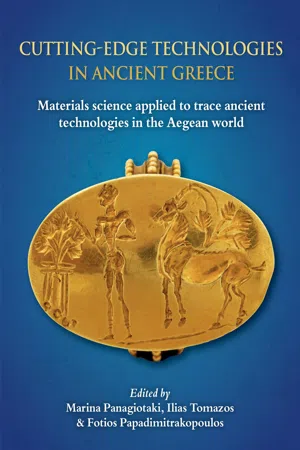
Cutting-edge Technologies in Ancient Greece
Materials Science applied to trace ancient technologies in the Aegean world
- 256 pages
- English
- ePUB (mobile friendly)
- Available on iOS & Android
eBook - ePub
Cutting-edge Technologies in Ancient Greece
Materials Science applied to trace ancient technologies in the Aegean world
About this book
This volume examines materials produced with the use of fire and mostly by use of the kiln (metals, plasters, glass and glaze, aromatics). The technologies based on fire have been considered high-tech technologies and they have contributed to the evolution of man throughout history. Papers highlight technical innovations of the technician/artist/pyrotechnologist that lived in the Aegean (mainland Greece and the islands) during the Bronze Age, the Classical and the Byzantine periods.
Trusted by 375,005 students
Access to over 1 million titles for a fair monthly price.
Study more efficiently using our study tools.
Information
Part One
1
Ancient ceramic kilns: recorders of the earth’s magnetic field and firing technologies in Greek archaeological sites
Despina Kondopoulou and Christina Rathossi
Introduction
The Earth is surrounded by a magnetic field, the origin of which lies at its liquid core and varies through time and space. These variations are recorded in baked clays due to their content in magnetic minerals, and have been used in archaeology for several decades as a dating tool. In order to achieve this scope, two parameters are of capital importance: the accuracy of the reference curves for the area, and the suitability of the available archaeological materials (fired structures, tiles, bricks, pottery).
This discipline named Archaeomagnetism developed considerably in Greece during the two last decades and in parallel with the basic target, that is dating of specific materials, while other experiments are conducted in order to ensure the material’s quality for such studies. The most prominent one is the calculation of firing temperatures which develop within a kiln or hearth and for this scope the appropriate method used is X-ray Powder Diffraction Analysis (XRPD) which also provides input on the prevailing atmosphere (Oxidizing/Reducing) and the duration of the firing.
Details about the Archaeomagnetic method and arising dating examples can be found in Kondopoulou and Aidona 2015, 199 and Kondopoulou et al. 2017a, 183.
Experimental data
Combined archaeomagnetic and XRPD studies were conducted on five Bronze Age kilns and five Hellenistic-Roman ceramic workshops distributed mostly in north Greece but also in Euboea and the Cyclades (Paros).
Archaeomagnetism-dating
The dating of the fired structures is based on the existence of Reference Curves, also called Secular Variation Curves (SVCs) which are constructed either at a country level or at a regional level. This second option is often favoured due to the better coverage in time. The parameters used for the dating are the angles of declination and inclination and the magnitude (intensity) of the Geomagnetic Field when we deal with structures in situ such as kilns, hearths, etc. When we study only pottery and ceramics in general, then we can calculate only the intensity of the field. Successful archaeomagnetic datings can be found in Kondopoulou et al. 2014; Aidona et al. 2018, among others.
Functioning and materials
The reliability of the archaeomagnetic results and especially of the intensity, which is the most complicated experiment, is directly dependent on the quality of the magnetic imprint on the clays, therefore it is strongly related to the firing temperature and conditions which prevailed in the kiln during its functioning. All this information derives from the XRPD experiments (Table 1.1). A relevant study on the matter was published by Kondopoulou et al. 2017b, focusing on prehistoric pottery. In the present contribution we will discuss a case study from historic kilns.
The obtained temperatures are fairly high for the Bronze Age kilns, varying between ≈550 and ≈800°C, with the exception of Eretria and Skala Sotiros where some very high temperatures are recorded. The ones for historical kilns are higher, as expected, reaching ≈1100°C at least and depend strongly on the position of the samples within the structure. A slight difference has been noticed between circular and rectangular kilns, with the former displaying higher firing temperatures. The soaking time is often shorter for the Bronze Αge which partly explains the difficulty in obtaining reliable archaeomagnetic data for this period.
Table 1.1. Petrological results obtained by XRPD analysis of kilns’ materials in different archaeological sites. n.d.: not detected.
| Archaeological sites | Magnetic minerals (He, Mgt) (wt %) | Estimated firing temperature (°C) |
| Archontiko (Bronze), N Greece | n.d.–1.98 | 600–800 |
| Apsalos (Bronze), N Greece | 1–3 | 550 -750 |
| Skala-Sotiros (Bronze), Thasos island, N Aegean | n.d.–1.81 | 600–1100 |
| Eretria (Bronze), Euboea island | 1–7.5 | 750–1050 |
| Mochlos (Bronze), Crete island, S Aegean | 1–10 | 600–750 |
| Samothraki island (Hellenistic), NE Aegean | 1–4 | 600–850 |
| Olympiada (Hellenistic), N Greece | n.d.–3 | 400–1050 |
| Katerini (Hellenistic), N Greece | n.d.–1.5 400–900 | |
| Polymylos (Hellenistic), NW Greece | n.d.–9 | 550–1000 |
| Paros island (Hellenistic-Roman), Cyclades-Aegean | 2–3.5 | 650–1100 |
A case study will be presented in the next paragraph from two ceramic workshops situated in north-western Achaia, dated in the Classic-Hellenistic periods where both XRPD and archaeomagnetic measurements have been conducted.
Archaeomagnetic and mineralogical analysis of two workshops in north-west Achaia
Ancient kilns in the city of Kato Achaia (Ancient Dyme)
During the works for the construction of new buildings in the city of Kato Achaia. Ancient Dyme (38.15 N, 21.55 E, 25 km from the city of Patras in Achaia prefecture, northwestern part of the Peloponnese) several circular kilns have been unearthed. One of them, KL1 is separated from the workshop which comprised kilns KL3 and KL5 by roughly 200 m. In this extensive ceramic workshop at least five kilns were located but not fully excavated. Only two of them were studied archaeomagnetically, KL3 and KL5 (Tema et al. 2015). In the present contribution we will focus on the studies conducted on kilns KL1 and KL5 (Fig. 1.1). These include dating by thermoluminescence, XRPD experiments, and magnetic measurements.
TL Dating
TL dating was conducted for three samples of kiln KL1 and four samples of kiln KL5. The final dating interval for each kiln was calculated as the mean value of the studied samples: this is 2607±53 (mean value error) ±88 (statistical error) for kiln KL1 (Polymeris, pers. comm. 2012) and 2027±25 (mean value error) ±98 (statistical error) for kiln KL5 (Tema et al. 2015). In absolute values, these dates correspond to 684–508 BC (Geometric/Archaic period) for KL1 and 112 BC–84 AD (Hellenistic/Roman period) for KL5.
Firing estimation and magnetic minerals
In order to estimate the firing temperature and to detect the presence of magnetic minerals in brick samples, the mineralogical composition of a set of nine brick samples was established using a Bruker D8 Advance Diffractometer with Ni-filtered Cu-Ka radiation, operating at 40 kV, 40 mA, and detected using a LynxEye® detector. The scanning area covered the 2θ interval 2–70°, with a scanning angle step of 0.015° and a time step of 0.3 s. Qualitative analysis of mineral phases was performed by the DIFFRACplus EVA® software (Bruker-AXS, USA) based on the ICDD Powder Diffraction File. The magnetic minerals were quantified using a Rietveld based quantification routine with the TOPAS® software (DIFFRACplus TOPAS Ver. 3.0 Tutorial, Bruker-AXS, USA).
The almost complete dehydroxylation of clay minerals (only a small reflection of white mica mineral is present in some samples) and the crystallisation of new high -T mineral phases such as diopside (fassaite) and gehlenite indicates firing temperatures T≥ 800°C (Fig. 1.2). The crystallisation of diopside and gehlenite is an indication that the raw materials used for the ceramic samples were a calcareous-rich clay (CaO>6 wt %). The presence of calcite is attributed either to secondary origin during the post-burial alterations or the recarbonation of portlandite (Ca(OH)2) generated by the hydration of unreacted lime (CaO).

Fig. 1.1. General view of the studied kilns. Note the location of the collected brick samples and their firing temperatures after XRPD analysis (see Fig. 1.2, Table 1.2).

Fig. 1.2. X-ray diffraction patterns of analysed samples. Abbreviations: Qtz=quartz; Plg=plagioclase; Kf=k-feldspar; Cc=calcite; Mi=white mica; Di=diopside; Gh=gehlenite; He=hematite.
Table 1.2 Rietveld-based quantification analysis, in wt %, of the iron oxides He=hematite Fe2O3; Estimated firing conditions (ox atm= oxidizing atmosphere); Macroscopic observation of ceramic body colour using the Munsell Soil Color Chart. In the second column, available archaeointensity results of sister samples from Tema et al. (2015, 503) are given for comparison.

Concerning the magnetic minerals, hematite was detected by XRPD analysis and in various amounts ranging from 1.50 to 3.37 wt %, as determined by the Rietveld quantitative analysis (Table 1.2). However, the SEM-EDS analysis also reveals the incorporation of Ti in the hematite structure, giving a titanohematite composition (solid solution hematite Fe2O3-ilmenite FeTiO3) for many analysed crystals in sample KL1_10 (Rathossi et al. 2018, 890–892). The presence of hematite is an index of an oxidising atmosphere prevailing in the kilns.
Magnetic measurements
Kiln KL1
In Figure 1.3a and b we present two basic magnetic experiments (i.e. hysteresis curves, variation of magnetic susceptibility with temperature) for sample KL1_1 and KL1_9. These experiments are classically used as preselection for good intensity results. Measurements of magnetisation in room temperature and increasing fields (Fig. 1.3a) reveal that there is a ferrimagnetic phase, such as magnetite or titanomagnetite, inside a paramagnetic host. The thermomagnetic curve (Fig. 1.3b) is characterised by a nearly perfect reversibility, suggesting the existence of stable magnetic minerals. However, as SEM-EDS analysis revealed also the existence of the ferric mineral titanohematite (solid solution hematite-ilmenite) in sample KL1_10, it might prohibit the successful intensity results, due to its very low Curie temperature ranging from about 70°C to 220°C.
Kiln KL5 (Tema et al. 2015)
In this study the authors do not use a preselection procedure but perform other experiments in order to define the magnetic mineralo...
Table of contents
- Cover
- Title
- Copyright
- Contents
- List of contributors
- Preface and acknowledgements
- Introduction: Lightning – fire – kiln – beacon
- Part One
- Part Two
Frequently asked questions
Yes, you can cancel anytime from the Subscription tab in your account settings on the Perlego website. Your subscription will stay active until the end of your current billing period. Learn how to cancel your subscription
No, books cannot be downloaded as external files, such as PDFs, for use outside of Perlego. However, you can download books within the Perlego app for offline reading on mobile or tablet. Learn how to download books offline
Perlego offers two plans: Essential and Complete
- Essential is ideal for learners and professionals who enjoy exploring a wide range of subjects. Access the Essential Library with 800,000+ trusted titles and best-sellers across business, personal growth, and the humanities. Includes unlimited reading time and Standard Read Aloud voice.
- Complete: Perfect for advanced learners and researchers needing full, unrestricted access. Unlock 1.4M+ books across hundreds of subjects, including academic and specialized titles. The Complete Plan also includes advanced features like Premium Read Aloud and Research Assistant.
We are an online textbook subscription service, where you can get access to an entire online library for less than the price of a single book per month. With over 1 million books across 990+ topics, we’ve got you covered! Learn about our mission
Look out for the read-aloud symbol on your next book to see if you can listen to it. The read-aloud tool reads text aloud for you, highlighting the text as it is being read. You can pause it, speed it up and slow it down. Learn more about Read Aloud
Yes! You can use the Perlego app on both iOS and Android devices to read anytime, anywhere — even offline. Perfect for commutes or when you’re on the go.
Please note we cannot support devices running on iOS 13 and Android 7 or earlier. Learn more about using the app
Please note we cannot support devices running on iOS 13 and Android 7 or earlier. Learn more about using the app
Yes, you can access Cutting-edge Technologies in Ancient Greece by Marina Panagiotaki, Ilias Tomazos, Fotios Papadimitrakopoulos, Marina Panagiotaki,Ilias Tomazos,Fotios Papadimitrakopoulos in PDF and/or ePUB format, as well as other popular books in Social Sciences & Byzantine History. We have over one million books available in our catalogue for you to explore.