- 128 pages
- English
- ePUB (mobile friendly)
- Available on iOS & Android
eBook - ePub
The Ghettos of Nazi-Occupied Poland
About this book
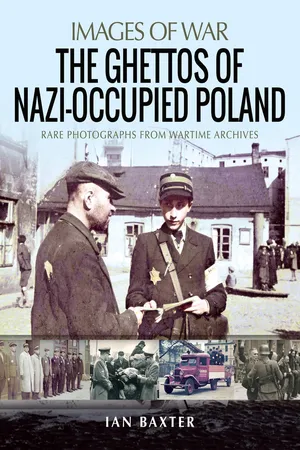
This pictorial history presents a vivid and harrowing exploration of Jewish ghettos during the Nazi occupation of Poland during WWII.
Following the 1940 invasion of Poland, the Nazis established ghettos in cities and towns across the country with the initial aim of isolating the Jewish community. These closed sectors were referred to as Judischer Wohnbezirk or Wohngebiet der Juden (Jewish Quarters). Drawing on a wealth of historical images, this volume shows the harsh and deteriorating conditions of daily life in these restricted areas.
In reality, these ghettos were holding areas where Jews were kept before being transferred to concentration, extermination, and work camps. Aware of their imminent fate, which included the threat of family separation, enslavement, and death, underground resistance groups sprung up staged numerous uprisings which were brutally and callously suppressed.
The Nazis' ultimate aim was the liquidation of the ghettos and the extermination of their inhabitants in furtherance of The Final Solution. This may seem unthinkable today but, as this book graphically reveals, they worked to achieve their objective regardless of human suffering.
Following the 1940 invasion of Poland, the Nazis established ghettos in cities and towns across the country with the initial aim of isolating the Jewish community. These closed sectors were referred to as Judischer Wohnbezirk or Wohngebiet der Juden (Jewish Quarters). Drawing on a wealth of historical images, this volume shows the harsh and deteriorating conditions of daily life in these restricted areas.
In reality, these ghettos were holding areas where Jews were kept before being transferred to concentration, extermination, and work camps. Aware of their imminent fate, which included the threat of family separation, enslavement, and death, underground resistance groups sprung up staged numerous uprisings which were brutally and callously suppressed.
The Nazis' ultimate aim was the liquidation of the ghettos and the extermination of their inhabitants in furtherance of The Final Solution. This may seem unthinkable today but, as this book graphically reveals, they worked to achieve their objective regardless of human suffering.
Tools to learn more effectively

Saving Books

Keyword Search

Annotating Text

Listen to it instead
Information
eBook ISBN
9781526761811Subtopic
Military & Maritime HistoryChapter One
Ghettoization
Designated areas of larger Polish cities were outlined in a massive programme of ghettoization. The programme was headed by Hans Frank who became Governor General of the occupied Polish territories with responsibility for the administration of the General Government. It was he who put into action the segregation of the Jews and their ‘ghettoization’.
Frank’s plan was to uproot all Polish Jews from their homes and businesses through compulsory expulsions. Entire Jewish communities were to be deported by train from their places of origin into special closed-off zones using Order Police Battalions. These battalions were subordinated to the SS and deployed specifically in army group rear areas and territories under German civilian administration. The police units were given strict orders to target the civilian population throughout the General Government and specifically to carry out the expulsion of Poles from the Reichsgau Wartheland under the new Lebensraum policies. They were told to be as brutal as necessary to expedite what they referred to as ‘Resettlement Actions’.
The Police Battalions, often supported by army units, moved into selected areas and removed the local population from their flats and houses, confiscating them. These areas were then marked off to become separated from the rest of society. Between late 1939 and 1940 there were also expulsions from German-occupied ‘Greater Poland’. Some 680,000 Poles were expelled from the city of Poznanό in Reichsgau Wartheland alone, of whom approximately 70,000 were moved into the General Government. These deportations were conducted under the leadership of SS-Obergruppenfu¨hrer Wilhelm Koppe.
The first deportations of the Jewish community into the newly-created ghetto system began in October 1939. All Jewish homes and businesses were vacated through forcible expulsions in a very short period of time. On the day of their removal notice, Jews received orders to present themselves at special assembly points so that they could be ‘evacuated further east’. Each person was issued with an evacuation number – a number which would give the authorities details of where they would be transported. So as not to create panic, the deportees were allowed to take 50kg of luggage. They also had to pay for their own railway tickets.
The first major transports began with the removal of some 70,000 to 80,000 Jews from Ostrava district in Moravia (now in eastern Czech Republic) and in Katowice district in the recently annexed portion of Poland. SS-Obersturmfu¨hrer Adolf Eichmann was tasked with managing the logistics of the mass deportation of Jews to the ghettos from these areas, and later to the extermination camps. His priority in 1939 was to remove Jews from the conquered territory of Greater Poland and transport them into the General Government economically and with minimal disruption to Germany’s ongoing military operations. By the end of 1941 some 3.5 million Polish Jews had been segregated and ghettoized by Eichmann in his massive deportation action involving the use of hundreds of freight trains.
In October 1941 the first transports of German Jews were sent by rail to either labour camps in Poland or the General Government to be ghettoized. The freight cars (Gu¨terwagen) were packed with 150 deportees, although 50 was the number initially proposed by deportation regulations. There was no food or water. An average transport took four days. Many died from hunger or exposure to the elements, and inadequate ventilation resulted in many deaths from suffocation. Often when the trains arrived at their destination and the doors were opened, everyone was dead.
Those that had survived the journey were removed from the trains under armed guard and either marched on foot or transported by vehicle to the ghetto. Even as they arrived inside the ghetto, many still believed this was only a stopover on the way to their new lives further east. They had no idea that they would soon see their ghettos destroyed, often barbarically, and that they would be forced into nearby forests or fields to be murdered, or be transported either to labour camps or death camps around Europe.

German soldiers beat Polish Jews in the vicinity of Łódź during the invasion of Poland. The persecution of the Jews of Poland began almost immediately after the German invasion. (USHMM: Mary Jane Farley)

Hans Biebow, German head of the Łódź ghetto administration, at his ...
Table of contents
- Cover
- Title
- Copyright
- Contents
- About the author
- Preface
- Chapter 1 Ghettoization
- Chapter 2 Life in the Ghettos
- Chapter 3 Liquidation of the Ghettos
- Chapter 4 The Warsaw Uprising
- Appendix
- Plate section
Frequently asked questions
Yes, you can cancel anytime from the Subscription tab in your account settings on the Perlego website. Your subscription will stay active until the end of your current billing period. Learn how to cancel your subscription
No, books cannot be downloaded as external files, such as PDFs, for use outside of Perlego. However, you can download books within the Perlego app for offline reading on mobile or tablet. Learn how to download books offline
Perlego offers two plans: Essential and Complete
- Essential is ideal for learners and professionals who enjoy exploring a wide range of subjects. Access the Essential Library with 800,000+ trusted titles and best-sellers across business, personal growth, and the humanities. Includes unlimited reading time and Standard Read Aloud voice.
- Complete: Perfect for advanced learners and researchers needing full, unrestricted access. Unlock 1.4M+ books across hundreds of subjects, including academic and specialized titles. The Complete Plan also includes advanced features like Premium Read Aloud and Research Assistant.
We are an online textbook subscription service, where you can get access to an entire online library for less than the price of a single book per month. With over 1 million books across 990+ topics, we’ve got you covered! Learn about our mission
Look out for the read-aloud symbol on your next book to see if you can listen to it. The read-aloud tool reads text aloud for you, highlighting the text as it is being read. You can pause it, speed it up and slow it down. Learn more about Read Aloud
Yes! You can use the Perlego app on both iOS and Android devices to read anytime, anywhere — even offline. Perfect for commutes or when you’re on the go.
Please note we cannot support devices running on iOS 13 and Android 7 or earlier. Learn more about using the app
Please note we cannot support devices running on iOS 13 and Android 7 or earlier. Learn more about using the app
Yes, you can access The Ghettos of Nazi-Occupied Poland by Ian Baxter in PDF and/or ePUB format. We have over one million books available in our catalogue for you to explore.