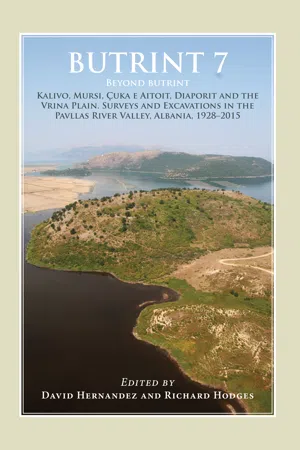
This volume brings together unpublished Italian and Albanian archaeological reports and new archaeological studies from recent fieldwork that throw new light on the archaeology and history of the Pavllas River Valley, the Mediterranean alluvial plain in the territory of Butrint, ancient Buthrotum, in southwestern Albania. It gives prominence for the first time to two important sites, Kalivo and Çuka e Aitoit, which are here reinterpreted and shown to have played major roles in the early history of Butrint as it evolved in the later first millennium BC to emerge as the key city of Chaonia in Epirus. Butrint 7 also presents the full excavation report of the Late Bronze Age and Hellenistic fortified site of Mursi, in addition to other Butrint Foundation surveys and excavations in the hinterland of Butrint, including the Roman villa maritima at Diaporit, the villa suburbana on the Vrina Plain, and Roman sites on Alinura Bay and at the Customs House, as well as new surveys of the early modern Triangular Fortress and a survey to locate the lost Venetian village of Zarópulo. The volume also features a new study of the Hellenistic bronze statuette of Pan found on Mount Mile and of his sanctuary at Butrint. The volume concludes with a comprehensive reassessment of the Pavllas River Valley in relation to Butrint, from the Palaeolithic to the modern eras, examining how dominion, territory, environment and the 'corrupting sea' reshaped Butrint and its fluvial corridor diachronically and particularly brought profound territorial, economic and social alterations under the Roman Empire.
eBook - ePub
Butrint 7
Beyond Butrint: Kalivo, Mursi, Çuka e Aitoit, Diaporit and the Vrina Plain. Surveys and Excavations in the Pavllas River Valley, Albania, 1928–2015
- 224 pages
- English
- ePUB (mobile friendly)
- Available on iOS & Android
eBook - ePub
Butrint 7
Beyond Butrint: Kalivo, Mursi, Çuka e Aitoit, Diaporit and the Vrina Plain. Surveys and Excavations in the Pavllas River Valley, Albania, 1928–2015
About this book
Trusted by 375,005 students
Access to over 1.5 million titles for a fair monthly price.
Study more efficiently using our study tools.
Information
Subtopic
Roman Ancient HistoryIndex
Social SciencesPART I
ITALIAN AND ALBANIAN
SURVEYS AND EXCAVATIONS
1 A Colonial Indifference to Butrint, 1923–1924. S. S. Clarke’s ‘Survey’ of the Hinterland of Buthrotum
Richard Hodges
Introduction1
On 4 May 1923, Stewart Studdert Clarke (1897–1924) (Fig. 1.1), a fellow of Exeter College, Oxford and student of archaeology at the British School at Athens, crossed the newly established Albanian–Greek frontier near Sagiada (in Greece) and began the first of four forays on foot into Albania, recording its then largely unknown archaeology.2 Further visits were made to other parts of the new state in July–August 1923 and in January 1924 when he returned briefly to Saranda.
Clarke’s untimely death in a boating accident off Salamis almost exactly a year later on 2 May 1924, however, meant that his Albanian research was never published. Instead, his diary-notes for a thesis on the Historical Geography and Topography of Epirus were eventually used by N. G. L. Hammond in his thesis and later monograph on Epirus, after he followed in Clarke’s footsteps some seven years later in 1930.3
Clarke made his first visit to southwest Albania in early May 1923, aided by a 1914 Austrian military map. His diary-notes are especially interesting because Clarke made the first survey of this region after Albania was granted nation status in August 1913. These notes, however, are as revealing for what Clarke did not record as for the sites that he found. Interpreted in this way, the diary-notes also throw a little tangential light on why Luigi Maria Ugolini, the Italian excavator of Butrint from 1928 onwards, chose to launch his Italian Archaeological Mission to Albania at nearby Phoinike in 1926–1927 after his first reconnaissance to Butrint in 1924.
Any archaeologist travelling to northern Epirus in the early 1920s was taking a risk. Southern Albania had experienced much political upheaval in the previous decade. After the Greek army invaded the region in the late winter of 1913, defeating the Ottoman administration, it was assumed that southern Albania would become part of Greek Epirus. However, after the Treaty of London was signed later that year, following lobbying by the Italians, the region was given to the new state of Albania.4 Initially this was resisted by the local population who, in 1914, sought independence as the Autonomous Republic of Northern Epirus.5 This new republic comprised a tract of largely mountainous countryside encompassing what is now southern Albania, from Saranda to Korça.6 After diplomatic intervention by the Greek government, the leaders of the autonomous republic ceded the region to Albania with certain conditions. As a result, Greek troops safeguarded the area until 1917 when a firm agreement was reached with the nascent state of Albania, following which Italian troops provided security for the Greek minority community. The Italians remained until after the Armistice in November 1918.7 The final southern border of Albania was ultimately fixed by the conference of Ambassadors of the Great Powers in a decision released on 9 November 1921, but possession of southern Albania continued to be disputed even after Albania was admitted to the League of Nations in 1921.
Table 1.1 is a timeline including the first visits to the region by American, British, Greek and Italian archaeologists.
S. S. Clarke’s Fieldwork in the Butrint Region
In early May 1923, S. S. Clarke spent four days in southwest Albania, entering the country by way of the customs post at Konispol. His attention was immediately galvanised by the prominent fortified Hellenistic citadel of Çuka e Aitoit, which he visited on 4 May, the day he arrived in Albania.8 Every walk was recorded in great detail, with timed entries being made often at quarter-hour intervals following the fashion of the British School at that time (Fig.1.2).9 Reading the diary-notes today, of course, the apparent aimlessness of his forays is striking. So little was then known about the archaeology of this remote corner of southwestern Albania that every hill and potentially every village held a fascination for Clarke. But the most apparent feature in Clarke’s unpublished narrative is his abortive attempt to reach the place that today would be the very first point of reference of any archaeological foray to this region: Butrint.

Figure 1.1. Sketch portrait of S. S. Clarke, c. 1923 (Courtesy of the British School at Athens)
The archaeological remains of Roman and Medieval Butrint had been amply described a century earlier by Colonel W. M. Leake after his visit in 1805, and by F. Pouqueville in the same year.10 Both Leake and
Table 1.1. Timeline of early explorations at Butrint
Timeline | Events |
August 1913 | Treaty of London: Butrint and the area around it were assigned to Albania as opposed to Greece. |
February–May 1914 | Autonomous Republic of Northern Epirus: Butrint and its region were part of this shortlived republic. Greek archaeologist Demetrios Evangelidis made small archaeological investigations of sites in the Saranda region. |
17 August 1921 | Bert Hodge Hill, Director of the American School of Classical Studies at Athens, visited Phoinike to consider an excavation. 4–8 May 1923 S. S. Clarke visited the Butrint region. |
27 August 1923 | General Enrico Tellini and his team surveying the disputed frontier between Albania and Greece were murdered, leading to the Corfu incident when Italian Prime Minister Benito Mussolini sought reparations from Greece by bombing and then occupying Corfu on 31 August. |
Spring 1924 | Luigi Maria Ugolini visited Butrint. |
10 August 1926 | Ugolini began two seasons of excavations at Phoinike. |
January 1928 | Ugolini inaugurated his excavations at Butrint. |
Spring 1930 | N. G. L. Hammond visited Ugolini at Butrint. |
Pouqueville had associated Butrint with Vergil’s epic, the Aeneid, an observation that certainly resonated with subsequent visitors to the region such as the artist Edward Lear, who made sketches here in 1857, and the Reverend E. Tozer, who briefly passed this way in 1864.11 Clarke’s diaries contain a synopsis of Leake’s description of Butrint as well as references to these earlier accounts. These notes make his decision not to visit Butrint on 6 May all the more interesting.
His diary-notes account for that day read as follows:12
May 6th–Sunday
Murzi – detained by service – saw the Vlachs at church. Kastro – between Komat and Kesarat on a βουνάκι (little mountain [he does not use the word for hill ( λόφος)]), called Machalás, apparently the one shown between those two villages, said to be 3 ½ hours from Tchifliki, with ancient walls like those here only towers λίγο χαλασμένο (a bit destroyed [he uses plural for towers, but singular for the adjective]) (reserved for next journey).
Tchifliki – depart 9.05. Cross Pavla wooden bridge 9.20. Travel across plain by winding path through corn to 9.55 – foot of Murzi. Cross little bridge and ascend to bazaar 10.05 (English speaking Theodoros Kolontzes).
Murzi – depart 11.30, follow right bank of Pavla which cross by tree, 12.00 turn sharp back [illegible word] belt of bush, two [illegible word] ft and in scrub meet several groups of ancient stones, one thus: Dimensions of top block is 0.90 × 0.60 × 0.48, bottom ones 80 × 40 × ?30 and 69 × 45 × ?35. These in scrub at mouth of prominent gorge, two m. on return to bearing on Murzi (top of village) 90° MB. Get back 1.20, crossing by another route up W bank of Pavla and cross by first bridge, all in 32 minutes. Murzi depart 2.30, walk by path between central foothills and E side of plain through to 3.15 Çura (pronounced Zarà). At Zarà papers (and others confirm) say that in 1885 was destroyed a statue of Demeter in flowing robes, sitting on a throne of white marble of beautiful Greek workmanship, also that another ἀγάλμα (instead of ἄγαλμα-statue) was removed by an Englishman 10 or 15 years ago, 4 ft long, chap called ὁ Kόκκινος Λόρδος (the Red Lord – lord is a title). Inscription reported at Dhiministras (10 mins East direction from Buthrotos and the potami (the river) is between them) of which I heard at Murzi are unknown here. At Dhiministras is ἡ πέτρα τοῦ ʼBράϊμ (Braim’s stone [he actually writes the stone of Vráim, but he is probably transcribing Braím, that is Ibrahim, hence the apostrophe at the beginning of the name]).
Building referred to two pages back: mass of masonry 3 m high, top part is practically detached, almost cubic 1 m core of stones and mortar. [Sketch]
Height of interior c. 1.20 m – is lined like a cistern.
Leave the pillbox 5.05 and going SW reach house at Vivari 5.15 – no barca. At place named Buthroton on Austrian map – acropolis inaccessible (no ferry) as photograph from Turkish (?Or Venetian) castle on near SW side. Just opposite in foreground is a ruined tower? of Turkish epoch.
Barka came, but first wanted 300 dr (or 30 lirettas) for fare to Karalibej (see Fig. 20.1) and then said it was too late. Returned to Çurà (1 hour) – on leaving Vivari, on R front is wooded hill topped by chapel called Shindoli, on left front towards Çurà is another church of Hag. Demetrios. On way down good view of Lakes Riza and Vivari in between this line of hills called first Kalivo and then Dhiapori, and on right front ‘toward’ (E of) Armiro mount Koκκali, and above Çurà mount Milá. Skala Sorenpás is hill on road Amiro-Karalibej.
Of 700 population in Murzi only 200 can read (Kolontzes).
Clarke’s description indicates that he sought out and eventually found a boat on the opposite side of the Vivari Channel from Butrint (which he describes as ‘the acropolis’), probably at the (Ottoman, later Venetian) Triangular Fortress. However, his diary indicates he was aiming to cross to the northeastern corner of Lake Butrint rather than to visit Butrint itself, an...
Table of contents
- Cover
- Butrint Archaeological Monograph Series:
- Title
- Copyright
- Dedication
- Contents
- Abbreviations
- Introduction and Acknowledgments – David Hernandez and Richard Hodges
- Part I. Italian and Albanian Surveys and Excavations
- Part II. Butrint Foundation Surveys and Excavations
- Conclusion
- Appendix: Dhimosten Budina (1930–2004) – ‘Architect’ of the Butrint Archaeological Park Oliver J. Gilkes and Richard Hodges
- Bibolography
- Plate section
Frequently asked questions
Yes, you can cancel anytime from the Subscription tab in your account settings on the Perlego website. Your subscription will stay active until the end of your current billing period. Learn how to cancel your subscription
No, books cannot be downloaded as external files, such as PDFs, for use outside of Perlego. However, you can download books within the Perlego app for offline reading on mobile or tablet. Learn how to download books offline
Perlego offers two plans: Essential and Complete
- Essential is ideal for learners and professionals who enjoy exploring a wide range of subjects. Access the Essential Library with 800,000+ trusted titles and best-sellers across business, personal growth, and the humanities. Includes unlimited reading time and Standard Read Aloud voice.
- Complete: Perfect for advanced learners and researchers needing full, unrestricted access. Unlock 1.5M+ books across hundreds of subjects, including academic and specialized titles. The Complete Plan also includes advanced features like Premium Read Aloud and Research Assistant.
We are an online textbook subscription service, where you can get access to an entire online library for less than the price of a single book per month. With over 1.5 million books across 990+ topics, we’ve got you covered! Learn about our mission
Look out for the read-aloud symbol on your next book to see if you can listen to it. The read-aloud tool reads text aloud for you, highlighting the text as it is being read. You can pause it, speed it up and slow it down. Learn more about Read Aloud
Yes! You can use the Perlego app on both iOS and Android devices to read anytime, anywhere — even offline. Perfect for commutes or when you’re on the go.
Please note we cannot support devices running on iOS 13 and Android 7 or earlier. Learn more about using the app
Please note we cannot support devices running on iOS 13 and Android 7 or earlier. Learn more about using the app
Yes, you can access Butrint 7 by David Hernandez, Richard Hodges, David Hernandez,Richard Hodges in PDF and/or ePUB format, as well as other popular books in Social Sciences & Roman Ancient History. We have over 1.5 million books available in our catalogue for you to explore.