- 260 pages
- English
- ePUB (mobile friendly)
- Available on iOS & Android
eBook - ePub
About this book
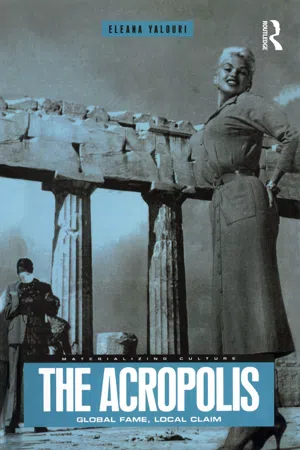
The Acropolis in Athens has captured the imaginations of readers, writers and travellers for centuries and every year draws crowds from all over the world. One of the world's most famous heritage sites, it has long been a national monument of Greece and a potent symbol of western civilization. But the Acropolis is typically viewed in the context of 5th-century-BC Athenian society, while the multiple local and international meanings and identities that the site shapes today are overlooked. This book looks at the meaning of the Acropolis in contemporary Greece. How are global ideas adopted and adapted by local cultures? How do Greeks deal with the national and international features of their ancient classical heritage? How do the global cultural constructions surrounding the Acropolis become part of local practices which project Greek cultural difference?The author examines this historic site as a powerful agent for negotiations of power on an international level. Drawing from a wide range of sources as well as original fieldwork, this handsomely illustrated book will make compelling reading for anyone interested in heritage issues, archaeology, anthropology material culture studies, and tourism.
Tools to learn more effectively

Saving Books

Keyword Search

Annotating Text

Listen to it instead
Information
Introduction
Local Present, Global Past
A couple of years ago I took an English friend visiting Athens to a taverna in Plaka, the old town of Athens which lies on the north foot of the Acropolis hill. During lunch I sensed that something was not quite right, as he remained silent during most of the three-course meal. When asked, he replied: ‘How can you eat while you’re looking at the Acropolis?’ I did not understand his question immediately, so he continued: ‘I mean how can you do something so trivial when you have that so close and so visible?’
I knew that my friend had a classical education, but as we had both attended many courses at University about the fusion of the past and the present, I did not expect him to feel so strongly about us having lunch near the archaeological site. For him, however, the presence of the fifth-century Acropolis was so powerful that it determined the socio-temporal landscape of the wider area and made any modern or everyday interference a ‘matter out of place’.
It was not until much later that it occurred to me that my friend’s reaction was typical of a more general habit to view the Acropolis in the context of its fifth-century past, detached from its present life. In fact, although the Acropolis often appears in literature, history and archaeological research as a product of high artistic quality and of great social and religious importance within the Athenian society of the fifth century BC, its position in modern Greek society and its role in more recent periods has been very little researched.
The acquaintance of the Western world with classical antiquity developed gradually, first through literary ancient sources, such as Pausanias and Pliny, Roman copies of Greek classical art, some late Hellenistic sculpture, and subsequently through the descriptions of travellers to Greece and designs, such as those made by the British painters James Stuart and Nicholas Revett or the French architect Julien David Le Roy. Goethe sought the land of the Greeks with his soul (‘das Land der Griechen mit der Seele suchen’). Although he had never seen Greece, he was so much identified with the classical Greek spirit that another representative of the Sturm und Drang movement, Schiller, wrote to him in 1794 (Staiger 1996: 34):
Since you were born a German, since your Greek spirit was thrown into this Nordic creation, you had no other choice than either becoming yourself a Nordic artist, or substituting for your imagination - with the help of the power of thought - what reality did not offer to it and in this way, as it were, giving birth to a Greece from the inside and in a rational way.
Although Romantic writers questioned the validity of classicist interpretations of ancient Greece, they nevertheless kept Greece as an important source of inspiration, albeit viewed from a different perspective than that of Classicism. It is typical that at the end of the eighteenth century, when Goethe and Schiller were publishing a periodical under the title Die Propylaen, the Romantic Schlegel brothers were publishing a periodical under the classicizing title Athenäum (Κονταράτος 1994: 42). Shelley, the prominent English Romantic poet, who also had never visited Greece, still felt he loved it so much as to claim, in 1821, that ‘We are all Greeks. Our laws, our literature, our religion, our arts have their root in Greece’ (Shelley 1934: 447).
Greek classical studies have spread beyond Europe, and have become ‘the beloved heritage of many people around the world’ (Lowenthal 1988).1 The diffusion of classical culture has made the monuments of classical antiquity the patrimony of a world expanding out of its homeland’s borders. Greek antiquities have been systematically and widely used in the name of international values. They do not only feature in museums internationally, but are even copied and have become emblems of cities far away from Greece (Figures 1.1–1.4).2 Even today, people all over the world, from the author Salman Rushdie3 to the former president of the United States, Bill Clinton, keep stating that they have a share in Greek heritage or even that they are Greeks (Figure 1.5).

Figure 1.1 The National Monument of Scotland on Calton Hill, Edinburgh (1822–1829) (Photo by Panayotis Dendrinos).

Figure 1.2 The Parthenon in Nashville, Tennessee, built on the occasion of the international exhibition for the centenary celebrations of the foundation of Tennessee (c. 1930) (Photo by David J. Coffta).

Figure 1.3 The Walhalla in Regensburg, Germany, built to symbolize the pan-Germanic unity in the period when Napoleon was dominating (1842) (Photo by Georg Benke).

Figure 1.4 Copies of the Erechtheion’s Caryatids in the Church of St. Pancras, London (1819–1822) (Photo by E. Yalouri).

Figure 1.5 The newspaper Καθημερινή (21/11/99) reports on Clinton’s visit to Athens and quotes his words ‘we are all Greeks’.
’Heritage’ has become an asset of growing value. On the one hand global agencies such as Unesco declare and sponsor ‘world heritage sites’ promoting them as belonging to all mankind ‘irrespective of the territory on which they are located’ (http://www.unesco.org/whc/2giff.htm#debut update 1/6/2000), while on the other more and more contestations over ownership of national heritage emerge. Discussions involving the politics of heritage are a case in point. Sites or monuments often become enmeshed in conflicts over contested identities and revivals of ethnicity. Issues of ownership and repatriation have increasingly become central in the nations’ negotiations of their identities and their claims internationally. Decolonization and multi-culturalism have increased efforts of former colonies to enhance perceptions of their identities. Peoples all around the globe manifest their will to control their heritage and the ways in which others represent them. Statements about ‘global patrimony’ ideals are often met with scepticism today, as they are often associated with an era of conquest when ‘heritage belonging to the world’ meant ‘heritage belonging to the West’. For the eighteenth-century West, the colonized peoples of the rest of the world were considered as condemned to permanent inferiority and ‘heritage blindness’ (Lowenthal 1998: 243), requiring guidance and help in safeguarding their legacies.
Classical Greek heritage has been ‘contested’ by ‘the world’ since well before the establishment of the Greek state in 1830. Once the Greek state was born, the modern Greeks inherited - together with Greek lands - also the title to the ancient Greek heritage. Thus the Athenian Acropolis, ‘the corner stone of the Classical Greek era’, in becoming a ‘world monument’, also became the national monument of Greece par excellence. The question is how these two local/national and global meanings of the same monument can co-exist and interrelate and how Greeks cope with this double-faceted aspect of their heritage, especially in an era which on the one hand promotes the idea of a global community and on the other encourages national difference.
In the preface of this work I referred to foreigners’ ‘black-and-white’ perception of Athens and Greek culture in general which is also embraced and reproduced by Greeks themselves. This perception has also informed and, equally, has been informed by discussions about Greek identity.
The travel writer Patrick Leigh Fermor (1966) viewed Greek identity as consisting of a dilemma between two archetypes, the one of ‘Hellene’ and the other of ‘Romios’ (Ελληνας, Ρωμιός). From an anthropological perspective, Herzfeld (1982a; 1987) developed this idea further and discussed the dialectic of Greek identity as consisting of two extreme poles: at one end stands Ήellenism (Ελληνισμός), which he calls the ‘outside’ view of Greek culture. This is linked to the idealization of ancient Greeks by Western Europeans, and it constitutes an imported view, adopted by the Greeks during the establishment of the Greek state in 1830. At the other end stands ‘Romiossini’ (Ρωμιοσύνη), which he calls the ‘inside’ view of Greek culture (1987:114). This is associated with the history of Greeks as part of the Byzantine and the Ottoman Empires, and is the view modern Greeks feel more at home with. Thus, according to Herzfeld, every Greek is ‘torn between two opposing stereotypes’: the one of ΉβΙΙεηεβ’ (idealized Hellenes of the Classical past) and the other of Ttomii’ (Christians of the Byzantine and Ottoman periods) (1987: 41). Herzfeld links these two facets of Greek identity with the paradox of Greece being considered the ancestor of Europe yet presently, as he says, on its margins or its ‘periphery’.
The positioning of Greece between ‘Europe’ or, more generally, ‘the West’ and ‘the Orient’ is one that has pervaded discussions - within Greece and outside - of Greek identity since the establishment of the Greek state. Throughout modern Greek history there are times when ‘the West’ has been associated with ideas of progress and modernization, virtues sought by Greece in its efforts to join the pace of the modern world. Especially during the early days of the new state it was believed that - through Europeanization - Greece could reach out to its past and heritage. At other times, however, ‘the West’ has acquired negative connotations, as it has been perceived as a foreign presence hostile towards Greece. In these cases ‘the West’ is often juxtaposed to ‘the Orient’, which is considered to be the place where the roots of the Greek folk resides, the place which gave birth to the Orthodox Byzantine Empire. On the other hand, ‘the Orient’ has also been linked with backwardness and the Dark Ages of Turkish occupation (cf. Herzfeld 1987). Thus ‘the West’ and ‘the East’ have become loaded with various meanings, according to historical, political, or cultural circumstances, and although they are not static concepts, they do retain some basic associations. ‘The West’, as the historian Έλλη Σκοπετέα (1992: 12) has suggested, has often been seen as a synonym of ‘the modern world’ with all its connotations and interpretations. On the other hand, ‘the Orient’ has been used by Greeks to refer to what Greeks call ‘Our Orient’ (καθ’ημας Ανατολή), ‘the borders of the West with the East from the East’s side’ (ibid.: 13) or, according to the linguist Μπαμπινιττης (1998), Asia Minor and areas of Hellenism in the Orient, and in general the Orthodox Orient.
As the literary theorist Δημήτρης Τζιόβας (1989: 51–52) notes, until 1922 (when what Greeks call the ‘Asia Minor catastrophe’ took place) Greek cultural identity was introspective and the main issues for the Greek nation were those of unity and continuity. From 1923 onwards, Greek cultural identity became extrovert, and the main issue was the differentiation of the Greek from other nations and the projection of its cultural specificity (‘Greekness’ - Ελληνικότητα). The ‘generation of the 1930s’, an arts and literature movement, tried to transcend polarities within Greek identity such as Romios and Hellene, traditionalism and modernization, etc., which were the outcomes of such introspective speculation. Representatives of the ‘1930s generation’, such as the literary figures of Seferis and Theotokas, juxtaposed Greek Hellenism (Ελληνικός Ελληνισμός) to European Hellenism (Ευρωπαϊκός Ελληνισμός).
The ‘1930s generation’ used this juxtaposition to describe the interaction of Greek identity with Western Europe. Sixty years later, the social anthropologist Roger Just (1995) adopted the notions of’local’ and ‘global’ Hellenisms to discuss how Greeks internalize global cultural constructs portraying Greece as the birthplace of history and the cradle of civilization. Just explained how ‘Western civilization’ imported Hellenism back to the place where it was first born and he illustrated ways in which it was reappropriated on a local level. I would like to explore this local-global relationship further, not just in terms of how the local translates global knowledge and constructions, but in terms of the extensive politics between the two. Moreover, I will try to elaborate on the nature of this local reappropriation in relation to classical Greek heritage. The geographer David Lowenthal (1988) was the first to introduce the problematization of Greek classical heritage as both Greek national and global heritage. He described the preoccupation of the West with the ancient Greek world and how the latter was adopted as Western/global heritage. He also showed how the Greeks, after the establishment of the Greek state, re-evaluated and readopted Greek antiquity as their national heritage.
In this account of research on Greek identity I should also mention the work of the literary theorist Artemis Leontis. In her Topographies of Hellenism (1995) she traced the logos (discourse) of the Greek topos (place), the ways in which the notion of the Greek homeland is constructed through literature. Studying Western travellers’ accounts of Greece as well as texts of Greek literature, she illustrates the ways in which notions of Hellenism are produced by Greek and Western European discourses, and she makes a distinction between ‘Hellenism’ (the concept of Hellenism produced in the West) and ‘Neohellenism’ (the concept of Hellenism produced in Greece since the establishment of the Greek state).
It becomes evident that the notion of Hellenism has many facets, which led to the distinction of categories such as ‘Neohellenism’, ‘Greek and European’ or ‘local’ and ‘global’ Hellenism. I must note, however, that the notion of Hellenism is used in Greece to refer to Greek identity as a whole. Greeks normally use it as shorthand to refer to more than the ancient classical past. For example the Greek word for Greece is ‘Hellas’ (Ελλάς) and Greeks are called ‘Hellenes’ (Ελληνες). Thus, ‘Hellenes’ are not simply the mythical giants of the pre-independence period (Κακριδής 1989) or the pagan Greek ancestors. Hellenism does not denote geographical space or chronological divisions. It declares a unity with common origins, language, religion, habits, and customs in both past and present. It is a concept that refers to the Greek presence as evidenced in terms of ideas, people, cultural values or material objects in both time and space.
Viewing Greek identity through oppositions or partitions such as ‘Romios/Hellene’, the ‘West/the East’, or ‘Centre/Periphery’ puts an emphasis on boundaries and encourages viewing the world as a ‘mosaic’, a collection of cultures and places, each one having a uniform character occupying a distinct space in the world map (cf. Crang 1999). Such an approach can be a useful tool towards understanding what is in reality a far more complex character of cultures. Perceptions of the West, the East, for example, are not the same everywhere. What is more, a culture may entail features of both the East and the West. By adopting the terms ‘local’ and ‘global’ in my work I want to emphasize the dynamic and dialectic character of the ‘local-global’ nexus. By using these terms, one can understand the proc...
Table of contents
- Cover
- Half Title
- Series Page
- Title Page
- Copyright Page
- Dedication Page
- Contents
- Acknowledgements
- List of Figures
- Abbreviations
- Preface
- 1 Introduction
- 2 The Acropolis Past and Present
- 3 Greece Condensed: Materializing National Identity
- 4 Contesting Greek Identity: Between Local and Global
- 5 Consuming Inalienable Wealth
- 6 The Aesthetics of Sacredness
- 7 Conclusions
- Notes
- Bibliography
- Index
Frequently asked questions
Yes, you can cancel anytime from the Subscription tab in your account settings on the Perlego website. Your subscription will stay active until the end of your current billing period. Learn how to cancel your subscription
No, books cannot be downloaded as external files, such as PDFs, for use outside of Perlego. However, you can download books within the Perlego app for offline reading on mobile or tablet. Learn how to download books offline
Perlego offers two plans: Essential and Complete
- Essential is ideal for learners and professionals who enjoy exploring a wide range of subjects. Access the Essential Library with 800,000+ trusted titles and best-sellers across business, personal growth, and the humanities. Includes unlimited reading time and Standard Read Aloud voice.
- Complete: Perfect for advanced learners and researchers needing full, unrestricted access. Unlock 1.4M+ books across hundreds of subjects, including academic and specialized titles. The Complete Plan also includes advanced features like Premium Read Aloud and Research Assistant.
We are an online textbook subscription service, where you can get access to an entire online library for less than the price of a single book per month. With over 1 million books across 990+ topics, we’ve got you covered! Learn about our mission
Look out for the read-aloud symbol on your next book to see if you can listen to it. The read-aloud tool reads text aloud for you, highlighting the text as it is being read. You can pause it, speed it up and slow it down. Learn more about Read Aloud
Yes! You can use the Perlego app on both iOS and Android devices to read anytime, anywhere — even offline. Perfect for commutes or when you’re on the go.
Please note we cannot support devices running on iOS 13 and Android 7 or earlier. Learn more about using the app
Please note we cannot support devices running on iOS 13 and Android 7 or earlier. Learn more about using the app
Yes, you can access The Acropolis by Eleana Yalouri in PDF and/or ePUB format, as well as other popular books in History & World History. We have over one million books available in our catalogue for you to explore.