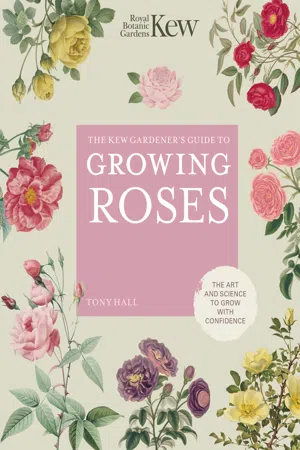
This inspirational book from Kew Gardens' rose expert is the perfect guide to choosing and growing these majestic and versatile flowers.
Instantly recognisable, fragrant and evocative, roses are the quintessential garden flowers. From low-growing ground-cover roses to long-stemmed Hybrid Tea roses, multi-petalled English roses, wild roses, small shrubs for containers, climbers and ramblers, in a range of forms, colours and scents, there is a rose for every garden situation.
Combining botanical illustrations and practical advice, The Kew Gardener’s Guide to Growing Roses is the definitive introduction to growing seventy-eight beautiful roses, with full growing instructions and details on feeding, propagation and training.
Twelve garden projects, from growing from seed to preserving rose petals, will bring the wonderful world of roses to life.
This book is from the Kew Experts series, in which the top gardeners and botanical scientists from Royal Botanic Kew Gardens offer up advice and information as well as suggesting handy projects on a range of gardening topics. Other titles include: Companion to Medicinal Plants, Guide to Growing Bulbs, Guide to Growing Fruit, Guide to Growing Orchids, Guide to Growing Herbs, Guide to Growing Succulents and Cacti, Guide to Growing Trees, Guide to Growing Vegetables and Guide to Growing House Plants.
eBook - ePub
The Kew Gardener's Guide to Growing Roses
The Art and Science to Grow with Confidence
- 160 pages
- English
- ePUB (mobile friendly)
- Available on iOS & Android
eBook - ePub
About this book
Information
PROJECT 1
Using roses in a mixed border or bed
Roses can look good in a dedicated rose garden, but they also fit very well in mixed plantings. You can design a beautiful garden border or bed with year-round interest by choosing plants that flower over a long period and that complement, contrast and harmonize with each other. Roses fit well into this type of planting scheme, with their variety of colours and repeat-flowering. The basics are plan, prepare and plant – and do not be afraid to experiment.
A good mixed border will include perennials, annuals and bulbs, as well as shrubs and roses. The larger plants and taller shrub roses should go at the back, graduating down to the smaller ones at the front.
Preparation is key. Once planted, your border or bed should be able to mature with minimal changes, but that’s not to say a design cannot be tweaked over time. Check the mature size of each plant you wish to grow so you can allow space for it to develop within the plan. When designing the planting scheme, think of its rhythm and flow. The best borders and beds are those that have some repeat plantings rather than lots of different plants that don’t tie together harmoniously.
Colours are a personal preference: you could, for example, opt for a range of pastel pinks and mauves, conjuring a cottage-garden feel; or choose more tropical hot colours. Aim to have a mixture that will give year-round interest.
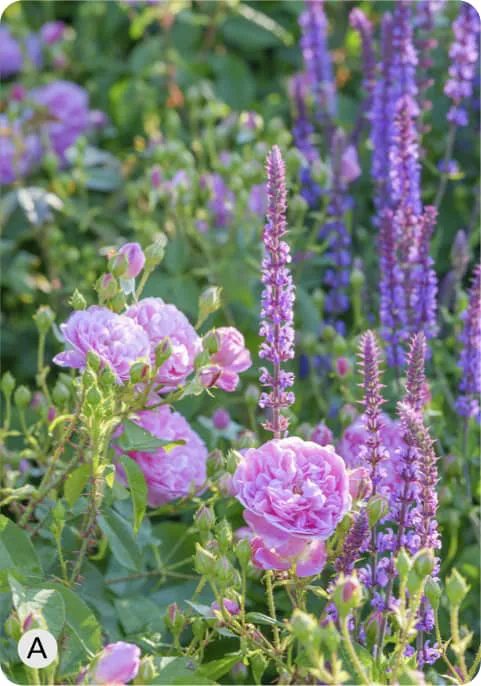
Oranges and yellows go well with blues and greens. Pastel shades could include Rosa The Poet’s Wife or Lady of Shalott combined with purple and mauve perennials, sage (Salvia), catmint (Nepeta) or verbena.
The greens of euphorbias or low-growing lady’s mantle (Alchemilla mollis) look good with roses, too. Spring-flowering shrubs like forsythia or viburnum provide early interest. Early bulbs like snowdrops (Galanthus) and daffodils (Narcissus) such as N. ‘February Gold’ or N. papyraceus can be followed by tulips (Tulipa) and ornamental onions (Allium) in late spring and summer. Pink roses like Olivia Rose Austin or Bonica will also go well with these colours, as well as with darker violet ones.

Opposite colours on the colour wheel are complementary, while those next to each other are deemed harmonious, and you can mix them up for a dynamic clash of colours.
- A Rosa Harlow Carr and Salvia nemorosa ‘Amethyst’ bring a feeling of calm with their pastel petals.
- B The different shades and shapes of foliage on the delphinium and artemisia beautifully set ...
Table of contents
- Cover
- Title
- Contents
- Introduction to Growing Roses
- Plants
- Project 1: Using Roses in a Mixed Border or Bed
- Project 2: Using Rose Hips
- Project 3: Roses for a Shady Spot
- Project 4: Propagating Roses in Water
- Project 5: Roses for an Exposed Site
- Project 6: Caring for Miniature Roses
- Project 7: Training as a Standard Form
- Project 8: Training a Rose Against a Wall
- Project 9: Growing Roses from Seed
- Project 10: Preserving Rose Petals
- Project 11: Growing Roses in a Container
- Project 12: Planting a Rose Hedge
- Troubleshooting
- What to do when
- Index
- Acknowledgments
- Copyright
Trusted by 375,005 students
Access to over 1.5 million titles for a fair monthly price.
Study more efficiently using our study tools.
Frequently asked questions
Yes, you can cancel anytime from the Subscription tab in your account settings on the Perlego website. Your subscription will stay active until the end of your current billing period. Learn how to cancel your subscription
No, books cannot be downloaded as external files, such as PDFs, for use outside of Perlego. However, you can download books within the Perlego app for offline reading on mobile or tablet. Learn how to download books offline
Perlego offers two plans: Essential and Complete
- Essential is ideal for learners and professionals who enjoy exploring a wide range of subjects. Access the Essential Library with 800,000+ trusted titles and best-sellers across business, personal growth, and the humanities. Includes unlimited reading time and Standard Read Aloud voice.
- Complete: Perfect for advanced learners and researchers needing full, unrestricted access. Unlock 1.5M+ books across hundreds of subjects, including academic and specialized titles. The Complete Plan also includes advanced features like Premium Read Aloud and Research Assistant.
We are an online textbook subscription service, where you can get access to an entire online library for less than the price of a single book per month. With over 1.5 million books across 990+ topics, we’ve got you covered! Learn about our mission
Look out for the read-aloud symbol on your next book to see if you can listen to it. The read-aloud tool reads text aloud for you, highlighting the text as it is being read. You can pause it, speed it up and slow it down. Learn more about Read Aloud
Yes! You can use the Perlego app on both iOS and Android devices to read anytime, anywhere — even offline. Perfect for commutes or when you’re on the go.
Please note we cannot support devices running on iOS 13 and Android 7 or earlier. Learn more about using the app
Please note we cannot support devices running on iOS 13 and Android 7 or earlier. Learn more about using the app
Yes, you can access The Kew Gardener's Guide to Growing Roses by Tony Hall in PDF and/or ePUB format, as well as other popular books in Biological Sciences & Horticulture. We have over 1.5 million books available in our catalogue for you to explore.