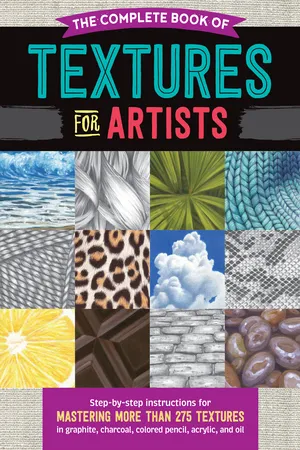
The Complete Book of Textures for Artists
eBook - ePub

The Complete Book of Textures for Artists

Step-by-step instructions for mastering more than 275 textures in graphite, charcoal, colored pencil, acrylic, and oil

  1. 144 pages
  2. English
  3. ePUB (mobile friendly)
  4. Available on iOS & Android
eBook - ePub

The Complete Book of Textures for Artists

Step-by-step instructions for mastering more than 275 textures in graphite, charcoal, colored pencil, acrylic, and oil

About this book

Learning to render a variety of textures is a fundamental skill for any fine artist, no matter the chosen media or subject matter. The Complete Book of Textures for Artists features more than 275 step-by-step lessons, tips, and techniques for rendering a wide range of textures in a variety of media, including graphite pencil, charcoal, colored pencil, oil, and acrylic.

Whether you're an experienced artist or just starting out, The Complete Book of Textures for Artists features a wide variety of both traditional and contemporary techniques. After an introduction to the basic tools and materials, discover a variety of drawing and painting techniques, such as hatching, crosshatching, shading, blending, layering, burnishing, and more. Organized into sections based on subject matter and media, each page features easy-to-follow steps demonstrating how to create each specific texture. Not only will you learn a variety of techniques, but you’ll also discover new ideas and inspiration for using the techniques in your own projects.
 
Packed with easy-to-follow instructions and plenty of helpful artist tips, The Complete Book of Textures for Artists is the perfect resource for beginning and established artists who are ready to master the intricacies of rendering realistic texture in their artwork.

Frequently asked questions

Yes, you can cancel anytime from the Subscription tab in your account settings on the Perlego website. Your subscription will stay active until the end of your current billing period. Learn how to cancel your subscription.
No, books cannot be downloaded as external files, such as PDFs, for use outside of Perlego. However, you can download books within the Perlego app for offline reading on mobile or tablet. Learn more here.
Perlego offers two plans: Essential and Complete
  • Essential is ideal for learners and professionals who enjoy exploring a wide range of subjects. Access the Essential Library with 800,000+ trusted titles and best-sellers across business, personal growth, and the humanities. Includes unlimited reading time and Standard Read Aloud voice.
  • Complete: Perfect for advanced learners and researchers needing full, unrestricted access. Unlock 1.4M+ books across hundreds of subjects, including academic and specialized titles. The Complete Plan also includes advanced features like Premium Read Aloud and Research Assistant.
Both plans are available with monthly, semester, or annual billing cycles.
We are an online textbook subscription service, where you can get access to an entire online library for less than the price of a single book per month. With over 1 million books across 1000+ topics, we’ve got you covered! Learn more here.
Look out for the read-aloud symbol on your next book to see if you can listen to it. The read-aloud tool reads text aloud for you, highlighting the text as it is being read. You can pause it, speed it up and slow it down. Learn more here.
Yes! You can use the Perlego app on both iOS or Android devices to read anytime, anywhere — even offline. Perfect for commutes or when you’re on the go.
Please note we cannot support devices running on iOS 13 and Android 7 or earlier. Learn more about using the app.
Yes, you can access The Complete Book of Textures for Artists by Denise J. Howard,Steven Pearce,Mia Tavonatti in PDF and/or ePUB format, as well as other popular books in Art & Art Techniques. We have over one million books available in our catalogue for you to explore.

Information

Section III

OIL & ACRYLIC

MIA TAVONATTI
Image

Tools & Materials

Sketch Pads

Some of the textures demonstrated in this section start with a basic sketch; however before putting paint to canvas, it’s best to work out your textures on paper. Sketch pads are ideal for this purpose. They come in all shapes and sizes, and they are easy to carry. Whenever you see an interesting texture that you’d like to paint, draw a quick sketch. Then use your sketch as a reference to draw the texture directly on your support, or transfer it using tracing or transfer paper. Just make sure to choose paper that will support the weight of your paint without too much buckling. When working in acrylic, use watercolor, acrylic, or mixed-media paper; when working in oil, use paper designed to hold oil paint and its mediums.
Image

Tracing & Transfer Paper

Tracing and transfer paper are used to transfer the outlines of a work to a support. Transfer paper is coated on one side with graphite (similar to carbon paper). Simply place the transfer paper facedown on your support; then place the artwork you wish to transfer faceup on the transfer paper. Use a pencil to trace over the lines of the artwork, pressing firmly. The outlines will transfer to your support. To use tracing paper, coat one side of the tracing paper with graphite and follow the same process.
Image

Drawing Pencils

Artist’s pencils contain a graphite center and are sorted by hardness, or grade, from very soft (9B) to very hard (9H). Pencil grade is not standardized, so it’s best to have a set of pencils from the same brand for consistency.
• Very hard: 5H–9H
• Hard: 3H–4H
• Medium hard: H–2H
• Medium: HB-F
• Medium soft: B–2B
• Soft: 3B–4B
• Very soft: 5B–9B
Image

Paintbrushes

Paintbrushes are classified by hair type (soft or stiff and natural or synthetic), style (flat, filbert, and round), and size. Flat brushes are great for producing straight, sharp edges. Medium and large flats are good for quickly filling in large areas. Small round and small filbert brushes have pointed tips that are suitable for adding details, and larger rounds and filberts are perfect for sketching rough outlines and general painting. When purchasing round or pointed brushes, opt for those with particularly long hairs or bristles.
Use the following brushes to create the examples in this section:
1/8-inch, 1/4-inch, 1/2-inch, 3/4-inch, and 1-inch flat brushes
• #1 round, #2 round, #3 round, #4 round, and #6 round brushes
• 1-inch #2 striper brush
Image
Filberts
Image
Flats
Image
Rounds
Brushes aren’t the only tools you can use to apply paint. Cotton swabs and blending stumps (which were used to create the texture Sequins, #212) are also useful. Cotton swabs are also great for removing paint from your surface.
HAKE BRUSH A hake brush is handy for blending large areas. While the area is still wet, use a clean, dry hake to lightly stroke back and forth over the color. Be sure to remove any stray hairs before the paint dries and never clean your hake in thinner until you’...

Table of contents

  1. Cover
  2. Title Page
  3. Table of Contents
  4. How to Use This Book
  5. Section I: Graphite & Charcoal with Steven Pearce
  6. Section II: Colored Pencil with Denise J. Howard
  7. Section III: Oil & Acrylic with Mia Tavonatti
  8. About the Artists
  9. Copyright