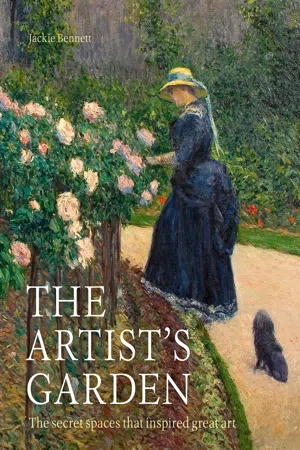
The Artist's Garden
eBook - ePub

The Artist's Garden

The secret spaces that inspired great art

  1. 224 pages
  2. English
  3. ePUB (mobile friendly)
  4. Available on iOS & Android
eBook - ePub

The Artist's Garden

The secret spaces that inspired great art

About this book

The Artist’s Garden offers an intriguing study into 20 gardens that have inspired and been home to some of the greatest painters of history.

The most alluring image of an artist at work is surely one where he or she has come out of their studio, set up their easel on the garden path, pulled on a hat to shade their eyes from the sun and taken their brush and palette in hand.

This sumptuously illustrated and fascinating book delves into the stories behind the gardens which inspired some of the most beautiful and important works of art.

These gardens not only supplied the inspiration for creative works but also illuminate the professional motivation and private life of the artists themselves – from Cezanne’s house in the south of France to Childe Hassam at Celia Thaxter’s garden off the coast off Maine.

Flowers and gardens have often been the first choice for artists looking for a subject. A garden close to the artist’s studio is not only convenient for daily material and ideas, but also has the advantage of changing through the seasons and over time. Claude Monet’s Giverny was the catalyst for hundreds of great paintings (by Monet and other artists), each one different from the one before. Sometimes a whole village becomes the focus for a colony of artists as at Gerberoy in Picardy and Skagen on the northernmost tip of Denmark.

This book is about the real homes and gardens that inspired these great artists – gardens that can still be visited today. The relationship between artist and garden is a complex one. A few artists, including Pierre Bonnard and his neighbour Monet were keen gardeners, as much in love with their plants as their work, while for others like Sorolla in Madrid, his courtyard home was both a sanctuary and a source of ideas.

This book is as unmissable for art lovers as it is for anyone who knows the joy of time spent in gardens, offering an intriguing insight into the lives of these great painters and the gardens which inspired them to their creative heights.

Frequently asked questions

Yes, you can cancel anytime from the Subscription tab in your account settings on the Perlego website. Your subscription will stay active until the end of your current billing period. Learn how to cancel your subscription.
No, books cannot be downloaded as external files, such as PDFs, for use outside of Perlego. However, you can download books within the Perlego app for offline reading on mobile or tablet. Learn more here.
Perlego offers two plans: Essential and Complete
  • Essential is ideal for learners and professionals who enjoy exploring a wide range of subjects. Access the Essential Library with 800,000+ trusted titles and best-sellers across business, personal growth, and the humanities. Includes unlimited reading time and Standard Read Aloud voice.
  • Complete: Perfect for advanced learners and researchers needing full, unrestricted access. Unlock 1.4M+ books across hundreds of subjects, including academic and specialized titles. The Complete Plan also includes advanced features like Premium Read Aloud and Research Assistant.
Both plans are available with monthly, semester, or annual billing cycles.
We are an online textbook subscription service, where you can get access to an entire online library for less than the price of a single book per month. With over 1 million books across 1000+ topics, we’ve got you covered! Learn more here.
Look out for the read-aloud symbol on your next book to see if you can listen to it. The read-aloud tool reads text aloud for you, highlighting the text as it is being read. You can pause it, speed it up and slow it down. Learn more here.
Yes! You can use the Perlego app on both iOS or Android devices to read anytime, anywhere — even offline. Perfect for commutes or when you’re on the go.
Please note we cannot support devices running on iOS 13 and Android 7 or earlier. Learn more about using the app.
Yes, you can access The Artist's Garden by Jackie Bennett in PDF and/or ePUB format, as well as other popular books in Arte & Técnicas artísticas. We have over one million books available in our catalogue for you to explore.

Information

THE ARTIST AT HOME AND AT WORK

Leonardo da Vinci
Peter Paul Rubens
Paul Cézanne
Pierre-Auguste Renoir
Max Liebermann
Joaquín Sorolla
Henri Le Sidaner
Emil Nolde
Frida Kahlo
Salvador Dalí
Images

Leonardo da Vinci

Amboise, France
Images
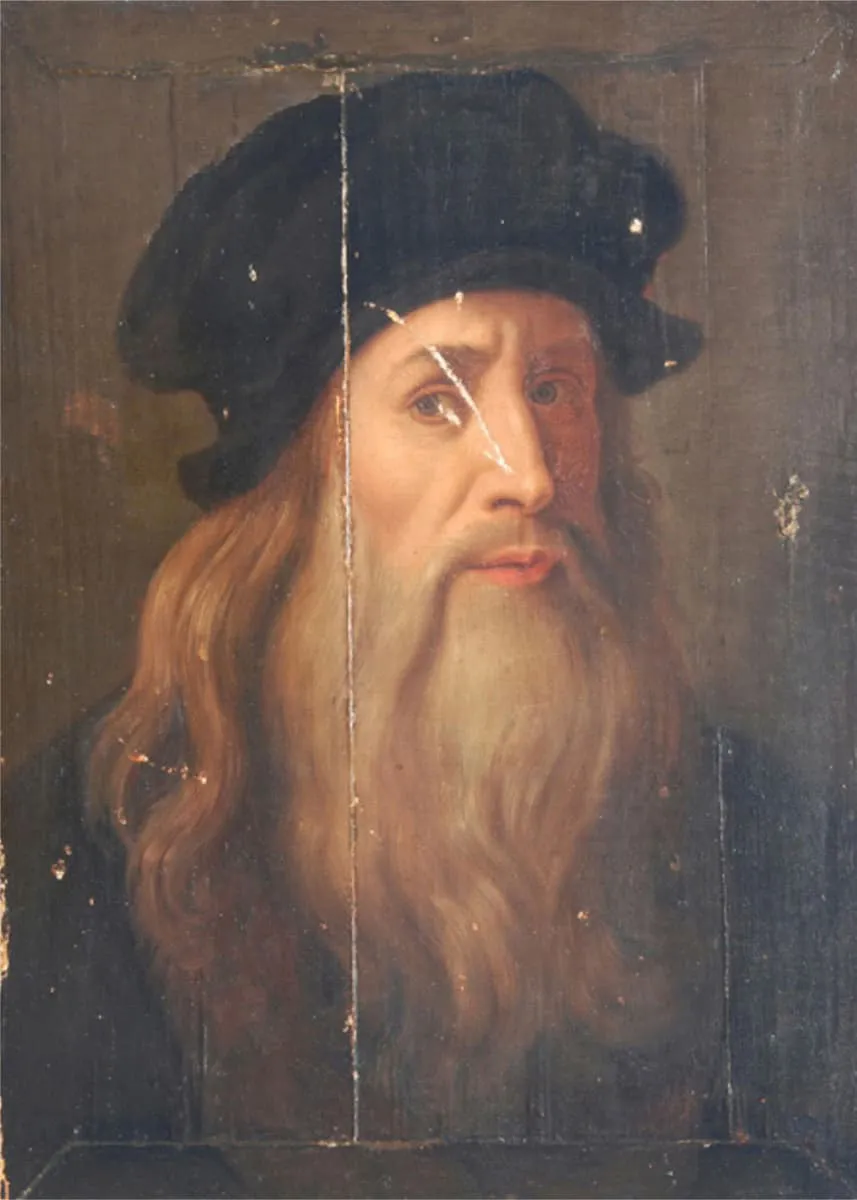
This early sixteenth-century self-portrait is thought to have been painted when Leonardo da Vinci was in his early fifties.
THE MAN WE KNOW simply as ‘Leonardo’ will be remembered not only as an artist, but also as an inventor, military architect, botanist, engineer, cartographer, sculptor and philosopher. Although he was brilliantly talented, Leonardo was not a prolific painter and few of his artworks survive today – his writings and polymathic mind will perhaps prove to be more enduring than his painting of The Last Supper on the walls of the Santa Maria delle Grazie convent in Milan. Yet there is one work that has captured the public’s imagination like no other. The Mona Lisa is not only Leonardo’s most famous painting, it also holds clues to the theories he held about the intimate connection between nature and the human body. A keen botanist, moving to Le Clos Lucé in France confirmed Leonardo’s passion for the natural world and particularly for plants, which he studied closely at his home by the Loire, where he spent his final years.
Images
The Italian artist spent the last years of his life at the Château du Clos Lucé in the Loire valley at the invitation of King François I.

EARLY PATRONS

Leonardo da Vinci took his name from the commune of Vinci, where he was born in the village of Anchiano, not far from Florence. The son of Piero da Vinci, a successful notary, Leonardo was born illegitimately to Caterina, a servant in his father’s house. When Leonardo was five years old, his mother was no longer able to support him and placed him permanently with the da Vinci family. He was raised by his paternal grandparents and an uncle, who took the boy horse riding around the Tuscan countryside. It was there, among the Montalbano hills, that Leonardo discovered the natural world and grew to believe that every part of man corresponded with every part of nature.
Taught to paint in Florence by Verrocchio, Leonardo’s career never followed a straight path. At the age of twenty-four he, along with several other members of Verrocchio’s household, was prosecuted for homosexuality, although the charges were later dropped. By the time he was thirty, he was receiving commissions for large religious works and, in 1482, he won the patronage of Ludovico Sforza, the Duke of Milan. In a famous letter to the Duke, Leonardo claimed that he could ‘construct bridges which are light and can be easily transported … drain water from moats … contrive catapults and weapons for firing arrows … and carry out sculpture in marble, bronze and clay.’ This confidence was not arrogance; he was a skilled practical engineer with a fantastically inventive mind.
Leaving Milan when the French invaded in 1499, he went on to sell his services to Cesare Borgia – the infamous politician and commander of the Papal armies. In 1503, Leonardo was commissioned by the Florentine minister of justice Piero Soderina to paint one of two wall paintings for the Palazzo Vecchio, the city hall in Florence – the other was by Michelangelo. The paintings celebrated famous Florentine victories; Leonardo’s was the Battle of Anghiari, fought in 1440, and on the opposite wall Michelangelo worked on...

Table of contents

  1. Cover
  2. Title Page
  3. Contents
  4. Introduction
  5. The Artist at Home and at Work
  6. The Artists’ Community
  7. Selected reading
  8. Visiting details
  9. Index
  10. Acknowledgments
  11. Picture credits
  12. Copyright