Pencil Art Workshop
eBook - ePub

Pencil Art Workshop

Techniques, Ideas, and Inspiration for Drawing and Designing with Pencil

  1. 144 pages
  2. English
  3. ePUB (mobile friendly)
  4. Available on iOS & Android
eBook - ePub

Pencil Art Workshop

Techniques, Ideas, and Inspiration for Drawing and Designing with Pencil

About this book

In Pencil Art Workshop, well-known artist and illustrator Matt Rota demonstrates several techniques in graphite, then ties it together with an international gallery of artists for inspiration.

The humble pencil is the world’s most flexible and forgiving drawing material. Pencil Art Workshop is the platform for artist and educator Matt Rota (author of The Art of Ballpoint) to show you key techniques that every artist should know. Following along with Matt is easy as he explores the pencil’s phenomenal, and sometimes surprising, range.

Turn to any chapter--Drawing with Line, Drawing with Tone, Drawing Quickly, Photorealism, Adding Color--and you’ll discover, through step-by-step instructions and illustrations, how to choose the right pencil for your specific project, and how to use it to its fullest in every drawing style. Each chapter in Pencil Art Workshop also includes a gallery of edgy and inspiring works by contemporary pencil artists to enjoy and to receive inspiration from.

Frequently asked questions

Yes, you can cancel anytime from the Subscription tab in your account settings on the Perlego website. Your subscription will stay active until the end of your current billing period. Learn how to cancel your subscription.
No, books cannot be downloaded as external files, such as PDFs, for use outside of Perlego. However, you can download books within the Perlego app for offline reading on mobile or tablet. Learn more here.
Perlego offers two plans: Essential and Complete
  • Essential is ideal for learners and professionals who enjoy exploring a wide range of subjects. Access the Essential Library with 800,000+ trusted titles and best-sellers across business, personal growth, and the humanities. Includes unlimited reading time and Standard Read Aloud voice.
  • Complete: Perfect for advanced learners and researchers needing full, unrestricted access. Unlock 1.4M+ books across hundreds of subjects, including academic and specialized titles. The Complete Plan also includes advanced features like Premium Read Aloud and Research Assistant.
Both plans are available with monthly, semester, or annual billing cycles.
We are an online textbook subscription service, where you can get access to an entire online library for less than the price of a single book per month. With over 1 million books across 1000+ topics, we’ve got you covered! Learn more here.
Look out for the read-aloud symbol on your next book to see if you can listen to it. The read-aloud tool reads text aloud for you, highlighting the text as it is being read. You can pause it, speed it up and slow it down. Learn more here.
Yes! You can use the Perlego app on both iOS or Android devices to read anytime, anywhere — even offline. Perfect for commutes or when you’re on the go.
Please note we cannot support devices running on iOS 13 and Android 7 or earlier. Learn more about using the app.
Yes, you can access Pencil Art Workshop by Matt Rota in PDF and/or ePUB format, as well as other popular books in Art & Art Techniques. We have over one million books available in our catalogue for you to explore.

Information

eBook ISBN
9781631594083
Topic
Art

CHAPTER 1
DRAWING WITH LINE

Drawing with line is the primary instinct when we learn to draw. Ask children to draw a picture of their family, and they’ll usually interpret the subject through a series of stick figures.
Image
Ideas come to us as abstractions in the form of line, but line is not how the eye sees the world. A line is an imaginary concept. If you consider that people instead see in light and shadow, then it’s logical to conclude that lines do not exist outside of our imagination. In our minds, we use lines to delineate one form from another, such as a cup from the table on which it sits, a leaf from a tree, or a single person from a crowd of people. Lines clarify and distinguish one object from another, but lines as a concept are an abstraction.
The process of drawing an image purely with line is the process of editing and simplifying the subject. The challenge in line drawing is the challenge of clarity—deciding what to include and what to leave out.
Image
Jun Cen, Mutual Tunnels 10, pencil on paper

TYPE OF LINE AND LINE PERSONALITY

When you’re drawing with line, consider how it defines the personality of the work of art. Line quality describes the feeling of a line, whether it’s smooth or rough, whether it has a consistent weight or a wide variation in thickness. These considerations will determine the style and mood of the finished drawing.
Image
Line quality is determined by a number of factors: the hardness of the graphite, the pencil’s sharpness, how the pencil is held, how the hand moves, and how hard the pencil is pressed into the paper. There are two distinct approaches to line quality—direct line and sculpted line.
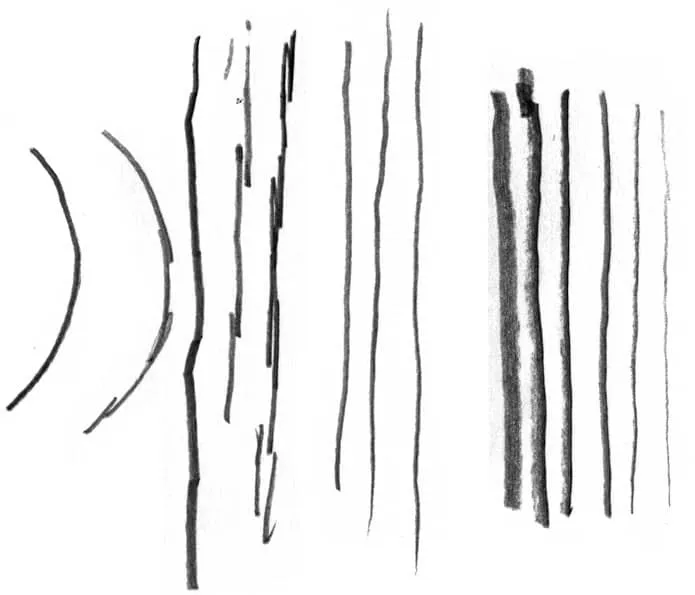
A direct line is one in which pressure is applied directly and evenly while the tip of the pencil is pulled across the page. A softer graphite pencil works best to create a bolder line. With a direct line, all the subtleties of the movement in the hand are captured in minute detail. This style reflects the idiosyncrasies and peculiarities in the motion of the arm and wrist.
There should be little hesitation in this approach so that there is a boldness to the line. This can lead to distortion, but the strength of this type of line is not in accuracy, it is in the confidence of the mark, which is the beauty of the line. The feeling in the line can be smooth or rough. Line weight variation is determined by the pressure placed on the pencil. Turning the pencil from the tip to the broad side of the tip during the stroke will also create a shift from a thin line to a thick one. Since the purpose of the line is its directness, the line, once drawn, should not be retraced, or its spontaneity will be lost.
Another approach is to sculpt a line. This involves discovering the line by building it up slowly through a series of shorter strokes. It reveals less of the gesture and does more to disguise the mark of the artist. The resulting line is refined and can be more subtle than a direct line.
Start lightly with a sculpted line, allowing the pencil to softly diagram the subject. A harder graphite is good for this. Make many passes at the line to discover the correc...

Table of contents

  1. Cover Page
  2. Title Page
  3. Contents
  4. Introduction
  5. A Pencil Timeline
  6. Tools and Materials
  7. CHAPTER 1: DRAWING WITH LINE
  8. CHAPTER 2: DRAWING WITH TONE
  9. CHAPTER 3: DRAWING QUICKLY
  10. CHAPTER 4: PHOTO-REALISTIC DRAWING
  11. CHAPTER 5: ADDING COLOR
  12. Artists Directory
  13. Acknowledgments
  14. About the Author
  15. Index
  16. Copyright