eBook - ePub
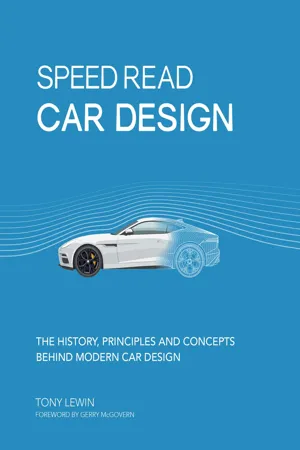
Speed Read Car Design
The History, Principles and Concepts Behind Modern Car Design
- 160 pages
- English
- ePUB (mobile friendly)
- Available on iOS & Android
eBook - ePub
About this book
This beautifully designed and illustrated essential guide to car design from Motorbooks' Speed Read series traces the inspirations of the first car designers and tracks the craft, the art, and the science that have propelled successive generations of designers and shaped the contours of the vehicles we see all around us.
Never before has the car-buying public been more aware of how a car's design fits into their everyday lives and what it communicates about the driver behind the wheel. Like all design, car design is complex subject. Every part of a car represents myriad decisions by the design team ruled by engineering, aesthetics, human interface, and emotion. Speed Read Car Design helps the you understand the hows and whys of that design process, offering an engaging review of history, theory, key concepts, and key designers. It’s a book for car enthusiasts, design fans, and anyone with a desire to better understand why our wheeled world looks the way it does.
In sections divided by topic, you'll explore the birth of car design, how it evolved over the last century, successes and failures in innovation, the elements that make up a car's style, the engineering behind the design, the creative process and design fads, and finally the road ahead in car design.
Each section ends with a glossary of related terms, and informational sidebars provide fun facts, historical tidbits, and mini-bios of key people in car design. Sleek illustrations of the cars give clear design examples throughout.
With Motorbooks’ Speed Read series, become an instant expert in a range of fast-moving subjects, from Formula 1 racing to the Tour de France. Accessible language, compartmentalized sections, fact-filled sidebars, glossaries of key terms, and event timelines deliver quick access to insider knowledge. Their brightly colored covers, modern design, pop art–inspired illustrations, and handy size make them perfect on-the-go reads.
Never before has the car-buying public been more aware of how a car's design fits into their everyday lives and what it communicates about the driver behind the wheel. Like all design, car design is complex subject. Every part of a car represents myriad decisions by the design team ruled by engineering, aesthetics, human interface, and emotion. Speed Read Car Design helps the you understand the hows and whys of that design process, offering an engaging review of history, theory, key concepts, and key designers. It’s a book for car enthusiasts, design fans, and anyone with a desire to better understand why our wheeled world looks the way it does.
In sections divided by topic, you'll explore the birth of car design, how it evolved over the last century, successes and failures in innovation, the elements that make up a car's style, the engineering behind the design, the creative process and design fads, and finally the road ahead in car design.
Each section ends with a glossary of related terms, and informational sidebars provide fun facts, historical tidbits, and mini-bios of key people in car design. Sleek illustrations of the cars give clear design examples throughout.
With Motorbooks’ Speed Read series, become an instant expert in a range of fast-moving subjects, from Formula 1 racing to the Tour de France. Accessible language, compartmentalized sections, fact-filled sidebars, glossaries of key terms, and event timelines deliver quick access to insider knowledge. Their brightly colored covers, modern design, pop art–inspired illustrations, and handy size make them perfect on-the-go reads.
Tools to learn more effectively

Saving Books

Keyword Search

Annotating Text

Listen to it instead
Information
THE BIRTH OF CAR DESIGN
Introduction
Evolution of the Species
The Golden Age of Car Design
Power to the People
Harley Earl
The Emergence of Style
Glossary

INTRODUCTION
DESIGN—THE GREAT DIFFERENTIATOR
Design had little or no part to play when the very first automobiles sputtered to life. Even engineering—if it could be flattered with such a term—was in short supply as pioneer inventors improvized with available materials from the horse and cart era. Comfort and style were irrelevant: the priority that overwhelmed everything else was that the contraption would start and would not break down too frequently.
Fast forward twelve decades to today’s mass-produced models and the position could not be more different. Today, performance and complete reliability are taken for granted, and it is design that sets one model apart from another. The image the car projects—what it looks like, how it feels, and how its quality stacks up—all have become at least as important as its engineering and its responses on the road. In short, design has become the greatest differentiator and style is the new entry ticket to customers’ hearts. Cars, like clothing brands, have become industrialized, commoditized, and commercialized. They are close to becoming fashion impulses rather than measured technical choices.
All this has elevated car design—and by consequence, the car designer—to new heights of importance. Now both the architect and the guardian of the brand, the designer is the figurehead giving visual expression to its messages and its values.
But it was not always so. While some of the early proprietors cared little about the appearance of their products, others, especially as the 1920s morphed into the 1930s, became fierce in the protection of the visual message delivered by their models.
For every Henry Ford decreeing that all cars must be black and basic there was a Vincenzo Lancia or André Citroen blending engineering innovation with elegant style; while Charles Rolls and Henry Royce specified their palatial radiator grilles but left the aesthetic shaping of the bodywork to outside craftsmen, there was Ettore Bugatti who, in collaboration with his son Jean, produced complete machines of such exquisite beauty that they are still feted as works of art. Later, William Lyons’s intuitive instinct for style ensured that all Jaguars would share the same sense of lithe, sinuous elegance, and in the modern era companies such as Audi have built their reputation on meticulous attention to every aspect of design.
Though Jaguar’s Lyons era is separated from Audi by several decades, the two share the common thread of a powerful individual with a keen eye for style and a strong brand image. Today, corporate consensus may have replaced the proprietor’s decree, but the message is the same: quality design sells, and is essential to the building of a strong brand position. What is different now is that good design has become democratized: thanks to companies such as Renault, which was a pioneer in bringing in design at a strategic level, true style is accessible to all—not just the fortunate few.

THE BIRTH OF CAR DESIGN
EVOLUTION OF THE SPECIES
Crossovers, shooting brakes, four-door coupés, off-road convertibles: the list of body styles is endless and the variety of formats offered today is truly bewildering. But has this always been the case?
In the 1950s and 1960s, when sedans and station wagons ruled the roost, there was much less variety. This was for sound technical reasons as automakers were just getting to grips with building cars with unitary construction techniques that, initially, made it uneconomic to add further body styles. In the interwar period the selection of styles had been broader: when vehicles were built on a separate chassis, the upper body was not a structural element and it was easier to provide a range of options.
It is possible to trace the origins of almost any body style back to the formats that first began to develop in the early 1900s. Coachbuilders applied their horse-and-carriage styles to motorized chassis: saloons had full roof structures to keep passengers warm, while limousines and broughams left the chauffeur out in the cold. Landaus and phaetons could be opened up at the rear; coupés were simply cut-down versions. Sports cars evolved along a separate path: minimalist and much lower, they remained stark and functional until the aerodynamic 1936 BMW 328.
Greater orthodoxy ruled the postwar decades, with the two-seater sports car a highlight. The 1960s saw the rise of small cars as well as the first examples of a body type that would become dominant—the hatchback. In 1970 the Range Rover set the seeds for the sports utility craze of the late 1990s, which in turn led to the post-2010 crossover phenomenon as automakers merged SUV design cues with mass-production car platforms.
And as the 2020s draw near, further trends are becoming clear: electric cars of all shapes and sizes, the emergence of compact but tough-looking “urban” crossovers, and the polarization of the large-car sector into low-slung, sporty, four-door coupés and more versatile models incorporating design cues from crossovers. And then there is the expected arrival of dedicated zero-emission vehicles locked in to urban mobility programs—and that will be yet another new direction in design.
RENAULT SCENIC
One of the most influential design steps of recent decades, Renault’s 1996 Scenic distilled the comfort, style, and versatility of the luxurious Espace into a smaller, less costly format. It was an instant success with families, creating a new segment in the market.
NISSAN JUKE
With its uncanny knack of spotting upcoming shifts in consumer demand, Nissan launched the aggressive-looking urban compact Juke in 2010. The polarizing design unleashed a flurry of imitators as buyers rushed for its funky image, with few worried about its compromised practicality.
SMART
Launched in 2000 after a troubled gestation, the two-seater Smart was ...
Table of contents
- Cover
- Title Page
- Contents
- Foreword: Why Good Design Resonates
- Introduction
- Section 1 The Birth of Car Design
- Section 2 A Century of Changing Shapes
- Section 3 Innovation
- Section 4 The Elements of Style
- Section 5 Engineering, Interiors, and Space
- Section 6 The Creative Process
- Section 7 And What Comes Next?
- Key Designer Timelines
- Index
- Copyright
Frequently asked questions
Yes, you can cancel anytime from the Subscription tab in your account settings on the Perlego website. Your subscription will stay active until the end of your current billing period. Learn how to cancel your subscription
No, books cannot be downloaded as external files, such as PDFs, for use outside of Perlego. However, you can download books within the Perlego app for offline reading on mobile or tablet. Learn how to download books offline
Perlego offers two plans: Essential and Complete
- Essential is ideal for learners and professionals who enjoy exploring a wide range of subjects. Access the Essential Library with 800,000+ trusted titles and best-sellers across business, personal growth, and the humanities. Includes unlimited reading time and Standard Read Aloud voice.
- Complete: Perfect for advanced learners and researchers needing full, unrestricted access. Unlock 1.4M+ books across hundreds of subjects, including academic and specialized titles. The Complete Plan also includes advanced features like Premium Read Aloud and Research Assistant.
We are an online textbook subscription service, where you can get access to an entire online library for less than the price of a single book per month. With over 1 million books across 990+ topics, we’ve got you covered! Learn about our mission
Look out for the read-aloud symbol on your next book to see if you can listen to it. The read-aloud tool reads text aloud for you, highlighting the text as it is being read. You can pause it, speed it up and slow it down. Learn more about Read Aloud
Yes! You can use the Perlego app on both iOS and Android devices to read anytime, anywhere — even offline. Perfect for commutes or when you’re on the go.
Please note we cannot support devices running on iOS 13 and Android 7 or earlier. Learn more about using the app
Please note we cannot support devices running on iOS 13 and Android 7 or earlier. Learn more about using the app
Yes, you can access Speed Read Car Design by Tony Lewin in PDF and/or ePUB format, as well as other popular books in Tecnología e ingeniería & Transporte e ingeniería automovilísticos. We have over one million books available in our catalogue for you to explore.