eBook - ePub
Available until 22 Apr |Learn more
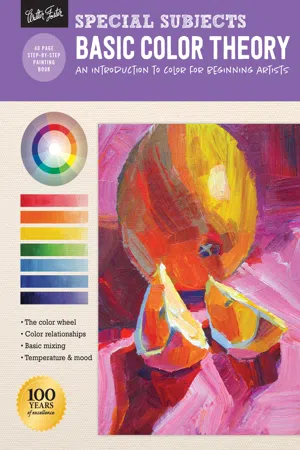
Special Subjects: Basic Color Theory
An introduction to color for beginning artists
This book is available to read until 22nd April, 2026
- 40 pages
- English
- ePUB (mobile friendly)
- Available on iOS & Android
eBook - ePub
Available until 22 Apr |Learn more
About this book
Understanding how to effectively use color is the first step to becoming a well-rounded artist. Special Subjects: Basic Color theory is your guide.
A perfect resource for new artists and art hobbyists, Basic Color Theory demonstrates the color wheel at work and covers all the essentials, including complementary, primary, secondary, and tertiary colors; hue, saturation, and value; color mood, temperature, and schemes; and how to create a color chart.
Each concept is clearly explained in easy-to-comprehend language so beginning artists can put their newfound knowledge to immediate use. Also included are step-by-step tutorials, as well as techniques for basic color mixing in different mediums.
Designed for beginners, the How to Draw & Paint series offers an easy-to-follow guide that introduces artists to basic tools and materials and includes simple step-by-step lessons for a variety of projects suitable for the aspiring artist. Basic Color Theory allows artists to widen the scope of their abilities, demonstrating how to create color and value charts, basic color mixing techniques, and a comprehensive approach to understanding color relationships.
A perfect resource for new artists and art hobbyists, Basic Color Theory demonstrates the color wheel at work and covers all the essentials, including complementary, primary, secondary, and tertiary colors; hue, saturation, and value; color mood, temperature, and schemes; and how to create a color chart.
Each concept is clearly explained in easy-to-comprehend language so beginning artists can put their newfound knowledge to immediate use. Also included are step-by-step tutorials, as well as techniques for basic color mixing in different mediums.
Designed for beginners, the How to Draw & Paint series offers an easy-to-follow guide that introduces artists to basic tools and materials and includes simple step-by-step lessons for a variety of projects suitable for the aspiring artist. Basic Color Theory allows artists to widen the scope of their abilities, demonstrating how to create color and value charts, basic color mixing techniques, and a comprehensive approach to understanding color relationships.
Tools to learn more effectively

Saving Books

Keyword Search

Annotating Text

Listen to it instead
Information
WHAT IS COLOR?
Artists must understand color to know how to use it properly. Although there will always be some personal influence in the way we interpret and display it, we must understand color relationships before we can organize it in our paintings.
In the late 1600s, Sir Isaac Newton (1642–1727) conducted and published a series of experiments involving prisms, light, and color, which form the basis of our current understanding of color. These experiments involved refracting white light through a prism—a simple triangular glass object that separates light waves into individual colors. The results revealed that light could actually be broken down into seven individual colors: red, orange, yellow, green, blue, indigo, and violet. Until this discovery, it was assumed that a prism somehow “colored” the light passing through it. To prove this wrong, Newton reversed the process: He projected the colors back into the prism, which resulted in pure white light. Artists and scientists alike were amazed by this breakthrough discovery that light is the source of all color.

© Shutterstock
As white light hits a prism, the light refracts and separates into the colors of the rainbow.

Scientist Sir Isaac Newton provided the foundation for color theory as we understand it today.
UNDERSTANDING LIGHT
The colors that we see when light strikes an object are the result of certain wavelengths (individual colors) being absorbed by the object while other wavelengths are being reflected back to us. Those reflected back to us are the colors that we see.
LIGHT & REFLECTED COLOR

As light hits a yellow object, yellow is reflected; all other colors are absorbed.

As light hits an orange object, yellow, orange, and red are reflected; all other colors are absorbed.

As light hits a purple object, red, blue, and violet are reflected; all other colors are absorbed.
THE COLOR WHEEL
A color wheel is a visual representation of colors arranged according to their chromatic relationship. The basic color wheel consists of 12 colors that can be broken down into three different groups: primary, secondary, and tertiary.

One of the easiest things to create is a 12-color color wheel with just the three primaries: red, yellow, and blue. All colors are derived from these three. Beginners should mix a color wheel with both the primaries and secondaries. This can help you understand how to create additional colors, see how colors interact, and se...
Table of contents
- Cover
- Title Page
- Contents
- What Is Color?
Frequently asked questions
Yes, you can cancel anytime from the Subscription tab in your account settings on the Perlego website. Your subscription will stay active until the end of your current billing period. Learn how to cancel your subscription
No, books cannot be downloaded as external files, such as PDFs, for use outside of Perlego. However, you can download books within the Perlego app for offline reading on mobile or tablet. Learn how to download books offline
Perlego offers two plans: Essential and Complete
- Essential is ideal for learners and professionals who enjoy exploring a wide range of subjects. Access the Essential Library with 800,000+ trusted titles and best-sellers across business, personal growth, and the humanities. Includes unlimited reading time and Standard Read Aloud voice.
- Complete: Perfect for advanced learners and researchers needing full, unrestricted access. Unlock 1.4M+ books across hundreds of subjects, including academic and specialized titles. The Complete Plan also includes advanced features like Premium Read Aloud and Research Assistant.
We are an online textbook subscription service, where you can get access to an entire online library for less than the price of a single book per month. With over 1 million books across 990+ topics, we’ve got you covered! Learn about our mission
Look out for the read-aloud symbol on your next book to see if you can listen to it. The read-aloud tool reads text aloud for you, highlighting the text as it is being read. You can pause it, speed it up and slow it down. Learn more about Read Aloud
Yes! You can use the Perlego app on both iOS and Android devices to read anytime, anywhere — even offline. Perfect for commutes or when you’re on the go.
Please note we cannot support devices running on iOS 13 and Android 7 or earlier. Learn more about using the app
Please note we cannot support devices running on iOS 13 and Android 7 or earlier. Learn more about using the app
Yes, you can access Special Subjects: Basic Color Theory by Patti Mollica in PDF and/or ePUB format, as well as other popular books in Art & Art Techniques. We have over one million books available in our catalogue for you to explore.