eBook - ePub
Available until 21 Apr |Learn more
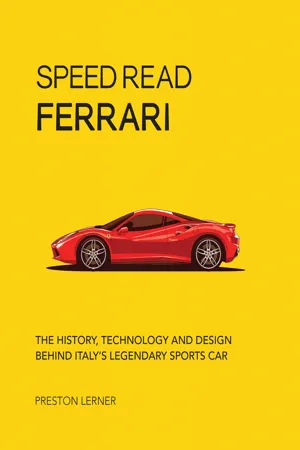
Speed Read Ferrari
The History, Technology and Design Behind Italy's Legendary Automaker
This book is available to read until 21st April, 2026
- 160 pages
- English
- ePUB (mobile friendly)
- Available on iOS & Android
eBook - ePub
Available until 21 Apr |Learn more
Speed Read Ferrari
The History, Technology and Design Behind Italy's Legendary Automaker
About this book
This beautifully designed and illustrated essential guide to Ferrari from Motorbooks' Speed Read series celebrates the world's premier performance-car manufacturer, from the first complete car Enzo Ferrari constructed in 1940—the Auto Avio Costruzioni—to masterpieces produced by Ferrari today.
Author Preston Lerner covers 50-plus aspects key to understanding Ferrari's amazing history, including both racing and production cars, design and technology, and the personal histories of key figures. In sections divided by topic, you'll explore the story of Ferrari's founding; descriptions and critiques of over 25 different Ferrari models, including the milestone racers, lust-inspiring road cars, and dominating F1, sports, and prototype racecars; profiles of the most famous Ferrari drivers; recaps of Ferrari's most memorable racing wins; and a survey of all the stylists, coachbuilders, engineers, salesmen, and executives who have contributed to Ferrari's success.
Each section ends with a glossary of related terms, and informational sidebars provide fun facts, historical tidbits, and mini-bios of key people in Ferrari history. Sleek illustrations of the cars bring the evolution of the company to life.
With Motorbooks’ Speed Read series, become an instant expert in a range of fast-moving subjects, from Formula 1 racing to the Tour de France. Accessible language, compartmentalized sections, fact-filled sidebars, glossaries of key terms, and event timelines deliver quick access to insider knowledge. Their brightly colored covers, modern design, pop art–inspired illustrations, and handy size make them perfect on-the-go reads.
Author Preston Lerner covers 50-plus aspects key to understanding Ferrari's amazing history, including both racing and production cars, design and technology, and the personal histories of key figures. In sections divided by topic, you'll explore the story of Ferrari's founding; descriptions and critiques of over 25 different Ferrari models, including the milestone racers, lust-inspiring road cars, and dominating F1, sports, and prototype racecars; profiles of the most famous Ferrari drivers; recaps of Ferrari's most memorable racing wins; and a survey of all the stylists, coachbuilders, engineers, salesmen, and executives who have contributed to Ferrari's success.
Each section ends with a glossary of related terms, and informational sidebars provide fun facts, historical tidbits, and mini-bios of key people in Ferrari history. Sleek illustrations of the cars bring the evolution of the company to life.
With Motorbooks’ Speed Read series, become an instant expert in a range of fast-moving subjects, from Formula 1 racing to the Tour de France. Accessible language, compartmentalized sections, fact-filled sidebars, glossaries of key terms, and event timelines deliver quick access to insider knowledge. Their brightly colored covers, modern design, pop art–inspired illustrations, and handy size make them perfect on-the-go reads.
Tools to learn more effectively

Saving Books

Keyword Search

Annotating Text

Listen to it instead
Information
Edition
1A LEGEND IS BORN

Enzo Ascendant: The Prewar Years
Staking a Claim: 1947 to 1969
The Fiat Connection: 1969 to 1988
Ferrari after Enzo: 1988 to 2016
Alone Again: Ferrari Circa 2017
The Prancing Horse Emblem
Glossary
A LEGEND IS BORN
ENZO ASCENDANT: THE PREWAR YEARS
Few car companies embody the character of their founder more faithfully than Ferrari. This is a marque with a famous split personality, obsessed by street cars at one end of the spectrum and race cars at the other. So, too, was Enzo Ferrari himself riven by contradictions—crude yet courtly, callous yet affectionate, quick-thinking yet pig-headed, narrow-minded yet larger than life. He was born in 1898 in the northern Italian town of Modena, the son of the owner of a small machine shop. After World War I, he moved to Turin and found work at a company that stripped war-surplus trucks down to bare chassis. He immediately started racing, with modest success, and soon finagled a position at Alfa Romeo. Ferrari quickly made himself indispensable to the burgeoning company, selling cars and poaching engineers. Although he wasn’t a first-class driver, his racing experience helped him persuade several wealthy enthusiasts to bankroll the formation in 1929 of a private race team, Società Anonima Scuderia Ferrari. In 1933, Scuderia Ferrari became Alfa Romeo’s works operation, with Ferrari presiding over a race program that featured luminaries such as Tazio Nuvolari and Achille Varzi. Relations with Alfa Romeo soured during the late 1930s, as Mercedes-Benz and Auto Union dominated Grand Prix racing. Ferrari returned to Modena to form a machine-tool company he named Auto Avio Costruzione. But he couldn’t resist the lure of racing, and he commissioned a pair of Fiat-based entries for the Mille Miglia in 1940. Both of the so-called 815s led their class. Neither finished. Then came World War II and the end of the prologue of the Ferrari story.
FUN FACT
Ferrari’s greatest victory as a driver, in the Coppa Acerbo in 1924, earned him a seat in an all-conquering Alfa Romeo P2 Grand Prix car. But he fell ill—or, some say, lost his confidence—before he could drive it, and he raced only intermittently thereafter.
HISTORICAL TIDBIT
During World War II, Italian officials ordered Ferrari to move his factory out of Modena in the hope of safeguarding it. Ironically, his new factory in Maranello was pummeled by three Allied bombing raids.
KEY PERSON
Ferrari was instrumental in enticing legendary engineers Luigi Bazzi and Vittorio Jano from Fiat to Alfa Romeo in the 1920s. After the war, both men worked for Ferrari in Maranello.

A LEGEND IS BORN
STAKING A CLAIM: 1947 TO 1969
It’s tempting to think of the 1950s as Ferrari’s golden years because so many immensely valuable cars date from this era. But these cars are so collectible largely because so few of them were built. Ferrari painstakingly assembled running chassis by hand, while the bodies were designed and built elsewhere. It wasn’t until 1958 that the factory got its first assembly line (to use the term charitably). In 1960, a total of 306 cars were built in Maranello; GM knocked out more than that in an hour. But if Ferrari got off to a slow start on the production side of the business, it sprinted out of the box on the racing front. A Ferrari 166 MM won the first 24 Hours of Le Mans staged after World War II, and Ferrari 500 single-seaters swept every World Championship race in 1952. By the 1960s, though, as racing costs skyrocketed, it became clear that profits from production cars could no longer finance the entire motorsports program. Enzo spent weeks negotiating the sale of his company to the Ford Motor Company before abruptly calling things off when he realized that he’d no longer be the despot-in-chief. This, after all, was a man who’d fired, en masse, the directors of engineering, sales, purchasing, personnel, and the race team, in 1961 for a perceived lack of loyalty—an episode known as “The Purge.” But Ferrari had an ace in the hole in the form of his ties to Gianni Agnelli, the tycoon in charge of the Fiat empire. In 1969, Fiat bought a 40-percent stake in Ferrari (with an option for an additional 50 percent when Enzo died), and the marque’s future was assured.
FUN FACT
The first car to bear the Ferrari nameplate, the 125 S, was what Enzo called “a promising failure” when it debuted at Piacenza in 1947. But it won its next race, in Rome, two weeks later.
HISTORICAL TIDBIT
The 250 GT, introduced in 1954, is generally considered to be the first genuine “production” Ferrari. The basic chassis, which was used for the next decade, worked equally well on road and track.
KEY PERSON
In 1963, Enzo and Henry Ford II hammered out, but ultimately refused to sign, a contract that would have created two new companies—Ford-Ferrari to build and sell sports and grand touring cars and Ferrari-Ford to go racing.

A LEGEND IS BORN
THE FIAT CONNECTION: 1969 TO 1988
The 1970s were memorable for a lot of reasons—Star Wars, the Walkman, the first Earth Day celebration—but cars generally weren’t one of them. Two oil crises and new safety regulations confounded automakers, especially those specializing in sexy, high-performance vehicles. Ferrari benefitted from the corporate backing, technical know-how, and physical resources of Fiat, and production skyrocketed from 928 in 1970 to 2,221 by the end of the decade. But for every electrifying Berlinetta Boxer, there was an uninspired 400 Automatic, and critics whispered that the company was pumping up sales by pumping out high-priced Fiats in Ferrari clothing. The news was better on the motorsports side. Even as purists howled about the unsentimental decision to scrap the prototype sports car program, the extra emphasis placed on Formula 1 produced four constructors’ titles and two second-place finishes in six years, with Niki Lauda and Jody Scheckter claiming three championships between them. Still, the coming of a new decade brought more hard times. In 1982, the only Ferraris being sold in America were the unloved 400i, the underwhelming Mondial, and the long-in-the-tooth 308. (The BBi wasn’t imported because it couldn’t meet US safety or emissions standards.) Then, the F1 team was hit with two gut punches—the death of Gilles Villeneuve and Didier Pironi’s career-ending crash. During the fallow ye...
Table of contents
- Cover
- Title Page
- Contents
- Introduction
- Section 1: A Legend is Born
- Section 2: Nine for the Road
- Section 3: Exclusive, Exotic, Exhilarating
- Section 4: Designed for Winning
- Section 5: The Heroes Behind the Wheel
- Section 6: Races to Remember
- Section 7: Team Players
- Index
- Ferrari Timeline
- Copyright
Frequently asked questions
Yes, you can cancel anytime from the Subscription tab in your account settings on the Perlego website. Your subscription will stay active until the end of your current billing period. Learn how to cancel your subscription
No, books cannot be downloaded as external files, such as PDFs, for use outside of Perlego. However, you can download books within the Perlego app for offline reading on mobile or tablet. Learn how to download books offline
Perlego offers two plans: Essential and Complete
- Essential is ideal for learners and professionals who enjoy exploring a wide range of subjects. Access the Essential Library with 800,000+ trusted titles and best-sellers across business, personal growth, and the humanities. Includes unlimited reading time and Standard Read Aloud voice.
- Complete: Perfect for advanced learners and researchers needing full, unrestricted access. Unlock 1.4M+ books across hundreds of subjects, including academic and specialized titles. The Complete Plan also includes advanced features like Premium Read Aloud and Research Assistant.
We are an online textbook subscription service, where you can get access to an entire online library for less than the price of a single book per month. With over 1 million books across 990+ topics, we’ve got you covered! Learn about our mission
Look out for the read-aloud symbol on your next book to see if you can listen to it. The read-aloud tool reads text aloud for you, highlighting the text as it is being read. You can pause it, speed it up and slow it down. Learn more about Read Aloud
Yes! You can use the Perlego app on both iOS and Android devices to read anytime, anywhere — even offline. Perfect for commutes or when you’re on the go.
Please note we cannot support devices running on iOS 13 and Android 7 or earlier. Learn more about using the app
Please note we cannot support devices running on iOS 13 and Android 7 or earlier. Learn more about using the app
Yes, you can access Speed Read Ferrari by Preston Lerner in PDF and/or ePUB format, as well as other popular books in Technology & Engineering & Automotive Transportation & Engineering. We have over one million books available in our catalogue for you to explore.