This book is available to read until 31st December, 2025
- 192 pages
- English
- ePUB (mobile friendly)
- Available on iOS & Android
eBook - ePub
Available until 31 Dec |Learn more
About this book
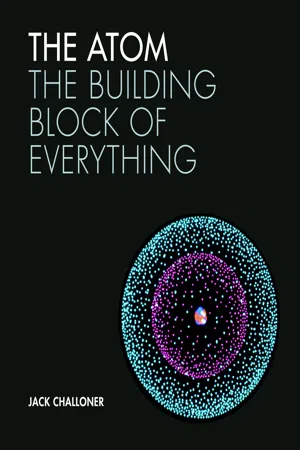
Until now, popular science has relegated the atom to a supporting role in defining the different chemical elements of the periodic table. This bold new title places its subject center stage, shining the spotlight directly onto the structure and properties of this tiniest amount of anything it is possible to identify. The book covers a huge range of topics, including the development of scientific thinking about the atom, the basic structure of the atom, how the interactions between atoms account for the familiar properties of everyday materials; the power and mystery of the atomic nucleus, and what the mysterious quantum realm of subatomic particles and their interactions can tell us about the very nature of reality. Sparkling text banishes an outdated world of dull chemistry, as it brightly introduces the reader to what everything is made of and how it all works, on the most fundamental level.
Frequently asked questions
Yes, you can cancel anytime from the Subscription tab in your account settings on the Perlego website. Your subscription will stay active until the end of your current billing period. Learn how to cancel your subscription.
No, books cannot be downloaded as external files, such as PDFs, for use outside of Perlego. However, you can download books within the Perlego app for offline reading on mobile or tablet. Learn more here.
Perlego offers two plans: Essential and Complete
- Essential is ideal for learners and professionals who enjoy exploring a wide range of subjects. Access the Essential Library with 800,000+ trusted titles and best-sellers across business, personal growth, and the humanities. Includes unlimited reading time and Standard Read Aloud voice.
- Complete: Perfect for advanced learners and researchers needing full, unrestricted access. Unlock 1.4M+ books across hundreds of subjects, including academic and specialized titles. The Complete Plan also includes advanced features like Premium Read Aloud and Research Assistant.
We are an online textbook subscription service, where you can get access to an entire online library for less than the price of a single book per month. With over 1 million books across 1000+ topics, we’ve got you covered! Learn more here.
Look out for the read-aloud symbol on your next book to see if you can listen to it. The read-aloud tool reads text aloud for you, highlighting the text as it is being read. You can pause it, speed it up and slow it down. Learn more here.
Yes! You can use the Perlego app on both iOS or Android devices to read anytime, anywhere — even offline. Perfect for commutes or when you’re on the go.
Please note we cannot support devices running on iOS 13 and Android 7 or earlier. Learn more about using the app.
Please note we cannot support devices running on iOS 13 and Android 7 or earlier. Learn more about using the app.
Yes, you can access Atom by Jack Challoner in PDF and/or ePUB format, as well as other popular books in Physical Sciences & Atomic & Molecular Physics. We have over one million books available in our catalogue for you to explore.
Information
CHAPTER 1
A BRIEF HISTORY OF THE CONCEPT “ATOM”
The idea that matter is made of tiny particles is at least 2,500 years old. Through much of history, it was relegated to the fringes of scientific thought for philosophical and religious reasons. But it regained popularity with the rise of science in Europe in the seventeenth and eighteenth centuries. The notion that atoms really do exist only became widely accepted with the rapid rise of atomic physics in the early twentieth century.

Molecular models presented to the Royal Institution, London, UK, by German chemist August Wilhelm von Hofmann, in 1865. Hoffman used the models in a lecture entitled “The Combining Power of Atoms,” at a time when the existence of atoms was still in doubt.
EVERYTHING AND NOTHING
The roots of modern atomic theory lie in ancient Greece. Oddly, perhaps, the story begins with philosophical wrangling about whether change is real or an illusion—and whether empty space can exist. Despite the development of well-thought-out and convincing atomic theories in both Greece and India, other ideas would come to dominate.
EVERYTHING CHANGES—OR DOES IT?
It was common for ancient Greek philosophers—as it is for scientists these days—to seek order in the world, and in particular to find a unified cause for the huge variety of phenomena we observe. When it comes to the physical world, or matter, the earliest Greek philosophers were “monists.” They proposed that either all matter begins as one kind of substance and then differentiates, or that there actually is only one kind of matter, which manifests in various forms.
One of the earliest Greek philosophers, Thales of Miletus (ca. 625–ca. 545 BCE), suggested that water might be the primary substance from which all other substances derive. Anaximenes, also of Miletus, thought that the primary substance might be air.
Several decades later, another Greek philosopher, Heraclitus of Ephesus (ca. 535–ca. 475 BCE), suggested that the primary material might be fire. His reasoning was that fire is an agent of change—and, our senses report, change is a vital and constant feature of the world. A contemporary of Heraclitus, Parmenides of Elea (born ca. 515 BCE), believed quite the opposite. Parmenides and his followers rejected the empirical experiences of the senses, relying instead on pure reason. They believed that all change is an illusion, that it simply does not exist.
Parmenides’s notion that change is an illusion followed from his belief that “nothingness” could not exist. He argued that the supposedly “changed” state of a thing is different from the original thing and so did not previously exist; it would therefore have to have come from nothing. Parmenides even rejected the idea that things could move. Motion was impossible, he said, because it would require the existence of “void,” or empty space, into which an object could move—and void was the same as “nothingness.” For Parmenides, reality was one perfect, full, unchanging sphere that had always existed and in which nothing ever changed. He called it the plenum. We will return to this notion in the context of modern theoretical physics in chapter seven.
ATOMS—MAKING SENSE OF CHANGE
The views of Parmenides were influential in ancient Greece, and the philosophers who succeeded him felt compelled to take his views into account. One of them was Democritus (ca. 460–370 BCE), widely credited with the first comprehensive atomic theory (although there were similar ideas in India at about the same time, see the box shown here). Democritus attempted to reconcile Parmenides’s notion of reality as an unchanging whole with the fact that change does seem to happen. He did so by making two adjustments to Parmenides’s ideas. First, he suggested that “void,” or empty space, can exist. Second, he proposed that all matter is made of tiny, indivisible particles. The individual particles retain their identity and their total number remain the same, so overall there is no change. But change can occur locally, because particles can move around, collide with one another, join and break apart, and rearrange themselves.
Democritus described his particles as ἄτομος (atomos, meaning “indivisible”). The word comes from ἀ- (a-, “not”) and τέμνω (témnō, “I cut”). He also supposed that the particles are always in motion and that they are identical apart from their size and shape.

The doctrine of monism proposes that everything is made of, or arises from, just one kind of matter—but how can an ocean, rocks, soaring birds, and clouds be made of the same thing?
INDIAN ATOMISM
Around the same time that Democritus was formulating his atomic theory in Greece, Hindu, Buddhist, and Jain philosophers and religious thinkers in India were having very similar ideas. In early Jainism, for example, matter was considered to be one of six eternal substances, consisting of tiny, indivisible particles called paramāṇus. However, regardless of how well-formed the ideas of the Indian philosophers were and how similar they seem to Greek atomistic theories, it was the ideas of Greek philosophers that would influence the development of atomism in Europe, where many centuries later the modern atomic theory was born.

Democritus’s atomistic philosophy attempted to make sense of the physical properties of matter. He suggested that a dense solid material is made of heavy and more closely-packed atoms, while a gas is made of extremely small, light atoms with a good deal of void between them. He also proposed that atoms link together, with physical connections, such as hooks and eyes, and that those connections can break and reform when chemical reactions take place, or when liquids evaporate and vapors condense—themes we explore in chapter four. Furthermore, the shapes of atoms confer certain properties; atoms of a liquid, for example, are round, so they easily flow over one another, while the atoms of salt are sharp.
Democritus’s theory was not widely accepted, for two main reasons. First, it is a purely materialistic vision of the world; there is no room for metaphysical or spiritual influences. Democritus had envisaged a special type of atom for the soul; these atoms are smaller than the others, able to pass easily between the atoms of the body. The materialistic character of his theory made it unpopular with many people, especially religious thinkers—for how can one reduce the human spirit and imagination to the movement of atoms?
NOTHING REALLY MATTERS
The other main sticking point for Democritus’s theory was its reliance on the notion of void—empty space. This would become increasingly important because of the ideas of one man: Aristotle (384–322 BCE). Aristotle’s ideas about matter were pragmatic, based very much on experience of the world, which is one reason why his works were so influential. Aristotle believed that matter is continuous and, in principle, infinitely divisible. The character, or “form,” of a substance is a separate quality from the matter itself. He stated his ideas as if they were truths, and for centuries that is how most scholars accepted them.
Aristotle firmly believed that empty space cannot exist. Any empty space would immediately be filled by matter around it, he claimed....
Table of contents
- Cover
- Title Page
- Contents
- Introduction
- Chapter 1 A Brief History of the Concept “Atom”
- Chapter 2 Structure of the Atom
- Chapter 3 Atomic Identities
- Chapter 4 Atoms Together
- Chapter 5 Seeing and Manipulating Atoms
- Chapter 6 Atomic Applications
- Chapter 7 The end of Atomism?
- Glossary
- Further Reading
- Index
- Acknowledgments
- Copyright