Flying the SR-71 Blackbird
eBook - ePub

Flying the SR-71 Blackbird

In the Cockpit on a Secret Operational Mission

  1. 224 pages
  2. English
  3. ePUB (mobile friendly)
  4. Available on iOS & Android
eBook - ePub

Flying the SR-71 Blackbird

In the Cockpit on a Secret Operational Mission

About this book

For anyone who has ever wondered what it's like to fly the SR-71 on a secret Mach 3 reconnaissance mission, this book has the answer. Completely redesigned and updated with photos from author Colonel Richard H. Graham's personal archive, as well as a new introduction, Flying the SR-71 Blackbird details what an SR-71 mission entailed, from planning to donning a pressure suit to returning to base.

The Lockheed SR-71, unofficially known as the Blackbird, was an advanced, long-range, Mach 3 strategic reconnaissance aircraft developed by Lockheed Skunk Works. The aircraft flew so fast and high that not one was ever shot down, even by a missile. SR-71 pilot and instructor Colonel Richard Graham offers a rare cockpit perspective on how regular Air Force pilots and navigators transformed themselves into SR-71 Blackbird crews, turning their unique aviation talents to account in an unprecedented way.

Arguably the world's foremost expert on piloting the Blackbird, Graham takes readers along on an operational mission that only a few Air Force pilots have ever experienced.

Frequently asked questions

Yes, you can cancel anytime from the Subscription tab in your account settings on the Perlego website. Your subscription will stay active until the end of your current billing period. Learn how to cancel your subscription.
At the moment all of our mobile-responsive ePub books are available to download via the app. Most of our PDFs are also available to download and we're working on making the final remaining ones downloadable now. Learn more here.
Perlego offers two plans: Essential and Complete
  • Essential is ideal for learners and professionals who enjoy exploring a wide range of subjects. Access the Essential Library with 800,000+ trusted titles and best-sellers across business, personal growth, and the humanities. Includes unlimited reading time and Standard Read Aloud voice.
  • Complete: Perfect for advanced learners and researchers needing full, unrestricted access. Unlock 1.4M+ books across hundreds of subjects, including academic and specialized titles. The Complete Plan also includes advanced features like Premium Read Aloud and Research Assistant.
Both plans are available with monthly, semester, or annual billing cycles.
We are an online textbook subscription service, where you can get access to an entire online library for less than the price of a single book per month. With over 1 million books across 1000+ topics, we’ve got you covered! Learn more here.
Look out for the read-aloud symbol on your next book to see if you can listen to it. The read-aloud tool reads text aloud for you, highlighting the text as it is being read. You can pause it, speed it up and slow it down. Learn more here.
Yes! You can use the Perlego app on both iOS or Android devices to read anytime, anywhere — even offline. Perfect for commutes or when you’re on the go.
Please note we cannot support devices running on iOS 13 and Android 7 or earlier. Learn more about using the app.
Yes, you can access Flying the SR-71 Blackbird by Richard H. Graham in PDF and/or ePUB format, as well as other popular books in History & Military Biographies. We have over one million books available in our catalogue for you to explore.

Information

Publisher
Motorbooks
Year
2019
Print ISBN
9780760366417
eBook ISBN
9780760366424

Chapter [01]

THE MAKING OF A HABU

It all begins with a desire … a desire to fly the world’s most secretive, highest, and fastest plane. On 24 July 1964, President Lyndon B. Johnson announced to the world the existence of a reconnaissance plane called the SR-71, able to fly at three times the speed of sound and at altitudes over eighty thousand feet. After the news release, many Air Force crew members became aware of the plane’s existence, perhaps even seeing it on their travels. They knew the mission of the SR-71 was to gather intelligence on foreign countries, but they knew little else.
A Habu (pronounced “haw-BOO”) is a poisonous snake found in Southeast Asia. Habus are pit vipers, more closely related to the adder than to species of North American snakes. The actual Habu is relatively small, usually not longer than five feet. It is not typically aggressive but will bite when provoked or backed into a corner. Bottles of (very expensive) Habu wine are widely sold on Okinawa. The Habu venom present in the wine, along with a dead snake at the bottom, was reputed to increase male virility … Okinawa’s own version of Viagra. Most foreigners thought it would bring on an attack of Montezuma’s revenge!
Image
Even Dell Comics knew about the SR-71 in this October 1967 issue!
When CIA pilots first flew the A-12s on Okinawa in May 1967, the locals thought this strange and somewhat evil–looking plane was similar to their black Habu snake. Superstitious Okinawans pointed at the sinister black plane in the skies, murmuring, “Habu … Habu.” From then on, Habu became the nickname of the SR-71s and the crews who flew them. At the completion of their first operational sortie on Okinawa, the pilot and RSO discovered a Habu patch mysteriously sewn on the left shoulder of their flight suits. Only those who flew the SR-71 on operational missions could wear the highly coveted Habu patch on their flight suits.
Flying the SR-71 was a completely different world that many Air Force pilots did not care to enter. Some had heard through the grapevine that the SR-71 physical examination was extremely thorough and that many pilots applying became permanently grounded when doctors found a hidden disability. Other pilots didn’t want anything to do with a flying job that required wearing a bulky pressure suit. Most fighter pilots would never consider flying any plane that belonged to Strategic Air Command (SAC); that was reserved for bomber pilots only!
Image
A-12 932 photographed on Wake Island in May 1967 while deploying from the United States to Okinawa, Japan.
The original cadre of SR-71 crew members was hand-selected by Colonel Doug Nelson, the first commander of the 9th SRW at Beale AFB. Since SAC “owned” the SR-71 program, outsiders were not considered during the initial selection of crew members. The first twenty-five crews selected flew U-2s, B-47s, B-52s, or B-58s in SAC. Soon after selection of the first crews, an application process for the SR-71 program was established, allowing crew members from outside of SAC to apply voluntarily.
When new crew members first arrived at Beale, they were given time to settle in and get their families situated. As a former SR-71 crew member himself, the squadron commander was well aware that once training began in earnest, crews became very busy and totally absorbed in all facets of their nine or ten months of training. The new pilot and RSO were paired together upon arrival at Beale. They would remain together until a future Air Force assignment split them apart.
The SR-71 squadron’s numerical designation was the oldest in the Air Force. It was first organized in 1913 as the 1st Provisional Aero Squadron at Texas City, Texas, flying the Wright “B” Pusher. In 1966, the unit assumed the mission of strategic reconnaissance at Beale AFB as the 1st Strategic Reconnaissance Squadron (SRS). At the very peak of the Blackbird program, around fifty SR-71 aviators comprised two squadrons at Beale, the 1st SRS and the 99th SRS. With a slow but constant decrease in crews, the 99th SRS was deactivated on 1 April 1971. On that date, the former 99th SRS commander, Lt. Col. Harlon Hain, assumed command of the 1st SRS.
It’s difficult for any crew member in a normal Air Force flying squadron to grasp just how small the 1st SRS eventually became. Often it seemed like a ghost town. When I arrived at Beale in 1974, there were only nine SR-71 crews combat ready (CR) and eligible to fly operational reconnaissance sorties anywhere in the world. Three of those crews were always on temporary duty (TDY) at Kadena. Of the six crews remaining at Beale, at least one or two crews were TDY somewhere in the United States. Another crew was always on leave or on vacation. Of the four or so crews remaining, two crews were typically spending time in the SR-71 simulator or flying T-38s. For me, it was an eerie feeling coming into a squadron with only a handful of crew members around.
Most crews arrived with either an Air Force secret or top secret (TS) security clearance. However, the SR-71 program was further compartmentalized and called for an SAR security clearance, a rare classification reserved only for highly sensitive military programs. A Senior Crown security clearance was issued at Beale for all personnel who had a need to know about the SR-71 program, from maintenance troops to the clerk typist in the squadron.
The SR-71 aircraft’s flight manual (called the “Dash-1”) and flying checklist were classified Secret NOFORN. Once they were briefed into the Senior Crown program, air crews signed for and were issued their flight manual, checklist, and other classified publications at the squadron. To control the large volume of classified documents issued to Habus, one entire wall of the squadron administration room was lined with large, five-drawer security safes.
All SR-71 pilots and RSOs flew the T-38 as well. The first priority upon arrival at Beale was to complete the T-38 checkout before starting SR-71 training. The T-38 was considered a companion trainer, a low-cost alternative for maintaining flying proficiency. The T-38 was also used as a pace-chase aircraft, flying in close formation with the SR-71 in case it was necessary to look over the plane in unforeseen circumstances or during emergencies. Once the T-38 checkout was completed, the grueling SR-71 training would soon begin, lasting about ten months and with no guarantee of ever flying the plane!

SR-71 SIMULATOR AND FLIGHT TRAINING

The SR-71 training program was not a formalized Air Force school. SR-71 combat-ready crew members in the squadron provided all training. For the first two weeks, air crews attended a field training detachment (FTD) course designed to teach new SR-71 mechanics the nuts and bolts of maintaining and repairing the Blackbirds. It was a unique opportunity for air crews to see and understand what made each individual system (hydraulics, pneumatics, landing gear, drag chute, etc.) on the plane work. It went well beyond the information our Dash-1 provided and formed a knowledge base to build on.
Image
The Habus’ other jet was the T-38. All SR-71 pilots were dual-qualified to fly the T-38. The jet was easy to fly and, in the no-flap configuration, came relatively close to simulating the final approach of the SR-71. Crews flew the T-38s in formation, low-level navigation, aerobatics, and cross-country flying around the United States. At one time, there were fourteen T-38s at Beale AFB. Here a crew practices flying chase on the SR-71. Lockheed Martin
Image
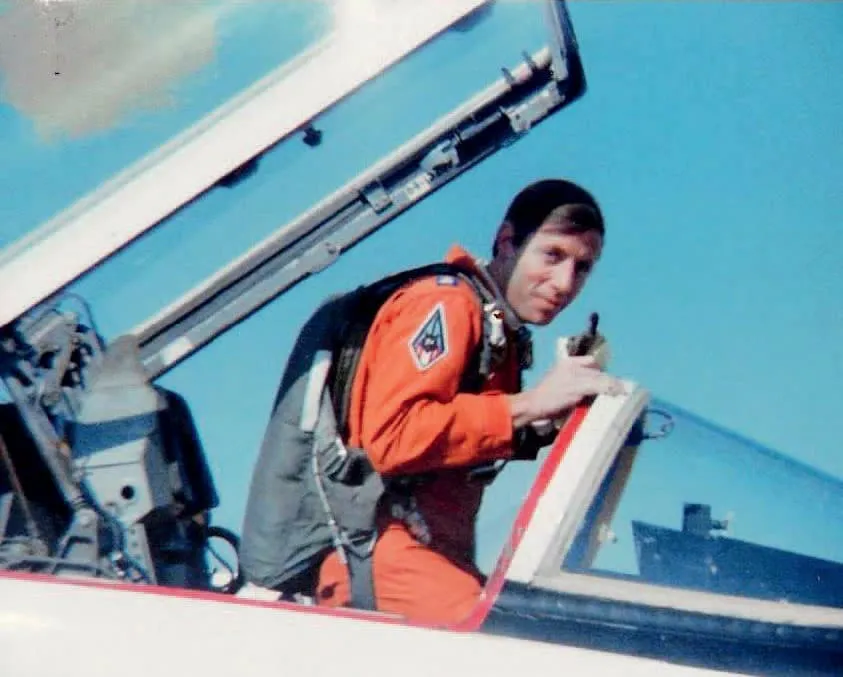
The author climbs out of a T-38 trainer after a local proficiency flight at Beale AFB.
SR-71… or RS-71?
On 24 July, 1964, President Lyndon B. Johnson gave a news conference at the State Department auditorium with 315 people in attendance. For years I had heard that President Johnson became dyslexic when he announced for the first time that the United States had developed a Mach 3 reconnaissance aircraft. The tale said that President Johnson was supposed to name the Blackbird the “RS-71” and that he confused the letters, reversed them, and said “SR-71.”
In 2000, I decided to research this. I contacted the Lyndon Banes Johnson Library in Austin, Texas, and asked for their help. Mr. Michael Parrish, archivist at the LBJ Library, said he would assist me in my quest for the truth. He sent me a copy of the exact text of the speech LBJ made that day in 1964. Here is an excerpt:
Good afternoon, ladies and gentlemen. I would like to announce the successful development of a major new strategic manned aircraft system, which will be employed by the Strategic Air Command. This system employs the new SR-71 aircraft, and provides a long-range, advanced strategic reconnaissance plane for military use, capable of worldwide reconnaissance for military operations.
The Joint Chiefs of Staff, when reviewing the RS-70, emphasized the importance of the strategic reconnaissance mission. The SR-71 aircraft reconnaissance system is the most advanced in the world. The aircraft will fly at more than three times the speed of sound. It will operate at altitudes in excess of 80,000 feet. It will use the most advanced observation equipment of all kinds in the world. The aircraft will provide the strategic forces of the United States with an outstanding long-range reconnaissance capability. The system will be used during periods of military hostilities and in other situations in which the United States military forces may be confronting foreign military forces.
The SR-71 uses the same J58 engine as the experimental interceptor previously announced, but it is substantially heavier and it has a longer range. The considerably heavier gross weight permits it to accommodate the multiple reconnaissance sensors needed by the Strategic Air Command to accomplish their strategic reconnaissance mission in a military environment.
This billion-dollar program was initiated in February of 1963. The first operational aircraft will begin flight testing in early 1965. Deployment of production units to the Strategic Air Command will begin shortly thereafter.
Appropriate members of Congress have been kept fully informed on the nature of and the progress in this aircraft program. Further information on this major advanced aircraft system will be released from time to time at the appropriate military secret classification levels.
In all three places where President Johnson’s speech text stated, “SR-71,” the audio tapes reveal he said, “SR-71.” The LBJ library also sent me a copy of the “Stenotype Transcript of Press Conference.” In those days the White House used a stenographer who was writing in shorthand what he heard, or thought he heard, the President saying.
It seems it was the stenographer who got mixed up and in...

Table of contents

  1. Cover
  2. Title Page
  3. Contents
  4. Preface
  5. Introduction to New Edition
  6. Chapter 1: The Making of a Habu
  7. Chapter 2: Mission Planning
  8. Chapter 3: Preflight Activities
  9. Chapter 4: Aircraft Preflight
  10. Chapter 5: Cockpit Left Console Preflight
  11. Chapter 6: Instrument Panel Preflight
  12. Chapter 7: Cockpit Right Console Preflight
  13. Chapter 8: Starting Engines
  14. Chapter 9: Before Taxiing
  15. Chapter 10: Taxiing and Before Takeoff
  16. Chapter 11: Takeoff and Climb
  17. Chapter 12: KC-135Q and “Cold” Tanker Air Rendezvous
  18. Chapter 13: Acceleration to Mach 3+
  19. Chapter 14: Cruising at Mach 3+: The “Hot” Leg
  20. Chapter 15: Decel and “Hot” Tanker Air Rendezvous
  21. Chapter 16: Recovery
  22. Chapter 17: Debriefings
  23. Chapter 18: The Blackbird’s Retirement
  24. Epilogue
  25. Acknowledgments
  26. Appendices
  27. Index
  28. Dedication
  29. Copyright