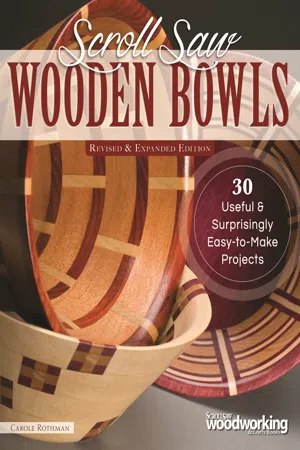
While wood bowls are commonly made on a lathe, this updated and expanded guided resource offers 30 projects for crafting beautiful bowls with the more accessible scroll saw. Each project is organized in a progressive learning format; beginning crafters can start with the most basic starter bowl and gradually work their way toward more elaborate bowls—such as laminated swag bowls; a flared lobed bowl made with varied angles; a thin, eight-segmented bowl; and an inward curving bowl. Original patterns for other types of vessels include a vase, a ginger jar, and a candy dish. For advanced wood crafters, an appendix expands upon the earlier material and pushes wood artists to create new patterns or adapt the existing ones to create art of their very own.
eBook - ePub
Scroll Saw Wooden Bowls, Revised & Expanded Edition
30 Useful & Surprisingly Easy-to-Make Projects
- 250 pages
- English
- ePUB (mobile friendly)
- Available on iOS & Android
eBook - ePub
Scroll Saw Wooden Bowls, Revised & Expanded Edition
30 Useful & Surprisingly Easy-to-Make Projects
About this book
Trusted by 375,005 students
Access to over 1 million titles for a fair monthly price.
Study more efficiently using our study tools.
Information
CHAPTER 1

Cutting the bowls in this book requires tilting your scroll saw table. The angle is determined by width of the rings and the thickness of the stock used.
Bowl Basics
Scrolled bowls are created from concentric rings cut at an angle, then stacked, glued, and sanded to the desired shape. Making a functional and attractive three- dimensional object from a flat piece of wood is quite amazing, not to mention economical. It’s also a perfect way to use up wood you have on hand. This chapter introduces the steps involved in making a scrolled bowl. Although the focus is on bowl basics—the materials, tools, and techniques you’ll need to get started—I’ve included information that will be useful for bowl makers of any skill level who are seeking to improve the quality and variety of their work.

Attention to grain and color helps ensure an attractive bowl.
Choose wood carefully
Examine boards before you buy them. Wood that is cupped, twisted, or otherwise defective is usually no less expensive than perfect pieces with attractive grain.
Choosing the Wood
The first step in making a bowl is choosing the wood. The stock used for scrolled bowls typically varies in thickness from ½” (13mm) to 1” (25mm), depending on wood type and project design. Most of the projects in this book are cut from ¾” (19mm) stock, a thickness generally available wherever hardwood is sold. This thickness accommodates a variety of profiles and angles and is generally easy to cut. Thicker wood is more challenging, requiring a slower feed rate to keep the blade from deflecting and distorting the cut.
It’s hard to resist the temptation to push the wood through the blade, especially if the cut is a long one, but the payoff for feeding the wood slowly is an accurately cut ring that will be far easier to work with. As you gain experience, you’ll learn how to manage thick and dense wood through proper technique and careful blade selection.
Selecting the primary wood
Many types of wood are suitable for scrolled bowls, either by themselves or combined with contrasting woods. I call these “primary woods” to differentiate them from wood best used for decorative accents. Here are some primary woods that are readily available and moderately priced.
Aspen
Although more difficult to find than in past years, it is relatively inexpensive, easy to cut and shape, and, when sanded well and shellacked, looks like ivory or porcelain. It is best used alone, since its softness makes it difficult to sand evenly when combined with harder wood. It is also vulnerable to discoloration from sanding dust and bleeding when combined with strongly colored woods.
Poplar
Inexpensive and easy to cut, popular is attractive when clear and light colored. Avoid pieces with large brownish-green patches, unless deliberately chosen for a special effect.
Cedar
This popular wood comes in many varieties and is easy to cut and sand. However, some types can cause respiratory problems and rashes, and others are prone to brittleness, so be sure you’re familiar with the characteristics of the variety you’re considering.
Mahogany
There are many types of mahogany, varying greatly in cost and beauty. All varieties are easy to cut and sand. Boards with dramatic grain, or with chatoyance (a shimmering quality), are most effective when used by themselves, with simple designs that showcase their beauty.
Maple
Either hard or soft maple is a good choice for a light-colored bowl, or for combining with a darker wood. Since color cast varies, choose your piece carefully to get the effect you want.
Cherry
A longstanding favorite of bowl makers and other woodworkers, cherry is vulnerable to burning when cut. To minimize or prevent this problem, cover the wood with clear or blue tape to lubricate the blade.
Walnut
Slightly more expensive than other common hardwoods, this attractive wood is easy to cut and sand. It also contrasts well with lighter-colored woods, such as cherry and maple.
Oak
Both white and red varieties work as stand-alone woods, or in combination with other hardwoods. Its distinctive grain pattern can produce unusual and dramatic effects when cut at an angle.
Selecting wood for combinations
Whether gluing in strips to create swags or vertical stripes, or layering wood horizontally, there are three factors to keep in mind.
Color contrast
Color contrast can be subtle, as with poplar and cedar, or dramatic, as with walnut and maple. Be aware that even boards from the same species can differ slightly in color. Walnut, for example, can vary from warm brown with a reddish cast to a cooler, brown-gray hue. These differences will become apparent as you try out different wood combinations, and can make one board a more appropriate choice than another. Since the finished color may be difficult to predict, you can preview the final results with an application of mineral spirits.
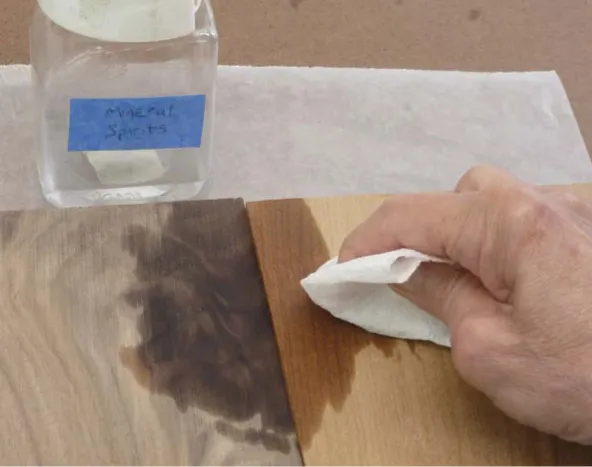
An application of mineral spirits will approximate what the wood will look like when the finish is applied.
Found Wood
Many of the bowls in this book were cut from “found” wood. I’ve rescued large boards of varnish-covered mahogany and teak from an old storage shed, and repurposed hard maple from my sons’ baby dresser. I’ve even done my share of dumpster diving. However, my best discovery was a local cabinet shop whose craftsmen tossed bowl-sized cutoffs of beautiful hardwoods into bins to be used for firewood. They were pleased to find a better use for their cutoffs, and the chance to “talk shop” with experienced professionals was an unexpected bonus. Be creative with your sources. You’ll benefit, and so will the environment.
Hardness
When possible, choose woods that are similar in hardness, like cherry and maple. They will be easier to sand smooth when glued together. Woods that are somewhat softer, like walnut and mahogany, can be combined successfully with slightly harder ones if care is taken to sand them evenly. Avoid great discrepancies in hardness—the beauty of the color combination will most likely be undermined by the uneven finished surface.
Sanding dust migration and color bleeding
The dust from strongly colored accent wood like padauk and redheart can migrate into the pores of adjacent pieces during sanding and discolor the wood. For this reason, it’s generally not wise to pair light-colored, porous wood with strongly colored exotics. However, if your design demands that you do so, vacuuming the workpiece frequently as you sand can often remove the offending dust. Strongly colored wood can also bleed into adjacent areas if the finish is applied too generously. Minimize this likelihood by using light coats of finish. Fortunately, the discolored areas can usually be corrected with an application of the appropriate solvent, and the finish repaired.
Don't be afraid to try new woods and combinations. If you don’t want to commit to a full-size project, make a small prototype to see how the wood cuts and sands. I’ve made my share of “designer sawdust” but have also had some wonderful discoveries—you’ll never know how things will work out unless you try.
Cutting the Rings
All the projects in this book are made from concen...
Table of contents
- Cover
- Title
- Copyright
- Contents
- Introduction: About This Edition
- Chapter 1: Bowl Basics
- Chapter 2: Basic Stacked Bowls
- Chapter 3: Laminated Wood Bowls
- Chapter 4: Multiple-Angle Bowls
- Chapter 5: Thin Wood Bowls
- Chapter 6: Thinking Outside the Bowl
- Appendix: Creating Patterns
- About the author
Frequently asked questions
Yes, you can cancel anytime from the Subscription tab in your account settings on the Perlego website. Your subscription will stay active until the end of your current billing period. Learn how to cancel your subscription
No, books cannot be downloaded as external files, such as PDFs, for use outside of Perlego. However, you can download books within the Perlego app for offline reading on mobile or tablet. Learn how to download books offline
Perlego offers two plans: Essential and Complete
- Essential is ideal for learners and professionals who enjoy exploring a wide range of subjects. Access the Essential Library with 800,000+ trusted titles and best-sellers across business, personal growth, and the humanities. Includes unlimited reading time and Standard Read Aloud voice.
- Complete: Perfect for advanced learners and researchers needing full, unrestricted access. Unlock 1.4M+ books across hundreds of subjects, including academic and specialized titles. The Complete Plan also includes advanced features like Premium Read Aloud and Research Assistant.
We are an online textbook subscription service, where you can get access to an entire online library for less than the price of a single book per month. With over 1 million books across 990+ topics, we’ve got you covered! Learn about our mission
Look out for the read-aloud symbol on your next book to see if you can listen to it. The read-aloud tool reads text aloud for you, highlighting the text as it is being read. You can pause it, speed it up and slow it down. Learn more about Read Aloud
Yes! You can use the Perlego app on both iOS and Android devices to read anytime, anywhere — even offline. Perfect for commutes or when you’re on the go.
Please note we cannot support devices running on iOS 13 and Android 7 or earlier. Learn more about using the app
Please note we cannot support devices running on iOS 13 and Android 7 or earlier. Learn more about using the app
Yes, you can access Scroll Saw Wooden Bowls, Revised & Expanded Edition by Carole Rothman in PDF and/or ePUB format, as well as other popular books in Technology & Engineering & Technical & Manufacturing Trades. We have over one million books available in our catalogue for you to explore.