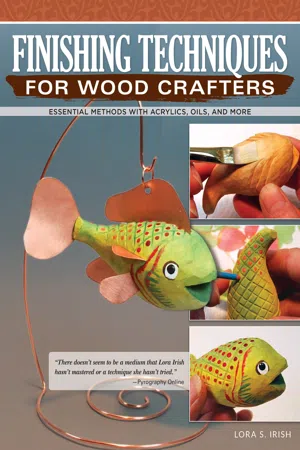
Learn how to choose, prepare, and apply the perfect finish for your next creative wood project! This practical guide to finishing techniques shows you how to create flawless finishes each and every time. Nationally known artist and best-selling author Lora S. Irish presents a wide array of beautiful acrylic paint techniques and oil staining/antiquing methods, with easy-to-follow instructions and workshop photographs that illustrate every step. Finishing Techniques for Wood Crafters takes you through all the basics of painting and staining any woodcarving, pyrography, or gourd project. Sample projects throughout the book demonstrate specific techniques—like applying a vintage finish to a chip carved fish; creating realistic skin tones on a wood spirit cane topper; enhancing a Celtic knot dragon with an interesting stone effect; and more. Once you master these artistic techniques you can mix and match them on any project.
eBook - ePub
Finishing Techniques for Wood Crafters
Essential Methods with Acrylics, Oils, and More
- 250 pages
- English
- ePUB (mobile friendly)
- Available on iOS & Android
eBook - ePub
About this book
Trusted by 375,005 students
Access to over 1.5 million titles for a fair monthly price.
Study more efficiently using our study tools.
Information
CHAPTER 1:
BEFORE YOU PAINT
Before you even touch a paint-loaded brush to your carving or pyrography project, you need to consider several factors that will directly affect how your final coloring will appear. Let’s take a quick look at how the surface texture of your project, the type of pre-treatment you use, and different primers can all affect the finished result. We’ll also look at factors to keep in mind after completing your painting.

Wood Surface Textures
Whether you are carving or wood burning, the final texture and smoothness of the wood surface directly affects how evenly any coloring can be applied. Here is a summary of a variety of ways you can alter the final texture of your work and how that final texture can affect the painting. This list is sequential; you can do any number of these steps, and each step will make your surface smoother and smoother, but you don’t have to do all of the steps, and you can skip around as long as you stay in order. (This is generally speaking—but there are always exceptions, so experiment and see what works for you.)
1. Flat Plane Carving or Fine Shaved Carving.
Finish your wood carving by checking for any rough stop cuts, small un-cut chips in the deep crevices, and coarse V-gouge strokes. Clean these areas with a sharp bench knife before you begin any painting steps. While those small, loose fibers of wood might not show in the unpainted wood stage of your project, once you apply color they will become very obvious.
2. Sanding with 220- to 320-Grit Sandpaper.
Sanding smooths wood out, dulling or removing the texture of the cuts. Sanding grit can leave very fine, shallow lines in the wood that can catch blended colors or antiquing. Work the sandpaper or sanding pad in the direction of the wood grain whenever possible.

Sanding a relief carving.
3. Removing Dust.
A dust-free surface is always ideal. Remove any dust left over from carving and sanding steps with a soft cloth. While paint may cover up a small area of dust on your work, that paint will eventually pop off the project because it never adhered directly to the wood surface.

This project was sanded well after carving, which allowed for even application of the base colors. Of course, the splattering effect used on top of the base colors would effectively mask any uneven color application.
4. Polishing with Heavy Kraft Paper.
A crumpled 6" (15cm) square sheet of heavy kraft paper, like a piece of a paper bag or paper packing material, will polish a wood surface. Kraft paper works like an extremely fine sandpaper and removes those last few loose wood fibers or fine sanding lines.
5. Buffing with a Soft Cloth.
A lint-free, soft, cotton cloth can be used to buff or polish a wood surface after the carving or burning is finished. Not only does the cloth remove any remaining sanding dust or wood fibers, but it also can add a bit of sheen if you use firm pressure all over.
6. Burnishing.
A wood project can be burnished by rubbing the surface briskly with a small piece of similar wood. This rubbing creates a smooth, polished surface with a soft, semi-gloss sheen. Burnishing is a final step that allows you to get the smoothest surface possible, particularly when preceded by sanding and buffing. See page for more information on burnishing.

Burnishing is a good pre-treatment when you want easy blending of hues for both acrylics and oils.
Depth and Intensity of Carved Texture
Deep, textured cuts in your carvings will hold more shading color and more antiquing/staining than shallow cuts. You can choose to use a variety of cut depths in your carving, from very smooth, flat planes to deeply incised details, to capture more color changes in the finished project. A light texture in your carving, as shown in the tiki pieces, can accent your color work, especially when you are dry brushing or antiquing the final painting, by allowing color to concentrate in the textured areas. Heavy textures, as shown in the wood spirit, are wonderful for dry brushing, antiquing, and for faux wood, stone, and marble effects. The deep, textured cuts really grab the color.


Wood Pre-Treatments
The woods that we paint tend to be very porous—they absorb water, oils, and colors quickly. Basswood, for example, which is the most common wood for character carving and fish decoys, is extremely absorbent and will need pre-treatment before any painting in order to create the smoothest paint finish possible. Here are some examples of pre-treatments that can be used on wood projects before actually painting. Most of the projects in this book use one of the following pre-treatments.
Sanding Sealer
Sanding sealer is a brush-on pre-finish that hardens the top surface of the wood, making the loose wood fibers stiff enough to sand away. Usually one to two light coats are applied to the raw wood and allowed to dry thoroughly. The sealer is then sanded using fine 220- to 320-grit sandpaper. Basswood, poplar, and butternut are all common carving woods that have a soft, finely grained surface that can be hard to sand to a smooth, glass-like finish. Sanding sealer soaks into the upper surface of these woods, hardening the wood fibers and making them easier to remove. Use a sanding sealer coat before painting if you are having problems teasing out those hard-to-reach loose wood splinters. The smoother your wood surface is, the smoother your color application will be.

This fish was pre-treated with a reworkable fixative spray sealer.
Reworkable Fixative Spray Sealer
Many art media techniques need a fixative to seal one layer of work before applying additional layers of color. A reworkable fixative spray sealer does just that. It seals and protects the color work you have already done on the project, yet allows new color to be applied to its lightly textured surface. Reworkable sealers can also be used to pretreat a raw wood surface, acting similar to sanding sealer by hardening and strengthening the upper surface of the wood. By applying one light coat of reworkable spray sealer to raw wood, you can control how much color soaks into the wood with the first application of thinned and wash coat paints.
Water Wash
For very soft woods, such as basswood or poplar, just a few light coats of water can pre-moisten a carving enough to allow acrylic or craft paints to flow smoothly onto the surface of the carving.
Acrylic Wash
Acrylic paints can be thinned with water, in at least a one-to-one ratio, to create an acrylic wash pre-treatment. Such washes allow you to blend and mix several colors or tones on the wood to create a base coat for a painting.

This dragon was painted starting with a multicolored acrylic wash.
Oil and Turpentine Coating
Mixing boiled linseed oil with turpentine at a one-to-one ratio makes a wonderful pre-treatment that allows the wood grain to show through the paint. This oil mix is often a pre-treatment base for dry brushing both acrylics and oil paints.
Spray or Brush-On Sealer
There is a wide variety of spray and brush-on finishes that can be used to seal wood before applying color. Matte and semi-matte sealers work best because they have a small amount of texture that captures and holds the layers of paint, as opposed to super-smooth gloss sealers. Spray and brush-on sealers are most often used as the finishing coat, meant to be the last layer of work in your color application, as they completely seal the wood surface and repel water, oil, and new layers of paint from penetrating into the wood. How...
Table of contents
- Cover
- Title
- Acknowledgements
- Copyright
- Introduction
- Contents
- Chapter 1: Before you Paint
- Chapter 2: All About Brushes, Paints, And Other Media
- Chapter 3: Learning to Mix Colors
- Chapter 4: Painting Techniques
- Chapter 5: Advanced Ideas and Special Effects
- Chapter 6: Bonus: Carving a Whittle Fish
- Chapter 7: Patterns
- About the Author
Frequently asked questions
Yes, you can cancel anytime from the Subscription tab in your account settings on the Perlego website. Your subscription will stay active until the end of your current billing period. Learn how to cancel your subscription
No, books cannot be downloaded as external files, such as PDFs, for use outside of Perlego. However, you can download books within the Perlego app for offline reading on mobile or tablet. Learn how to download books offline
Perlego offers two plans: Essential and Complete
- Essential is ideal for learners and professionals who enjoy exploring a wide range of subjects. Access the Essential Library with 800,000+ trusted titles and best-sellers across business, personal growth, and the humanities. Includes unlimited reading time and Standard Read Aloud voice.
- Complete: Perfect for advanced learners and researchers needing full, unrestricted access. Unlock 1.5M+ books across hundreds of subjects, including academic and specialized titles. The Complete Plan also includes advanced features like Premium Read Aloud and Research Assistant.
We are an online textbook subscription service, where you can get access to an entire online library for less than the price of a single book per month. With over 1.5 million books across 990+ topics, we’ve got you covered! Learn about our mission
Look out for the read-aloud symbol on your next book to see if you can listen to it. The read-aloud tool reads text aloud for you, highlighting the text as it is being read. You can pause it, speed it up and slow it down. Learn more about Read Aloud
Yes! You can use the Perlego app on both iOS and Android devices to read anytime, anywhere — even offline. Perfect for commutes or when you’re on the go.
Please note we cannot support devices running on iOS 13 and Android 7 or earlier. Learn more about using the app
Please note we cannot support devices running on iOS 13 and Android 7 or earlier. Learn more about using the app
Yes, you can access Finishing Techniques for Wood Crafters by Lora S. Irish in PDF and/or ePUB format, as well as other popular books in Technology & Engineering & Technical & Manufacturing Trades. We have over 1.5 million books available in our catalogue for you to explore.