eBook - ePub
How to Draw
A Comprehensive Drawing Course: Still Life, Landscapes, Buildings, People, and Portraits
- English
- ePUB (mobile friendly)
- Available on iOS & Android
eBook - ePub
How to Draw
A Comprehensive Drawing Course: Still Life, Landscapes, Buildings, People, and Portraits
About this book
Learn the Basics of Drawing Drawing is an essential skill that represents the first step into all other visual arts. This practical book teaches aspiring artists how to draw the most popular topics: buildings, landscapes, people, portraits, and still life. Even absolute beginners will be amazed at what they can achieve by working through this book and learning from the tips, tricks and know-how of experienced artists. Fifty original, exciting projects free readers to practice and perfect their skills without dreary routine exercises. Each demonstration features a photograph of the subject, the finished drawing, clear instructions, and step-by-step photos. How to Draw shows how to draw with a variety of different media, including artist's pencils, chalk, charcoal, dip pens, graphite sticks, and more. Inside How to Draw: Practical art instruction for drawing all of the most popular topics: buildings, landscapes, people, animals, portraits, and still life. 50 demonstrations each include a photograph of the subject, the finished drawing, and clear instructions with step-by-step photos. Advice on how to draw with a variety of different media, including artist's pencils, chalk, charcoal, dip pens, graphite sticks, and more. Introduction to essential tools, materials and basic drawing techniques.
Trusted by 375,005 students
Access to over 1 million titles for a fair monthly price.
Study more efficiently using our study tools.
Information
Topic
ArtSubtopic
Art TechniquesANIMALS

Introduction
The earliest drawings that we know about are of animals, and many of them are remarkably lifelike considering the artists were using crude materials on cave walls. Animals continued to be the subject of many artists’ work, from Stubbs’ gleaming horses to Landseer’s loyal dogs. Leonardo da Vinci sketched umpteen cats, and Rembrandt rendered the wrinkled skin of an elephant with crosshatching. Throughout his life, Picasso created images of animals and could capture the essence of their character with just a few lines.
Today, animals are still among the most popular and appealing subjects for drawing, and yet many of us are reluctant to try because we think they are more difficult to draw than other subjects. In reality, no subject is more difficult to draw than another, and there are various techniques and methods that can help to simplify the process, allowing you to draw more convincing, lifelike animal portraits.
Everyone can learn to draw well—it just takes confidence and a little extra knowledge—and the enjoyment and satisfaction that it can bring is immeasurable. Animals are wonderful subjects: for their loyalty and personalities, for the way they move, or for their markings and expressions. Our own pets—great characters and companions, hilariously funny one minute or cute and affectionate the next—can make the best models, not least because we know them so well. All animals can become charming drawings, the only problem being that they’re always on the move and that picture-perfect pose can be gone in an instant.
You can use photographs as references, but try not to rely on them too heavily. Drawing from photographs will help to build up your confidence, giving you time to study the subject at close hand without it moving away, but sketch from life as often as you can, as well. However brief or vague, this will help you to understand each animal in greater depth and your drawings will be freer and livelier as a result. Sketches needn’t be complete drawings—just a few lines to indicate the spine, tail, eyes, and whiskers can be enough to give the right impression.

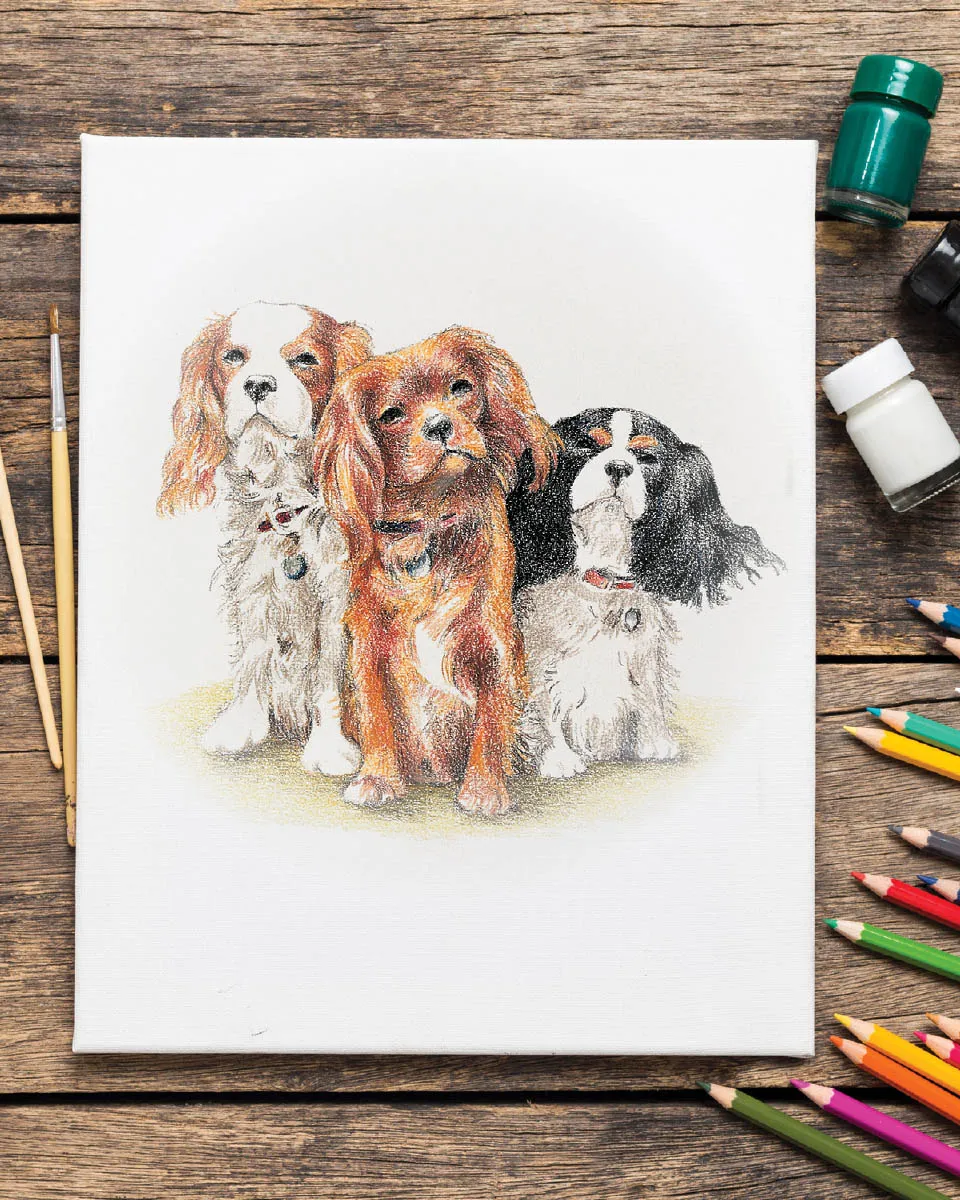
Forget about failure—each time you put pencil to paper the task will become a little easier, the results just that bit better, and the satisfaction even greater.
Projects
PROJECT 1
Basic Cat
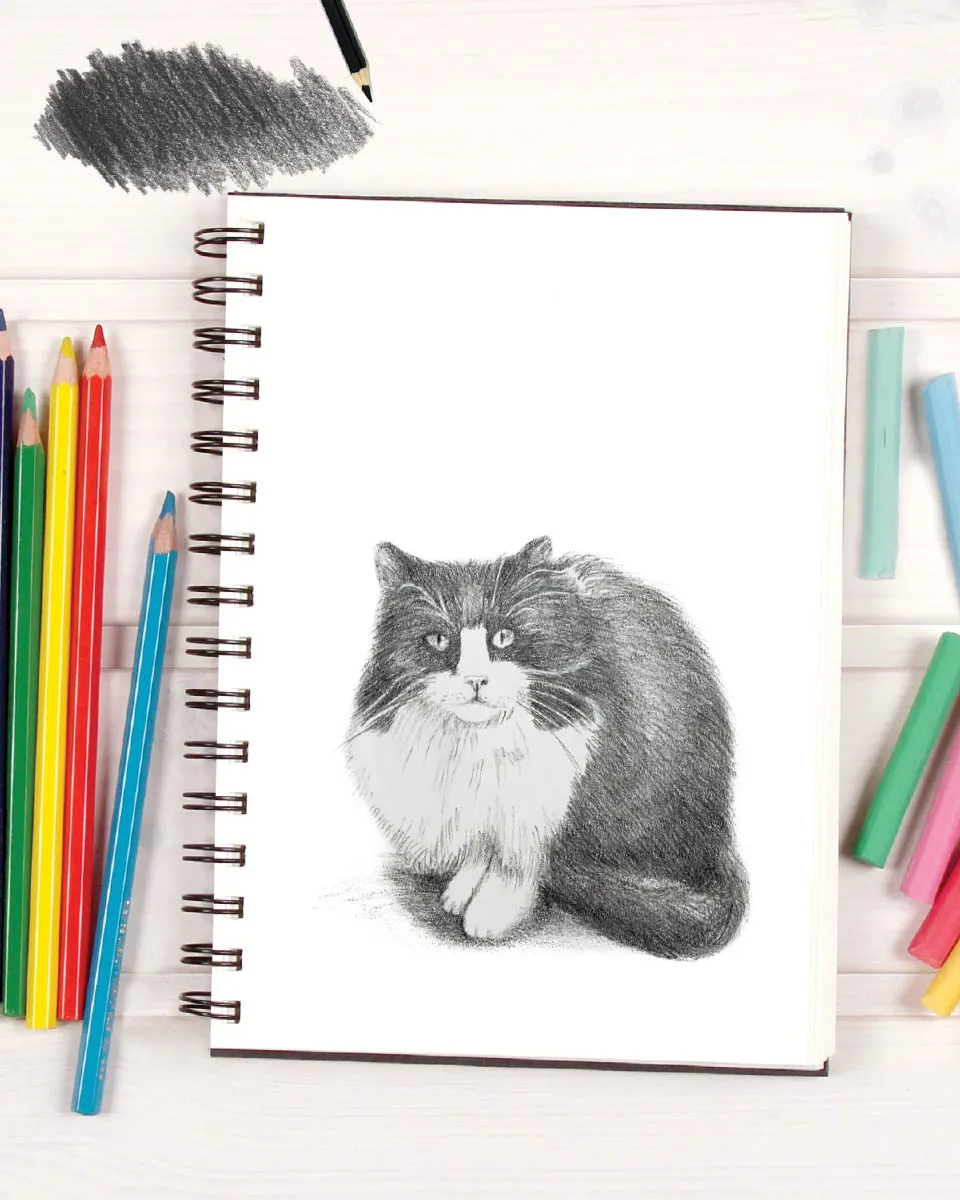
GRAPHITE PENCILS OR STICKS
A good, basic principle when drawing an animal is to begin by looking at the whole shape. If you can render the basic form accurately, you will be able to add detail convincingly too. Know before you even begin to draw what proportions (approximately) you will be working with.
Graphite pencils are easy to use and can produce a range of versatile marks as they move quite fluidly across the paper. They are also easily erased, which makes them ideal for beginners. Graphite sticks are similar to pencils, but tend to be heavier and more brittle. Thick sticks are best for broad, loose drawings while thin sticks work well for more detailed work.
Try them out in a sketchbook, just making a few marks to begin with, to get used to the feel of them. Keep your pencil or stick sharp for details such as whiskers, and use the stick on its side for broader areas of tone. I have only concentrated on the cat for this first demonstration but, if you find you are doing quite well, you could also include the contrasting lines and tones of the roof tiles to make a slightly more intriguing image. A tip if you do this—make the details on the cat a little sharper and be fairly loose with the tiles to just give a general impression—the cat should remain the focus.

Subject
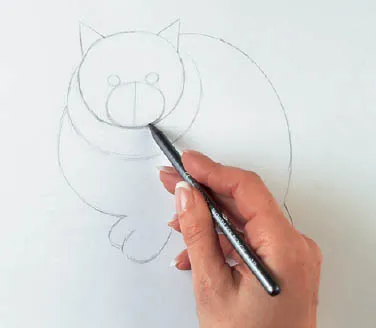
A cat is a good subject for beginners. The face can be broken down into two circles, with a small triangle for the nose and two larger triangles for the ears. The eyes are ovals that rest in the head circle. By observing a cat’s face in terms of these basic shapes, you eliminate any anxiety about where to begin. Before you start drawing, however, think about composition. A tiny animal in the center of the paper will diminish its effect, while an overly large animal will appear to “fall off” the edges of the paper.
Materials
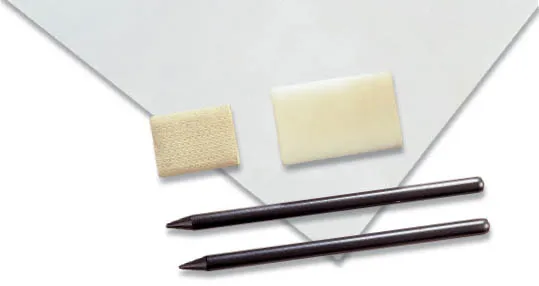
• Sheet of smooth cartridge (drawing) paper 11 ¾" x 8 ¼" (297 × 210mm)
• 2B and 4B graphite pencils or sticks
• Plastic eraser
• Kneaded eraser
1 Study the photograph of the cat as a series of simple shapes. The face is composed of two circles, and behind the head you can see the curved shapes that begin to form the body. Transfer these shapes to your paper using the 2B graphite pencil. Hold the pencil fairly far back and draw lightly, as you do not want these initial guidelines to show in the finished drawing. Make sure that your cat is large enough on the paper to appear significant.
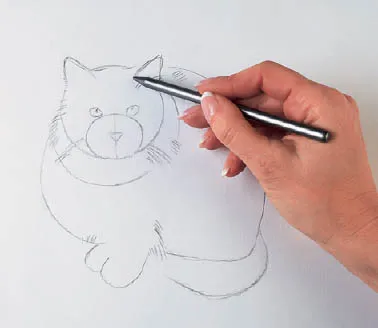
2 Still seeing the cat as a series of shapes, add a small triangle for the nose and begin to make adjustments to the initial guidelines. For example, notice that the ears begin on the forehead, not on the top of the head, and that they curve slightly. A photograph is a particularly good reference for seeing exactly how an animal’s features fit together—where the nose meets the mouth and the distance between the eyes and top of the head, for example. Keep checking the proportions as you go.
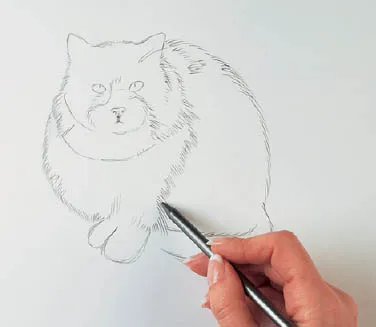
3 Although head shape and proportion varies from one cat to another, there are a few common characteristics that are useful. For example, the eyes are always roughly halfway down the face and slant upward at the outer edges. Cats’ cheekbones also slant upward at the outer edge and the fur on the nose grows down. Soften the nose on your drawing and add an upside-down “Y” for the mouth. Begin to add little lines on the body to indicate fur. Use the plastic eraser to remove your guidelines as you add more detail.
4 To create the impression of fluffiness, keep you...
Table of contents
- Cover
- Title
- Copyright
- Contents
- Introduction
- Tools and Materials
- Basic Techniques
- Animals
- Buildings
- Landscapes
- People
- Portraits
- Still Life
- Index
- Photo Credits
- About the Authors
Frequently asked questions
Yes, you can cancel anytime from the Subscription tab in your account settings on the Perlego website. Your subscription will stay active until the end of your current billing period. Learn how to cancel your subscription
No, books cannot be downloaded as external files, such as PDFs, for use outside of Perlego. However, you can download books within the Perlego app for offline reading on mobile or tablet. Learn how to download books offline
Perlego offers two plans: Essential and Complete
- Essential is ideal for learners and professionals who enjoy exploring a wide range of subjects. Access the Essential Library with 800,000+ trusted titles and best-sellers across business, personal growth, and the humanities. Includes unlimited reading time and Standard Read Aloud voice.
- Complete: Perfect for advanced learners and researchers needing full, unrestricted access. Unlock 1.4M+ books across hundreds of subjects, including academic and specialized titles. The Complete Plan also includes advanced features like Premium Read Aloud and Research Assistant.
We are an online textbook subscription service, where you can get access to an entire online library for less than the price of a single book per month. With over 1 million books across 990+ topics, we’ve got you covered! Learn about our mission
Look out for the read-aloud symbol on your next book to see if you can listen to it. The read-aloud tool reads text aloud for you, highlighting the text as it is being read. You can pause it, speed it up and slow it down. Learn more about Read Aloud
Yes! You can use the Perlego app on both iOS and Android devices to read anytime, anywhere — even offline. Perfect for commutes or when you’re on the go.
Please note we cannot support devices running on iOS 13 and Android 7 or earlier. Learn more about using the app
Please note we cannot support devices running on iOS 13 and Android 7 or earlier. Learn more about using the app
Yes, you can access How to Draw by Ian Sidaway,Susie Hodge in PDF and/or ePUB format, as well as other popular books in Art & Art Techniques. We have over one million books available in our catalogue for you to explore.